Wildlife

What’s happening with Alaska’s largest bald eagle congregation? It’s hard to say

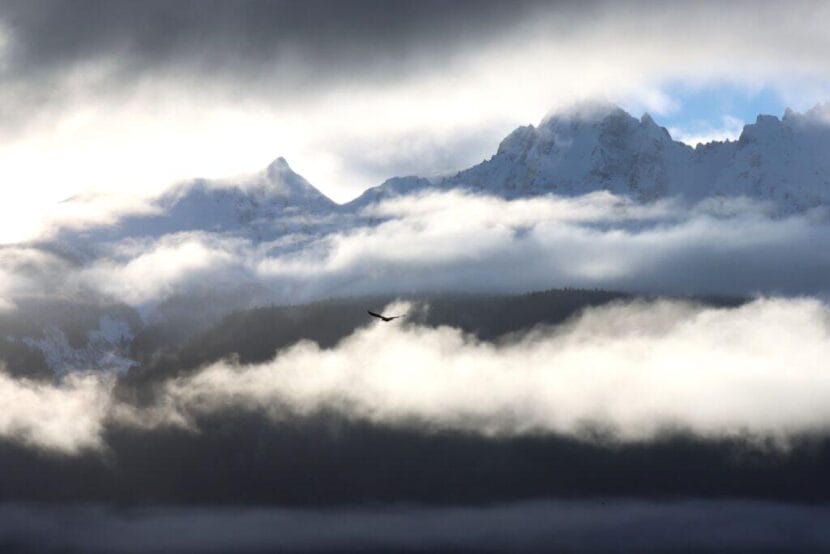
An eagle soars in the skies in front of a cloudy mountain range.
A bald eagle flies through the Alaska Chilkat Bald Eagle Preserve in November, 2025. (Avery Ellfeldt/KHNS)

Most weeks between September and December, Stacie Evans drives up the Haines highway, counting bald eagles through a high-powered scope.

Her drives are part of a longstanding annual survey that aims to provide insight into the valley’s annual gathering of eagles, which is one of the world’s largest. Last week, she saw more than 1,400.

“It’s the highest count that’s been documented since the year 2000,” said Evans, who is the science director of the Takshanuk Watershed Council, a local conservation nonprofit.

The annual gathering in the Alaska Chilkat Bald Eagle Preserve is central to the area’s identity – and it serves as an economic boost for the town of Haines at the start of the winter.

Evans emphasized that the road surveys do not amount to a comprehensive population count, so there’s no way to say for certain how many raptors are actually in the area each year.

But they do provide a snapshot of what’s happening, particularly within sight of the highway. The large number of eagles counted this year marks a departure from recent survey data, which has captured significantly fewer eagles compared to decades past.

“We can say that there has been a decline,” Evans said. “I mean, it’s pretty obvious from when the survey started in 1988.”
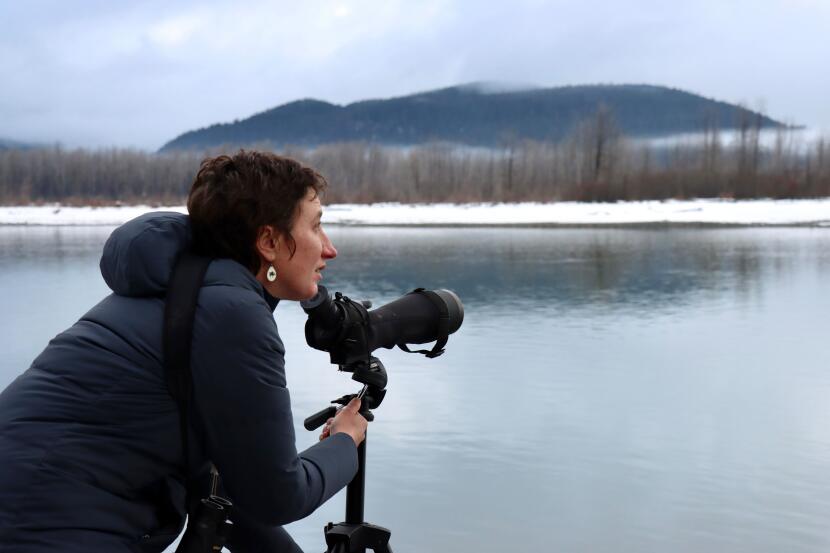
Stacie Evans counts eagles on the banks of the Chilkat River in early November, 2025. (Avery Ellfeldt/KHNS)

Between 1988 and 2000, for instance, surveyors counted well over 1,000 eagles every year but one. But in road surveys conducted since 2011, peak counts only surpassed 1,000 four times, including this year.

Some locals say they’ve seen a decline with their own eyes. Craig Loomis has lived in Haines since the 1960’s. He recalls driving up the highway and seeing far more eagles than he does today.

“I mean there were eagles all over the place,” Loomis said. “And that didn’t count the ones away from the river that we couldn’t see.”

A big year for salmon – and eagles

The road survey entails counting eagles at the same pullouts, and along the same sections of road, as many weeks as possible from mid-September through mid-December. That protocol has remained consistent over the years.

At each stop along the way along Evans’ drive last month, eagles were perched in the cottonwoods and scattered across the riverflats both alone and in larger groups.

The valley has a resident bald eagle population that sticks around all year. But each fall, more arrive from as far away as Washington state to take advantage of a unique hydrological feature – and fishing opportunity.

“A lot of the water that’s coming from the Tsirku into the Chilkat is subsurface, so it’s not exposed to air temperature,” Evans said. “Which means in the winter time, it is relatively warm, and so it keeps the Chilkat River from freezing.”

That facilitates prime access to a particularly late run of chum salmon heading into the coldest months of the year.

“It is a really unique thing. There’s not a lot of fish available at that time of year,” said Steve Lewis, a raptor biologist with the U.S. Fish and Wildlife Service. “It probably gets them through the winter.”

The high count in November likely correlates with an especially strong chum run. Alaska Fish and Game area management biologist Nicole Zeiser said this year’s peak chum count – recorded via aerial surveys – surpassed 20,000 fish.
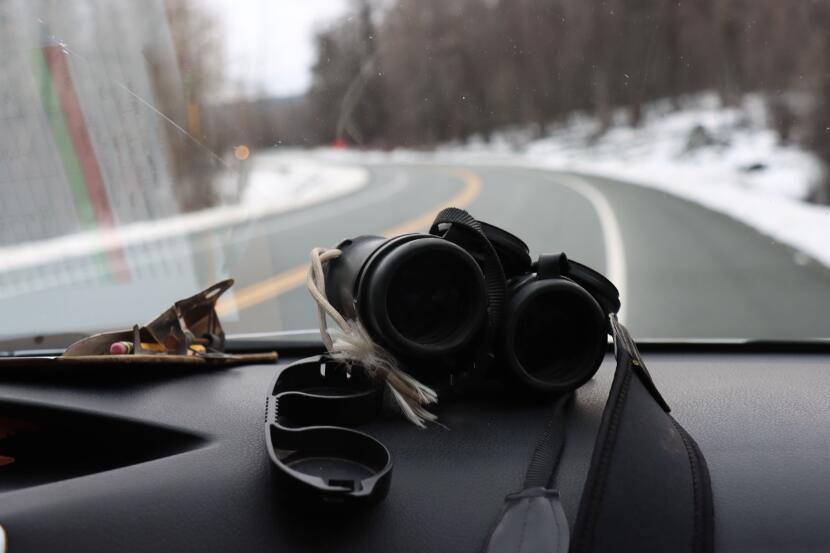
Evans’ binoculars and clipboard during her weekly eagle survey in early November. (Avery Ellfeldt/KHNS)

In an email, she said that’s a “strong number given that surveys capture only a fraction of the total fish present in the drainage.”

In 2020, the run was incredibly weak – and the eagle count was, too. The peak count that year was under 300 birds. Zeiser did not respond to questions about the long-term stability of the Chilkat chum run.

Weather is the other factor that can impact the eagles and where they feed. Warmer falls can result in more open water. Lewis said that allows the eagles to feed in different areas of the valley that are farther from the road, making them harder to spot.

“If it’s really, really cold, and lots of places are frozen, then the eagles are really condensed. If it’s not that cold, and they can be spread out, then they’ll be spread out,” Lewis said.

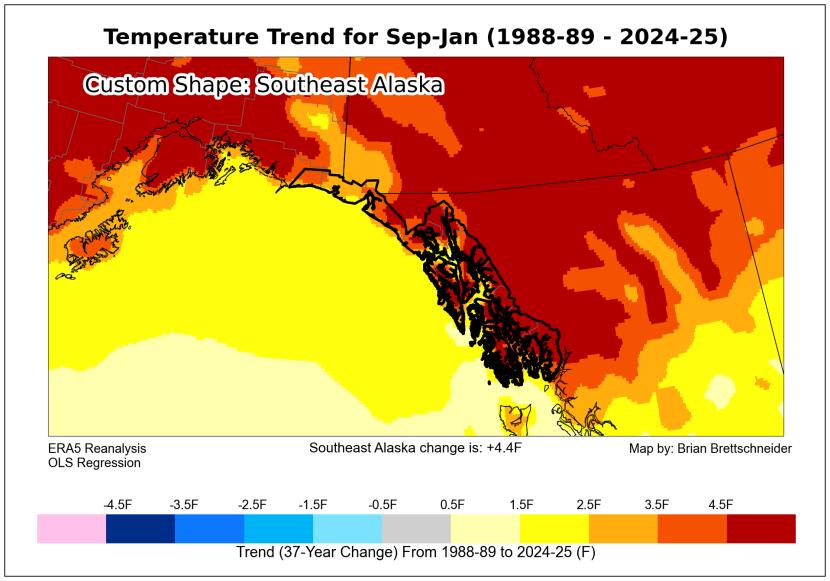
That could happen more frequently with climate change. In Southeast Alaska, average temperatures between September and January are about four degrees higher today than they were in 1988, according to data from the National Oceanic and Atmospheric Administration.

“Any anecdote that says it is warmer than it used to be is almost certainly correct,” NOAA Senior Scientist Brian Brettchneider said in an email.

The annual Bald Eagle Festival typically happens in mid-November. But Kathy Benner, of the Haines-based American Bald Eagle Foundation, said event organizers are considering delaying the event to increase the odds that it will overlap with cold temperatures – and lots of eagles feeding within eyeshot.

“I personally think it probably would be a great idea to try to move it a little bit closer to when the temperatures are colder,” she said.
‘No means for counting’

The Chilkat Valley gathering is often described as the world’s largest, but experts say the Harrison River in British Columbia — considered Canada’s only “salmon stronghold” river — likely deserves that title.

The area can draw as many as 15,000 eagles in November and December, said Myles Lamont, a wildlife biologist with TerraFauna, a Canadian wildlife consulting group.

The gathering in the Chilkat Valley, meanwhile, is often put at somewhere between 3,000 and 4,000 eagles.

Fish and Wildlife biologists used to fly over the Chilkat Bald Eagle Preserve to do a more comprehensive survey. But that hasn’t happened for at least 20 years, Lewis said, and it probably isn’t in the cards any time soon.

“We don’t have tons of funding no matter what,” he said. “And I don’t have a lot of funding to support that kind of specific area survey for this one population.”

Lewis said that’s unfortunate, given that he regularly hears from people in Haines who are interested in learning more about what is happening in the eagle preserve each year.

Evans, of Takshanuk, said the organization would be interested in aerial surveys, but they also lack the necessary funding. Benner, of the Bald Eagle Foundation, said the same.

“We have no means for counting at this time,” Benner said in a phone interview.
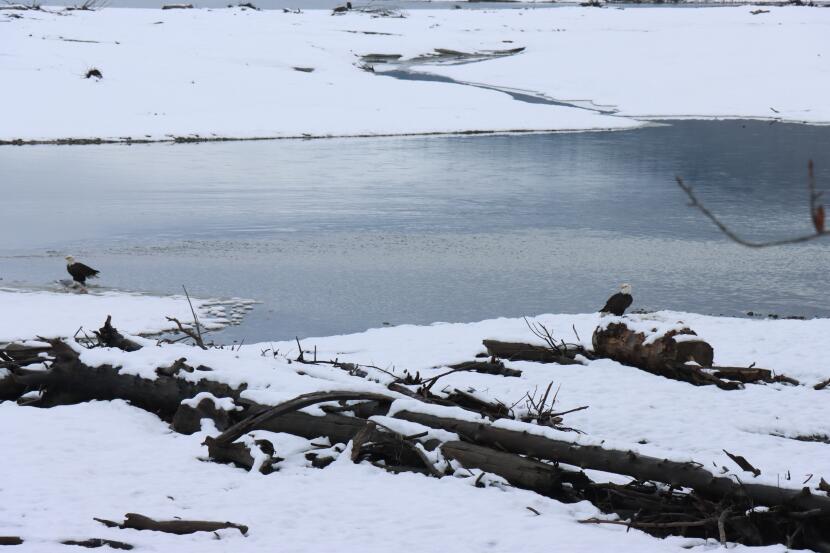
Bald eagles feeding in the Alaska Chilkat Bald Eagle Preserve. (Avery Ellfeldt/KHNS)

That leaves the road survey data. It’s not a perfect system; the surveys have been conducted by different people over the years, and there are a smattering of years with no data. Plus, there’s no way to see the entire valley from the road.

“It doesn’t necessarily always give you the most unbiased look at what the numbers are doing,” Lewis said. “But obviously, if there’s lots of eagles in the valley, you’re probably gonna have a higher count. If there’s not as many, you’ll probably have a lower count.”

Evans emphasized that bald eagle populations as a whole are doing quite well. So even if the Haines congregation is shifting in some way, over time, that doesn’t mean the raptors are in danger. It could just mean they’re elsewhere.

“This is not a population survey at all,” Evans said. “There’s no indication that eagle populations are diminishing.”

Lewis echoed that point. Ultimately, he said, “I’m not sure what the eagles are doing in the valley.”

A new technology aims to help ships avoid whale strikes

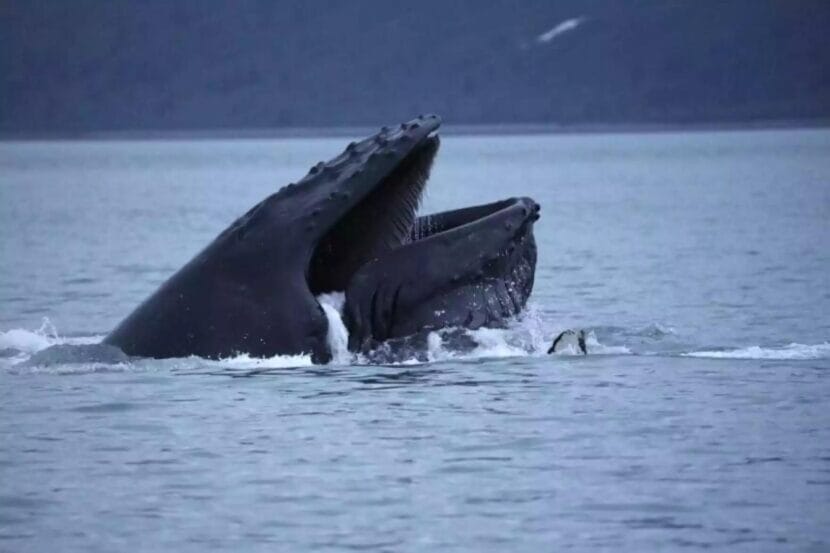
A whale surfaces in Glacier Bay in July 2023.
A whale surfaces in Glacier Bay in July 2023. (Clarise Larson /KTOO)

Researchers say vessel strikes are a major threat for whales, including in the waters off Alaska. A new technology is aiming to change that by using AI, thermal imagining and marine observers.

Matson’s container ships bring cargo and cars from Tacoma, Washington to Anchorage, Kodiak and Dutch Harbor. The company has partnered with WhaleSpotter, a new system that helps ships detect whales, said Matson’s CEO Matt Cox.

“Every handful of years, we, unfortunately, do have a strike, and of course, we report that up,” Cox said. “But the hope is, this new technology will make that even more rare of an occurrence in the future.”

WhaleSpotter was introduced commercially about a year ago and is now used by a dozen companies, including some in Alaska, said Shawn Henry, the company’s chief executive officer. He said Matson is their latest partner and the first container ship company to use the system.

Danger of ship strikes

Researchers say ship strikes are one of the leading causes of whale deaths worldwide. In the Juneau area alone, at least nine humpback whales were hit by ships in the last five years, according to a local project called Juneau Whale HEALTH.

“Vessel strikes are a major threat to whales,” said Heidi Pearson, a professor of marine biology at the University of Alaska Southeast and a principal investigator for the project. “Most ship strikes go undocumented. Especially if it’s a large vessel, they could hit a whale and not even know it.”

Andy Szabo, the director of conservation and research organization the Alaska Whale Foundation, said ship strikes are especially prominent in the areas frequented by cruise and cargo ships.

“Whenever you’re running high-speed, large boats through whale waters, that increases the likelihood of strikes,” he said.

Humpback whales are the most prone to strikes because they often swim close to the surface and close to shore, Szabo said.

The harm from the vessel strikes is compounding on top of other challenges whales face, he said. Recently, a marine heatwave in the Pacific known as the Blob disrupted ecosystems along the West Coast of the U.S., causing thousands of humpbacks to starve, Szabo said.

He said the population still has not recovered.

“They’re not doing great at all,” Szabo said. “So when you have that, and then you overlay on top of that vessel strikes, even if it’s not a lot of animals, it can have an impact.”

The new whale-detection system

WhaleSpotter technology is designed to alert ship crews when there is a whale nearby and give them an opportunity to change course or stop.

“We are enabling a vessel to detect a whale well ahead of the amount of time it needs to make a turn or slow down,” said Henry with WhaleSpotter.

Thermal cameras track temperature changes in a four-nautical-mile radius around a ship, Henry said. Then, the technology uses artificial intelligence to determine which images likely captured whales. Remote marine mammal observers – real people watching the data feed from elsewhere – do the last checks. Then the system sends an alert to crews about a possible whale nearby.

WhaleSpotter technology is designed to detect whales by using AI, thermal imagining and marine observers. (Woods Hole Oceanographic Institution)

The Woods Hole Oceanographic Institution in Massachusetts has been developing the technology for the last 15 years, Henry said. The institute granted WhaleSpotter a license to sell the technology, and the company has been working with different clients for about a year.

“We have a number of different other types of vessels that are using the product,” Henry said. “Some of them – vessel strike avoidance, some of them for marine operations like cable laying and pile driving.”

Cox, the CEO of Matson, said the company tested the technology on their ships. He said the trials showed that the system is effective at detecting individual whales and pods, and sometimes even the direction the whale is traveling in.

“We’ve had cases where those whale detections have been spotted, and we’ve been able to navigate around the pod or the individual whale to lessen the chances of a strike,” Cox said. “It’s worked really well.”

Now Cox said Matson plans to have it on all three of its Alaska ships. He said the crews are excited about it.

There’s genuine enthusiasm and excitement on board the vessels,” he said.

Pearson, at the University of Alaska Southeast, said the WhaleSpotter technology can be a game changer for whales, vessels and their crews and passengers.

“Of course, if a whale gets hit, it’s awful for the whale, but it can also damage vessels. Whale strikes have also been known to cause damage to human passengers on the boat,” she said. “So anything we can do to mitigate that protects whales and humans as well.”

Szabo, with the Alaska Whale Foundation, said that outfitting ships with technology to detect whales is a good first step, but he wants to know more about what the crews will do with that information.

He said that if the whale is too close, the ship might not have enough time to turn. And if the whale is too far and is moving, the original location might be irrelevant. Plus, he said, if there are many whales in the area, it can be unclear what the best course of action for the ship might be.

Still, Szabo said he is optimistic about the technology.

“It can’t be a bad thing,” Szabo said. “I just hope that there is sufficient effort put into the whole training and procedures and protocol side of things as well, to make it as useful as it could be.”

New lawsuit seeks to block revived bear-culling program in Western Alaska

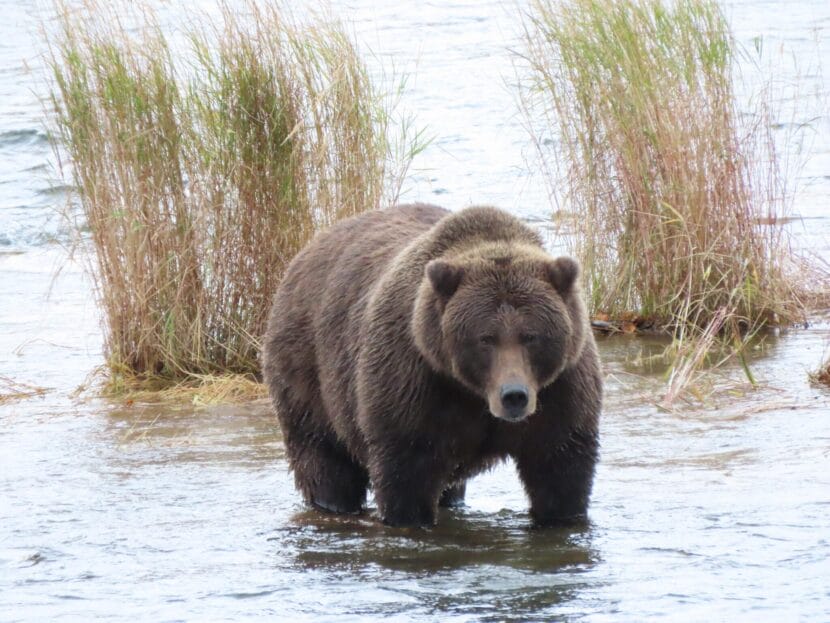
A brown bear stands in in shallow water in front of two bunches of tall grasses.
A brown bear stands in water in Katmai National Park on Sept. 27, 2022. A new lawsuit has targeted a revived predator control program that aims to boost Mulchatna caribou herd numbers by killing bears in a portion of the herd’s range. (T. Carmack/National Park Service)

The state’s latest plan to kill bears in part of Western Alaska to try to boost a flagging caribou population has drawn a new legal challenge.

Environmental groups on Monday filed a lawsuit in state Superior Court that seeks to strike down the Alaska Board of Game’s July approval of a controversial predator control program in the part of the state used by the Mulchatna caribou herd.

The lawsuit, filed by the Alaska Wildlife Alliance and the Center for Biological Diversity, is the latest step in a legal and political battle over state efforts to increase the herd size. It names the board, the Alaska Department of Fish and Game and the department’s commissioner as defendants.

The lawsuit argues that the revived program approved by the Board of Game suffers from many of the same flaws that were in the previous program. That program had been approved by the board in 2022 but was overturned by court rulings earlier in the year that resulted from a previous lawsuit filed by the Alaska Wildlife Alliance.

Two state judges found that the program, under which 186 brown bears, five black bears and 20 wolves have been killed since 2023, violated the elements of the Alaska constitution.

Monday’s lawsuit says the new predator control program is largely the same as the old one and it continues to violate the Alaska constitution’s requirement for sustained yield of natural resources. For Alaska, the principle of sustained yield holds that renewable resources should be managed so that they can exist indefinitely.

There are two ways that the sustained yield requirement is violated, according to the lawsuit.

The board, when it approved the predator control plan presented by the Alaska Department of Fish and Game, “failed to take a hard look at brown and black bear population data” for the targeted area, thus failing to properly consider impacts to those populations, the lawsuit said.

And the plan has no end point, meaning there is no trigger for suspension of predator control if bear populations drop below a minimum threshold deemed necessary for their sustainability, the lawsuit said.

“The Board of Game gave the Alaska Department of Fish and Game the authority to aerially shoot any bears of any age across 40,000 square miles until 2028, with no population data or cap on the number of bears killed,” Nicole Schmitt, executive director with the Alaska Wildlife Alliance.

She noted that the southeast border of the targeted area is only 3 miles from Lake Clark National Preserve, 30 miles from Katmai National Park and 50 miles from McNeil and Brooks Falls, sites that are world-famous for the large numbers of brown bears that gather there to fish for salmon. Meanwhile, the western border reaches two national wildlife refuges, “which means this program threatens bears who move across vast stretches of public lands,” she said.

Cooper Freeman, Alaska director at the Center for Biological Diversity, called the program “a disgraceful misuse of public resources and a betrayal of the trust Alaskans place in their wildlife managers.”

“There’s no excuse for the state of Alaska to be gunning down bears from helicopters,” Freeman said in the statement.

The commissioner of the Alaska Department of Fish and Game defended the program, though he did not specifically address the claims in the new lawsuit.

“ADF&G is committed to all users of the herd in rebuilding this population, which has been identified as important for providing high levels of human consumption under state statute and regulation,” Commissioner Doug Vincent-Lang said in a statement.

Vincent-Lang said “intensive management,” or IM, has shown to be helping the caribou herd. Intensive management is the term Alaska wildlife managers use for predator-control programs.

“There is strong evidence that neither disease nor nutrition are preventing this herd from recovering. Department predator removal efforts in the Mulchatna caribou herd IM program are administered to reduce wolf and bear populations in small, defined areas for short periods of time, to enhance caribou calf survival and to increase herd abundance,” Vincent-Lang said in his statement. “Predation has been isolated as the limiting factor preventing the herd from growing, and predator removal is increasing calf survival—we know that now—and we have seen increased calf survival as a result of our past IM efforts.”

The Mulchatna caribou herd crashed in recent decades, and there is heated debate about the cause.

The herd peaked at about 200,000 animals in 1997, when it provided up to 4,770 caribou for subsistence hunting in the region’s communities, according to the Department of Fish and Game. But the population crashed after then and is now estimated at about 16,000 animals, according to the department. Hunting has been closed in recent years.

State wildlife officials argue that predation by bears and wolves on caribou calves is the reason for the decline. The department has stated a goal of boosting the herd to a size ranging from 30,000 to 80,000 animals, enough to support resumption of hunting.

Backers of the Mulchatna predator control program have included the Alaska Federation of Natives, which passed a resolution in 2023 that supported the program because the organization says it is necessary to ensure food security in that part of the state.

But critics of the program, including some veteran Alaska wildlife biologists, argue that other factors caused the herd’s population crash. Among the cited factors is a change in habitat, driven by long-term warming, that makes the region less supportive of lichen-eating caribou and more favorable to moose and other animals dependent on woody plants. Migratory tundra caribou herds around the Arctic have suffered similar problems, with overall population declines of 65% in the past two to three decades, according to the 2024 Arctic Report Card released by the National Oceanic and Atmospheric Administration.

The Board of Game and Department of Fish and Game have lost past court fights over Mulchatna predator control.

Aside from having judges rule that the earlier program was unconstitutional, one of the judges found in May that the department acted in bad faith by continuing to conduct aerial shooting this spring even after the program was declared legally void.

A baby seal rescued near Petersburg has been released back into the wild

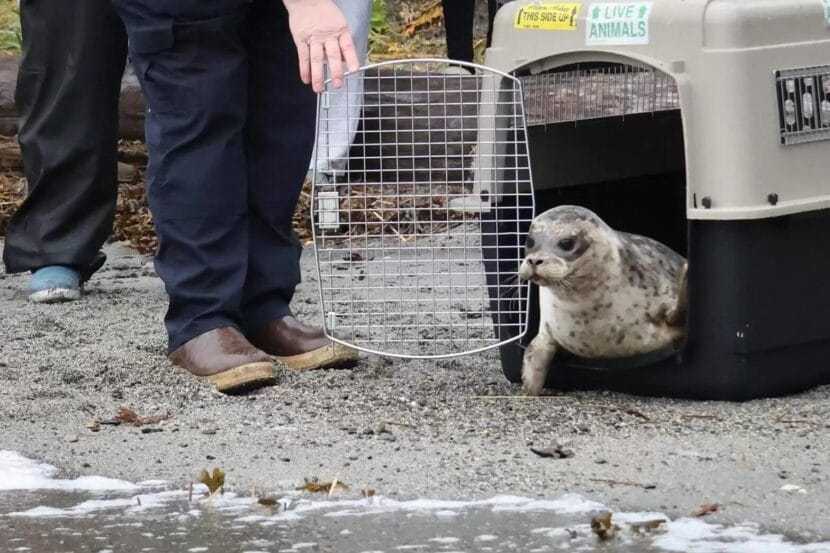
Jerod Cook opens the door of Bravo’s kennel on Petersburg’s Sandy Beach, releasing the seal back into familiar waters on Oct. 23, 2025.
Jerod Cook opens the door of Bravo’s kennel on Petersburg’s Sandy Beach, releasing the seal back into familiar waters on Oct. 23, 2025. (Olivia Rose/KFSK)

Back in May, National Marine Fisheries Enforcement Officer Jerod Cook responded to a call from Petersburg’s police department about a stranded baby seal at the Libby Straits, south of town.

“He was just hanging on to the beach there,” Cook said. “We never did see a mother for it.”

He moved the seal to a safer location, then came back to check on it the next day.

“It was obvious that something, a decision, needed to be made,” Cook said.

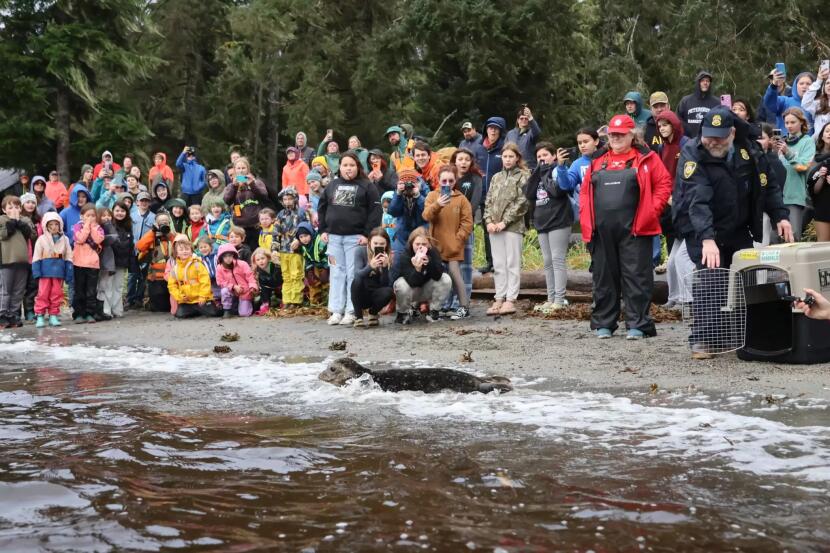
After several weeks of treatment at the Alaska SeaLife Center in Seward, that seal returned home on Oct. 23. Over a hundred people gathered at Sandy Beach to see the nearly five-month-old Bravo get released back into the wild.

Among the excited crowd was coach Matt Pawuk’s middle school basketball team. He admitted that they should have been at practice.

“I like to say it’s because they’re gonna get extra credit in their science class,” Pawuk said. “But mostly I’m doing it out of selfish reasons, because I really want to see this.”

Over 100 people gathered on Sandy Beach in Petersburg to see off the rescued seal on Oct. 23, 2025. (Olivia Rose/KFSK)

Nearby, members of Petersburg’s outdoor child care program gathered along the water.

“We love watching the seals when they’re here,” Kinder Skog co-founder Katie Holmlund said. “So it’s really exciting to get to see one released back into the wild.”

In May, after rescuing the baby seal, Cook sent it on that morning’s jet to Seward.

“His mother hadn’t come to him, and so I checked with the sea life center. They said they’d take him,” Cook said.

Jane Belovarac is the wildlife response curator with the Alaska SeaLife Center. She said they estimated Bravo was about three days old when he was found.

She said there are a number of reasons why a baby could get separated from its mom, but they don’t know what happened with Bravo.

The Alaska SeaLife Center is the only licensed marine mammal rehabilitation center in the state, and they got straight to work getting Bravo ready to go home.

“When this guy first came to us, he was about 16 pounds,” Belovarac said. “He now weighs over 50 pounds, so he is at a really good weight to go back out into the wild and start hunting on his own.”

In addition to helping Bravo pack on the pounds, the center also had to prove that he could hunt on his own and that he would have more than a 50% chance of surviving in the wild.

“We definitely feel very confident that this guy is going to do well,” Belovarac said.

Among the gathering at Sandy Beach, Jonas Banta was waiting for the seal’s arrival. Banta had already gotten a sneak peek of Bravo because he flew in on the same jet. Banta came to Petersburg to go deer hunting, but when he heard about the seal’s release, he came to check it out.

He said flying on the same plane as a seal was “actually very exciting,” and that the smell of the seal was also pretty prominent.

“It was smelly,” he said. “It smelled just like herring.”

Bravo enters the waves at Petersburg’s Sandy Beach on Oct. 23, 2025. (Olivia Rose/KFSK)

Bravo arrived in a kennel in the back of a pickup truck and was promptly swarmed by children, eager to see him. He was soon carried past the excited crowd and brought to the water.

The crowd quieted down as Belovarac told Bravo’s story from the shoreline.

“He hasn’t seen the ocean in a very long time, and he’s never seen this many people. So we don’t want to scare him,” she said, asking the gathering to give the seal space.

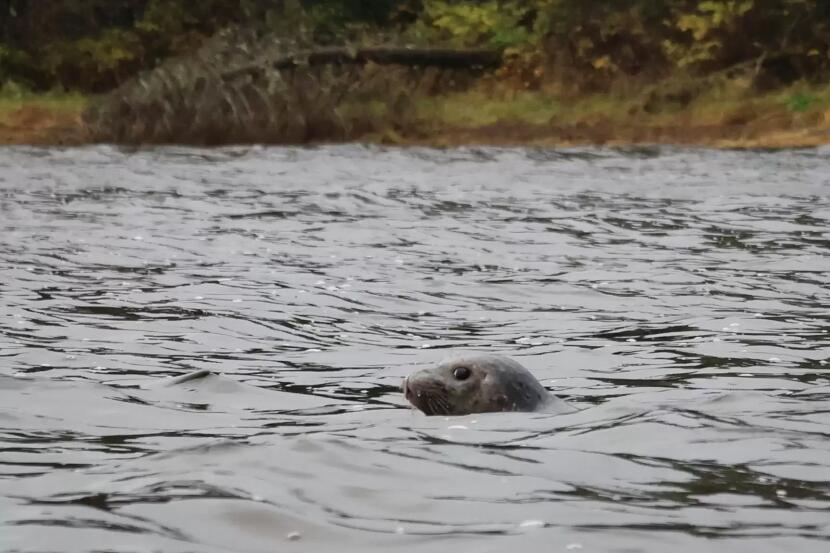
Cook opened the door to the kennel, and Bravo hopped out into the waves. He came back to the beach once before heading off into the water, where other bobbing seal heads were waiting.

Belovarac says if you see a marine mammal that you think needs help, you can call the 24-hour NOAA statewide hotline at (877) 925-7773, or the Alaska SeaLife Center 24-hour hotline at (888) 774-7325.

Juneau’s fat bears are on the prowl for trash as winter approaches

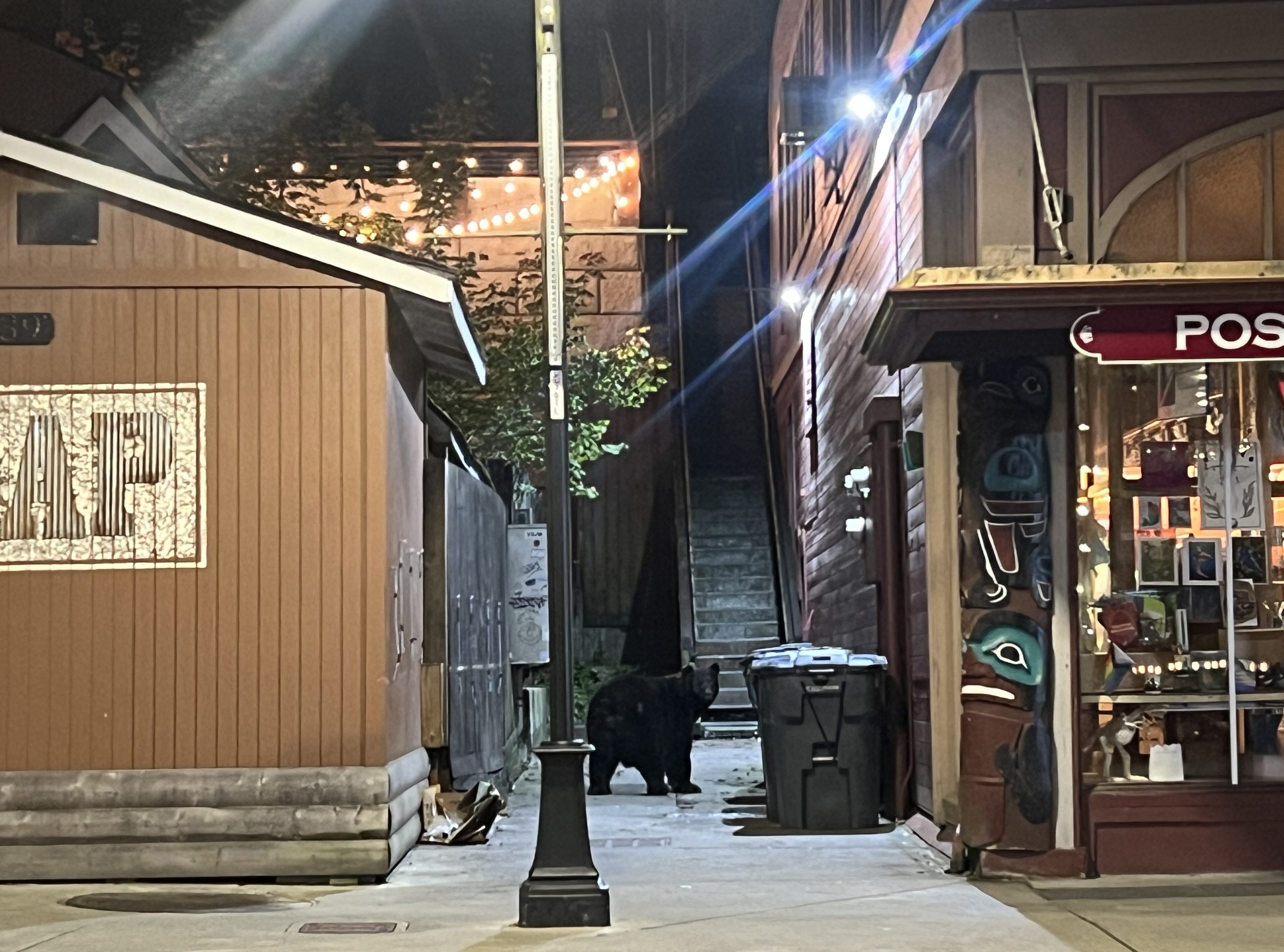
A black bear glances back at the people yelling from the sidewalk in front of the Triangle Club before ascending the stairs. (Photo by Alix Soliman/KTOO)

Listen to this story:

Although voting for Fat Bear Week in Katmai National Park closed last month, Juneau’s black bears are packing on the pounds to keep from starving during hibernation, and they’re going for whatever they can find.

At about 9 p.m. on a mid-October evening at the Triangle Club, the bartender and patrons dashed outside at the sight of a hefty black bear in the alleyway across the street. The bear sniffed at a row of garbage cans that are bear-resistant, but not bear-proof. 

People banged their fists on a metal trash can and yelled at the bear to go away, for its own sake. 

After glancing back at the row of people standing on the sidewalk, the bear heeded the warning and sauntered up the stairs. 

According to downtown residents, this scene has replayed most nights this month. That’s because autumn is a time when bears in Alaska enter hyperphagia, which is a period of gluttony driven by insatiable hunger. 

Carl Koch, Juneau’s wildlife management biologist at the Alaska Department of Fish & Game, said that the season’s change, marked by a decrease in daylight and drop in temperature, triggers bears to devour massive amounts of food so they can survive the winter. But their usual diet is not as abundant.

“I mean, there may be still some salmon around, but they’re rapidly running out of natural foods,” he said.

The grasses they eat tend to be more nutritious in the spring and berry season has ended. So Koch said he’s been getting calls about bears rummaging through trash. He expects that to slow down in November and December, when bears head uphill to hibernate.

During hyperphagia, black bears’ heart rates can double and they tend to venture farther to find a meal. They spend almost all day, every day eating. It amounts to around 20,000 calories per day — double what they typically eat during the summer — and they can put on around a third of their body weight. 

Koch says the availability of resources, including trash, might make them stay out longer.

“They can delay hibernation if there’s food out,” he said. 

He says he received a report of people feeding a young bear downtown, which is illegal in Alaska and could dangerously train the local bears to associate humans with food. The department euthanized two bears last year that had become aggressive around trash bins on South Franklin Street.

Koch recommends keeping food out of vehicles, bringing bird feeders indoors until winter and keeping trash in secured bins. And he says to follow the city ordinance to put garbage out for pick-up no earlier than 4 a.m. on trash day.

Petersburg joins other Southeast Alaska communities in asking for stronger sea otter management

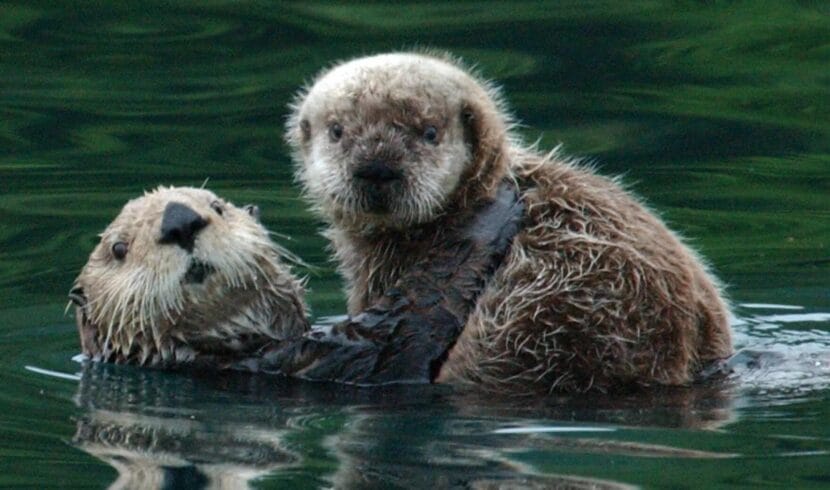
A pair of sea otters in the water, holding each other
Sea otters. (U.S. Fish and Wildlife Service)

The Petersburg Borough Assembly passed a resolution on Sept. 15 calling on state and federal authorities for help dealing with rising sea otter populations. Petersburg now joins Wrangell and Haines in asking for stronger otter management.

The Petersburg resolution urges authorities and stakeholders to collaborate in creating a sea otter management plan. It also asks the federal government to loosen regulations for how Alaska Native subsistence hunters can use harvested sea otters. Currently, hunted sea otters can only be used as “authentic Native handicrafts.”

Multiple Assembly members voiced their support, including Rob Schwartz.

I crabbed commercially for 35 years,” Schwartz said. “One of the reasons I got out is because we know we’ve seen this over the decades, the exponential increase in the population of the sea otters.”

Sea otters were once wiped out in Southeast Alaska due to the fur trade, but their population has skyrocketed since reintroduction to the region in the 1960s. Those sea otters consume a lot of shellfish, putting them at odds with fishermen.

Proponents for sea otter management say otters are causing trouble for the local economy and ecology because they’re depleting the shellfish resource and taking harvest from fisheries.

While this resolution doesn’t change state or federal law, it asks for disaster assistance for crab and dive fisheries in Southeast.

Both Mayor Mark Jensen and Vice Mayor Donna Marsh offered to recuse themselves for potential conflicts of interest. Jensen currently holds a commercial Dungeness crab permit. Marsh’s husband is a commercial crabber, and she has also previously held a crab permit. The Assembly allowed both Jensen and Marsh to vote on the resolution.

Marsh proposed an amendment to broaden who could legally take sea otters. Currently, sea otters are federally protected under the U.S. Marine Mammal Protection Act, and can only be hunted by people who are one-quarter Alaska Native or an enrolled member of a coastal tribe.

The amendment, reviewed by the borough’s attorney, says that the Assembly would support regulations allowing sea otters to be taken by any Alaska resident with a valid hunting license.

The resolution with the added amendment passed 4-1, with Assembly member Jeigh Stanton Gregor opposed. He said he could not support the new amendment.

I am definitely in favor of this resolution. I think action is needed on a variety of levels involving the sea otter population,” said Stanton Gregor. “But as far as I can tell, this resolution, if we include that amendment, would be in violation of federal law for the Marine Mammal Protection Act.”

This resolution is not legally binding; it’s a request for federal and state authorities to take action.

Site notifications
Update notification options
Subscribe to notifications