Wildlife

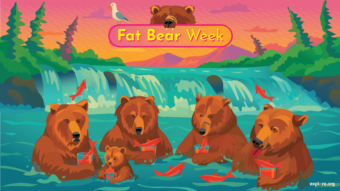
Fat Bear Week kicks off with buxom babes and up-and-coming chonkers

Editor’s note: Due to a slow web editor, today’s installment was posted after Day 1 results were released. Here is the line up nevertheless. Tune in Wednesday morning for the Day 2 breakdown. 

It’s the most fattastic time of the year: Fat Bear Week! Welcome to Day 1. Let’s get the ball rolling! 

Match 1: 128jr “Biggie” vs 609 “Bean”

Two chubby junior champs go digitally head-to-head in the first match of Fat Bear Week! 128jr “Biggie” won this year’s Fat Bear Week Jr. contest, and 609 “Bean” is a former Fat Bear Week Jr. winner from 2022. 609 Bean is newly emancipated this summer, after spending not two, not three, but four summers under the care of her mother or auntie. Her upbringing alone is a unique story, but 609 in her subadulthood is here to show us that she is, in fact, no longer a Bean-ie baby. She caught the first fish on the lip this season (like her mother before her and her mother before her) awll by hershelf and she appears to be an expert snorkeler to boot. She was even seen being courted by and then mating with 151 Walker, a well-established beefcake of a bear. She may be freshly independent, but she’s massively mastering the bear necessities. 

Fat Bear Week 2025 contender 609’s weight gain over the course of this summer. (Graphic courtesy of Explore.org)

Up against 609 is the notorious B.I.G.gie. 128jr Biggie shares a life experience with 609; they both lost a sibling in their first year as cubs. Biggie’s sibling (“Smalls”) tragically died on camera last summer, days after being attacked by a boar. Ugh, it was a whole family saga and it put members of the bear cam community (me) into a legit depression. But Biggie’s survival is a legend in the making, and the Biggie we see today is living large and in charge, at least as much as she can as a yearling. She may be little, but she’s gangsta. And if you don’t know, now you know. ?

Fat Bear Week 2025 contender 128Yearling or “Biggie”‘s weight gain over the course of this summer. (Graphic courtesy of Explore.org)

Match 2: 503 “The Prince of Katmai” vs 901

These are not unbiased updates. It is pawsitively unfair that they stacked my boi 503 against the buxom babe that is 901. 901 is so fat she looks like an AI generated fat bear. Technology could literally not draw her fatter. A child could make a ball out of playdough and call it her portrait. When seated, there is approximately no space between her stomach and the ground. She spends all the time at the beach, like an actual Bearbie grrl. (Why yes that’s my bear cam username). A Nice Guy like 503 probably doesn’t stand a chance, so this might be my only opportunity this week to campaign for him. 

Fat Bear Week 2025 contender 901’s weight gain over the course of this summer. (Graphic courtesy of Explore.org)

503: *Looks at clock, takes a breath* Okay, here’s the CliffsNotes. Abandoned as a cub, 503 was adopted by 435 Holly (“the Queen”), who raised her as one of her own. Because he was just a cub but given a number like a subadult, people call him Cubadult. Not me. I call him by his other name, The Prince of Katmai. Not just because he was adopted into royalty, but because of his charm, his benevolence. He got 32 Chunk (a literal scarface) to play. He displaced 856 (top bear for decades; speculated to be his dad) without violence. Even when attacked by others he pushes them back, and then he walks away. Most boars achieve dominance through brute strength and aggression, but The Prince is, by and large, far and wide – gentle. He has grown into his gigantic genes and in a matter of years I predict he will not only be a Fat Bear Week winner amongst the humans, but the King of Katmai amongst the bears.

Fat Bear Week 2025 contender 503’s weight gain over the course of this summer. (Graphic courtesy of Explore.org)

May the fattest bear win. Voting is open 8 a.m. to 5 p.m. AKST at www.fatbearweek.org!

Place your Fat Bear Week bets starting Tuesday

The 2025 Fat Bear Week Bracket (Courtesy of Explore.org)

Ladies and Gentlebears, welcome to Fat Bear Week 2025! 

This annual, week-long competition from Katmai National Park is a celebration of a summer’s worth of hard work, a hat tip to a healthy ecosystem and a collection of survival stories. The bears have been busy feasting on salmon and stocking up on nutrients for their winter hibernation, and they’ve got the fall bods to prove it. 

What started as a one-day event in 2014 conjuring the attention of a few thousand nature conservancy social media followers has grown into a week-long event boasting 1.2 million votes last year. There are fat bear fans in every part of the country, fat bear curriculums in classrooms, fat bear campaign posters, fat bear Spotify playlists and, of course, fat bear bets on who will be crowned the champion. 

Similar to March Madness, Fat Bear Week is a bracket-style, single elimination tournament. New to the scene? I’m here to break it down for you: 

Who’s in the bracket? 

Not all the bears at Katmai are contenders. Rangers refill the roster largely based on the availability of spring and fall comparison photos, the bear being fat, and other unknown-to-us but reasonable reasons. The much-anticipated 2025 bracket was released bear-by-bear Monday live and on Youtube. You can find the complete list of all twelve competitors, before-and-after photos as well as short biographies at FatBearWeek.org

How does it work / How do I vote?

Fat Bear Week is Tuesday, Sept. 23 through Tuesday, Sept. 30. Each day, one or two matches will be posted on FatBearWeek.org. Between 8 a.m. and 5 p.m. AKST, you may vote for one bear in each match. The winner of each match is announced that evening and advances to the next round.

Which fat bear do I vote for?

The voting rubric is different for different people. Some folks believe you should only vote for the physically, empirically, literally, fattest bear. Some believe it’s a matter of weight gain. That is, you should determine which bear was most successful in becoming a fat bear between spring and fall. Others believe that fatness is a symbol of overall survival and that one should vote on a fat bear’s skills, success and story arc. Who here is giving off main character vibes? Vote for them! 

Personally, I love Fat Bear Week for the poetry: the 230 Ben dancer in us. The 128 Grazer fierce mama in us. I love Fat Bear Week for the stories: 32 Chunk eating with a broken jaw; 503, the adoptee, who befriends all. Above all, I love Fat Bear Week for the kinship between bears, and between us and the bears. 

Whether you’re a Fat Bear Week superfan or a newcomer to the scene, I hope you find a bear to throw your weight behind. We’re zooming in on a robust ecosystem that nourishes larger-than-life bears. Surviving was yesterday; today we’re thriving. Let’s celebrate!

Owner of wildlife facility near Haines now faces felony animal cruelty charges

A decorative pile of animal bones at the Kroschel Films Wildlife Center property in June 2025.
A decorative pile of animal bones at the Kroschel Films Wildlife Center property in June 2025. (Avery Ellfeldt/KHNS)

The State of Alaska has filed criminal charges against Chilkat Valley resident Steve Kroschel two months after state agencies first raided his once-popular wildlife facility, near Haines.

The state Office of Special Prosecutions filed three felony and two misdemeanor charges against Kroschel on Thursday, alleging cruelty to animals. Each of those felony charges could result in up to a $500,000 fine and five years in prison, according to Alaska statute.

An arraignment has been scheduled in Haines for Oct. 8, the state said in a release. Reached by phone on Friday morning, Kroschel was in Central Russia and not yet aware of the charges.

“This is insane, absolutely insane,” he said. “My heart, my spirit, my mind, is all about taking care of life on Earth.”

The charges are the most recent development in a years-long battle between Kroschel and the state over the Kroschel Films Wildlife Center.

For two decades, the facility has offered thousands of visitors close-up views of wild animals. But a series of incidents and inspections over the years raised concern among state officials over animal welfare and human safety.

Those concerns, plus a lapsed federal license, eventually led to the revocation of Kroschel’s state permit. Then, in June, two state agencies executed a search warrant and seized dozens of animals as part of a criminal investigation.

Charging documents indicate the three felony charges are related to “inflicting severe or prolonged physical pain or suffering” on animals including a moose, a porcupine and a brown bear. The two misdemeanors allege Kroschel failed to care for animals including a porcupine and moose.

Kroschel remains adamant that the charges are unfair and inaccurate.

“Every animal that I’ve had that passed away was either examined in a necropsy that I requested, or the state, and it was either old age or something like that,” he said. “It was not because of negligence. But they’re trying to pin that on me as animal cruelty, that’s insane.”

Kroschel has spent much of the last two months in Russia, where he says he’s helping care for some wolf pups and two orphaned grizzly bear cubs.

The Office of Special Prosecutions did not respond to multiple requests for comment but said in a statement that the charges are “only allegations and are not evidence of guilt.”

Fat Bear Week starts Tuesday. Who will be the chubby champ?

Two bears vying for a prime fishing spot near Brooks Falls. (Brian Venua/KMXT)

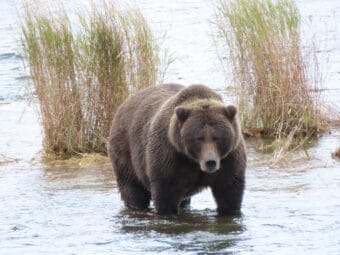
The brown bears in Katmai National Park and Preserve have been packing on the pounds this summer. Starting Tuesday, you can vote online for the chunkiest bear in the annual Fat Bear Week competition. The name of the event says it all, said Katmai park ranger Sarah Bruce.

“We celebrate how fat the bears get,” she said. “Fat equals survival. A fat bear is a healthy bear.”

Fat Bear Week started as a one-day celebration over a decade ago, but has grown into an international phenomenon. Over a million people from more than 100 countries voted in the bracket-style competition last year.

Bruce called the face-off the park’s hallmark event.

“Fat Bear Week brings the park into the living room of anybody who wants to enjoy this place,” she said. “Even just this past week, we had a bear cam fan who visited the park from New Zealand.”

Bruce is originally from Maryland and she’s hooked, too.

She said it’s stunning to watch the bears transform as they feast on fish in the Bristol Bay watershed – home to the world’s largest sockeye salmon run.

“It really is quite a sight to see these bears go from 5, 6, 700 pounds and they come out of the den over 1,000 pounds by the end of the season,” she said.

Most bears in the area start making their way to their dens in October and November. While hibernating, bears will drop a third of their body weight because they don’t eat or drink.

#32 Chunk is a big bear. Last year, Chunk lost to Grazer by a difference of over 40,000 votes. Last summer, Chunk killed Grazer’s cub after it slipped over the waterfall. The whole incident was caught on the live cameras on explore.org (Christine Loberg/NPS)

Park rangers are still finalizing this year’s 12 chunky competitors but Bruce said there may be some familiar faces – like potentially Grazer, the reigning champion, along with Chunk, last year’s runner up. Online voting in the bracket-style challenge opens at explore.org Tuesday and runs through Sep. 30.

But if you want to get in on the action early, Fat Bear Week also has a junior division where the plumpest cub advances to the main bracket. Voting for the juniors starts Thursday and closes Friday.

Drone photos suggest a 2014 marine heat wave is still stunting orca growth, reproduction in Alaska

An aerial photo of seven killer whales, including young ones, swimming through greenish water.
Killer whales, including calves and juveniles, travel in their family group in the Gulf of Alaska in June 2025. (New England Aquarium in collaboration with North Gulf Oceanic Society under NMFS Research Permit 26614)

It’s well documented by now that the marine heatwave that hit the Pacific Ocean in 2014 had devastating effects on Alaska’s marine ecosystem and commercial fisheries.

Now, scientists are uncovering long-term impacts on Alaskan killer whales specifically – a harbinger as marine heat waves become more frequent and severe with climate change.

“We’ve learned that females that were growing during those heat wave years grew to smaller sizes,” said John Durban, a senior scientist with the New England Aquarium in Boston who has been studying killer whales in the Gulf of Alaska for two decades.

“If you’re smaller as a whale, it means you don’t have as much fasting endurance, you can’t store as much blubber,” Durban added. “So if you go through lean times, you’re less likely to bring a successful pregnancy to term.”

Durban has been partnering with the Alaska-based nonprofit North Gulf Oceanic Society to monitor several hundred resident, salmon-eating killer whales in the Gulf of Alaska. He flies drones over the water, which capture images of the whales from more than 100 feet in the air.

Those images allow researchers to measure how individual whales are developing over time.

The North Gulf Oceanic Society has been monitoring killer whales in the Gulf for more than four decades. Durban said that work became particularly important in the aftermath of the Exxon Valdez oil spill, which correlated with an “unprecedented” number of whale deaths among two pods that were exposed to the spill, according to NOAA.

The resident killer whales gradually recovered over the years. Or at least they were recovering, before the 2014 heatwave known by many as “The Blob” hit the area, according to Durban’s research.

“We started seeing that this recovery that had happened over the previous three decades basically getting wiped out in the course of a couple of years,” Durban said.

The technology has delivered some good news. This summer, researchers observed three new calves, plus some slightly older ones that appeared to be healthy and growing as expected.

That could mean the population is on a path to recovery. But it doesn’t mean the Gulf’s resident killer whales are in the clear. The females impacted by the heat wave may be less resilient in the face of future events, such as heat waves or dips in the salmon population.

“We’re cautiously optimistic, but I think it does mean that there’s some vulnerable whales out there,” Durban said.

His latest scientific findings haven’t yet been published. But he said he’s working on several scientific papers that lay out evidence that the so-called blob is still impeding Alaskan killer whales’ growth and reproductive success today, a full decade later.

As he sees it, the findings underscore the importance of studying apex predators. They rely on species down the food chain, which means they can serve as early indicators of trouble in the broader ecosystem.

Durban emphasized that the findings also highlight something else: the threat of climate change.

“These marine heat waves that we’re starting to see in increasing duration and intensity around the world are having really important effects on marine food webs.”

Baranof Island bears get first-ever state count

Bear 309 was captured, tagged and released on Aug. 22, 2025.
Bear 309 was captured, tagged and released on Aug. 22, 2025. (Stephanie Sell/ADF&G)

Biologists have launched the first-ever state study of brown bear numbers on Sitka’s Baranof Island. Managers say they need updated data to manage the population appropriately.

Baranof Island is really big — about 1,600 square miles and larger than the state of Rhode Island. The brown bear population is currently managed using really old numbers based on populations from a different island, measured nearly 40 years ago.

Stephanie Sell, a wildlife research biologist with the Alaska Department of Fish and Game, said there’s never been a population estimate study completed on Baranof.

“The management numbers that we’re using for brown bears on Baranof were extrapolated from a project that happened on northern Admiralty (Island) in the late 1980s and the early 1990s,” Sell said.

There was a track study in the 1930s, where researchers went up salmon streams to measure the widths of paw pads to determine how many animals were on the island, but modern research techniques invalidate it.

Based on the information they found on nearby Admiralty Island — located between Sitka and Juneau — Sell said researchers determined there was likely more suitable habitat on Baranof, meaning more bears.

The number they settled on? 1,045.

But Sell said they really don’t know how accurate that number is. And to be able to sustainably manage brown bears on the island, it’s really important to have updated information.

“What we’re trying to do is figure out what those numbers are,” she said.

Sell estimates the study will take about five to six years to complete. Biologists recently wrapped a similar six-year project near Haines and Skagway. Sell said ADF&G had been managing for a population of 400 bears in the area, but the study led them to lower that estimate to just over 300.

“I don’t know if it’s going to be more or less on Baranof Island, but that’s what this project is going to hopefully find out,” she said.

The price tag on the study is still unknown, according to Sell, but they have a funding source: the Pittman-Robertson Wildlife Restoration Act, which is supported by federal excise taxes on the sale of ammunition and firearms.

In early September, Sell and her assistant began capturing brown bears near Sitka and putting GPS collars on them to learn more about their habitats and day-to-day movements.

“We use helicopters wherever we can to dart bears, and then it takes us about an hour to process the bears,” she said. “We also use foot snares in places where we won’t run into people, for safety reasons. And then the other method is free range darting, where we sit next to some sort of salmon stream or some sort of attractant, where the bear is drawn in by some natural food source, and we just wait for bears to show up.”

Each of the 25 bears they aim to capture each year will wear a collar for up to two years. When they retrieve them, researchers will then be able to look at that data and focus their efforts on the next part of the study: genetics.

“Once we get more spatial data and see where bears are moving across the island, we can start looking at where we’re going to actually put genetic sampling detectors,” Sell said. “We’re going to start catching bear hair to increase our sample size, and that way we can use that information to determine how many animals are actually on the island.”

A brown bear on northern Baranof Island. (Steve Bethune/ADF&G)

Sell said Baranof bears are generally really dark, almost resembling black bears. They’re also quite fat this time of year because of the island’s healthy salmon runs — something she said they didn’t see everywhere else this year.

“What we do know about Game Management Unit Four bears is that they’re genetically similar to polar bears,” Sell said. “They had refugia, it seems like, since the last ice age. And so they’re genetically different from mainland bears.”

(Refugia are geographical areas where a population, species or community has survived environmental instabilities over long periods of time.)

As of Friday, Sell said biologists have put 20 collars on bears: 14 on females and six on males.

Brown bear hunting season in Sitka starts on Sept. 15. Hunters are currently able to harvest 42 bears on Baranof — that’s 4% of the estimated population. Sell said they hope to be done tagging for the season before that begins.

Later on in the study, she said they’ll be reaching out to the community to see if anyone wants to volunteer by checking hair snares. If anyone has questions, wants to volunteer, or even give her a guesstimate on how many bears they think might be on Baranof Island, Sell said they can email her.

Site notifications
Update notification options
Subscribe to notifications