Wildlife

Humpback whale severely injured in Glacier Bay National Park

Humpback whale #2583 with a deep gash behind its dorsal fin on June 27, 2025. (Photo courtesy of Janet Neilson/National Park Service, taken under the authority of Scientific Research Permit #27027 issued by NOAA Fisheries)
Humpback whale #2583 with a deep gash behind its dorsal fin on June 27, 2025.
(Photo courtesy of Janet Neilson/National Park Service, taken under the authority of Scientific Research Permit #27027 issued by NOAA Fisheries)

State seizes 39 animals from a wildlife facility outside Haines

The entrance to the Kroschel Films Wildlife Center, pictured above on June 27, 2025.
The entrance to the Kroschel Films Wildlife Center, pictured above on June 27, 2025. (Avery Ellfeldt/KHNS)

Steve Kroschel over the last two decades has offered tens of thousands of visitors close-up views of animals including wolves, moose – and a brown bear named Kitty.

But on a walk through the Kroschel Films Wildlife Center in Mosquito Lake on Friday morning, the property was quiet. The animal enclosures appeared empty. Save one – it held a mink.

The critter, it seemed, was left behind after Alaska Wildlife Troopers and the Alaska Department of Fish and Game arrived at the property on Thursday, executed a search warrant and seized 39 animals. No charges have been filed, but a copy of the warrant provided to KHNS by Kroschel’s attorney indicates he’s under investigation for crimes including animal cruelty.

Dennis Seifert, who lives down the road and sometimes helps out at the center, stopped by on Friday at the request of center staff.

“I’m just feeding the weasel that the cops missed,” Seifert said, after tossing a dead quail into the enclosure and filling a water dispenser. “We didn’t think they were going to get them because there’s underground tubes that run all around the property for them to travel in.”

The raid comes amid a years-long saga between Kroschel and the state of Alaska – namely, the Department of Fish and Game.

The facility has been around since the early 2000s. By Kroschel’s count, it draws between 8,000 and 10,000 people every year.

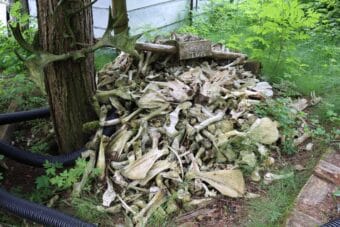
Once inside, visitors are greeted by decorative piles of bones, and enclosures fastened with fencing, posts and hand-written warnings. Wooden planks on the moose enclosure, for instance, read: “Stay Back! Will Kick!” and “Do Not Touch Moose.”

A recent inventory report from Kroschel said he had 59 animals. But the state of Alaska is ultimately responsible for managing wildlife – including captive game. In fact, some were placed at the facility by Fish and Game, including a moose calf in 2022 and two minks in 2023, an agency spokesperson said.

But Fish and Game staff say they’ve been concerned about the facility for years, and more recently have asked Kroschel to address everything from what they say are inappropriate feeding practices to insufficient enclosures.

Kroschel, meanwhile, says he’s complied with the requests and that his facility is safe for both humans and animals.

“The [Alaska Department of Fish and Game] has wanted to get rid of me, and shut me up and shut me down for years. Three years,” Kroschel said in a phone interview on Monday.

“But I’ve been doing this for 24 years here in Haines, licensed and operating. No one’s ever gotten bitten, and there’s not been anything egregious has happened,” he added.

An empty animal enclosure at the Kroschel Films Wildlife Center in Mosquito Lake, near Haines. (Avery Ellfeldt/KHNS)

Animal welfare, feeding, hygiene concerns

Kroschel acknowledges that there have been some incidents. In 2023, for instance, a moose escaped from its enclosure and wandered off the property. And in 2021, a bear broke into the facility and killed two moose.

Then, last August, Kroschel’s federal license lapsed. The Chilkat Valley News reported at the time that it was later reinstated, but in the meantime, Fish and Game revoked his state educational permit. The agency did so on the grounds that he didn’t have the required federal license – and pointed to a long list of other concerns.

“The underlying problems have to do with animal welfare, basic care and feeding, hygiene, those kinds of things. And also security,” Mark Burch, who serves as the assistant director of Fish and Game’s Division of Wildlife Conservation, said in an interview in mid-June.

Kroschel contends he’s done everything the regulators have asked him to do – from fixing and expanding enclosures, to adding new fencing and more.

In April, Kroschel reapplied for the state permit. But in a May 2 letter seen by KHNS, Fish and Game said staff had reviewed the new application and identified more concerns.

Among them: Kroschel reported using pool treatment chemicals to clean animals’ drinking water, which the department said could be toxic if consumed regularly.

“I encourage you to realistically assess if you can meet the requirements listed below, and if not, please advise us of that. If the issues are not corrected by June 15, 2025, I will not issue a 2025 permit,” Fish and Game Commissioner Doug Vincent-Lang wrote in the letter.

Michelle Bittner, an attorney who has been working with Kroschel on permitting issues, said she and Kroschel responded to the agency’s concerns in late May. That included by clarifying that Kroschel had used small amounts of chlorine dioxide to clean water receptacles, and by submitting a positive report from a veterinarian, who visited the property earlier that month.

When Bittner followed up on the status of the permit on June 21, Vincent-Lang replied that the Fish and Game was coordinating with other agencies and would have a decision soon, according to an email exchange seen by KHNS.

Bittner said that was the last communication from the commissioner before state wildlife troopers and Fish and Game staff arrived at the property on June 26, executed the search warrant and seized the animals.

A moose enclosure at the Kroschel Films Wildlife Center sits empty after two state agencies removed 39 animals from the Kroschel Films Wildlife Center. (Avery Ellfeldt/KHNS)

An ongoing investigation

Alaska Department of Public Safety Spokesperson Austin McDaniel said he can’t comment further on the warrant, which is confidential, or potential charges mid-investigation.

But the warrant indicates the troopers were there to gather evidence related to animal abuse. It also says animals seized included Kitty, Kroschel’s brown bear, a moose, three wolves and three lynx.

Kroschel said that when he returned to the property after the fact, he found a range of animals had been left behind – including the mink, and an injured fox. He added that the warrant has some inconsistencies.

“Where the hell did they get three lynx? There’s two lynx. So either they don’t know how to even identify a species, or they can’t count,” he said.

Fish and Game spokesperson Shannon Mason declined to answer a list of questions earlier this week about the decision to remove the animals, and where they are now.

But the agency said in a statement on Tuesday that it had relocated 39 animals from the facility – and that some were left behind. The animals were then transported to Anchorage. Two animals died during the operation – a wolf, before transport, and a snowy owl, which was euthanized once in Anchorage “due to pre-existing health conditions,” the statement said.

Kitty the bear has reportedly been transferred to the Alaska Zoo. Reached in Anchorage by phone on Wednesday, Kroschel said he visited the zoo and saw Kitty in an enclosure.

McDaniel, with the public safety department, directed all animal-related questions to Fish and Game. He added that troopers did not relocate any animals during their search for evidence and that he can’t provide a timeline for the investigation.

Kroschel, for his part, is still processing the raid – and potential criminal charges. He said the animals are his family and that he will continue working to protect them.

“How would you feel if your family was torn away from you and you didn’t even know where they went, how they are almost a week later?” he said.

In an aim to make some money in the interim, he’s working to launch a new tour attraction in Skagway. Pending permit approval, he said tourists will be able to purchase a ticket and spend 30 minutes with his reindeer. Unlike the other animals, they’re considered livestock – and aren’t managed by Fish and Game.

Skagway Borough Manager Emily Deach said in an email that commercial tourism activities in the borough’s industrial zone require a conditional use permit. Kroschel has submitted a permit application for the “feeding and viewing of reindeer for tourism.”

Deach said the Skagway Planning and Zoning Commission will review the permit application July 10.

Some Southeast Alaska wolves are eating sea otters. It could be toxic.

This female wolf died on Pleasant Island in 2020. A series of tests on the animal identified elevated levels of mercury, likely attributable to her pack’s reliance on sea otters for food. (Photo by Alaska Department of Fish and Game)

On a small island near Gustavus, a wolf pack has decimated the local deer population – and started feeding on sea otters instead.

The shift underscored coastal wolves’ adaptability. But then one died.

“We found her in a hole, under a tree,” Gretchen Roffler, a wildlife research biologist with the Alaska Department of Fish and Game. “She had lost about a third of her body weight. She was emaciated.”

The researchers sent the carcass to a wildlife veterinarian, who did a series of tests on the animal’s liver, muscle, brain and kidneys. The results ruled out diseases and factors ranging from canine distemper to algal toxins. What they did find were elevated levels of mercury.

“They were many orders of magnitude higher than other wolf liver tissues that had been analyzed in other parts of the world,” Roffler said during an interview this week in Haines.

The finding kicked off a sweeping research project that examined different wolf packs’ reliance on marine prey for food, and how that diet might affect their mercury levels – and long-term health.

In a study published late last month in the journal Science of the Total Environment, researchers concluded that two wolf populations near Gustavus are increasingly relying on marine prey – specifically sea otters – for food. And that in some cases, like the wolf who died, the shift is resulting in potentially toxic mercury exposure.

“The ability of wolves to switch their diets from terrestrial prey to marine prey, just shows how resilient they can be. But we now know that their reliance on marine prey can also lead to the risk of toxicity,” Roffler said.

The researchers looked at a handful of areas including Pleasant Island — the island where wolves are now largely eating sea otters instead of deer. They also looked at an area of the Gustavus mainland, where wolves mostly eat terrestrial animals – namely, moose – but have started adding more marine animals to their diet.

Using hair and muscle tissue samples archived over the last 20 years, they concluded that marine-heavy diets can have dangerous consequences. That was especially the case when compared to samples taken from wolves in two other areas – Douglas Island near Juneau, and the Interior – where wolf diets are predominantly terrestrial.

Roffler said some mercury is not uncommon in predators with marine diets, like fox and polar bears.

“The thing that was unusual in our study was the severe mercury concentrations in these wolf tissues,” she said.

The study has implications for wolves and other predators beyond the Gustavus area – particularly as sea otters proliferate along Alaska’s coasts.

See otters were hunted to local extinction during the fur trade in the 1800s. But then, in the 1960s, the state reintroduced them to the region. In the time since, the marine mammal has recolonized some areas, including around Glacier Bay National Park.

“We can assume that as sea otters continue to recolonize parts of their former range and grow in numbers, that wolves and other terrestrial predators will start using them as prey,” Roffler said.

But why is mercury present in marine environments – and animals – in the first place?

Report co-author Ben Barst, an assistant professor at the University of Calgary who studies ecotoxicology, said mercury ends up in the ocean after humans release it through activities like coal combustion and gold mining.

“It can be a vapor in the atmosphere, can travel for long distances, and then eventually it’s deposited even very far away from its original emission sources. It’s deposited in rain and snow and other types of precipitation,” Barst said.

In Southeast, there’s another potential source: Glacier runoff. It holds mercury, and is increasing with climate change.

No matter the source, once mercury enters an aquatic environment, microbes convert it into a new form that easily makes its way into living organisms. Think: mussels, clams and sea urchins.

“You get all this mix of minerals in there. And of course, it’s going to go in the ocean and of course, the sediment. The clams and everything else, crabs, bury themselves in it,” said Chilkat Valley local and marine mammal hunter Tim Ackerman. “The sea otter are going to dig those up and consume them.”

By the time an otter becomes wolf prey, it can deliver a big dose to the apex predator.

“We see this in other instances with fish. You know, small fish are getting eaten by larger fish, which are getting eaten by the biggest fish, and they tend to have the highest mercury concentrations,” Barst said.

The researchers initially assumed that high concentrations of mercury in wolves could be unique to the Gustavus and Pleasant Island area, Barst said. More research is needed to determine whether that’s the case; there’s uncertainty about the contribution of glaciers and how wolf diets might fluctuate over time.

But Barst said it’s possible the trend could play out elsewhere as sea otters proliferate – and predators increasingly tap into marine food webs.

“We’re trying to get a handle on, are the concentrations of mercury that we’re seeing in Pleasant Island wolves, are those the highest that we’re going to see?” Barst said.

Where do Juneau’s bald eagles go in the winter?

Bald eagles perch in trees beside the Lemon Creek Landfill. (Photo by Alix Soliman/KTOO)

Listen to this story:

On a sunny morning at the Lemon Creek Landfill, Steve Lewis, a wildlife biologist with the U.S. Fish & Wildlife Service, walks through the wetland toward the line of trees surrounding the dump. Bald eagles are squabbling over a big, salmon-colored plastic bag. 

They congregate here to eat. He counts more than 20 eagles swooping around the trash piles.

“It’s just unfortunate, because it’s basically like an unnatural occurrence that mimics natural occurrence,” Lewis said. “This is pretty similar to what you might see at the Chilkat.” 

Do you have a Curious Juneau question? Submit it at the bottom of the page.

He’s talking about the Chilkat Bald Eagle Preserve in Haines, where thousands of bald eagles from all over Southeast go in the winter to feast on a late fall run of chum salmon. 

But that’s not where they all go.

For Curious Juneau, KTOO listener Mark Branson asked where Juneau’s bald eagles go in the winter, and what they eat.

“Eagles eat a lot of fish and they eat a lot of waterfowl those are probably the two big things,” Lewis said. “But, you know, they’ll eat things at the dump here.”

Lewis outfits the birds with little GPS backpacks to track their movements. He said bald eagles go where the food is, including hooligan and salmon runs, areas where waterfowl hang out, places they can scavenge dead animals and yes landfills. 

How far they travel for a meal depends on whether they’re going to have eaglets. Those who will be parents don’t go far. 

“We have birds that stay here all year,” he said. “There’s territorial birds that have nests.” 

Hundreds of bald eagles stick around Juneau through the winter, Lewis estimates. They feed on what they can find nearby so they can defend their territory from potential thieves and retain their nest to have eaglets in the spring. 

But Lewis said that not all eagles are interested in breeding. Those birds travel to Haines and even farther.

“There’s adults that are not territorial,” he said. “We call them floaters. They have a little bit less affinity to necessarily staying in one place.”

Since bald eagles can live around 30 years, he reckons the floaters probably don’t feel a sense of urgency about reproducing. Instead, they can wait until the conditions feel right and roam along the coast and up rivers in the meantime. 

Lewis estimates that 30% to 40% of adult bald eagles in Southeast are ‘floating’ in a given year. That’s not including juvenile eagles, which ‘float’ as well while they learn about their environment. 

The young birds can be identified by their splotchy brown feathers. They develop the characteristic white head and tail plumage at around four years old.

Many floaters visit the Chilkat Valley near Haines, where an odd upwelling of warm water at the confluence of the Chilkat and Tsirku Rivers prevents the water from freezing and allows a late fall run of chum salmon to spawn. The salmon provide a feast for thousands of bald eagles starting in November. 

Reba Hylton, the tourism director for Haines, said locals call it the “council grounds” since there are so many white heads poking through the trees like wigged legislators of old. She said the eagles are most active in the morning. 

“They’re still lazy,” she said. “I mean, there’s plenty of food to go around, but they’ll still try and come in and take each other’s food. So you get a lot of squawking that happens.”

But Southeast’s floaters don’t just fly to Haines. Some bald eagles that Lewis tagged in Juneau, Sitka and the Chilkat Valley have traveled as far north as the Peel River in Yukon Territory and as far south as Vancouver Island, British Columbia.

He said their movement patterns look as if he put GPS tags on his friends.

“The church would be important for some, and the bar is important for some and the library is important for some,” Lewis said. “Eagles are kind of that way, I guess.”

For some bald eagles, the dump is important. In Juneau, it’s common to hear people refer to the national bird a trash bird or a “dump buzzard,” Lewis said. But he still finds them impressive, no matter where they like to hang out. 


Curious Juneau

Are you curious about Juneau, its history, places and people? Or if you just like to ask questions, then ask away!

‘Stubby squid’ saved by savvy science center aquarist

The stubby squid at the Sitka Sound Science Center usually burrows in the sand during the day, but emerges when she feels comfortable. (Photo provided by Matt Wilson.)

In a corner tank in the Sitka Sound Science Center, there’s a soft creature about the size and shape of a plum. She’s a deep, ruddy purple, and she blasts little puffs of sand when someone gets too close to the tank.

Matt Wilson has worked as the aquarist here for a few years. He manages the care of about 200 species in the aquarium. He says this stubby squid — also known as a dumpling squid, or Rossia pacifica — isn’t really a squid at all.

“With every, you know, group of animals, there’s some weirdos that are out on the fringes,” he said. “They are most closely related to cuttlefish, more than they are squid or octopus. But they are not quite cuttlefish.”

Wilson found the stubby squid by accident. In March, he was walking along the beach next to the Science Center, looking for live crabs to feed to aquarium animals.

Wilson found the stubby squid while walking along Sage Beach, pictured here. (Photo by Meredith Redick/KCAW)

“I think she was trying to go after shrimp that were eating the herring eggs right after herring spawn,” he said. “She was only in a couple inches of water when I spotted her.”

Stubby squid usually live in deeper waters and burrow in the sand during the day. Wilson says finding one out in the open like that was a sign she was in bad shape.

“She was a dark purple, which means that all of her color-changing cells had completely relaxed,” he said. “So she probably was almost sort of unconscious at the time, and she could barely move, and she couldn’t burrow in the sand.”

Wilson scooped the stubby squid up in a bucket. Over several days, he adjusted the temperature and salt levels in the tank to better resemble a typical habitat. Wilson said the animal stayed ghost white for two days — a bad sign — but then changed colors and started burrowing again.

“That was our first sign that she probably was going to start to improve, and from there, she has continued to make a full recovery from that, and is now doing all the normal behaviors we’d expect,” he said.

It was a fortuitous outcome – Wilson happens to be one of a handful of aquarium biologists with experience caring for the species. He first worked with them more than a decade ago, learning from guidelines left by the late octopus specialist Roland Anderson. Anderson cared for stubby squid during a three-decade career at the Seattle Aquarium — one of the only public aquariums that displays the species.

Wilson poses next to the stubby squid in her tank (left) in May 2025. (Photo by Meredith Redick/KCAW)

“It was about probably four years off and on working with these animals before I really felt like I was getting positive, good interactions with them,” Wilson said.

Kathryn Kegel is a curator at the Seattle Aquarium. She says stubby squid don’t often show up in aquariums because they can be hard to find, don’t live long, and they’re not easy to keep – they’re really picky eaters.

“They hunt small crustaceans, and don’t always like to eat dead food,” she said.

Kegel says reviving an unhealthy stubby squid, like the one Wilson found, can be especially difficult.

For Wilson, keeping the stubby squid alive and happy is a lot of work. He doesn’t often get to watch her hunt, but when he does, it’s quite a show.

“They pop up completely out of the sand, start to basically hover and rise just above the sand and shoot those tentacles out really, really quickly, like just lightning speed, grab that animal, pull them back and bite it with their beak to immobilize and paralyze it,” he said.

Stubby squid typically live for one-and-a-half to two years. Wilson says that this particular pint-sized predator was already full-sized — a whopping three inches — when he found her. He estimates that she has another four-to-six months left.

“That’s the downside to working with cephalopods, is that they don’t live for very long in most cases,” he said.

After she dies, this stubby squid will be preserved as a learning tool. Wilson sees that as another way to respect the animal.

“Skeletons, preservations, all of those are really important to me as somebody who wants to continue to respect that animal and have them continue to teach even after death,” he said.

He considers his relationship with the animals as a collaborative one – and he says that’s why he avoids giving pet names to animals in his care.

“These are not my pets,” he said. “These are my colleagues.”

Wilson also hopes to expand the existing care manual for the species, sharing what he’s learned, so that other biologists can effectively care for this not-quite-a-squid, not-quite-a-cuttlefish creature.

In the meantime, visitors can meet the stubby squid at the Sitka Sound Science Center.

Scientists and Inupiaq hunters count bowhead whales. So far, the numbers seem to be on the rise.

Observers count bowhead whales passing by Utqiagvik, part of a census that takes place every 10 years. (Photo by John Citta/North Slope Borough Department of Wildlife Management)

When bowhead whales pass Utqiagvik on their way north, it’s a good time to count them. So ever since April 1, observers have been climbing a perch built on sea ice, right at the edge of an open lead, to count the whales as they swim past.

Every 10 years, scientists and local hunters team up to carry out this census of bowhead whales that migrate between Bering, Chukchi and Beaufort seas. It is an effort to evaluate the health of the whale population up north, and it helps set subsistence harvest limits for the years to come.

“We do it for the whaling captains, and we do it in collaboration with them,” said John Citta, a senior wildlife biologist with the North Slope Borough Department of Wildlife Management who is leading the effort. “They’ve taught us how to be on the ice safely.”

Bowheads might be thriving as ice declines 

Whaling captains trained the observers on how to work safely on the ice. They will continue counting whales from the perch throughout the spring bowhead migration.

That visual count is only the first step of the census. Scientists will need to statistically adjust the data to account for the whales the observers don’t see. But so far, Citta said the raw numbers have been high. He said the final abundance estimate might turn out at around 20,000 whales or more. The highest counts in recent years found around 17,000 whales.

“We think there are a lot more whales out there now than what there used to be,” he said. “We suspect the populations continue to grow, but we just don’t know that for certain yet.”

An observer looks for whales from a perch built on sea ice.
An observer looks for whales from a perch built on sea ice. (John Citta/North Slope Borough Department of Wildlife Management)

Citta said the bowheads might be thriving as the sea ice in the Arctic declines. Past bowhead research suggests that the whales were in better physical condition in years with less sea ice, he said.

But the shrinking sea ice and increasing open water habitat can also lead to more competition with humpbacks, predation from killer whales or collisions with ships. Citta said the only way to know is to continue monitoring the bowhead population.

Hunters’ contribution to whale count

Whalers have been involved in the bowhead census since the early 70s. That’s when the International Whaling Commission, an organization that regulates whaling, estimated that there were fewer than a thousand whales in the Bering-Chukchi-Beaufort stock. That estimate was so low that the commission first tried to place a moratorium on whaling and then reduced the harvest.

Hunters protested the limit, saying it was based on an undercount.

While that early count only included whales passing through the open lead, hunters knew that some animals traveled far from shore or under thick ice. Over the years, the late Craig George collaborated with local whalers to improve the census methods and account for those whales.

“We were able to improve our techniques over the years,” said Geoff Carroll, a retired wildlife biologist who worked with George. “We were able to show that there’s plenty of bowheads to support the subsistence hunt.”

A bowhead whale swims through an open lead near Utqiagvik.
A bowhead whale swims through an open lead near Utqiagvik. (Photo by Kate Stafford/Oregon State University)

An acoustic component of the count, pioneered around 1984, helped determine how many whales could be heard migrating when the lead is closed or the weather is too poor to see whales. Kate Stafford, a researcher at the Marine Mammal Institute at Oregon State University who studies bowheads using acoustic monitoring, has worked on the past five bowhead censuses.

“This combination of methods makes for a more robust population estimate and confirms what Native whalers have always known – that whales migrate in heavy ice, sometimes far offshore and at all times of the day,” Stafford said.

Declining sea ice could change the census

Last August, scientists deployed hydrophones – underwater devices that record ocean sounds – on the sea floor. They plan to retrieve them this fall.

“It turns out that bowhead whales really talk a lot when they’re migrating,” said Carroll, who is also an advisor for this year’s census.

An aerial survey will happen later this summer.

The North Slope Borough is collaborating with the National Oceanic and Atmospheric Administration on flights over the Alaskan and Canadian Beaufort seas to photograph migrating whales, Citta said.

While counting whales from the observation perch has been a success this season, Citta said that with sea ice becoming less reliable each year, the method is getting more dangerous.

“We’re worried that those ice-based counts will not be a viable way to count bowheads in the future,” he said. “If that’s the case, we need alternatives, and one of the leading alternatives is an aerial survey.”

After the count is done, scientists will need to process the data, which can take up to two years. The International Whaling Commission expects the final estimate, which will be used to decide whether to renew the region’s subsistence whaling quota, in 2029.

Site notifications
Update notification options
Subscribe to notifications