Wildlife

Alaska Board of Game approves petition for emergency predator control

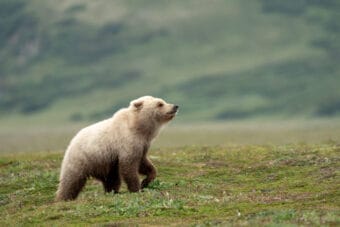
A young adult brown bear walks in front of a forested area in Katmai National Park and Preserve on June 16, 2018. (R. Taylor/National Park Service)

The Alaska Board of Game on Thursday approved state officials’ request to continue a controversial predator control program in Western Alaska, even though a judge ruled two weeks ago that the bear-killing program violated the state constitution.

The board granted an Alaska Department of Fish and Game petition for emergency action to carry out a third season of shooting bears and wolves to keep them from preying on the ailing Mulchatna Caribou Herd. In the past two years, the predator control program — carried out in late spring and early summer within the herd’s range — killed 175 brown bears, five black bears and 19 wolves, according to the department.

The emergency finding is warranted to help a herd that fell from a peak of about 200,000 in the late 1990s to about 13,000 now, too low to allow any hunting, board members said on the final day of a weeklong meeting in Anchorage.

“Right now, we have a herd that has shut down where a large number of people in Western Alaska can’t put caribou in their freezer right now. And it’s not going to grow if they don’t have calf survival,” said Stosh Hoffman, a board member from Bethel.

People in the region need to be able to hunt caribou because other food sources are uncertain, Hoffman said.

“We’re in tough times out here. A lot of things are changing. The salmon is in big decline. Our moose population, everyone knows it’s going to tip over real soon, like new moose populations tend to do. When they crash, they crash hard,” he said. He noted that the Alaska Federation of Natives, at its last convention, unanimously supported a resolution in favor of Mulchatna predator control.

But Nicole Schmitt, executive director of the Alaska Wildlife Alliance, said she was “shocked” at what the department and the board did.

“We just think it was a complete betrayal of the public process,” Schmitt said. Emergency regulations in the past have closed hunting, not opened or reopened predator control, she said. “This says to me if the board wants something done, they will manufacture an emergency to that end.”

The Alaska Wildlife Alliance is considering how to respond, she said. We’re looking at something that includes a legal response, as well as other options,” she said.

The Department of Fish and Game submitted the petition for emergency action last Friday, on the first day of the regularly scheduled Anchorage meeting.

While department officials say the predator removals done to date have resulted in increased calf births that help the herd, opponents say factors like habitat change rather than predation are behind the herd’s population decline.

Opponents also say that the program threatens populations of bears, including those that frequent the well-known bear-viewing areas in Katmai National Park and Preserve.

The Alaska Wildlife Alliance filed a lawsuit in 2023 that resulted in the ruling against the program.

Superior Court Judge Andrew Guidi ruled on March 14 that it was carried out in violation of public-notice and public-comment requirements and that it violated the state constitution’s sustained-yield mandate by failing to adequately evaluate impacts to bear populations.

At the Board of Game meeting, there was debate among members about whether adequate public notice and opportunities for public comment had been given this time. Some members argued for a separate meeting. But the majority, by a 5-2 vote, decided to deal with the matter Thursday, the last day of the weeklong meeting.

The vote to authorize the program’s resumption passed by a 6-1 margin. Member John Wood, who agreed with others that the matter qualified as an emergency but had expressed some concerns about proper public notice, was the lone dissenter.

Ryan Scott, director of the department’s Division of Wildlife, said the program can start imminently. To be effective, it has to be carried out in the late spring and early summer, during the calving season, he said.

The department is poised to start its third season of the Mulchatna predator control, he told Board of Game members.

“It’s not about beginning to gear up. We are full tilt. We have contracts in place, we got fuel moving,” he told the board. Though the court ruling has implications for proper processes to follow, the department is treating the matter as having some urgency, he said. “I mean, 30 days from now, we’ll probably be putting people in the field,” he said.

Alaska officials seek emergency rule to continue bear-killing program, despite court ruling

A subadult brown bear stands on June 8, 2018, on the shore of Naknek Lake in Katmai National Park and Preserve. A state program that is killing bears in an effort to boost an ailing caribou herd was found last week to be unconstitutional, but the Department of Fish and Game is now seeking emergency authority to continue the program. Opponents say the predator-control program will not help the caribou but could put Katmai bears at risk. (Photo by Russ Taylor/National Park Service)

Alaska officials are seeking emergency authorization to keep killing bears and wolves in a region in the western part of the state even though a judge ruled a week ago that the state predator control program there was unconstitutional.

The Alaska Department of Fish and Game on Friday petitioned the state Board of Game for an emergency regulation allowing the “intensive management” program to continue for a third year in the range of the ailing Mulchatna Caribou Herd.

The proposal came on the first day of an eight-day Board of Game meeting in Anchorage. The board sets hunting rules that are carried out by the department.

The Mulchatna herd, in Western Alaska, peaked at 200,000 animals in 1997, but it is now down to about 13,000 animals. Hunting has been closed for several years. Department officials argue that removal of bears and wolves is needed to help the herd population grow back. Residents of dozens of rural communities in the region have traditionally depended on the herd for food, and increased caribou numbers would allow their hunts to start again, department officials argue.

So far, the state program that started in 2023 has killed nearly 200 bears and 19 wolves through the program, according to the department.

Alaska Board of Game member John Wood and Alaska Department of Fish and Game Commissioner Doug Vincent-Lang listen on Friday to public testimony at the first day of an eight-day Board of Game meeting in Anchorage. The board is now considering an emergency petition to continue a predator-control program that was ruled unconstitutional last week. (Photo by Yereth Rosen/Alaska Beacon)

That has already benefited the herd, as seen in the increase in the number of calves born, the department’s proposal said. Continuing the program is “critical” to the goal of getting the herd large enough to allow resumed hunting, it said.

“Not being able to conduct control efforts in the third year is detrimental to the program and will result in a loss of the improvements in calf recruitment and survival that have been realized since the department treatment began in 2023,” the department’s proposal said.

The Alaska Wildlife Alliance, the plaintiff in the case that resulted in last week’s ruling, said the Department of Fish and Game is attempting to circumvent the law.

“We’re just kind of stunned right now,” Nicole Schmitt, the alliance’s executive director, said during a break in the Board of Game’s meeting on Friday.

The late proposal, released just that morning, was also rushed without proper public notice or opportunity for public comment, just as the earlier predator-control authorization had been, Schmitt said.

“The state is trying to push through an emergency regulation, in the hopes that it is not stopped before they are done killing bears, lawfully or otherwise,” she said.

Caribou cross the Kanektok River in the Togiak National Wildlife Refuge on Aug. 25, 2009. The Mulchatna caribou herd, which ranges in the refuge, has declined sharply since the late1990s. The Alaska Department of Fish and Game argues that removal of bears and wolves will help the herd recover. (Photo by Allen Miller/U.S. Fish and Wildlife Service)

Superior Court Judge Andrew Guidi, in his March 14 ruling, found that the Board of Game’s action in 2022 that authorized the predator control program violated constitutional standards for public notice and public comment. The Alaska Wildlife Alliance and Michelle Bittner, an Anchorage attorney who filed a separate lawsuit challenging the predator-culling program, argued that the board rushed its approval through improper and secretive means.

Guidi also found that the board’s approval of bear kills in the Mulchatna caribou range failed to properly consider impacts to the bear population, in violation of constitutional mandates for sustainable management.

Supporters and opponents of the Mulchatna predator control program disagree about the causes of the caribou herd’s decline.

While department officials point to bears and wolves as limiting recovery, opponents of the bear- and wolf-killing program say other factors caused the caribou decline. Those include some sweeping habitat changes, with a warming climate allowing woody bushes and trees to spread into tundra territory. Caribou from herds like the Mulchatna depend on tundra plants for food, but the proliferation of woody plants has made the area more favorable for moose.

Disease is another factor cited as a reason for the caribou population decline.

The Board of Game has identified a goal of getting the population back up to between 30,000 and 80,000 animals, enough to support hunts of 2,400 to 8,000 caribou a year, according to the Department of Fish and Game.

Anchorage judge rules state’s brown-bear killings are unconstitutional

Katmai bears fish at Brooks Falls. (Photo courtesy National Park Service)

The Alaska Department of Fish and Game’s decision to kill almost 200 brown bears in order to boost a struggling caribou herd violated due process and was unconstitutional, an Anchorage Superior Court judge ruled Friday.

Judge Andrew Guidi’s 10-page decision means at least a temporary end to the state’s controversial bear-killing program, which was intended to aid the struggling Mulchatna caribou herd.

“Unless they want to seek a stay of this decision, they’ve got to stop killing bears,” said attorney Joe Geldhof, who represented the Alaska Wildlife Alliance in a lawsuit that prompted Friday’s decision.

The Alliance sued the state in 2023 to challenge the application of Alaska’s “intensive management” project in Southwest Alaska.

Originally designed to kill wolves in order to boost the populations of prey species that hunters pursue, the program was expanded in 2022 to cover bears that have been preying on the Mulchatna caribou herd.

That herd, which contained 200,000 animals at its peak in 1997, has declined to about 13,000 animals and is closed to hunting.

Anchorage attorney Michelle Bittner filed a separate lawsuit, also challenging the state’s bear-killing program.

Both lawsuits argued that the state’s Board of Game failed to follow adequate due process standards before beginning the program.

Before a judge could consider the merits of either case, state attorneys argued that Bittner did not have the standing to bring a lawsuit on the issue. That argument went all the way to the Alaska Supreme Court, which ruled in February that Bittner could bring her case.

That cleared the way for the Alaska Wildlife Alliance’s lawsuit to advance as well, with oral arguments taking place in March.

Ruling Friday on the merits, Guidi concluded that the Board of Game violated due process and did not provide adequate public notice when it began its bear-killing program.

“The notice provided by the BOG contemplating extension of an existing wolf control program to lands managed by the federal government that was altered to include a bear removal program on state lands substantially changed the subject matter of the proposal,” Guidi wrote. “These changes went far beyond varying, clarifying or altering the specific matter of the proposal addressed in the original notice. As a result, the BOG failed to adhere to mandatory due process standards.”

Guidi also found that the Board of Game violated the Alaska Constitution’s principle of sustained yield because it valued the sustainability of caribou herds but didn’t adequately study what would happen to bear populations.

“The issue of the bear population and distribution is an obvious salient issue touching on sustainability,” he wrote. “Addressing the sustainability of a constitutionally protected resource like bears almost certainly requires the BOG to engage in more than a rudimentary discussion about a bear population or engage in conclusionary opinions when considering a proposal to initiate a program calling for the unrestricted killing of bears.”

A spokesperson for the Alaska Department of Law, which represented the Board of Game in the lawsuit, said the state is reviewing the order and considering its options for how to proceed.

Juneau Animal Control is searching for an elusive German Shepherd

A German Shepherd named Jackie who has been on the run in the Mendenhall Valley since February was recently spotted by a local photographer. (Courtesy of gillfoto)

After a German Shepherd named Jackie evaded euthanasia in Los Angeles, she’s now evading animal control officers in Juneau.

Listen:

Since Jackie’s escape on Valentine’s Day, Thom Young-Bayer has been strategizing with animal control officers how best to recapture her. 

Part of their plan involves a large cage with a weighted plate on the bottom that closes the entrance if anything steps on it. There’s a dish with dog food, cat food and beef dumplings on the plate and cheeseburgers zip-tied to the back of the cage. The trap wouldn’t hurt Jackie, as Young-Bayer demonstrated recently by crawling inside. The searchers check it twice a day.

For a while after they set up the trap in the Mendenhall Valley near Dredge Lake, nothing happened – except for a squirrel that made off with some coffee cake. 

“And then one night, all the bait disappeared,” Young-Bayer said. “And the trap was set off, so we decided to put a trail camera out.” 

Since, they’ve seen Jackie come to the trap on the camera footage, carefully reaching over the mechanism to get the food, and backing out of the cage.

She keeps returning, so Young-Bayer is hopeful. But there’s a time limit: the bears will wake up soon. 

“That’s the last thing we want is to trap a bear cub,” he said. “That would be really bad.” 

A trap baited with cheeseburgers sits waiting for Jackie. (Photo by Yvonne Krumrey/KTOO)

They won’t be able to leave bait out in the woods much longer. 

Jackie came up to Juneau from Los Angeles in January with two other dogs. They were slated for euthanasia to make room as devastating wildfires pushed more animals into shelters in the region. Thom’s wife Skylar Young-Bayer wasn’t going to let that happen. She convinced Juneau Animal Rescue to take three dogs from California. 

“And they’re like, ‘Sure, you know, we could probably do three or four, but someone needs to go down there and get them,’” she said. “And I’m like, ‘well, I’ll do it.’” 

Skylar brought Jackie and two other dogs up from shelters she said have a euthanasia rate of 30 to 40%. She works with these shelters to alert adoptees and foster networks when a dog is added to a list of potential euthanasias. The Young-Bayers adopted two of their own dogs from these high-kill shelter areas. 

Local families adopted all three dogs within a month, but Jackie slipped her collar on a walk the first day she was at her new home.

“And this is the thing: we all really underestimated Jackie,” Young-Bayer said. The cunning canine continues to evade capture. 

But despite her wiliness, Jackie doesn’t seem to be dangerous, Young-Bayer said. 

“She’s very scared and shy and sweet,” she said. “She’ll give you kisses. She doesn’t bite.”

And Jackie is resourceful. 

Each day, animal control hears reports of a couple of sightings of Jackie, but she’s always moved on by the time they get there, minutes later. An animal control officer nearly lured her by hand with a cheeseburger, but a passing jogger accidentally scared her off. 

So now, the Young-Bayers, alongside animal control officers, have been checking traps they set in the woods in the for her.

Jackie the German Shepherd in an undated photo. (Courtesy of Juneau Animal Rescue)

Rick Driscoll is the director of Juneau Animal Rescue, which also houses Juneau’s animal control officers. He said Jackie is shy and evasive, so people shouldn’t go out searching for her. 

“She’s not going to just walk up to you and let you put a collar or a leash on her,” Driscoll said. “So it’s best if they just report it to us.” 

He said if anyone sees Jackie during the day, they should call JAR. 

Driscoll said he’s worried about her. 

“She’s the biggest thing that’s on my mind, as the executive director of JAR,” he said.

He’s afraid she could be hit by a car, eat something poisonous, or just lose too much weight and become weak.

The couple that adopted Jackie misses her too. Eulaysia Rayne Bostrack said she felt a personal connection to the sweet dog she picked up. 

“I am from LA, I know about the fires and the life of the stray dogs down there,” she said. “I’ve seen it all, so I know what she’s been through.”

The community is showing it cares too. Bostrack said the night after Jackie slipped her collar, about 40 people helped search until the early hours of the morning. Bostrack has seen her dog twice since she went missing. 

“And both times, I kind of broke down because we didn’t get too much time with her,” she said.

Bostrack is hopeful that, with Juneau’s support, she can bring Jackie back home again — and keep her there, with added reinforcements. 

“I’m going to try and look into getting a three strap harness,” she said.

Alaska fisher gets six months in federal prison for attempting to kill endangered whale

A sperm whale is seen in an undated photo published by the National Oceanic and Atmospheric Administration. (NOAA photo)

A federal judge in Juneau has sentenced a Southeast Alaska fisher to six months in federal prison after pleading guilty last year to one count of misreporting a fish catch and one count of violating the Endangered Species Act for directing his crew to kill a sperm whale.

Dugan Paul Daniels had previously agreed to the sentence as part of a plea agreement, and Judge Timothy Burgess confirmed the imposition of sentence in a hearing Monday morning.

The six-month sentence was at the top of the sentencing range allowed by the plea deal and in line with what prosecutors had requested.

While it isn’t clear whether Dugan Paul Daniels’ crew successfully killed the whale after Daniels ordered them to shoot it, federal law prescribes the same punishment for an attempted kill and an actual one.

In addition to the prison sentence, Daniels will pay a $25,000 fine and be banned from commercial fishing for one year. He also must perform 80 hours of community service.

According to court filings by prosecutors, Daniels was fishing in Southeast Alaska waters in March 2020 when a whale began taking fish from his fishing gear, damaging it. Similar behavior has been seen up and down Alaska’s coast, but prosecutors believe this is the first time that a fisher has tried to kill a whale in retaliation.

According to messages sent via his GPS unit, Daniels directed a crew member to shoot the whale, tried to ram it with his fishing boat, then tried to kill it by reeling in his fishing gear while the whale was trapped in it.

In a written statement about the sentencing, newly appointed Alaska U.S. Attorney Michael Heyman said, “Let this sentence serve as an example that these violations will not go unpunished.”

Alaska hunters, researchers say whales and fish are changing their migration patterns in the warming climate

Two humpback whales feed in Beaufort Sea, northeast of Point Barrow. (Kate Stafford)

Catching salmon in the North Slope village of Kaktovik was unheard of not too long ago. But resident Robert Thompson says some fishermen now see salmon more regularly. About five years ago, he caught a dozen salmon – a small but noticeable number.

“Before it was unusual, and people would talk about it, that somebody got a salmon,” Thompson said. “Now it’s fairly common.”

Fishermen, hunters and researchers gathered at the Alaska Marine Science Symposium in Anchorage in January to discuss how several fish species and marine animals are changing their migration patterns in the warming climate. That includes humpbacks gaining new ground up north, bowheads expanding their diet and salmon observed in the Arctic.

Salmon are spawning in the Arctic

Elizabeth Mik’aq Lindley is a graduate student from Bethel who grew up fishing for salmon. Now she studies Pacific salmon in the Arctic.

In 2023, she and other researchers installed temperature loggers at the depth of salmon nests in several rivers – including the Anaktuvuk River, which runs through Gates of the Arctic National Park and Preserve.

“If it gets too cold, the stream can freeze straight through to the bottom, into these nests, and embryos will freeze and die,” Lindley said.

Anaktuvuk River is seen from above On Sept. 14, 2023.
Anaktuvuk River is seen from above On Sept. 14, 2023. (Peter Westley)

Temperature also influences incubation and when embryos will hatch and start making their way to the ocean.

But in a year of tracking the water temperature, the researchers never saw it get below freezing. They also estimated that salmon emerged around August. That’s later than in other parts of the state, but it’s the optimal time for the Arctic. While more data is needed to see if salmon populations are growing in Arctic rivers, the conditions seem survivable.

“Salmon are spawning in the Arctic,” Lindley said, “and it does seem like it’s thermally survivable, thermally possible and plausible that they can incubate and emerge at the right time, given these temperatures.”

Bowheads are expanding their foraging grounds

The warming environment has also been affecting bowhead whales.

Traditionally, bowheads travel south to spend their winters feeding on krill in the Bering Sea. But with ice conditions reshaping the zooplankton community, the animals have been delaying that migration — or even staying in the Chukchi and Beaufort Seas all winter.

Marine ecologist Clarissa Ribeiro Teixeira looked at the whales’ baleen plates to better understand the change. Elements that make up baleen plates – stable isotopes of nitrogen and carbon – can offer a window into an animal’s diet and movements. Each plate grows continuously and has information from about 20 years of the whale’s life, she said.

Marine ecologist Clarissa Ribeiro Teixeira speaks during the Alaska Marine Science Symposium on Jan. 30, 2025.
Marine ecologist Clarissa Ribeiro Teixeira speaks during the Alaska Marine Science Symposium on Jan. 30, 2025. (Alena Naiden)

Teixeira and her colleagues sampled baleen sections from 11 whales harvested on the North Slope over two decades. They also looked at the ice conditions during those years. What they discovered was that after 2016, when there was very little ice, bowheads shifted their behavior.

“The reduction in the sea ice cover may have influenced the prey availability distribution for these animals, motivating bowhead whales to explore new foraging habitats or include a wider composition of their prey sources into their diet,” she said. “That’s amazing, because it shows how resilient these individuals are, right?”

Humpbacks are frequenting the Arctic

Less ice might also mean new territory for humpback whales.

Kate Stafford, who is an oceanographer and a professor at the Marine Mammal Institute at Oregon State University, studies bowheads in the Arctic. But in 2021, she and her late colleague Craig George saw a whale that, to their surprise, turned out to be a humpback – a species that was once rare in the Utqiaġvik area.

“You just never know what you’re going to find,” she said. “We all need to take our eyes off of our phones and watch the water.”

Birds surround a humpback whale in Beaufort Sea.
Birds surround a humpback whale in Beaufort Sea. (Kate Stafford)

Stafford says data from local whalers and aerial surveys points to more humpbacks visiting the area.

In Utqiagvik, humpbacks were sighted only twice before 2021 and two or three times in years after that. Then, last fall, researchers saw more than 25 whales feeding close together for two days in a row.

“We came across what I would call Humpback Palooza,” Stafford said. “Just dozens of humpback whales, which was crazy.”

Researchers took photos of whales and uploaded them to Happywhale, a citizen science project that helps identify whales using a technology similar to face recognition. Several of the whales seen near Utqiaġvik matched whales seen in Hawaii breeding grounds.

Young humpbacks usually follow the migration patterns they learn from their mothers, Stafford said. Because researchers observed multiple mother-calf pairs, the whales might return to the area.

“This does suggest, at least to me, that humpbacks are here to stay near Utqiaġvik, at least so long as there’s something to eat,” she said.

Kate Stafford speaks during the Alaska Marine Science Symposium on Jan. 30, 2025.
Kate Stafford speaks during the Alaska Marine Science Symposium on Jan. 30, 2025. (Alena Naiden)

Utqiaġvik whaler Michael Donovan said he did not witness Humpback Palooza, but he has seen a few humpbacks during his fall hunts. He said that he and other whalers are worried the humpback whales might be competing with bowheads — a staple subsistence resource for his community — for krill and copepods.

“They’re an invasive species, you know. They come in and eat the same food that our bowheads eat,” Donovan said.

Donovan and other hunters say they support scientists studying species that are growing their presence in the Arctic’s warming waters. Meanwhile, Stafford said scientists rely on people like Donovan for their research.

“The hunters and whalers, they’re really good naturalists, they’re really good observers and biologists,” she said. “They need to understand the seasonality of animals, the behavior of animals, how the environment impacts animals.”

Stafford says that local hunters contribute so much to her research, she’s grateful when her work can help them, too.

Site notifications
Update notification options
Subscribe to notifications