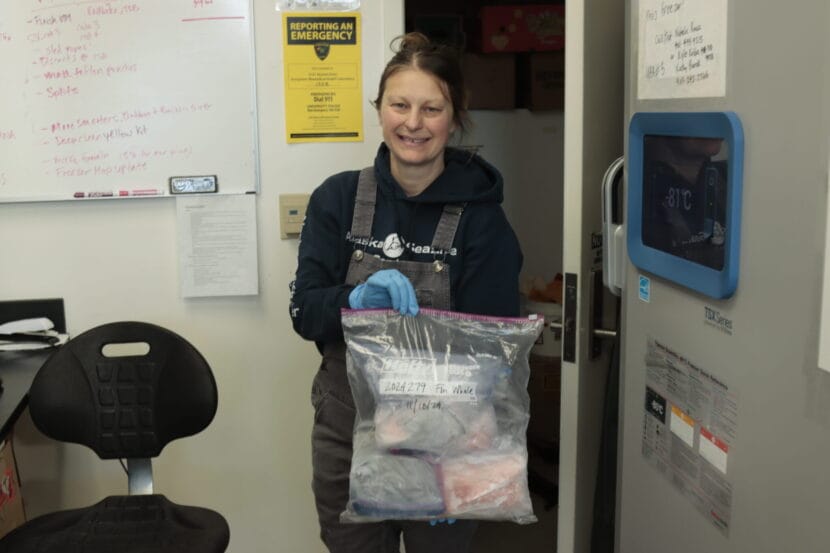
Natalie Rouse shows a bag of blubber taken from a fin whale that washed up near downtown Anchorage. (Wesley Early/Alaska Public Media)
Natalie Rouse opened a large freezer on Thursday stocked with bags of assorted whale parts.
“So here are pieces of blubber,” she said. “And then we’ve got a little bit of baleen in here. And then I have another big trash bag of baleen, and then another sample bag.”
Rouse is a necropsy biologist with Alaska Veterinary Services, and she’s part of a team trying to learn more about the young fin whale that washed up dead last weekend near downtown Anchorage. Since then, hundreds of residents have flocked to the frozen mudflats to catch a rare sight of the massive whale carcass. Meanwhile, Rouse has been at the Ecosystem Biomedical Health Laboratory at the University of Alaska Anchorage, going through more than 65 samples her team took from the animal.
“We got samples of feces, stomach contents, from two different areas of the GI tract,” Rouse said. “We took samples of baleen, we took samples of the tongue, we took samples of the heart.”
Rouse said she typically conducts necropsies in warmer months, and the winter is a slower time of year at the lab. She said the timing of this whale presents both challenges and advantages.
“It bursts the tissues at the cellular level, when they freeze, so that degraded some of those samples,” Rouse said. “However, the other samples are probably decomposing a lot less quickly than they would when it’s warm out.”
She said her team already learned quite a bit from the samples, including that the whale was female, and a juvenile.
“It was eating because it had a lot of feces, it had stomach contents,” Rouse said. “And we have some signs that maybe had some non-specific signs of disease, but that could be incidental.”
Rouse said they’ve sent off some of the samples to the Lower 48 for a better look at any diseases the whale had, as well as for cellular examination. While finding out what killed the whale is one question they’re trying to answer, Rouse said there’s a lot more to be learned.
“There are people that look for harmful algal bloom toxins, and they do surveillance for that on every marine mammal that we’re able to give them samples for,” Rouse said. “There’s someone studying dive physiology. There’s somebody that is doing aging with different tissues. So yeah, we’re going to learn a lot from this whale, even if we don’t figure out what the cause of death was.”
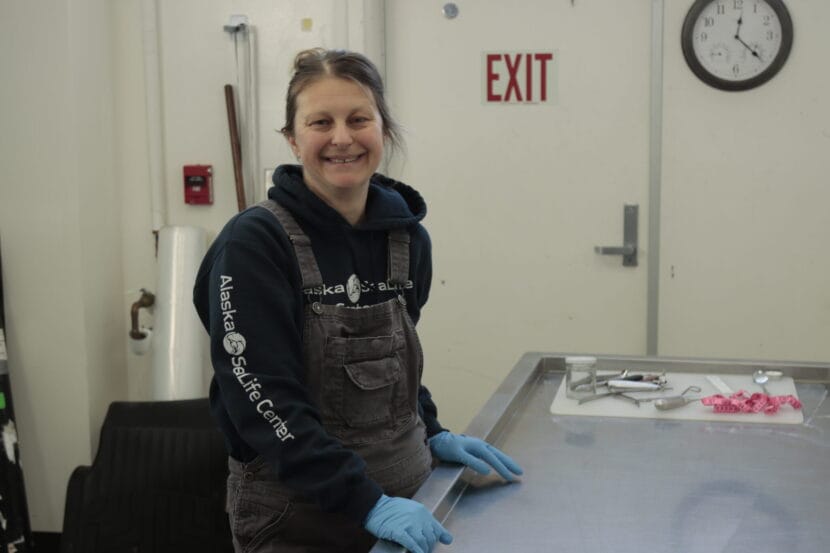
Natalie Rouse stands by a sterilized table at the UAA Ecosystem Biomedical Health Laboratory. (Wesley Early/Alaska Public Media)
Rouse said the whale washed up with the tides on Saturday. Getting it back into the ocean will be a different story, since any heavy machinery that could move the whale likely won’t be able to make it out on the frozen mudflats. She said she anticipates the whale will wash out with high tides set to hit the area in mid-December.
“The most direct way to get it, get rid of it, would be to let it go out with the tide, and that allows for it to be returned to the ocean, where it provides a lot of food for all the other creatures in the ocean,” Rouse said.
As residents continue to make the pilgrimage to the whale, Rouse hopes that people will be respectful of the creature, and she offers a few safety tips.
“All wildlife can carry zoonotic diseases, and we don’t know why this whale died,” Rouse said. “So it’s important to take the same precautions you would take with any other, you know, dead animal on the side of the road. And so don’t, you know, don’t let your dogs eat it, and you don’t want to touch it and then touch your eyes, ears, mouth, nose, that kind of thing.”
Rouse also said that walking on icy, frozen mudflats comes with its own risks, so if you’re going to try to get a look at the whale, bring some cleats.
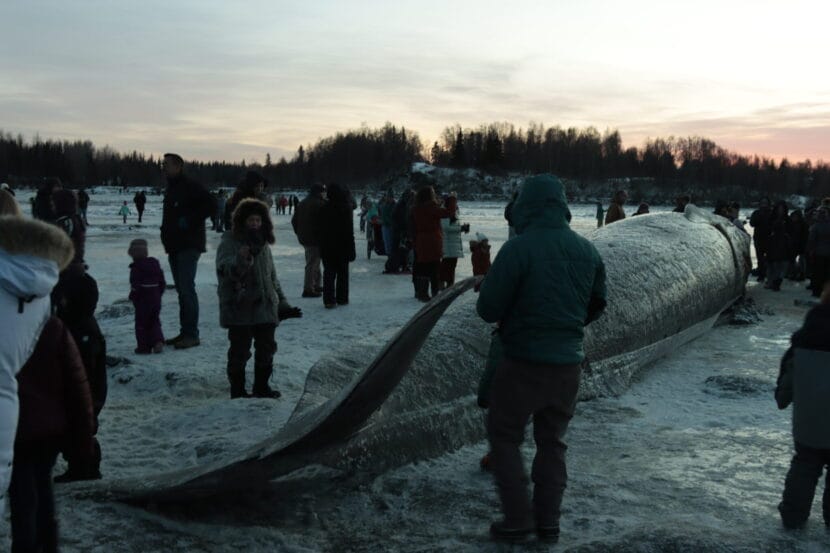
Hundreds flock to see a dead fin whale on Anchorage’s mudflats on Nov. 20, 2024. (Wesley Early/Alaska Public Media)
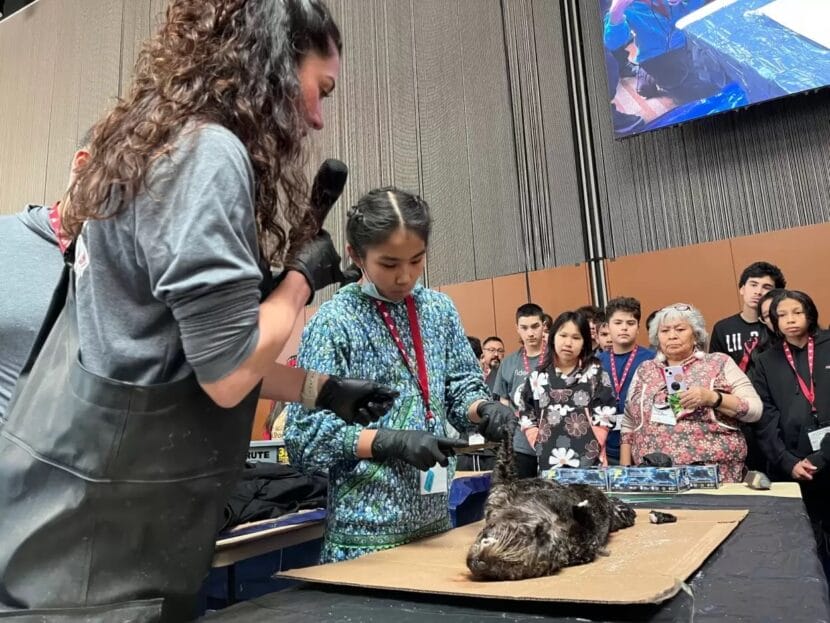
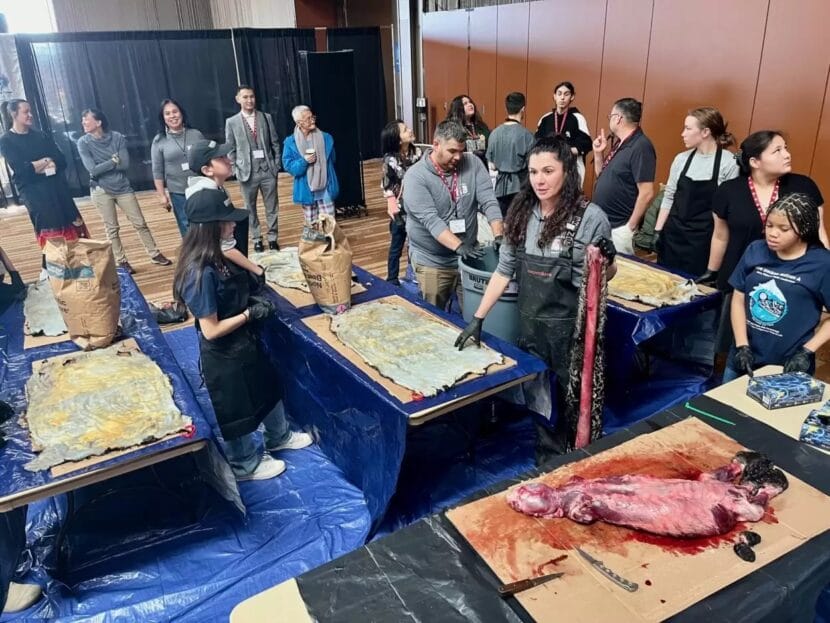
Kootink Heather Douville of Craig teaches workshop participants how to skin a sea otter at the Elders and Youth Conference in Anchorage, Oct. 15. The workshop was hosted by the Central Council of Tlingit and Haida Indian Tribes of Alaska. (Photo by Angela Denning/CoastAlaska)
For years, the regulations about who could hunt sea otters in Alaska were confusing. Many thought hunters must be at least one-quarter Alaska Native and belong to a coastal tribe. But a recent opinion from the U.S. Fish & Wildlife Service confirms that any coastal tribal member can hunt sea otters, no matter their blood quantum.
The Central Council of Tlingit & Haida Indian Tribes of Alaska, the regional tribe of Southeast, led a workshop on processing sea otters at the Elders and Youth Conference in Anchorage in October.
The Central Council of Tlingit and Haida Indian Tribes of Alaska host a sea otter workshop at the Elders and Youth Conference in Anchorage, Oct. 15. The workshop was led by Kootink Heather Douville, who hunts sea otters out of Craig. (Photo by Angela Denning/CoastAlaska)
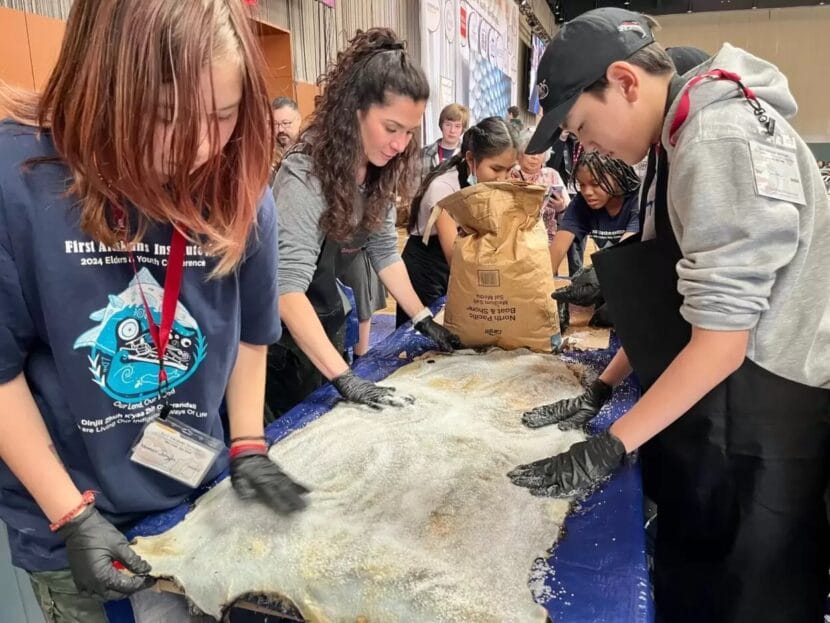
At the event, dozens of people gathered around long tables covered in plastic in the Dena’ina Convention Center. Most are youth, but there are elders, too. They’re here to learn how to clean and process sea otter pelts, a fur traditionally prized for its warmth.
“Sea otters have up to a million hairs per square inch,” said Kootink Heather Douville. “They’re the most densely furred mammal on the planet.”
Douville hunts sea otters from her home in Craig on Prince of Wales Island. She sews all kinds of things with the pelts like hats, scarves, purses, and blankets. Several people are waiting at her table, eager to learn how to skin an otter with a knife.
“The word for knife in Lingít is lítaa,” Douville said.
Sea otters are protected under the federal Marine Mammal Protection Act. Who can hunt them has long been questioned by the Central Council of Tlingit and Haida Indian Tribes of Alaska. About a year ago, the Tlingit & Haida asked the federal government for another legal opinion of the law language, focused on one word in the statute.
“There’s actually an ‘or’ in the regulation,” said Gooch Xaay Ralph Wolfe, Tlingit & Haida’s director of Indigenous Stewardship.
He said the law actually allows sea otter hunting by people who live on the coast and are a quarter Native — or are an enrolled member of a coastal tribe.
“There’s people who cannot hunt and haven’t been able to hunt because they don’t have a quarter-blood quantum,” Wolfe said. “And our argument for that is there’s no other people in the world who are justified by blood quantum. There’s horses and dogs, and we are neither.”
Scientists agree that Southeast Alaska’s sea otter population has increased, with the region hosting more than 22,000 of the voracious shellfish eaters. Wolfe said the population has dramatically increased in recent years, in part, due to lack of hunting.
“The otters have been devastating populations of resources that we rely on for so long now; in the management that it’s been under is kind of a management of terror, right?” said Wolfe. “Like there’s fear that’s put out there to go out and hunt these things.”
At the sea otter workshop, attendees were from all over the state.
Ten-year-old Leona Richardson is Inupiaq and took a turn with the knife. Her family is from Ambler in northwest Alaska but she lives in Anchorage.
“I just want to know what it feels like cutting an animal,” Richardson said. “And some Native people that I’m friends with, they said, just touching the animal just makes you feel more Indigenous to your culture, and I really liked it.”
Twelve-year-old Alissa Levit also had a go. She’s from Venetie, north of Fairbanks.
“I think it was pretty fun; it was very interesting,” Levit said. “I’ve done skinning with moose and caribou legs before, but this one was more fun than that.”
Kootink Heather Douville of Craig teaches youth how to salt sea otter skins at the Elders and Youth Conference in Anchorage, Oct. 15. The workshop was hosted by the Central Council of Tlingit and Haida Indian Tribes of Alaska. (Photo by Angela Denning/CoastAlaska)
Although she didn’t go into the implications of the new ruling in her workshop, leader Kootink Heather Douville clearly sees a benefit in sharing sea otter processing with kids from outside her tribe.
“I think youth are sacred, and I’m so glad that so many showed up,” she said.
Douville said youth are the link between past generations and those to come.
“In our culture, and I believe, that our youth are the insurance that we have a bright, healthy future,” Douville said. “And we should invest in our youth, teach them what we know, have them here beside us, watching and working on our traditional foods and materials with us, and it gives them purpose.”
Now, these youth can take their newly learned skills home with them. And maybe one day, they’ll be able to hunt sea otters themselves.
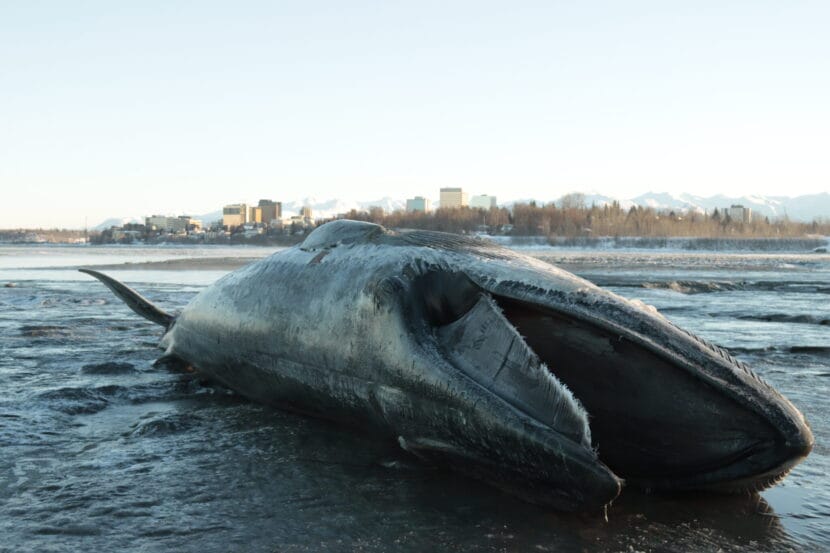
A fin whale washed ashore on Anchorage’s mudflats over the weekend. By Nov. 18, it had started to freeze over. (Wesley Early/Alaska Public Media)
A dead whale the size of a school bus washed up along Anchorage’s Tony Knowles Coastal Trail on Saturday.
On Monday morning, dozens of people braved the numbing cold to see the frost-covered carcass resting on the frozen mudflats near Westchester Lagoon. The whale was lying on its side and its mouth was open so wide spectators were crawling inside the baleen to take photos.
That’s something Barbara Mahoney, a biologist with the National Oceanic and Atmospheric Administration, does not encourage. She asked visitors to keep a safe distance from the whale as biologists try to learn more about it. So far they know it’s a 47-foot female fin whale. The agency got its first report about the carcass Saturday from the group Defenders of Wildlife.
“It’s in very good condition,” Mahoney said in an interview Monday. “It’s been cold out, so that’s probably helping.”
Fin whales are born at 21 to 25 feet long then grow to about 70 feet as adults, Mahoney said, which has led biologists to estimate that the whale was a yearling or juvenile when it died.
No major injuries have been found on the fin whale so far, Mahoney said, including any signs that it was struck by a ship.
“We do not know how or why this animal is on the beach,” she said.
On Monday morning, Anneliese Kupfrian was bundled in warm gear to see the whale. She was also here Sunday night, but said it was crowded with more than 100 people, so she decided to come back for another look.
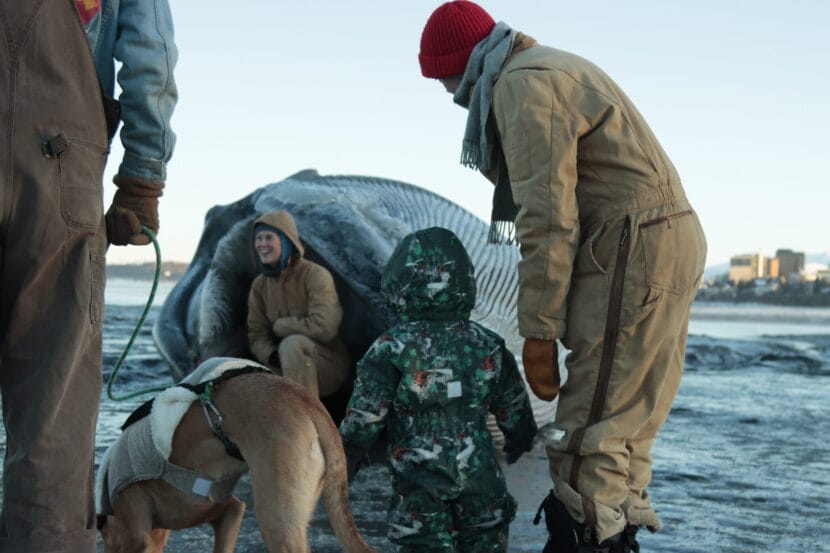
Two year old Ersa Karoly-Lister and his mother Cecilia watch as Anneliese Kupfrian poses for a photo inside a beached whale’s mouth in Anchorage on Nov. 18, 2024. (Wesley Early/Alaska Public Media)
She’s glad people are taking advantage of the rare sight.
“I think it’s kind of funny that this is just like the hype right now. Like, ‘Hey, have you heard about the whale? Go check it out. Like, get out there, get a picture,’” Kupfrian said. “How many opportunities do you have to have something wash up this close, right in town, for everyone to go see it, learn about it? Pretty cool community experience.”
Mahoney said fin whales are “semi-common” in the lower Cook Inlet, although their habitat extends throughout Alaska waters of the Bering Sea and Pacific Ocean.
So far, Mahoney said biologists have made several measurements of the whale including its girth and tail length. They’ve also taken samples of its skin and blubber to assess its genetics and blubber thickness. Mahoney said biologists were attempting a full necropsy of the whale’s organs Monday afternoon, but frigid winds were freezing exposed flesh within the carcass.
According to Mahoney, beluga whale beachings are commonly reported in the Anchorage area, with beachings of larger whales less frequent.
“It does happen, but it’s very infrequent to have large whales in the upper Inlet swimming and/or beached,” she said.
In 2016, two fin whales were found dead in Southcentral Alaska waters. One was struck by a cruise ship and found on the ship’s bow when it docked in Seward. The other was beached in Knik Arm and later died.
Two humpback whales have beached in the area in recent years, including a carcass that washed ashore at Kincaid Park in September 2017. Both that carcass and another at nearby Point Campbell drew large crowds despite difficult treks to reach them, Mahoney said, which has left her unsurprised at locals’ interest in the fin whale.
“This is really pretty easy to get to: flat Coastal Trail, a little shuffle down off some rocks, and then you’re on the frozen beach,” she said.
Fin whales are protected under the Endangered Species Act, and federal law bars removing parts from the carcass. Mahoney asked visitors to remember potential dangers posed by the area – including the mudflats, which can soften to their quicksand-like summer texture under extensive foot traffic.
“It is Cook Inlet, and we need to be aware of the tides,” Mahoney said.
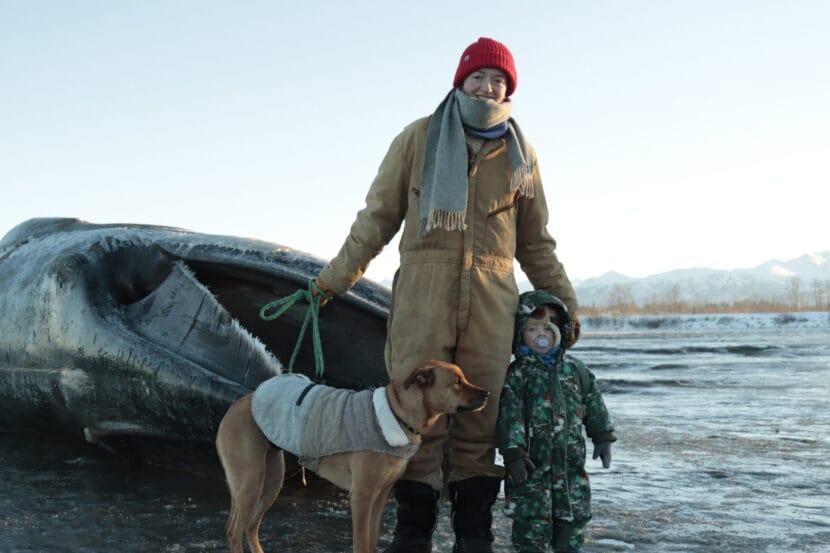
Cecilia Karoly-Lister and her son Ersa pose in front of a dead beached whale near Westchester Lagoon in Anchorage on Nov. 18, 2024. (Wesley Early/Alaska Public Media)
Back on the flats Monday morning, Cecilia Karoly-Lister took photos with her 2-year-old son and her dog alongside the whale carcass.
She said she’s grateful for the opportunity to take a closer look at the animal, but it’s also sad.
“It’s definitely sad. I’m really curious,” Karoly-Lister said. “Aesthetically, she’s stunning. I feel like it’s beautiful to see how her colors are perfectly mirrored in the mountains and the mud.”
Karoly-Lister said she’s interested to hear how and why the whale washed up so close to town.
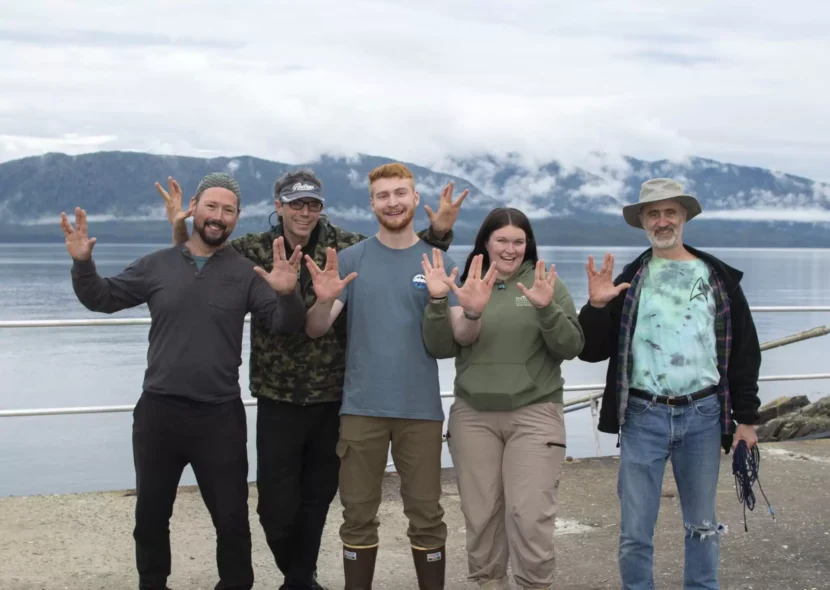
From left to right, Josef Quitslund and Whale-SETI affiliates Fred Sharpe, Jack Mezzone, Rachel Meade and Joe Olson throw up the Vulcan Salute at Five Finger Lighthouse on July 24, 2024. (Photo by Shelby Herbert/KFSK)
Researchers from an organization that seeks out extraterrestrial life camped out at a remote lighthouse in Southeast Alaska for the better part of the summer, but they weren’t out there looking for little green men.
They were there to look for — and listen to — the humpback whales that swarm the waters of Frederick Sound.
On a July voyage to Five Finger Lighthouse, skipper Josef Quitslund noticed something moving in the distance. He slowed down and cut the engine, then tossed a contraption that looks something like a baby monitor into the water.
The device — something called a hydrophone — picks up humpback whale sounds. Almost out of nowhere, several adult humpbacks rushed to the surface, mouths agape, scooping up a school of herring.
They were bubble-net feeding, a kind of cooperative hunting strategy where groups of whales get together to blow complex configurations of bubbles that allow them to trap their prey.
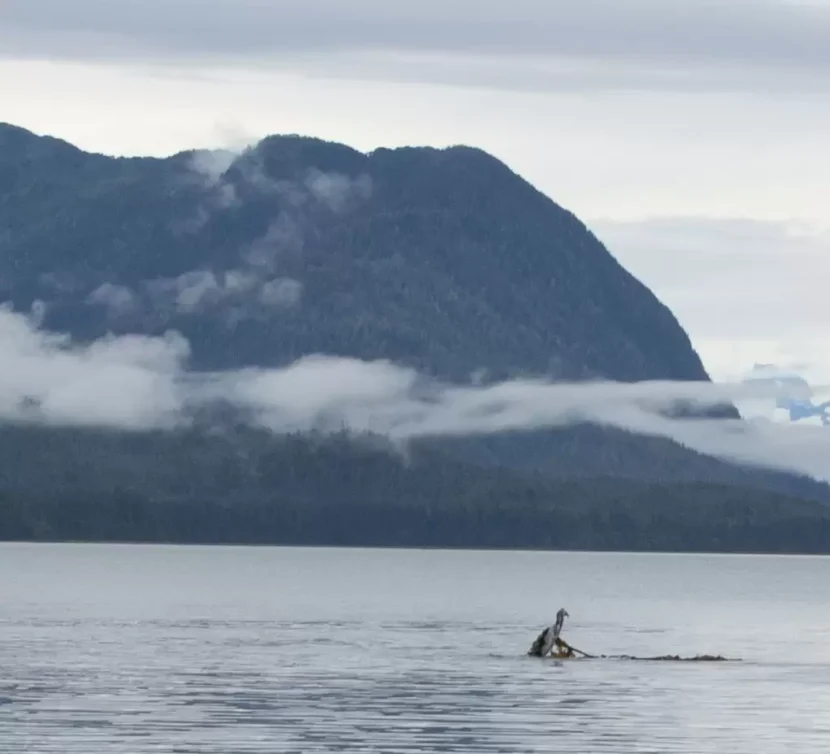
Quitslund’s wife, biologist Stephanie Hayes, pointed out a calf hanging back — rolling back and forth in a patch of kelp.
“He’s playing with kelp!” Hayes said, gesturing at the calf. “He’s giving himself a kelp bath!”
The whales finished their breakfast and the whale researchers continued on to the lighthouse, where premier whale behavioral scientist Fred Sharpe was helping coordinate Whale-SETI, a 15-year project spearheaded by the Search for Extraterrestrial Intelligence Institute.
“Frederick Sound is this incredible solar-powered krill factory,” said Sharpe. “It brings whales — in some years, by the hundreds. And we’re a couple mountain ranges back from the open ocean, so we’re shielded from the ship noises.”
The team needs that relative quiet so they can listen carefully to the whales in the surrounding waters.
A humpback whale calf “plays” with kelp wrapped around its flipper on July 24, 2024. (Photo by Shelby Herbert/KFSK)
Sharpe and his team have been trying to crack the code of humpback whale communication for many years now, and he thinks they’re getting close. He’s part of a research group that “talked” to a female humpback whale named Twain by playing whale noises back to her with an underwater speaker.
“We had an event where we described a 20 minute interaction with a whale right up by the lighthouse, where we exchanged 36 signals back and forth: one of these ‘throp’ calls. Throp call is one of their basic social sounds that the humpback whales give,” Sharpe said. “The social sounds are kind of like … sort of social chatter — a diverse set of social chatter, but shows some stability over time and space.”
Acoustic engineer Joe Olson was wearing an on-the-nose Star Trek sweatshirt.
He said encounters like the one with Twain might inch us closer to understanding extraterrestrial intelligence. But he said they can’t approach the experiment like they’re trying to learn a language on human terms.
“We only see what we’re looking for,” said Olson. “And so, with the communication of the humpbacks, we’re only going to figure out what it is that we’re looking for, right? It’s the same with aliens. For all we know, there’s aliens sending neutrino signals. But… we have no way to manipulate neutrinos. And they may have been beaming things out as saying: ‘Hey, look, look, look!’”
Another group of SETI researchers were scheduled to arrive at the lighthouse in just a couple of days, and Sharpe’s team had much to do to prepare.
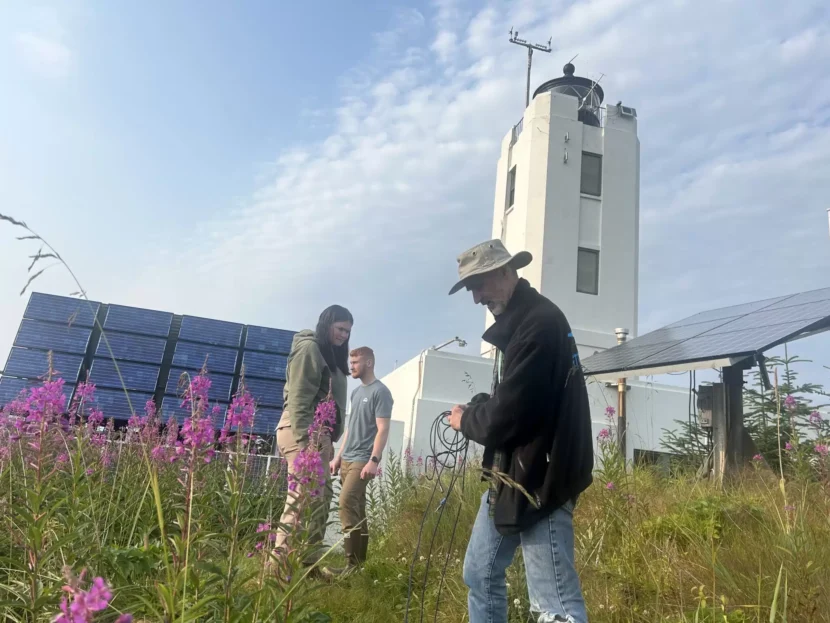
Rachel Meade, Jack Mezzone and Joe Olson set up hydrophones on Five Finger Island on July 24, 2024. (Photo by Shelby Herbert/KFSK)
They set up hydrophones on almost every corner of the island. But those devices weren’t just picking up whale noises, as Olson explained on a cliff where he had installed a hydrophone.
“We’re just hearing bivalves over here. Stuff that’s stuck to the walls … barnacles, mussels, whatever,” Olson said, before giving his best bivalve imitation.
Lighthouse keeper Don Merrill has watched this team of scientists scurry around his home with strange equipment for several days now. On the alien question: he’s got his doubts.
“Do you want it from a religious standpoint, or from a metaphysical standpoint?” asked Merrill. “When you’re bringing up aliens, I am quite a skeptic.”
But his face lit up when asked how he feels about the hydrophone speakers strewn across his house.
“That’s cool,” said Merrill. “I come out here sometimes and I’ll just turn the sound up, just because I want to know what’s going on. I grew up on the ocean, [as a] fishermen. I had no idea that was that much sound down there. That is a wild place! … It’s really opened my eyes.”
Inspiring that kind of excitement is part of what the group is aiming for with this project. Olson said by holding up the possibility of communicating with animals, they can get people to care about them.
“When we see something that we understand or we love or we connect with, we’re more likely to try to protect them or to respect them,” he said. “And who knows, maybe we’ll crack the code, right? If there’s a code to be cracked, maybe Fred will be the one to crack that code.”
They’re not quite there yet. But at the end of the summer research session, Sharpe said he’s happy with the diversity of noises and behaviors they added to their repertoire. He said he’s excited to continue attempting to translate humpback whale language to make us feel a little less alone on the planet — if not the universe.
Humpback whales plunge into the depths of the Frederick Sound after feeding on July 24, 2024. (Photo by Shelby Herbert/KFSK)
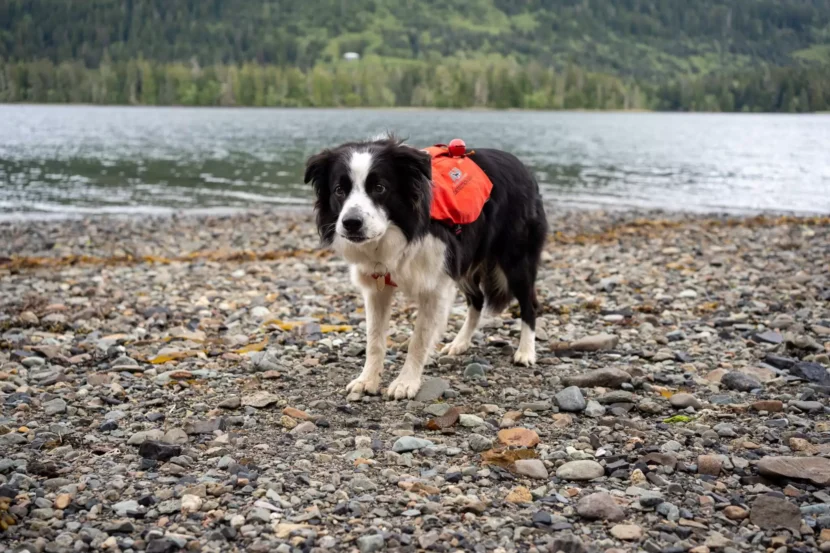
Barley of K9 Conservationists on a beach near Craig, Alaska. May 8, 2024. (Jack Darrell/KRBD)
Barley’s professional title is “canine conservationist.” This summer, the former shelter Australian Shepherd was searching the woods on the outskirts of Craig, Alaska, for wolf poop.
“Biologists love poop. It’s a huge part of our job,” said Barley’s owner, Kayla Fratt.
Fratt is a dog trainer and Ph.D. student at Oregon State University. She trains dogs, like Barley, to help solve mysteries – less like Scooby Doo and more like conservation mysteries. Fratt said that before they came up to Alaska, she and Barley had hunted jaguar scat in Guatemala and, more recently, tracked down bird and bat carcasses on wind farms in the Midwest.
“For research on how they can set up the wind turbines to reduce those fatalities and kill fewer of these migrating flying animals,” Fratt said.
That’s partially why the Alaska Department of Fish and Game brought Fratt here to Prince of Wales Island.
Fratt said the mystery they’re out to solve is how wolves are moving through this environment, or, rather, swimming.
“We know the wolves swim between these islands,” Fratt said over the tinkling of the bell on Barley’s jacket.
The canine conservationist followed a scent to a rotted log. Beneath it was a small pile of wolf droppings camouflaged by the undergrowth. He lay down.
Prince of Wales Island is massive, and it’s surrounded by many uninhabited outlying islands. Biologists believe the wolves here likely showed up around 16,000 years ago. They are part of a subspecies known as Alexander Archipelago wolves, which are only native to the woods and coasts of Southeast Alaska and British Columbia.
Currently, state researchers estimate wolf density on Prince of Wales Island and then apply that model to the outer islands.
One of the leading methods they use for gathering data are contraptions called hairboards. They’re basically wooden planks wrapped in barbed wire, nailed to the ground, and lathered with a stinky goo. Wolves like to roll on them and they leave hair, which managers can test for DNA.
“And there’s reason to believe that that won’t be accurate,” said Fratt.
It’s a sentiment also expressed by Tom Schumacher, the regional supervisor for Fish and Game.
“Some people think that that produces low estimates, and it’s quite possible it does,” Schumacher said.
He said that part of the hairboard method is attempting to account for the wolves that hairboards could be missing.
“Like if you say all 3-year-old females never roll on hairboards, then those animals are invisible to the sampling technique,” Schumacher explained at a public meeting in Craig last year.
Additionally, Fish and Game currently has very limited data about how many wolves are on these outer islands.
“And we’re checking all of these islands, I think all in all, we’re going to hit over 25 islands, we’re just getting a ton of data,” said Fratt as she followed Barley through the woods.
Fratt said that by testing the scat they find, they’ll be able to identify individual wolves.
“And with that individual identification – oh, he’s got another one,” Fratt said as Barley darted off toward a scent. “With that individual identification, (we) will actually be able to say if we detect the same wolf, say on Prince of Wales and on Hessa Island, then we can say that those wolves are using both the main island and these outer islands as well.”
Fratt and Barley’s work matters partly because Fish and Game manages the wolf hunting and trapping seasons on Prince of Wales. The trapping season begins Nov. 15 and the hunting season began on Oct. 1. To set a quota of how many wolves you can sustainably hunt, you need to know how many wolves you have. Counting wolves in a dense forest, though, can be like finding a needle in a haystack. In this case, it’s a haystack the size of Delaware.
When Barley caught a whiff of some good data, his behavior changed. He looked focused, slowed down.
“There’s movement,” Fratt said as Barley stopped and began sidestepping. “We call it crabbing. He’s just kind of moving sideways through odor.”
Barley crabbed his way across the trail and then hopped over a log. There, inside a rotting hollow, was a pile of wolf droppings.
“And when you get the right dog for this job, there’s just nothing they want to do other than go to work,” Fratt said proudly.
Barley’s job is very physical. The forest is covered in downed trees and rough terrain. He trains for it like an Olympian.
“He sees a sports medicine veterinarian, he gets a massage every night. We do doggy yoga,” Fratt laughed. “He gets protein powder with his food every day. He’s got these fish oil supplements for his joints.”
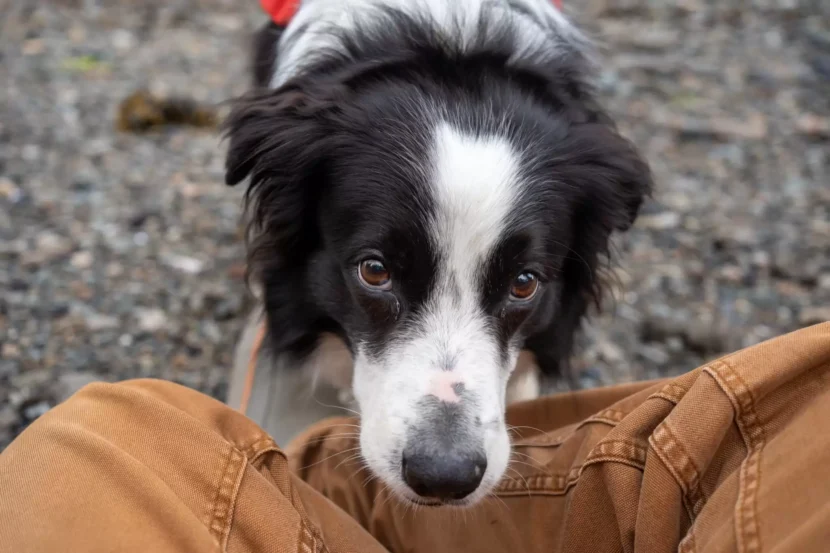
Barley after a hard day’s work on Prince of Wales Island. May 8, 2024. (Jack Darrell/KRBD)
Fratt said she got into the work because she always wanted to work outside. She said she grew up in northern Wisconsin, the daughter of a wildlife biologist.
“I always wanted to be one of those people who’s on a nature show, you know, that was that was the dream.”
When Fratt got to college though, she picked up a side gig as a dog trainer.
“So I was kind of balancing these two loves. I really wanted to work in ecology and conservation, but also was making all my money and spending all my time training dogs,” she said.
The lightbulb moment came when she heard about dogs that were trained to sniff out orca poop on the coast of Washington. Fast forward, she and two other trainers founded K9 Conservationists. The company’s mission is to take dogs from shelters and train them into a scientist’s best friend. They’re up to five dogs. Barley was their founding conservationist.
“He’s just over 10 years old. Now this is probably his last big project,” Fratt said. She turned to Barley. “You got anything to say? You want to go to work?”
He shook the bell on his jacket, barked and then took off down the trail.
“As you can tell, Barley is absolutely nuts for his toy. And that’s one of the number one things we look for when we’re hiring a dog for this job,” said Fratt.
That quality makes for a good canine conservationist, and they for it when they recruit trainees from shelters.
“We’re looking for the sort of dog that when you pull the toy out of the bin, they stop breathing, their pupils dilate, you know, and they’re just glued to it,” Fratt said. “Or maybe they’re barking and spinning and screaming, you know, it’s not always nice, it’s not always pretty, but we’re really looking for dogs that are that level of crazy about their toys.”
It’s also a source of frustration for some dog owners. Fratt explained that most of the dogs at K9 Conservationists were given to shelters because they were “too much dog” for someone – the kind of dogs that would tear open a cabinet if you put their tennis ball in it. Those are the dogs they want because they will search through rain and snow without giving up, as long as they know they’ll get their ball at the end of it.
Barley is a true professional. Fratt said he’s found scats that were over a year old, some that were run over by logging trucks. If finding wolf poop was a sport, Barley would be its Lebron James and Fratt said it’s an honor to be courtside for his last season.
“That means so much to me. I’m getting to be somewhere as beautiful and special as Alaska with him and especially as he’s aging and coming to the close of his career,” she said.
Barley’s final project is slated to last for three summers. This was the first.
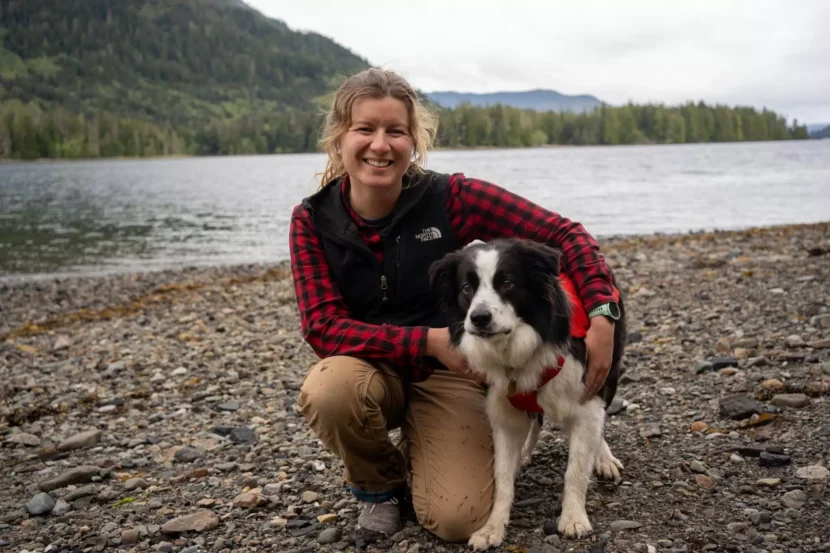
Barley with his trainer and owner Kayla Fratt near Craig, Alaska. Fratt is a dog trainer, PhD student at Oregon State University, and co-founder of K9 Conservationists. May 8, 2024. (Jack Darrell/KRBD)
Tad Fujioka was chair of the Seafood Producer’s Cooperative. Searchers found his body on Wednesday morning (10-30-24) north of Sitka in Nakwasina Sound, near where he had cached a partial deer carcass two days earlier. (Bethany Goodrich photo)
The call that Tad Fujioka was overdue could not have come at a worse time. On the evening of Oct. 29, Sitka and the outer coast of Southeast were being lashed by a windstorm, with some gusts in excess of 50 miles per hour.
Nevertheless, Fire Chief Craig Warren says Air Station Sitka launched a helicopter equipped with infrared to search an area about ten miles north of Sitka in Nakwasina Sound.
“The Coast Guard did fly the night of the report, and kind of looked around the area,” said Warren. “It was dense forest, they couldn’t see much through the FLIR. And then the next morning, we deployed teams out of the Fire Department before 8:00 a.m. The first team was on the ground there about 8:30 dropped in by the Coast Guard.”
Fujioka was believed to be returning to an area where he had shot a deer on Monday in much better weather, and had cached part of the carcass.
Warren says the department organized 25 members into three teams for the ground search, plus two Alaska State Wildlife troopers, and the state biologist.
The Coast Guard flew two of the teams to a high point above the area where Fujioka was believed to be hunting, and another team was landed on the beach. His body was found by a ground team at about 11:30 in the morning, not far from where he had cached the deer. Wounds indicated that Fujioka had died from a bear mauling.
The shock reverberated quickly around Sitka. Norm Pillen is the President of Seafood Producers Cooperative, where Fujioka was board chair.
“He was very involved,” said Pillen, “Our hearts go out to his family. It’s just … [I] can’t even imagine. It’s a huge loss to them, to the community, to the fishing industry and to SPC. We’ll miss him.”
Fujioka came late to fishing. Before becoming a troller aboard his boat, the Sakura, he worked in Sitka’s municipal engineering department. He brought precision and an attention to detail in fisheries allocation issues that made him a powerful advocate at Alaska Board of Fisheries meetings.
The next meeting scheduled for this January in Ketchikan. Pillen says Fujioka’s absence will be felt.
“He really could dive deep, and had tremendous ability for recall and digging into things and pulling out information that he needed,” said Pillen, “and we really appreciated that about him. It’s going to be a huge hit for the industry to not have him involved.”
Fujioka’s outside-the-box thinking wasn’t limited to fisheries. He was a long-time member of the Sitka Fish & Game Advisory Committee, which in 2021 was reckoning with an extraordinary number of brown bears killed by authorities or residents in Sitka that year, fourteen in all. Overhauling Sitka’s entire trash pick-up system didn’t seem a practical solution, nor did shooting every bear that came into town, as some on the Committee suggested.
Fujioka’s analytical mind and understanding of bear behavior led him to suggest something small-scale and possibly effective, if it’s ever tried.
“What if you looked at it from the other way, and we had some booby trapped garbage cans out there, maybe it would only take one or two bad experiences for a bear to associate that big black thing with an unfavorable experience,” Fujioka told fellow committee members..
The bear that likely killed Fujioka was a brown bear sow with two cubs. She was seen by the Coast Guard helicopter in the area near where Fujioka’s remains were found, but ground searchers did not encounter her. Fish & Game biologist Steve Bethune accompanied searchers on Wednesday. He characterizes the incident as a defensive attack – rather than predatory – and says the sow had almost certainly claimed the deer carcass and was defending her food supply.
Bethune said some efforts were made Wednesday afternoon to locate the bear on the ground, without success.
Tad Fujioka was 50 years old. His death remains under investigation by Alaska Wildlife Troopers.
Close
Update notification options
Subscribe to notifications
Subscribe
Get notifications about news related to the topics you care about. You can unsubscribe anytime.