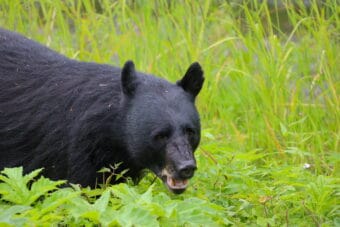
Juneau lies in the midst of prime black bear habitat. Bears and people have to share the city, and new research hopes to figure out how they can do that more peacefully.
The number of bears killed in Juneau has quadrupled since the 1980s. Just this summer, the Alaska Department of Fish and Game euthanized two young bears downtown after they became aggressive while eating from trash cans.
Roy Churchwell is the management coordinator for wildlife in Southeast. He says bear-human encounters have always happened in Juneau, but he suspects population growth, combined with pressures brought on by human-caused climate change, might be contributing to more problem bears.
“There have been some upticks in some years, because it’s become a little more common for there to be fewer fish and fewer berries,” Churchwell said. “When that happens, that brings more bears into town.”
When bears have trouble finding their natural foods, he said, they might turn to “urban foraging.” That’s a fancy way of saying they eat our trash.
That’s a problem for public safety, as bears can get overly comfortable around and aggressive towards people when they’re regularly eating trash. Often, that’s what leads the department to put a bear down. According to Churchwell, they want to avoid that outcome whenever possible.
“How, as a department, might we be able to manage the people — and manage the bears — in a way that we can both be in town but have less of an impact on each other?” he said.
To learn more about how to improve their management strategies, the department commissioned Dr. Todd Brinkman and researcher Binta Wold, experts in wildlife ecology from the University of Alaska Fairbanks.
Brinkman and Wold have designed a survey to learn more about the way people interact with bears around town. It was sent out this spring to 5,000 randomly selected residents.
Though waste management is a known source of bear problems, the survey hopes to learn more about specific patterns in the way people interact with bears around town.
“So, how many people are getting their trash broken into every year? How many people are experiencing property damage,” Wold said. “And is there anything we can learn about that group of people?”
It might be that bear resistant trash cans are cost prohibitive, Wold said, or bear encounters are more common in neighborhoods that lack garages to store their garbage. It’s also possible that overflowing trash cans attract bears to areas that are crowded with tourists.
The survey asks questions about those possibilities, and about how Juneau residents feel about the Department of Fish and Game’s bear management strategy over the last five years.
Wold said nearly 1,000 people have filled out the survey so far. While there are no concrete results yet, most respondents agree that bears cause serious problems in town.
“But so far, a majority of folks responding also are saying that they enjoy living alongside bears and that the benefits of living alongside bears outweigh the costs,” she said. “It’s a complex story.”
The goal is for the survey to simplify that story, or at least help wildlife managers to make sense of it, so that they can come up with strategies to help bears and Juneauites continue living side by side with minimal conflict.