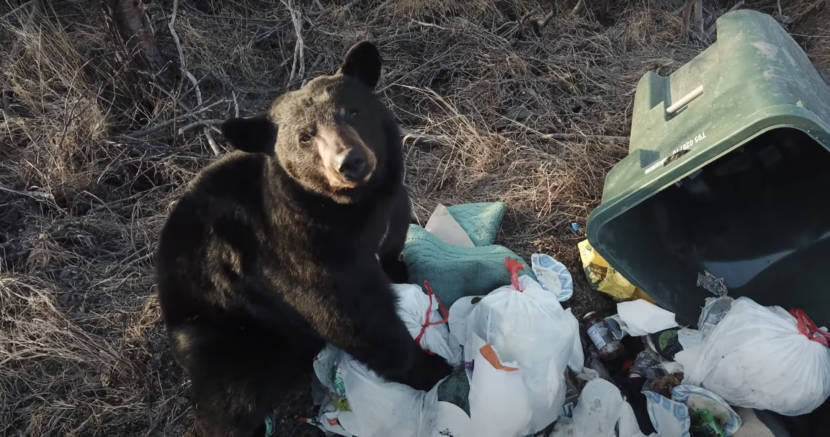
A screenshot from drone footage shows a black bear going through trash in the Bear Valley neighborhood of Anchorage on Sunday, April 25, 2021. (Vern Poraning)
The Alaska Department of Fish and Game euthanized two black bears in downtown Juneau on Wednesday evening after they displayed aggressive behavior around garbage cans.
Wildlife management biologist Carl Koch said he initially responded to reports of a yearling that was entering shops, including a jewelry store on South Franklin Street.
“As we were looking for the little bear, we encountered two other bears that were uncooperative, you know, somewhat aggressive,” Koch said. “We were dealing with lots of tourists getting close to them, and so we did end up removing two bears for safety reasons.”
Those bears were more mature males. According to Koch, they were shot with tranquilizer darts and later put down. The yearling is still at large.
Bear sightings are common in the neighborhood.
“There’s a great habitat just above Franklin Street surrounding a bunch of houses, stairwells, that will lead down to garbage cans,” Koch said. “There were a lot of full cans that the bears could get after.”
Koch said he found many cans that were easy to get into on Wednesday, with extra garbage that was placed on top of them, out in the open.
Unsecured trash draws hungry bears. If a bear is easily shooed away, it doesn’t pose a threat. But when bears get used to trash as an easy food source, they get used to people, too, which makes them more bold and confrontational.
Bear sightings in the busy downtown tourist areas can draw large crowds. Curious onlookers plus confrontational bears means big concerns for public safety.
“You tell people to back off and they say, I paid all this money, I’m gonna get my picture,” Koch said.
Koch says the Juneau Police Department has been responding to more bear-related calls this summer than usual, and wildlife biologists are not sure why they’re especially active this year.
Fortunately, no other bears have been euthanized in the area.
Still, Koch says the best way to avoid that outcome in the future is to do a better job of securing and cleaning up trash. According to city law, residents and business owners can be subject to fines if their garbage attracts bears
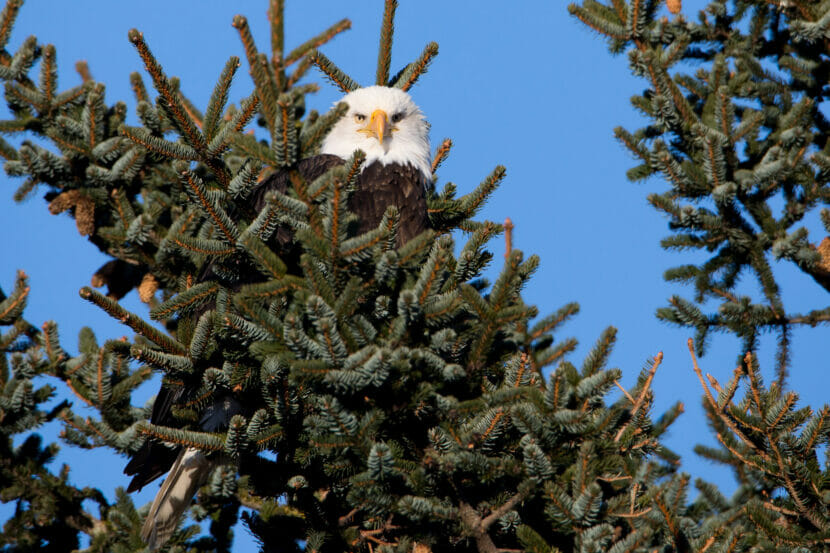
A bald eagle is seen on Feb. 6, 2018, perched in a tree in the Kodiak National Wildlife Refuge. (Photo by Lisa Hupp/U.S. Fish and Wildlife Service)
Dock users at Kodiak’s biggest boat harbor are being urged to keep an eye out for eagles in the area, as several attacks have been reported in the last week. U.S. Fish and Wildlife staff say this is a rare occurrence, but residents should still be wary when in the area of St. Herman Harbor.
Kodiak’s Harbormaster and Port Director Dave Johnson posted on social media the morning of July 11, warning everyone who is using St. Herman Harbor, also known as Dog Bay, of at least three eagle attacks in a specific area of the dock.
Kodiak Island Borough Assembly member James Turner confirmed the attacks at an assembly work session on July 11, and said a few people required sutures on their heads. Turner is also the local plant manager for OBI Seafoods.
“Be careful over in Dog Bay, walking on L and M floats. There have been multiple eagle attacks,” Turner said. “U.S. Fish and Wildlife is looking into this. But multiple people have been attacked and multiple people have needed stitches.”
Steve Lewis, a wildlife biologist at the U.S. Fish and Wildlife Service, with a focus on eagles and raptors, said this type of encounter is “strange” for the Kodiak area.
“I’ve dealt with eagles in lots of places and normally they just aren’t that defensive. Like I’ve done things like I’ve climbed nest trees. And most of the nest trees, in fact all of them, the birds [the eagles] don’t dive bomb you as you’re climbing, like when you get to the nest,” Lewis explained. “They are definitely aggravated. You can see them flying around and they are calling, but they aren’t diving at you or anything aggressive.”
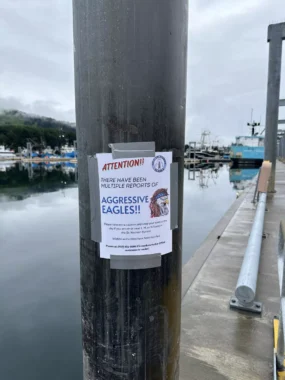
Kodiak Ports and Harbor staff put flyers up near Floats L & M of St. Herman Harbor warning of bald eagle attacks in the area. (Davis Hovey/KNOM)
But in Kodiak, Lewis suspects this one aggressive eagle was not protecting a nest. Instead its behavior might be due to the abundance of dead fish and food scraps available around the docks. He adds that it could possibly be a pair protecting a nest, but he is not as convinced of that explanation. Bald eagle’s breeding season goes from March to the end of August, according to Lewis, with the young fledglings starting to fly out of the nest at this point in July or earlier.
“I think they are probably getting fed by people around the harbor,” Lewis stated. “And I think that in a similar way that it kind of changes how bears are, if they start getting food from people, they become more aggressive towards people. I think that might be similar to what’s going on with these birds.”
The bald eagle is the national bird of the United States and has certain protections, although permits can be obtained for special uses like for science or to make Alaska Native handicrafts under the Bald and Golden Eagle Protection Act, and Migratory Bird Treaty Act. The USF&WS just updated its permit program for bald and golden eagles earlier this year in April. As such, it is illegal to harm or kill a bald eagle.
Lewis recommends anyone walking in the area of St. Herman Harbor should hold something above their head to protect themselves, or continue to watch the birds so that they won’t swoop down and attack other people. Lewis said eagles tend to attack the highest point of a person that is visible to them, so holding a hat or umbrella above your head could help protect you from injury.
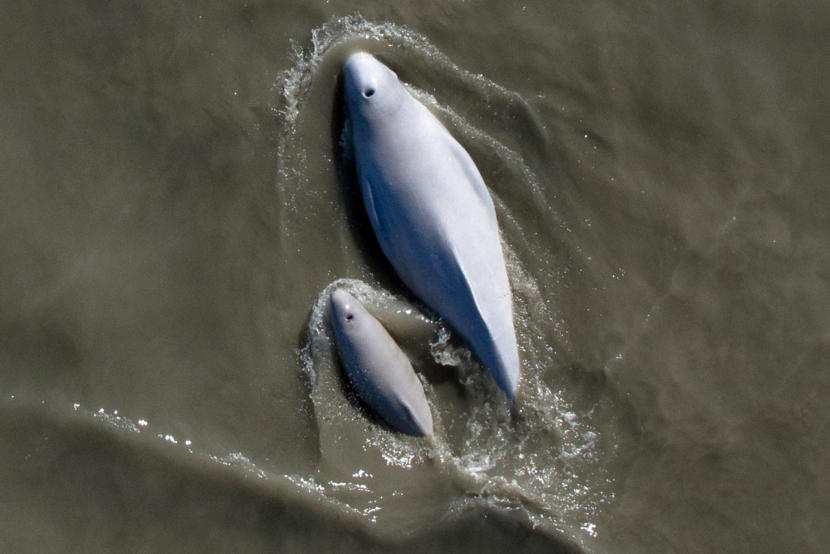
A Cook Inlet beluga whale mother and neonatal calf swim together. (Public domain photo by Hollis Europe and Jacob Barbaro/NOAA Fisheries)
A federal judge is sending Interior Department officials back to the drawing board after concluding a Cook Inlet oil and gas lease sale didn’t adequately consider the possible impacts on endangered beluga whales in the area.
The ruling temporarily suspends a lease held by dominant Cook Inlet producer Hilcorp. The privately held Texas-based oil and gas company won a 5,693-acre lease in a 2022 sale.
Hilcorp was the only bidder in the lease sale, which was mandated by the 2022 Inflation Reduction Act. At the insistence of West Virginia Democratic Sen. Joe Manchin, that climate-focused federal law also included provisions mandating oil and gas lease sales in Cook Inlet and the Gulf of Mexico.
A coalition of Alaska-based and national environmental groups challenged the Cook Inlet lease sale. They argued the Interior Department agency that offered the sale had not taken a hard enough look at the possible impacts of drilling on the endangered population of roughly 300 beluga whales that live in Cook Inlet. Oil and gas production involves loud undersea noises from things like piledriving, drilling and vessel traffic, and the groups argued that can interfere with belugas’ echolocation.
U.S. District Judge Sharon Gleason agreed, but she stopped short of vacating the lease sale entirely. She ordered the Bureau of Ocean Energy Management to come up with a supplemental environmental analysis and a range of alternative lease arrangements that better account for the possible impacts on Cook Inlet beluga whales.
“In sum, the Court finds that BOEM failed to consider a reasonable range of alternatives at the leasing stage in violation of [the National Environmental Policy Act] because it failed to consider any alternative that would offer for lease a reduced number of blocks that would meaningfully reduce overall impacts, could feasibly meet the purpose and need of Lease Sale 258, and would better allow for ‘informed decision-making and informed public participation,’” Gleason wrote in the 49-page order.
That could ultimately force the Interior Department to shrink or cancel Hilcorp’s lease, said Earthjustice attorney Carole Holley, who represented the Center for Biological Diversity, the Natural Resources Defense Council, Cook Inletkeeper, Alaska Community Action on Toxics and the Kachemak Bay Conservation Society.
“This ruling just confirms that the Inflation Reduction Act is far more limited in scope than industry and its allies, and in this case, the state of Alaska, have been pushing, and it does not override NEPA, or our other bedrock environmental laws,” Holley said by phone.
The National Environmental Policy Act is a Nixon-era law that requires federal agencies to evaluate the possible environmental impacts of their actions. Earthjustice and a variety of conservation groups are also challenging similar lease sales mandated by the Inflation Reduction Act in the Gulf of Mexico.
Though the state of Alaska and federal government often clash on resource development, Alaska intervened in the case to support the lease sale. Department of Law Communications Director Patty Sullivan said in a prepared statement that the state was disappointed by the decision.
“In 2022 Congress sought to provide certainty for this overdue and long awaited lease sale,” Sullivan said. “The state is disappointed with the continued uncertainty in leasing caused by the court’s order, which is counter to the intent of Congress to provide certainty.”
A spokesperson for the Alaska office of the Bureau of Ocean Energy Management did not respond to a phone call seeking comment. The agency manages oil and gas activity in federal waters, which generally begin three miles offshore. Most Cook Inlet oil and gas production occurs onshore or in state waters.
Oil and gas industry analysts point to long-term trends, including rising renewable energy production and higher production costs, as reasons for lackluster interest in recent oil and gas lease sales.
The Bureau of Ocean Energy Management will be required to update the court on its progress on a supplemental environmental analysis in six months, the judge ruled.
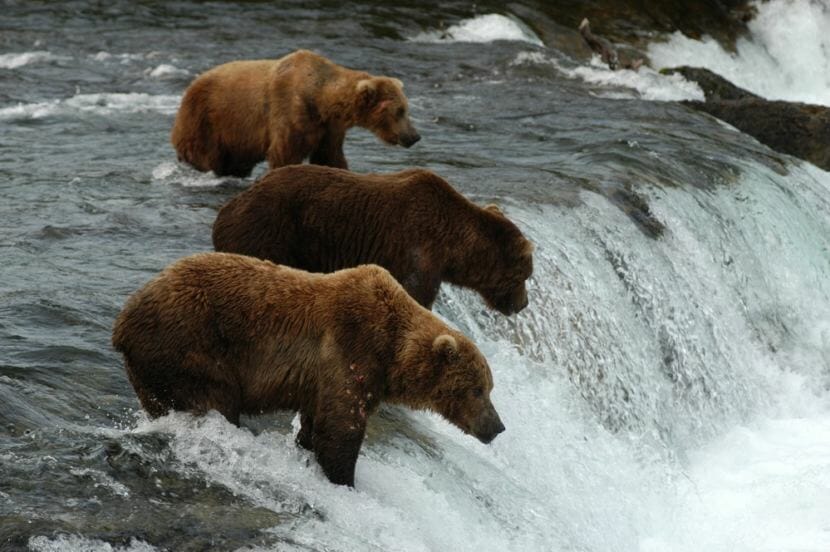
Katmai bears fish at Brooks Falls. (Photo courtesy National Park Service)
A new streaming series about Alaska has joined the ranks of TV shows like “Deadliest Catch,” “Bering Sea Gold” and dozens of others, this time focused on the fat bears of Katmai National Park and Preserve.
The latest series, “The Hungry Games: Alaska’s Big Bear Challenge,” features narration from a well-known New Zealand star. Rhys Darby, who has appeared in the HBO comedy series “Flight of the Conchords” and the recent “Jumanji” films, describes himself as a “comedian, actor, leg model, cryptozoologist, artist, and author.”
In a brief preview clip for the series, which premiered Thursday, Darby is narrating a scene where a Katmai bear known as Boldface tries to cross a flowing channel with her three cubs. The mama bear goes in first to test the waters and then calls for the younglings to follow.
“Boldface is waiting for them about halfway across the river. If they can swim to her, she can carry them the rest of the way. C’mon kids, hurry up and get to your mom,” Darby narrated.
The show will also include a ranking system similar to Katmai National Park’s Fat Bear Week tournament, where several brown bears in the park are pitted against each other and the public votes for their favorite fattest bear. Darby, however, will add more context and commentary to the bears’ activities while they bulk up for winter.
In “The Hungry Games,” the large brown bears are given scores based on their actions, like eating hundreds of pounds of food over the course of 150 days. The three categories they’ll be measured in are Beefiness, Ingenuity, and Grit – an acronym that spells out B.I.G.
Once the show is over, the highest scoring bear will be crowned the Hungry Games champion.
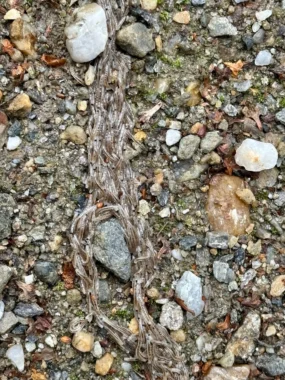
Snake worm gnat larvae on a driveway off Pika Road in Fairbanks on Tuesday July 9th, 2024.
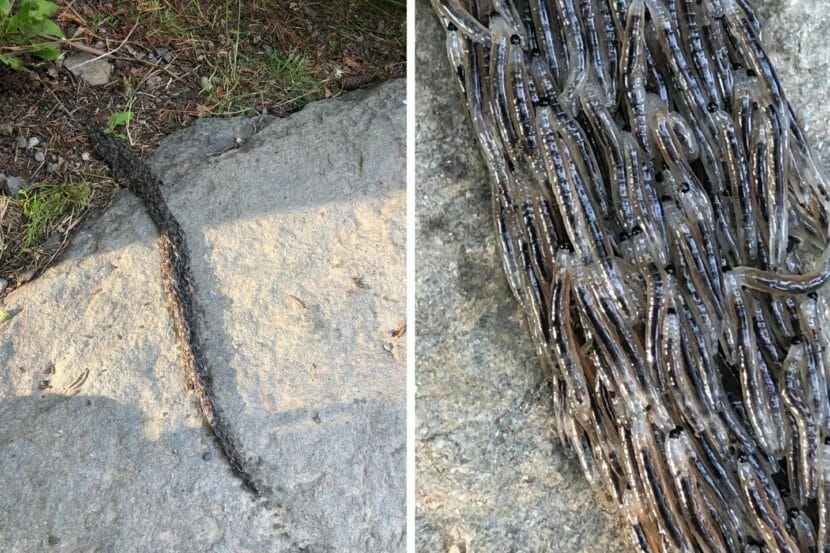
Another mass mass of gnat larvae was reported in Fairbanks this week. University of Alaska Fairbanks entomology professor and Museum of the North curator of insects Derek Sikes says the sighting on Pika Road is the latest report of what he calls snake worm larvae.
“Because it looks a little like a snake when you have all these larvae moving in long column across a road,” he said.
The unusual lines of moving gnat larvae were first reported in Fairbanks in 2007, and Sikes says sporadic sightings have come in over the years since.
“When people see these things going across trails or roads, it’s quite remarkable, and people take pictures and send them in,” he said. “But we don’t get reports every year, so we don’t know how cyclical it is. We don’t know if they’re actually making these columns in the woods where nobody is observing them.”
Sikes says he initially worked with specialists in Germany and Japan to identify the larvae, eventually looking at their DNA.
“Became pretty clear that we were dealing with new species,” he said.
Sikes says the data got back burnered until 2021 when post-doctoral entomology researcher Thalles Pereira of Brazil picked it up.
“He came and finished the project,” Sikes said. “Did all the final analysis and wrapped it up and drafted the paper.”
A Camp Denali staff member spotted this column of gnat snakeworm larvae on July 8, 2022. (Photos courtesy Jenna Hamm)
The paper came out in December 2023.
Sikes says a lot of questions remain about the species they officially named Sciara serpens, including whether it is different from gnat larvae observed in similar formations elsewhere in North America. There’s also the question of why the larvae group in snake-like processions.
Sikes theorizes they climb on top of one another to protect themselves while crossing roads and trails.
“Sliding over their comrades below so you get this kind of conveyor belt thing going across the road where they can make it across with minimal exposure of their moist bodies to the dry conditions,” he said.
He says another possibility is that the formations are a defensive measure.
“Birds that might otherwise prey on individual larvae, will leave them alone because they look like a big animal, like a snake or something,” he said.
Sikes encourages anyone who sees snake worm gnat larva to report them with photos, time, location and other information, using the iNaturalist app.
He says all the Alaska observations have been in the morning when its cooler, but it’s unknown whether the larvae columns are weather-related.
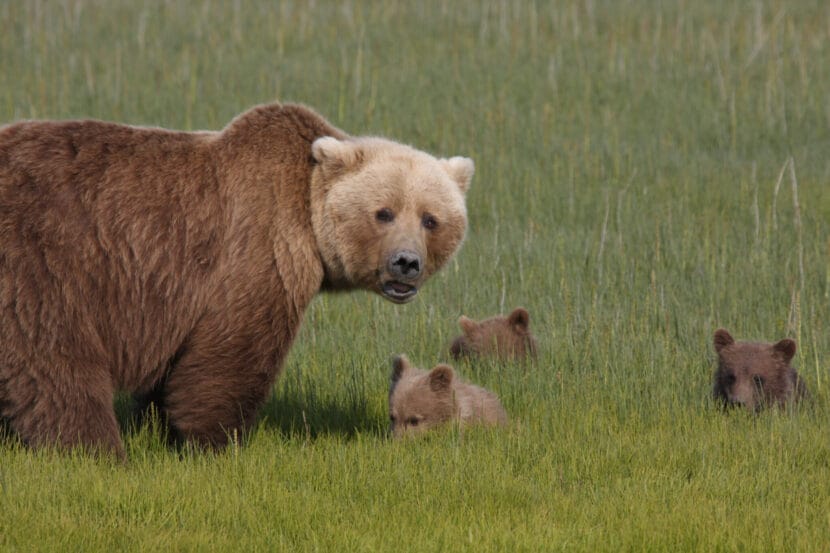
Three brown bear cubs crouch in the grass near their mother in a meadow in Lake Clark National Park and Preserve in 2009. A new rule resurrects a ban on bear baiting by sport hunters in national preserves in Alaska, but the National Park Service opted against expanding the rule to ban other controversial practices. (K. Jalone/National Park Service)
Bear baiting will be again banned on national preserves in Alaska starting on Aug. 2, under a new rule adopted by the National Park Service.
The rule restores a ban for sport hunters that was imposed in 2015 by the Obama administration, then subject to a 2020 Trump administration rule that attempted to overturn it.
Bear baiting is the practice of leaving food to lure the animals so that they can be more easily hunted. Critics consider it unethical, though hunters who practice it argue that they abide by strict rules.
To the National Park Service, bear baiting creates unacceptable safety risks, both for the animals that live in national preserves and for the people that visit them. The danger is that bears will become habituated to human-provided food and be more likely to interact with people.
That was the top concern when the agency adopted its new rule banning bear baiting, said Peter Christian, a spokesperson for the National Park Service’s Alaska district.
“It’s not something the Park Service can support from a public safety perspective,” he said. “We’re trying to protect people from bears and bears from people.”
The new rule stems from a 2020 lawsuit that challenged the Trump administration change. That Trump-era policy never went into effect; U.S. District Court Judge Sharon Gleason ruled that it violated National Park Service laws and policies, and she ordered the agency to reconsider it.
The process of replacing the Trump-era rule started in February 2022, the Park Service said.
The new rule affects only sport hunters. It does not affect subsistence.
Sport and subsistence hunting is permitted on national preserves in Alaska, under the Alaska National Interest Conservation Act. However, sport hunting in preserves must be conducted according to federal law.
In its new rule, the Park Service declined to restore all of the Obama-era prohibitions on controversial sport hunting practices such as killing black bear cubs, adult female bears with cubs, using artificial light at den sites and killing wolves and coyotes, including pups, during the denning season.
The Park Service said it declined to extend the new rule beyond the bear-baiting ban because some of the other prohibitions it was considering are already disallowed for sport hunters under state law.
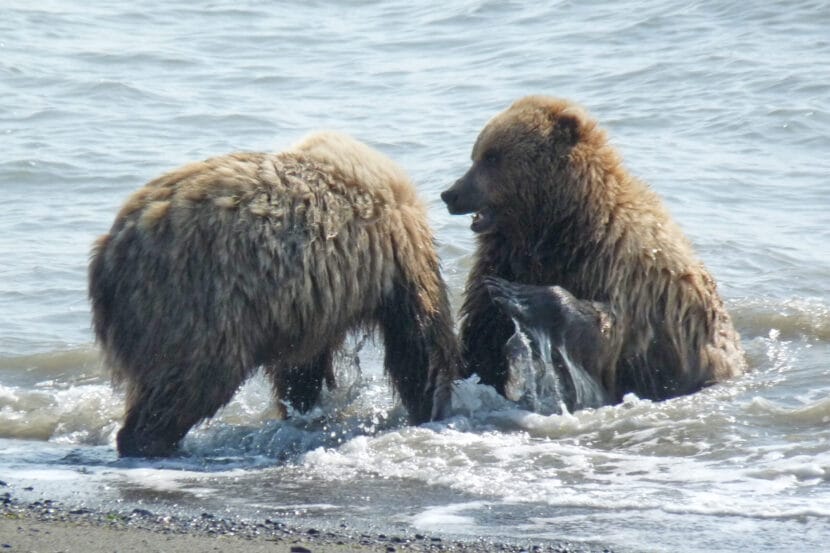
Brown bears cavort in the water in Katmai National Park and Preserve on June 30, 2009. (Photo provided by National Park Service)
The Alaska Department of Fish and Game may allow sport hunters to use some of those practices, but it does so only sparingly, Christian said. “The state had the authority to authorize them, and when they do, it’s limited to a very small area for a short period of time,” he said.
The state’s authority does not extend to subsistence hunting in national preserves. That category of hunting is federally managed.
The new National Park Service rule was criticized by parties on both sides of the issue.
Members of the groups that sued to overturn the Trump-era rule said the new rule fell far short because it allows several controversial hunting practices to continue in the reserves.
“Stopping bear baiting in preserves is important for visitor safety and ecological health. The rest of this rule is disappointing,” Jim Adams of the National Parks Conservation Association said in a statement. Adams is the association’s Alaska senior regional director.
“In its rule, the Park Service recognizes that numerous sport hunting practices conflict with the agency’s mission — yet allows them to continue,” Adams said.
Jon Jarvis, former superintendent of Wrangell-St. Elias National Park and Preserve and a former director of the National Park Service, was also critical.
“The National Park Service has opposed the State’s unsportsmanlike predator hunting practices for many years,” Jarvis said in the National Parks Conservation Association’s statement. “These methods are in clear conflict with longstanding NPS wildlife conservation policies and mandates and are not appropriate in areas managed for future generations by the NPS. This rule is a major setback for the protection of wildlife diversity in our national preserves of Alaska.”
On the other side, Safari Club International, one of the hunting organizations that intervened in the 2020 lawsuit in defense of the Trump-era rule, characterized the new rule as unjust.
“We will likely be back in court over the new rule. A federal judge already recognized that harvest over bait does not pose a safety or conservation concern. Despite that ruling, anti-hunters in the Park Service have pushed through a rule that is opposed by the State, as well as Alaska Native communities and Alaska citizens. While very few bears are likely to be harvested over bait, SCI will fight this restriction to avoid ‘death by a thousand cuts’ — a favorite strategy of anti-hunters,” the organization said on its website.
The state of Alaska, along with hunting groups, intervened in support of the Trump-era rule and opposed the more expansive rule that the Biden administration considered. In a March 24, 2023, letter sent to the National Park Service, Alaska Department of Fish and Game Commissioner Doug Vincent-Lang said the proposed rule usurps Alaska authority and harms individual Alaskans.
“It has far-reaching implications on the availability of national preserve lands for hunting and traditional cultural practices as Congress intended and Alaskans have long depended upon,” he said in the letter.
Gleason in May issued an order allowing appeals to proceed. Some parties, including the state, have already taken that opportunity.
“The State along with the other parties have already appealed Judge Gleason’s decision to the Ninth Circuit,” Patty Sullivan, a spokesperson for the Alaska Department of Law, said by email. “The State’s brief is currently due at the end of this month. We are in the process of reviewing this new rule to determine how it impacts the ongoing appeal and whether to pursue additional litigation.”