Wildlife

National Park Service bans sport hunters from baiting bears

A brown bear in Denali National Park. (NPS photo)

The National Park Service has decided to ban the practice of baiting bears in Alaska in order to hunt them for sport. Wildlife conservation groups applaud that step, though some say the new hunting rule doesn’t go far enough.

The new federal ban on bear-baiting only applies to sport hunters in National Park Service-managed Preserves in Alaska. It applies to black and brown bears but doesn’t affect subsistence hunting.

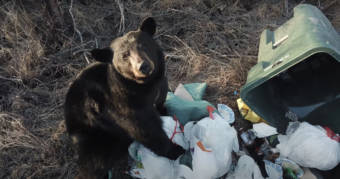
The Park Service cited safety concerns. Visitors could stumble onto a bait station and have a bad encounter with a bear defending its food, the rule says. Hunters who bait bears typically use dog food, donuts or bacon grease, which the Park Service says is a public safety risk because it conditions bears to human sources of food.

The ban comes after years of rulemaking and reversals as each new administration took office. The agency also had to comply with a judge’s decision in a lawsuit challenging previous Alaska hunting rules.

The National Parks Conservation Association says the new ban is too narrow. Prior versions banned killing black bear cubs,  sows with cubs, and sport hunting wolf pups during denning season. Those practices are allowed under the current rule.

Meanwhile, the state of Alaska and many sporthunters say the federal government should leave wildlife management to the state.

Rod Arno, policy director at the Alaska Outdoor Council, said by text message that the state continues to lose game-management authority, bit by bit. He said the rule represents a lost opportunity to harvest bears, which, in his view, leaves fewer moose for human consumption.

Possible rat sighting on remote St. Paul Island raises alarm

For more than two decades, the Pribilof Islands have implemented a rat prevention program to keep the island rat-free. (John Ryan/KUCB)

It may sound silly to outsiders, but for the remote Pribilof Island of St. Paul, a possible rat sighting could be a big deal.

The community of about 300 residents has worked for decades to be rodent-free. Officials with the island’s tribal government have said the invasive species would devastate local seabirds and permanently change the wildlife populations.

According to a Facebook post from the Aleut Community of St. Paul Island Tribal Government, a rat was potentially spotted last Wednesday. The tribal government’s Ecosystem Conservation Office is working to confirm the sighting using trail cameras at the city fourplex where the unconfirmed sighting was reported.

In 2018, local and federal officials spent almost a year trying to eradicate a rogue rat on the island. They believed the rodent likely snuck in on a boat.

Millions of seabirds descend each year on the rocky oasis near the middle of the Bering Sea. It’s one of the few places that has successfully protected its rich natural habitat and wildlife from invasive rodents.

According to Lauren Divine, the director of the tribal government’s conservation office, there have been no signs of a rat and the sighting is still unconfirmed. She said their staff immediately put out traps and trail cams, and are working with the U.S. Fish and Wildlife Service’s Maritime Refuge staff to place additional materials like black lights, which they will use to detect feces.

Traps are baited with peanut butter, and staff is monitoring daily for any signs of the rat. Signs include things like droppings, chew marks and shredded fibers or debris.

The tribal government asks locals to keep all food and waste properly stored or disposed of. If you spot a rat or evidence of one, or if you’d like to have traps placed around your home, call the conservation office at 907-615-5306.

Alaska Wildlife Troopers take lead on last week’s mountain lion death on Wrangell Island

A mountain lion. (Photo by Justin Shoemaker/USFWS, Public Domain)

Mountain lions aren’t known to live in Wrangell, but that doesn’t mean the Southeast Alaska island hasn’t served as stomping grounds for the apex predator.

In fact, a mountain lion was shot and killed on the south end of Wrangell Island recently.

Alaska Wildlife Troopers and the Alaska Department of Fish & Game were notified of the death on June 3 and took possession of the carcass. Troopers are leading the investigation, but did not immediately return calls for comment.

Frank Robbins, the state’s area biologist in Petersburg, said it’s the second known mountain lion killed on Wrangell Island. The first was in 1989. Another was accidentally trapped on Kupreanof Island in 1998. All three were males.

“It’s not unprecedented and it appears to be a young male,” he said. “The Stikine River acts like a corridor, essentially for travel. So it’s likely that, you know, young males dispersing down the Stikine River ended up on Wrangell Island.”

He said that young male lions can travel great distances in search of their own home ranges.

Robbins said there are a lot of trail cameras out on Wrangell and nearby islands associated with elk and deer research. They haven’t gotten a photograph of a mountain lion yet, because the species is rare in the area.

“It’ll likely happen again, at some point,” he said. “It’s very interesting. We’re the only area in Southeast Alaska that has had documented lions, mountain lions.”

Robbins said that at some point another young male mountain lion will likely go down the Stikine River and show up in Wrangell again. But it’s anyone’s guess as to when that will happen.

Could Alaska once again be home to woolly mammoths? This reporter had to find out.

A screenshot from the Alaska Future Ecology Institute website. (From Nathaniel Herz/Northern Journal)

As far as we know, the last time a woolly mammoth roamed mainland Alaska was almost 12,000 years ago. And even if it sounds like a fairytale, some people think mammoths might once again stomp around in the far north.

Northern Journal reporter Nat Herz went from fairytale to rabbit hole recently, trying to unearth an understanding of how woolly mammoths might be “de-extincted,” as they say. And it all started with a calendar.

Herz joined Alaska Public Media’s Casey Grove to explain.

Listen:

This interview has been lightly edited for length and clarity.

Casey Grove: OK, you went on a little journey here. Maybe not a little one. A long one.

Nat Herz: A mammoth one.

Casey Grove: A mammoth-sized journey. Tell me how this all went. How did you get into this?

Nat Herz: You know, every month I try to review the public calendars of the key state department commissioners, the agency heads, and I was looking at the Department of Fish and Game commissioner’s. And there was a four-hour meeting that was just labeled “woolly mammoth.” It was actually spelled wrong. It was spelled like “Wally” mammoth. And I was like, “What the… heck?” for your listeners.

And so I made a call, and I was like, “What’s going on with this? Is this real?” Because I had heard some kind of rumblings and gotten an email a while back about maybe some mammoth resurrection-related stuff. And I was like, “OK, four-hour meeting, Department of Fish and Game commissioner, is there anything here?” So I ended up doing what reporters do, which was I just filed a Freedom of Information request, and I asked for every email in the Fish and Game commissioner’s inbox that contained the word “mammoth.”

Casey Grove: And what did that reveal?

Nat Herz: As it turns out, you go back 10, 15, 20 years, I think there are, in the words of one of the emailers to the Department of Fish and Game commissioner, there are these gonzo scientists in Siberia that had this idea that basically, permafrost, if it thaws, there’s a ton of methane in it, which if it thaws, then flows up to the atmosphere and makes global warming worse. So what if we could keep the permafrost frozen and stop all of that greenhouse gas from going up into the atmosphere?

And the idea that these Russian gonzo scientists had was, “What if we release a menagerie of herbivores out onto the tundra?” And the theory here that has been somewhat borne out by their, you know, fairly limited research, is that these herbivores go out, they tromp around during the winter in the snow — which normally insulates the tundra and actually keeps it warmer — if you trample the snow on the tundra, it actually allows the tundra to stay colder during the harsh winter climate and for less permafrost thaw to happen.

So it turns out there’s a guy in Haines, Alaska, who made a documentary about the Russians, who now wants to basically recreate what they’re calling a “Pleistocene park” in Alaska and basically introduce a bunch of herbivores out onto the tundra, probably near Denali, and basically do a bunch of scientific research to see if they can stop permafrost thaw.

Casey Grove: Scientific research, and I’m sure a few tourists would be interested in at least taking their pictures, right? Now, how does that connect back to the emails that you found? And I guess there’s a company that’s involved in the United States?

Nat Herz: Yeah, so, to be clear, the Alaska Future Ecology Institute, which is the one that wants to set up this kind of herbivore park near Denali, they are mammoth agnostic. They’re like, “Yeah, mammoths, you know, would be great snow tramplers, but really, you know, we’re more in the mode of like, musk ox, reindeer, you know, conventional charismatic megafauna.”

At the same time, there is a bioscience company called Colossal that is sort of a union of a tech guy and a very highly regarded geneticist named George Church. They have created this company that is getting into what they call the “de-extinction” business. And what they want is to take the DNA from a frozen mammoth, which generally can be fairly intact, because mammoths, unlike dinosaurs died off not that long ago. They want to take that DNA, take some of the kind of key mammoth traits — the wooliness, the fattiness, the tusks — and basically splice those in to an elephant genome and basically resurrect the woolly mammoth and have it kicking around.

And one of the justifications for doing this is that if you take the mammoth and you put it out on the tundra, in one of these kind of tundra environments, it can help with this process of trampling down the snow and preserving the permafrost. And they are saying they’re gonna have their first mammoth-elephant hybrid, I think, by 2028, and they’re interested in putting it in Alaska.

Casey Grove: Right, so it’s like, they need a place to do this. And some of us might think that that’s bonkers, but they say that they can do it. How seriously is the state of Alaska taking that, though?

Nat Herz: I interviewed the Fish and Game commissioner, Doug Vincent-Lang, for this story, and I think he understands that these guys are legit, and this could be also useful technology for Alaska species that are at risk, potentially, like King salmon. And I think, you know, he’s not going to discount it. If and when they get to the point of having, you know, something that they’d be ready to put out on the tundra here, which would not be, I think, for a long time, because it’s going to take years and then it has to grow up and be ready to live without, you know, supervision and support, but I think they would probably entertain it.

One of the most fun parts of the correspondence that I got ahold of was, you did also have this company, the Chief Animal Officer from Colossal, send another email to Doug Vincent-Lang that said, “What if we also could, like, resurrect a Pleistocene wolf? And, you know, we’d want to have the predator-prey balance right, and so could we set the wolf out on the tundra and have it chasing the mammoths around.” And Doug Vincent-Lang had this, like, very deadpan, serious response where he was like, “Yeah, that seems like a lot. Let’s stay focused on the mammoth for now.”

Casey Grove: There was another kind of funny part, I thought, in that conversation with Doug Vincent-Lang, the Fish and Game commissioner, where he said something like, “You know, we’re not trying to do Jurassic Park here.” But then he did describe doing something like this, at least a pilot program, like, on an island, which sounded to me like Jurassic Park.

Nat Herz: Yeah, that is actually correct. There’s been a discussion here. It sounds like the the the Fish and Game commissioner has talked with the president of the tribal government on St. Paul Island, like way out in the Bering Sea, about, you know, would this be an appropriate place to put a mammoth where it, you know, could not escape and run rampant through the streets of Anchorage?

So, you know, again, like, I think it’s out there, but it’s definitely something that people are really talking about. And I think, you know, that is, like, the bottom line of this story is that it is an irresistible concept and an irresistible conversation, and people are captivated by this idea. It is the OG, original charismatic megafauna, is the woolly mammoth. And I just think it’s impossible for people to not get excited when they hear that this could happen. It sounds science fiction, but it may not actually be science fiction anymore, given the technology that we have access to. And I think, you know, both because it is just compelling stuff and because it is at least technologically plausible, this is stuff that people are really sincerely engaging with.

Casey Grove: And then, one last thing, you mentioned something like they’re four years out, they think from maybe actually creating this woolly mammoth-elephant hybrid. But Alaska is maybe not the only place that they’re looking at doing this, right? I mean, is this kind of like how cities compete for the Olympics? Are we competing for the for the first woolly mammoth?

Nat Herz: Yeah, that’s a great question. I was actually really upset by this. You know, it’s like, you sort of think about it, and you’re like, “OK, someone’s gonna resurrect a woolly mammoth, and they’ll eventually need a place to release it into the wild. Like, obviously, it’s going to be Alaska.” And when I interviewed the company’s chief executive, he was like, “Nope, sorry. You guys don’t have a monopoly on mammoth territory. They actually kind of roam far and wide. And we’ve been having great conversations with North Dakota and the state of Wyoming about, you know, could we put a mammoth there.” And so, as I wrote in my story, Wyoming and North Dakota, get off our lawns. These are our mammoths. Stay away.

Homer man dies in moose attack

Dale Chorman posing in front of a tree. (Courtesy Dale Chorman’s family)

A Homer man died Sunday morning after being attacked by a moose.

According to an online dispatch posted by Alaska State Troopers, a cow moose charged at 70-year-old Dale Chorman and another person.

Journalist and writer Tom Kizzia was asked by Chorman’s family to speak on their behalf. He said Chorman and his friend were looking at newborn moose calves on Chorman’s property located east of Homer near Fernwood Drive when the moose charged at them.

“They were going down to see how close they could get to see if they could get any pictures of these newborn twins, but it was really thick, real dense part of the woods,” Kizzia said, “it was thick alder and elderberry, like we know around here, and suddenly out of nowhere, that moose was coming at them. They hadn’t seen it.”

Medics declared Chorman dead after arriving at the scene. Troopers say the moose has left the area. As of Sunday, troopers are still investigating the incident and the exact cause of death.

According to the Alaska Department of Fish and Game, cow moose with calves tend to be aggressive in late spring and summer. The department recommends running behind a solid object like a tree if a moose charges at you.

Where do the Foodland ravens roost?

A raven sits on the roof of the Foodland grocery store on Thursday, May 16 2024. (Photo by Anna Canny/KTOO)

Marc Wheeler lives in downtown Juneau, close to the Foodland grocery store. He often stops there for lunch. That’s when he sees the parking lot’s resident ravens.

“I’ll be like walking while I eat it, and they’ll literally follow you like a gang of thugs,” Wheeler said. “Cause they’re just counting on you dropping something.”

Like many Juneauites, Wheeler has had a lot of fun watching the curious corvids that wander around town, but he noticed that most of them disappear at sundown. 

“Where’s the roost?,” Wheeler asked for this installment of Curious Juneau. It took some nighttime detective work to find out. 

The first lead came from Bob Armstrong, a naturalist and wildlife photographer who has been working in Juneau for more than 60 years. 

A raven holds a cup of Raven’s Brew coffee in the Foodland parking lot. (Photo courtesy of Bob Armstrong)

He’s photographed hundreds of ravens. One of his favorite shots from Foodland shows a bird with a bright red cup of Raven’s Brew coffee. The picture was carefully staged.

“I came into the parking lot and just put some latte in it and just set it up 20 feet away from the car and just sat there and waited,” Armstrong said.

Within a few minutes, a half dozen birds started circling it. Eventually, one took the lid in its beak and lifted the cup to show off an illustrated raven with its wings outstretched.

“But then what surprised me is it opened the lid of the cup – it had to snap it off – and then drank the latte that was in there,” he said. 

Ravens are scavengers, meaning they spend their days looking for something — anything — to eat. Insects, berries, eggs paired with trash from the landfill and lattes.  

A feeding frenzy in the Foodland parking lot, where a passing shopper tossed some food to the birds. (Photo by Anna Canny/KTOO)

That explains why they hang out near Foodland looking for scraps. But their roosting habits are more mysterious. Despite decades of observation, Armstrong couldn’t tell me where ravens go at bedtime. Tracking them precisely would probably require tagging them.

Scientists in Fairbanks have used radio-transmitter tags to track urban ravens on a forty mile commute to their roosts in spruce trees outside the city.

KTOO doesn’t have the budget for radio transmitters. At least, not that kind of radio transmitter. So this study would need to be more low-tech. 

Armstrong did have one idea. He suggested the spruce trees on Willoughby Avenue. 

“Because if I go to Bullwinkle’s for pizza at night or something and come out at night, and then walk along that sidewalk there, I hear a lot of ravens talking from the trees in total darkness,” he said. 

A rainy Tuesday night stake-out revealed no ravens in the trees. But there was some evidence in the echoey, dimly lit parking garage of the State Office Building. 

The first sign of ravens were spikes along the railing, installed by people to keep birds out. Clearly, they didn’t work well, because the concrete railing on the garage’s third floor was covered in white bird poop, and there were a few black feathers left behind in the parking spaces. 

The most significant clue was a nest, about a foot across, that was nestled in a few U-shaped pipes in a corner of the garage. It appeared empty, but it was a sure sign of raven residency. 

An abandoned raven’s nest in the parking garage of the state building. (Photo by Anna Canny/KTOO)

To find a raven roost, one must get inside the mind of the bird. John Marzluff, a retired professor of wildlife science at the University of Washington, has spent his career doing just that. He’s a corvid expert who has studied crows, jays and ravens.

“There are kind of two strategies in a raven society,” Marzluff said. 

The first is for the older breeding pairs. Mates roost together.

“Those birds typically roost in a pretty consistent place on their territory, night after night after night,” Marzluff. 

A pair of ravens in the trees on Willoughby Avenue, in front of the state building. (Photo by Anna Canny/KTOO)

They’re fiercely protective of that territory, especially when they’re tending to a nest like the one in the parking garage. 

“The rest of raven world are what we call vagrant non-breeders,” Marzluff said.

Those ravens are the most low-ranking in the bunch. They aren’t tied to a particular spot that they’re defending or returning to every day. 

“They may aggregate at rich food sources like Foodland,” Marzluff said. “But it’s not the same birds every day, you know, day in and day out. To say that there’s a flock or a group that’s the “Foodland ravens” — probably not the case.”

They’re just ravens that happen to be at Foodland. 

The ravens would like you ignore this sign posted at the Foodland grocery store. (Photo by Anna Canny/KTOO)

And that makes sense because ravens move around a lot to follow food. Marzluff’s research has shown that they travel thousands of square miles for their next meal. They’re flexible based on the changing seasons and the surprise delicacies that might appear. 

“If all sudden there’s a big spill of a bag of dog food at Foodland, that word is gonna get out,” Marzluff. “Because the birds that are there will be very active and other birds will hear or see them and come in.”

Marzluff research has revealed that ravens, especially the vagrant non-breeders, use their roost as an “information center.” They’ll meet up with dozens or even hundreds of ravens to “talk” about food sources or predator threats that they encountered during the day.

The parking garage at the downtown Juneau library, where ravens roost. (Photo by Anna Canny/KTOO)

These roosts are typically found in tree stands or on cliffs, but in an urban environment that might change. A parking garage, for instance, is usually close to easy food. 

“It’s also warm, and it’s also sheltered from the elements, and maybe even a little bit lighter so they can see any oncoming potential predator,” Marzluff said. “It might just be the perfect place.”

Ravens catch some shut eye in the eaves of the parking garage. (Photo by Anna Canny/KTOO)

While the State Office Building’s parking garage was empty, the parking garage of the downtown library turned out to be a jackpot just past 10 p.m. on a Thursday night.

One the top level, 13 ravens – a superstitious grouping – perched on the lamps, pipes and crevices in the ceiling. 

They declined an interview, which makes sense. It’s pretty rude for a reporter to break into their home while they’re sleeping.

Site notifications
Update notification options
Subscribe to notifications