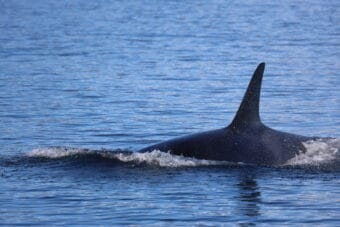
A whale surfaces in Glacier Bay in July, 2023. (Clarise Larson/KTOO)
Wildlife biologist Janet Neilson keeps a close eye on Alaska humpbacks. For the National Park Service whale monitoring program, she keeps a count of the whales that migrate up from Hawaii to feed in Glacier Bay and Icy Strait every summer.
During the summers between 2014 and 2018, she and researcher Chris Gabriele, who has led the park’s monitoring program for three decades, noticed something was off.
“Young whales, calves went missing. We had whales in the prime years of their lives go missing. And we certainly had some older whales go missing as well,” Neilson said. “But it really seemed like it hit all the whales.”
Neilson is one of 75 co-authors on a new study, which finds that almost 7,000 North Pacific humpbacks went missing between 2012 and 2021 — a 20% drop-off from the peak population of more than 33,000. Researchers believe they starved to death during the record-setting marine heatwave known as “the blob.”
Naturalist Ted Cheeseman is the one who brought all the whale researchers together. He’s the founder of Happy Whale, a photo database that uses artificial intelligence to quickly identify individual whales by the unique black-and-white patterns on the underside of their tail fins, or flukes. With Happy Whale, Cheeseman set out to do a simple population count.
“But when we first saw these numbers, it turned a population study into a climate study,” Cheeseman said.
That’s because the database revealed a sharp decline in humpbacks that coincided with “the blob,” which spiked ocean temperatures from Alaska to California between 2014 and 2016, killing fish,seabirds and more than 30% of Alaska’s humpbacks.
Climate change may complicate the species’ conservation success story. Back in the 1990s, Cheeseman worked as a tour guide in Antarctica. And he said humpbacks were hard to come by back then.
“We didn’t see many whales at all,” Cheeseman said. “We did, however, visit some of the largest whaling stations that were ever built — you know, they’re factories. Absolutely factories to turn living whales into product.”
Commercial whaling pushed humpbacks to the brink of extinction, but their populations in the North Pacific have boomed since it ended. Humpbacks were taken off the endangered species list in 2016. But around that same time, researcher Heidi Pearson was seeing the whales around Juneau get skinnier and skinnier.
Pearson, who researches at the University of Alaska Southeast, says these whales are usually more adaptable than other marine species. They can travel long distances to find food. And their diet is flexible.
“So the fact that they still declined due to what we think is lack of prey means that it must have been really bad,” she said.
She says she still believes in the resilience of humpbacks. But the study’s results make it clear that the species is feeling the pressure of warming driven by the burning of fossil fuels.
“I really learned a lot about the fragility, actually, of the ocean system to this warming,” Pearson said. “Animals and systems are resilient, but clearly during the heatwave they reached this tipping point.”
For Neilson, in Glacier Bay, the decline emphasizes the need to protect humpbacks even when their populations seem healthy. Though they’re recovering in Glacier Bay, she says, they’re still not back to their pre-heatwave levels. And they’re also frequently threatened by ship strikes and entanglements in fishing gear near the coast.
“It’s important to realize that the whales that we do see out on the water these days are survivors of a major ecological disruption,” Neilson said. “Those survivors deserve protection because more heat waves are coming.”
As those heatwaves come, real-time population monitoring for humpbacks may be more important than ever bef0re. The whales, which are large, coastal animals that are easy to track, can be indicators of overall ecosystem health in a rapidly changing ocean.
Technology like Happy Whale can help researchers better track whales as they migrate all across the North Pacific. The new study pulled more than 200,000 fluke images from the database, which were collected from researchers and more than 4,000 citizen scientists.
“The scale of problems that our world is facing today within the environmental realm — climate change being the biggest one — they’re only going to be solved by collaboration,” Pearson said. “No one can do it alone, in their one study site.”
A Cook Inlet beluga whale mother and calf. A research project has identified and catalogued a variety of calls that Cook Inlet belugas use to communicate with each other. The study also found that commercial shipping is the dominant source of human-made noise in the inlet and may be interfering with the endangered whales’ calls. (Photo by Hollis Europe and Jacob Barbaro/NOAA Fisheries)
For the first time, the underwater calls made by the endangered beluga whales in Southcentral Alaska’s Cook Inlet have been recorded, identified and cataloged.
To accomplish that, University of Washington Ph.D. student Arial Brewer spent thousands of hours listening to the noises captured from audio devices planted on the seafloor. The result was a catalog of 18 distinct calls used by the belugas, which were a mixture of whistles and pulsed calls.
And, importantly for the belugas’ conservation, there is now evidence that those calls might be getting drowned out by noises from the commercial ships that ply the marine waters of Alaska’s most populous region, according to a study led by Brewer that details the findings.
Commercial ships are the dominant noise source in the inlet, “the most prevalent and just lasted the longest,” Brewer said. “Commercial ship noise can last for hours and hours.”
Brewer, in addition to her Ph.D. studies, works at the National Oceanic and Atmospheric Administration’s Alaska Fisheries Science Center. That agency and the Alaska Department of Fish and Game were partners in the study.
Cook Inlet belugas, which number about 330 animals according to the most recent estimates, are among the world’s 21 beluga populations. Only a few have had their calls recorded and cataloged, so that raises questions about the specificity of the 18 Cook Inlet calls that Brewer found.
“Whether those are completely unique to Cook Inlet or they just haven’t been described in other populations, we don’t know for sure,” she said. But it would be logical to think that the Cook Inlet calls are geographically distinct because the beluga population there has been isolated for 10,000 years, she said. “So, you know, ecologically, I think it makes sense.”
Also yet to be determined, she said, is whether Cook Inlet belugas are increasing the sound levels of their calls so they can be heard over the din of ship engines and other manmade noises. That behavior, known as the Lombard effect, does happen elsewhere, such as among belugas in eastern Canada’s St. Lawrence River, she said.
During the project, which used acoustic devices planted on the seafloor at two key sites in 2018 and 2019, Brewer and her partners heard plenty of other underwater noise. What is believed to be oil and gas activity sounded like “jingling or flushing” she said. There were occasional bursts from small boats’ outboard motors. Even airplane noise could be distinctly heard from the bottom of the inlet.
“I was really surprised when I started on this project,” Brewer said. “You can hear if it’s like a commercial plane coming into the airport or if it’s like a little prop plane and it really sounds like it does in air.”
There are also natural sounds, like calls from humpback or killer whales that may swim through, and the scratching and popping of ice, which is likely seasonal background noise to Cook Inlet belugas.
For some environmentalists, the findings about ship noise are evidence that regulators need to do more to reduce effects on industrialization on Cook Inlet belugas, which federal scientists say numbered about 1,300 in 1979 but declined steeply after then.
The Center for Biological Diversity has been calling for a pause to issuances of incidental harassment authorization that allow operators in the inlet to accidentally disturb belugas and other Cook Inlet marine mammals. Those authorizations are granted under the federal Marine Mammal Protection Act, either by NOAA’s National Marine Fisheries Service or by the U.S. Fish and Wildlife Service, depending on the marine mammal species.
Under the act, the actions, known as “takes,” that are permitted through authorization can range anywhere from minor encounters that might cause a protected animal to have a slight physical reaction like a change in swimming direction to those that cause accidental animal deaths. The allowable takes depend on the type of authorization.
Some of the most recent authorizations issued for incidental harassment of Cook Inlet belugas and other inlet marine mammals were given in 2022 to Hilcorp for activities around a drill rig. The first authorization covered work until Sept. 14, 2023; and the second is valid until mid-September of this year. More recently, the National Marine Fisheries Service in January issued an incidental take authorization to the Port of Alaska for construction work.
The Hilcorp authorizations were issued over the objections of the Center for Biological Diversity and other organizations. In a petition submitted in 2022, the center asked NOAA’s National Marine Fisheries Service to stop issuing incidental harassment authorizations until it completes a study of the cumulative effect on the endangered beluga population.
“They’re allowing tens of thousands of these takes a year, and that’s just incredibly harmful,” said Cooper Freeman, Alaska representative for the Center for Biological Diversity. “And they have no idea what the cumulative effect of all that is.” Since most of the activities in the inlet do not require incidental harassment authorizations, a pause should not cause serious problems, Freeman said.
“The residents love Cook Inlet beluga whales and really care about these whales and want to see their recovery,” he said. “We think that the agency, by completing this cumulative analysis, can help meet their goal of recovering the belugas and get a better handle on all the impacts that are hindering their recovery.”
While authorizations issued over the past nine years allowed a cumulative 100,000 beluga takes, the actual number that occurred was far lower, according to a NOAA spokesperson. Virtually all the permitted takes in Cook Inlet have been for what is classified as minor disturbances not expected to cause harm, said agency spokesperson Julie Fair. Examples of allowable takes include research activities that support the agency’s Cook Inlet beluga recovery plan, she said.
Beyond the question of permitted takes, there is another way to reduce noise impacts to belugas and other whales: slower speed limits.
Brewer pointed to Washington’s Puget Sound as an example. There, in habitat for an endangered killer whale population, shippers are experimenting with slower vessel speeds. It is, for now, a voluntary program.
Additionally, a new state law that goes into effect next year creates a mandatory 1,000-yard vessel buffer there to protect the whales.
Noise disturbances have been at the center of concerns elsewhere in Alaska, including their potential effect on whales swimming in Arctic waters. There, climate change has reduced sea ice and expanded shipping opportunities.
A 2021 study by Canadian and U.S. scientists, including some from the University of Alaska Fairbanks and Alaska Department of Fish and Game, found that belugas and bowhead whales in the Chukchi and Beaufort seas are swimming in the same places where ship traffic is expected to increase. “Without proactive vessel management and effective mitigation measures, acoustic disturbance of whales is expected to increase, and eventually expand to more months of the year, as ship traffic continues to increase in step with increases in the length of the open water season,” the study said.
Two whales surfaces near Juneau in early September 2023. (Clarise Larson/KTOO)
By some estimates, Juneau is the world’s largest and most lucrative whale watching port.
“We are about double the size of some of the other busy whale watching ports worldwide,” said Heidi Pearson, a professor of marine biology at the University of Alaska Southeast. “And it’s because of the cruise ship industry.”
Each year, hundreds of thousands of visitors — including at least 367,000 cruise ship passengers — take a boat tour hoping to catch a glimpse of a fin or a fluke of humpbacks that come to Juneau to feed every summer.
The resident whales are beloved by visitors and locals alike. Many are even known by name, but scientists say there’s a lot we don’t know about their health.
A research team led by Pearson and her collaborators at the National Oceanic and Atmospheric Administration and University of Alaska Fairbanks hopes to change that with a proposed whale monitoring project, which would be funded by money from cruise ship passengers.
Whales in Juneau face all kinds of health stressors, but overcrowding from cruise ships tourists may be one of them. There are at least 72 active whale watching tour boats operating out of Juneau, and the fleet has been growing steadily over the past three decades.
But the population of humpbacks remains relatively small. Pearson says there are usually fewer than a dozen feeding in the area at any given time. All those tour boats could stress them out.
“We know that in the presence of whale watching vessels, they travel more quickly. They have shorter dives, and they have a faster respiration rate,” Pearson said. “We know there’s behavioral impacts, but what we don’t know is, you know, are they just short term impacts? Does it have any effect on the physiology or health of the whale?”
A whale surfaces near an Alaska Tales Whale Watching boat in early September 2023. (Clarise Larson/KTOO)
The proposed monitoring project will build on previous studies of whale stress and health, which took blubber samples from local whales to measure levels of the stress hormone cortisol. More long-term monitoring could shed some light on how whales are reacting to tourism pressure.
The project proposed budget is $160,000 to sustain regular blubber sampling and photographic surveys and to hire an additional researcher to analyze the data.
The funding would be generated by cruise ship passengers. The city of Juneau takes a $5 tax per person. But city Tourism Manager Alexandra Pierce said that money can’t be used for just anything.
“Passenger fee projects are pretty highly restricted,” Pierce said.
Back in 2016, the city was sued by Cruise Lines International Association Alaska, or CLIAA, the trade association for the cruise industry, for using passenger fees to construct the park that houses “Tahku,” Juneau’s iconic life-sized humpback whale sculpture.
The lawsuit was settled in 2019. But according to the settlement agreement, CLIAA has more of a say in how the city spends cruise passenger fees. Often, approved projects are concentrated in the downtown waterfront area.
The money can hypothetically be used for other things. But the cruise industry would have to approve it.
Pierce says that whale monitoring makes sense, because whale watching is one of the city’s most popular and lucrative tourist attractions, bringing in at least $60 million dollars annually. But she also says that Juneau’s whales are more than just money-makers.
“They hold a really important emotional place in the community,” Pierce said. “Both for visitors who were thrilled to be able to see them, and for residents who want to see them protected and not feel like they’re being harassed or bothered.”
In recent years, the health and happiness of the local whales has been the subject of public scrutiny. Some local whale watching companies have been looking for ways to minimize their potential disturbance to whales, but there’s not a lot of science to help them figure out the best way to do that.
With the monitoring project, researchers could learn more about disease, reproductive health, pregnancy, diet and other factors that affect whale’s health. Pearson says taking that holistic approach is important, because tourism is not the only stressor for Juneau’s whales.
A bald eagle takes off near Unalaska Bay. (Berett Wilber/KUCB)
A viral TikTok video posted on Jan. 20 brought Unalaska eagles to screens across the world. It was produced by Eryn Whittern, who moved to Unalaska in April of last year.
“When my husband first told me about it, I was like, ‘Unalaska? What are you talking about?’” Whittern said. “That’s pretty much what everyone’s reaction is on TikTok, too, because it sounds so weird.”
“Weird” is one way of putting it. Unalaska is an industrial town on an island wedged between the Pacific Ocean and the Bering Sea. It runs on diesel power and the might of the fishing industry. When it isn’t being pummeled by wind and rain, its natural beauty is nothing short of breathtaking. In the summer, wildflowers dot the island’s emerald-green hills and, during migratory months, whales breach in the safety of its bays.
It’s only fair that influencers might want to plant their flags here and make adventure content. But Whittern’s online presence is decidedly modest. She posts videos from her hikes and usually doesn’t “break the internet,” so to speak. That changed when she uploaded something originally meant for friends and family.
Last month, Whittern posted a TikTok video that has since racked up millions of views. It’s not of a dazzling vista or of wildlife running free in the Aleutian tundra. It takes place at the Unalaska City Landfill — and readers should know that it does contain some astonished profanity.
“I was going to the dump with my trash, and there were a ton of eagles there,” Whittern said. “There’s always a bunch, but there was an exceptional amount that day.”
The video opens with a dirty bald eagle, milling around by itself. Then Whittern pans to another eagle. And another. One flaps across the shot and a new tableau is revealed: the interior of the landfill baler building, with a whole flock of eagles perched atop a trash pile. Whittern pans to a walkway near the ceiling, its railing lined with over a dozen birds.
Comments poured in from all over the world. Many viewers had no idea Unalaska existed until they saw Whittern’s post. One skeptic, however, didn’t think the video was filmed in Alaska at all.
“A person commented that I’m not really from Alaska,” Whittern said. “I’m just faking it to get clout. The reasoning was that in the video, we didn’t have any snow.”
As for future posts, Whittern’s plans remain unclear. She said some of the comments she got on the viral video made her apprehensive to post again. But there are still things she wants to capture that would be hard to find anywhere else.
“Now I have all these followers and I’m like, ‘Should I post something?’,” Whittern said. “Even when I was driving here, there were a couple of eagles sitting on the light posts, and they had their wings out — they’re drying their wings. I was like, ‘I bet you people haven’t seen that before.’”
Regardless of what Whittern does next, one thing is certain: there will be no shortage of Unalaska oddities waiting for their moment in the spotlight.
Tundra voles are among the small mammals Dr. Phil Manlick, with the U.S. Forest Service, studies to understand how warming is changing boreal and Arctic food webs.
Tiny organisms are making big moves in Alaska’s boreal and Arctic ecosystems, encouraged by climate change.
Underground fungi and bacteria are becoming more active as permafrost thaws in northern regions, breaking down dead plants and other organic matter that was previously frozen in the soil. Scientists call this new activity a “microbial awakening.”
A new study led by U.S. Forest Service research biologist Phil Manlick found that the microbial awakening is actually changing the structure of the Arctic and boreal food webs, that is, it’s changing the interconnected relationships between organisms and what they eat.
“What it means is that a food web that was in the past, supported by primary production in plants, is now supported by decomposition,” Manlick said.
Manlick and his team studied samples from small mammals collected at the Bonanza Creek Experimental Forest near Fairbanks over the last 30 years of warming. During that period, they determined that fungi were becoming a bigger part of the animals’ diets.
Manlick calls this a “browning” of the food web. In the past, most of the energy supporting small mammals like shrews and voles came from eating plants. Now, he said, for some species, most of that energy is derived from fungi.
“We can say, with very strong certainty, that fungi are becoming a really, really important player in terms of energy,” Manlick said. “If you look at a shrew in 1990, they were probably getting 40 to 50% of their energy from fungi. And now it’s like 90 to 100%.”
Manlick said there’s still a lot that scientists don’t understand about the ripple effects this new abundance of energy will have on northern ecosystems, which are rapidly transforming as a result of human-caused climate change.
Amanda Koltz, a University of Texas ecologist who co-authored the study, said it’s already understood that increased microbial activity as a result of permafrost thaw has global implications.
Decomposition in the soil releases carbon dioxide and methane into the atmosphere, which adds to the carbon emissions humans are already pumping out, speeding up global warming.
The world’s permafrost is estimated to hold twice as much carbon as is currently in the atmosphere.
“Even though these northern ecosystems — at least for folks down south — seem very far away and irrelevant, it’s not actually true, because what happens in the Arctic and in the boreal is really globally relevant,” Koltz said.
The Arctic is already warming four times faster than the rest of the planet due to climate change.
Manlick and his team have more research planned to study how the microbial awakening is impacting higher levels of the food web this summer.
Matthew Wooller, director of the Alaska Stable Isotope Facility at the University of Alaska Fairbanks, kneels among the mammoth tusk collection at the University of Alaska Museum of the North in 2021. Wooller is coauthor of a study that analyzed the layers in a tusk left by a female woolly mammoth that died in Interior Alaska 14,000 years ago. Evidence is that the animal was killed by ancient hunters living in the area. (Photo by JR Ancheta/University of Alaska Fairbanks)
Chemical analysis of a 14,000-year-old woolly mammoth tusk found that the animal, a healthy female that trekked about 1,000 kilometers (600 miles) from Canada’s Yukon Territory before dying at 20 in Interior Alaska, had territory that overlapped that of early humans.
The chemical fingerprints in the tusk, combined with DNA analysis of the bones of two young mammoths found in the area, create a compelling case that the people who lived in Pleistocene-era Alaska hunted the giant animals, according to research led by University of Alaska Fairbanks scientists. The findings are detailed in the journal Science Advances.
The mammoth was discovered in 2009 and named Élmayųujey’eh, or Elma for short. The name, bestowed by the Healy Lake Tribal Council of Interior Alaska, translates to something not beautiful but very striking in appearance.
Found along with Elma’s tusk were remains of two juvenile mammoths – the ribs that held meat known to be used elsewhere by ancient humans. They died near a spot along the Tanana River known as Swan Point, which is the earliest confirmed human habitation site in Alaska. Isotope analysis of the tusk shows a life’s journey that began in the vicinity of ancient human settlements in Canada.
Though there is not a “smoking gun” showing that Elma was killed by hunters, there is a “preponderance of data” supporting that conclusion, said Matthew Wooller, a coauthor and director of the Alaska Stable Isotope Facility at UAF, where the chemical analysis was conducted. Elma’s journey started in the vicinity of known sites of ancient human habitation in Canada and ended abruptly in the vicinity of a known human habitation site in Alaska, where campsites hold evidence of hunting in general, such as remains of other animals and blades typically used in hunting. “So it’s just uncanny to us,” Wooler said.
The reconstruction of Elma’s life journey provides valuable information for modern animals now roaming the same territory that she trod. It is a warning sign for conservation of critically endangered large animals like rhinos, said Audrey Rowe, a UAF PhD student who is the study’s lead author.
“Really, my takeaway is that large animals are so much more fragile in terms of extinction than smaller ones,” Rowe said. “You see this over and over again throughout the history of the planet.”
She cited the way that non-avian dinosaurs disappeared but tiny mammals that were scurrying around the planet at the same time endured. The pattern continued through the end of the last Ice Age and into modern times, she said. Larger animals that take longer to reproduce are “not resilient against sudden changes,” she said.
For woolly mammoths, the reasons for extinction continue to be debated. Were they victims of climate change, or were they hunted into oblivion by ancient humans?
Rowe said does not belong to either “camp climate change” or “camp overkill.”
It is unlikely that mammoths would have survived in Alaska, at least, even if there were no people, she said. But overhunting could have contributed to the demise, especially considering how long it took them to reproduce. They reached sexual maturity at about 15 years, and their gestation period was about 22 months, she said.
“So killing one mammoth is a bigger impact on the population than killing one bison or one moose or one caribou just because of that much longer period of time that it takes for them to reproduce,” she said
Elma’s fate was different from that of a different Alaska woolly mammoth that trod much of the same ground about 3,000 years earlier, a male named Kik. Previous isotope analysis of his tusk, also done by the UAF team, traced his wanderings in Interior Alaska and through the Brooks Range until he died, alone, of starvation at about age 28. Those findings were released in 2021.
There were some revealing differences between Elma’s travels and those made by Kik. Elma chose more high-elevation areas, which made sense because the climate changed significantly in the 3,000 years since Kik’s travels. By the time Elma was on the scene, warming had caused lower elevations to be wetter, soggy and brushier, making it more difficult for such large animals to navigate than the steppe-dominated landscape of Kik’s time, Wooller said.
“For anybody that has done any walking about in Alaska, you know, the last place you’d want to be walking about, during summer certainly, is down in the kind of swampy lowlands, the muskeg and the like,” he said.
All those movements could be tracked back in time in the layers of Elma’s and Kik’s tusks. Mammoth tusks, which grew in layers at consistent rates throughout the animals’ lifetimes, turn out to be excellent recorders of history, matching what the animals ate to the varied geologic structures across Alaska, which have their own chemical fingerprints, Wooller said.
A caribou walks by the Hulahula River in the Arctic National Wildlife Refuge in 2019. Information about extinct woolly mammoths could help shed light on the history of Alaska’s modern caribou. (Photo by Alexis Bonogofsky/U.S. Fish and Wildlife Service)
The findings about Elma, on top of those about Kik, are proving useful for another animal that travels long distances over Arctic Alaska terrain: caribou.
Like the extinct mammoths, caribou depend on a climate that is changing rapidly, becoming less hospitable as woody shrubs spread north and displace the tundra plants that caribou normally eat.
Caribou are not in danger for now, as they reproduce quickly and have the benefit of modern wildlife monitoring and management, Rowe said. But there are some potential trouble signs, she said.
“If the entirety of Alaska starts to be covered in boreal forest or maybe even if more temperate climates start to creep northward into where we live, that would not be ideal for caribou and we might see a lot more moose, a lot less caribou perhaps,” she said.
As part of her research into ancient caribou and reconstruction of herd movements, Rowe is using isotope analysis of teeth that is similar to what has been used on the woolly mammoth tusks. She is comparing modern teeth from the Fortymile herd with teeth from ancient caribou that used the same territory. Part of her work will be to determine whether the ancient and modern caribou are linked or are completely different biologically, as well as determining if they have been ranging over the same territory for thousands of years or have made changes in their travels.
Analysis of the teeth is more challenging than that performed on the much-bigger mammoth tusks, Rowe said. Unlike mammoth tusks, caribou teeth grow at uneven rates and stop growing entirely after the animals’ first two years of life.
There are other key differences, aside from the obvious fact that caribou are still here while mammoths are not.
Mammoths didn’t really migrate in the sense that biologists use the word, she said. They traveled around a lot to find food, but they did not use regular seasonal back-and-forth pathways.
University of Alaska Fairbanks Ph.D. student Audrey Rowe, the lead author of a study describing the life journey of a woolly mammoth that roamed Alaska 14,000 years ago, works at an archaeological site near Swan Point in Interior Alaska. (Photo by Matthew Wooller/University of Alaska Fairbanks)
Mammoths were among those animal species with small feet for body size, which appears to be a feature that helped doom certain Pleistocene animal species that were not able to adapt to post-Ice Age change to a warmer climate with more swampy terrain and more snow. Like mammoths, extinct woolly rhinos and ancient Pleistocene horses that once roamed northern Alaska had small feet relative to their body weight, while caribou, moose and muskoxen and other animals with feet large enough to spread out body weight more effectively on soft surfaces are still here.
The string of ancient human sites along the Tanana River, aside from suggesting hunting of mammoths that regularly traveled that corridor, show how habitat changed over thousands of years. There was a shift from a heavy reliance on big Pleistocene mammals during Elma’s time to more bison and elk about 1,000 years later to a much heavier reliance on caribou starting about 6,000 years ago.
Elsewhere along the Tanana River corridor, though not at Swan Point specifically, is evidence of ancient people eating salmon. The oldest archaeological evidence of salmon consumption was found at a site known as Upward Sun River. There, 11,500-year-old chum salmon bones found by UAF anthropologist Ben Potter, also a coauthor of the study about Elma, showed how ancient people started a shift into fishing.
While changes in the landscape are believed to have driven mammoths into oblivion, their disappearance could have also changed the landscape. Through grazing and tramping on the ground, they put a check on the spread of vegetation and helped preserve permafrost freeze, Wooller said. “And so the removal of ecosystem engineers would certainly have had an impact, for sure,” he said.
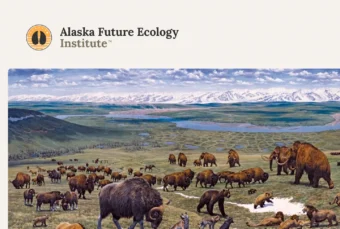
Partly because of that and partly because of the general fascination with the ancient creatures, there are efforts to resurrect the species. Wooller is a scientific adviser to one company, Colossal Laboratories and Biosciences, that is seeking to reestablish mammoths or mammoth-like cold-climate elephants to help restore far-north grasslands like those of the past, which it describes as better carbon sinks than the current mossy and forested terrain that has succeeded the mammoths’ era. There are other companies, in the United States and in Korea, that are pursuing the same goal. Possible methods could use ancient DNA and replicate it through cloning or employ some sort of artificial insemination with modern elephants. Another project, Pleistocene Park in Siberia, is focused on recreating the steppe ecosystem that supported the extinct mammoths, using large grazers like bison and muskoxen to do so.
Rowe is skeptical that Alaskans would welcome giant elephant-like creatures stomping around the state’s Arctic landscape in the modern era. But if not practical for Alaska, the idea is more intriguing for a different location, like Siberia or Mongolia.
“I personally think it would be really cool to be able to see a mammoth or something close to it again,” she said. “Maybe not necessarily here, but I certainly, I would certainly take a trip to Pleistocene Park to see it if that were to happen someday.”