Wildlife

Anchorage’s white raven has become a local legend

Kathrin Seymour, owner of Kat’s Wilderness Photography, says she made a lot of friends with other photographers, as they passed the time in Spenard parking lots, hoping to catch sight of the white raven. (Courtesy Kathrin Seymour, Kat’s Wilderness Photograph)

Since October of last year, Anchorage has been visited by a rare, feathered celebrity — a white raven, which appears to have taken up residence in the Spenard neighborhood.

Last summer, the raven was spotted south of Anchorage on the Kenai Peninsula, where biologists confirmed the bird is not an albino but leucistic — which means it has a gene that causes a loss of pigmentation. It also has blue eyes. Biologists believe it’s most likely the same bird that has delighted Anchorage this winter.

Almost every day you can find new photos of the raven on Facebook on a page called Anchorage White Raven Spottings. There, you can see the bird aloft with its feathers, translucent through the light, or at play with another raven in the snow. Someone recently snapped a shot of the raven, as it strutted with a slice of pizza in its beak.

There’s also footage on Facebook of the raven loosening a bolt on a streetlamp and carrying it off in its beak, and a guy in conversation with the bird from its perch near McDonald’s.

Glen Klinkhart, a retired Anchorage police detective, says he uses some of the surveillance skills he learned in law enforcement to track the raven down. (Courtesy Glen Klinkhart)

Among the most recent posts, there are regal photos of the raven perched on a spruce bough as the moon rises in the backdrop. Many faces of the bird have been captured by a ravenous Anchorage paparazzi, who don’t seem to compete against one another but cooperate by sharing tips on how to photograph their quarry.

“It’s just so different. It is so out of the norm,” says Glen Klinkhart, a retired Anchorage police detective who has almost made tracking the raven a full-time job.

“We all know what a raven looks like. We all know the shape, how it’s supposed to look,” Klinkhart said. “And then when you see this, this white raven with this genetic difference, it just kind of stops you.”

Michelle Hanson captured a shot of white raven paparazzi behind Billiard Palace and Bar. (Courtesy Michelle Hanson)

Scientists say the white raven is very rare. But how rare? Rick Sinnott, a wildlife biologist, says he knows of only two other white raven sightings in Anchorage. The last one was 20 years ago in the Midtown area.

“It wasn’t as white as this one,” said Sinnott, who remembers that its feathers were tipped with a bronze hue. “It was shiny bronze. It was very beautiful.”

Sinnott says another white raven was spotted 20 years before that and believes three sightings over the course of four decades meets the definition of rare, especially when you consider the genetic odds. Sinnott says it would take both a male and a female with a recessive leucistic gene to mate — and even then, maybe one of four chicks would be white, if any at all.

Ravens are smart enough to know what they look like and can recognize themselves in mirrors, so Sinnott worried that other ravens would pick on the white raven because it’s different. But he’s glad that doesn’t appear to be the case.

“When it’s around other ravens, it doesn’t seem to raise feathers around the top of its head, which would suggest it’s not subordinate,” Sinnott says.

Glen Klinkhart took this photo of the raven after it had a squawking match with four other ravens over a carton of Häagen-Dazs ice cream. (Courtesy Glen Klinkhart)

In fact, the white raven behaves more like an “alpha” bird. In a recent post, Klinkhart shared pictures of the raven in a spat with four black ravens over a discarded Häagen-Dazs carton of White Raspberry Chocolate Truffle ice cream. In the last photo in the series, the raven shows off its prize.

It’s one of more than 10,000 photos Klinkhart has taken of the raven since October. But there’s one that he’s especially proud of, taken on a day in which he found the bird completely alone. He laid down on the ground to watch, with camera in hand.

“It started getting closer and closer. And I just froze. I’m like, ’Don’t move. Don’t affect its behavior. Let it behave,’” said Klinkhart, who wondered if the bird was just curious.

“That white raven came (within) about two feet of me and looked in my camera lens,” he said. “Then it tilted its head. And then it waddled off.”

Klinkhart says he was so close to the bird that the photo showed his reflection in the bird’s blue eye, a magical moment. Since that first time, the raven has come close to Klinkhart’s lens a couple of times. In a video, the bird comes so close that Klinkhart is unable to focus his camera.

In many Alaska Native stories, the bird is a mystical being.

Meda DeWitt, a Lingít healer who works with medicinal plants, says she first heard about the white raven’s meaning years ago from another traditional healer, the late Rita Blumenstein, known as Grandma Rita — a Yup’ik from Southwest Alaska, trained by her elders from childhood to ease pain and suffering.

“This is one of the stories that she would tell that brought hope,” DeWitt said. “She would say, ‘We will see a white raven, and that’s when we’ll know that humanity as a whole is shifting towards one of peace.’”

DeWitt says it’s a prophecy Grandma Rita heard from her elders, an example of the white raven’s long history throughout the world as a messenger bird. Even the Greek god Apollo had one, which turned from white to black after displeasing him.

Rita Blumenstein at the 2019 Rural Providers Conference at Alaska Pacific University. Blumenstein, who was known as Grandma Rita, was known for her healing hugs. (Rhonda McBride/KNBA)

In Alaska Native stories, Raven also transforms. DeWitt says not to forget that Raven is a trickster who finds trouble. Her uncle tells a story about how Raven wanted to bring mankind fresh water to drink, so he tried to steal a bucket from a chieftain’s house. Soot blackened his feathers as he escaped through a smoke hole. In another version of the Lingít story, Raven turns black after he steals the moon, the sun and the stars to bring light into the world.

DeWitt believes Raven has transformed yet again and has returned to encourage mankind to save the planet, a message especially important to Alaska Natives.

“Our whole job is to steward the earth, and if the earth is sick, that means we’re sick,” DeWitt said. “When I see something like White Raven, it gives me a profound sense of hope. Even beyond hope, knowing that we’re going to be successful.”

Floyd Guthrie, another traditional healer who is Tsimshian, Lingít and Haida, says he has waited a long time for the white raven to appear.

“It makes our hearts feel good, because we connect to the truth of his existence,” said Guthrie, who believes the raven has always been around to watch over humans but not necessarily visible.

“It’s so wonderful to see White Raven with the blue eyes,” Guthrie said. “In his own way, he just has to tell us, ’I’m not very far away from you.’”

Guthrie and his wife, Dr. Marianne Rolland, specialize in treating trauma. Years ago, when Rolland was searching for a name for their counseling center in Anchorage, she says the words “White Raven” came to her, not in a voice, but from what she calls a place of knowing.

“White Raven is reminding us of our own spirituality and of what we’re here on earth to do,” Rolland said. “That we’re not just physical human beings, but we’re spiritual beings.”

Rolland says she’s not surprised by the hundreds of raven photographs that have been posted on Facebook, which include artwork the bird has inspired. From paintings to sculptures to beaded earrings, there’s almost a cottage industry of art featuring the raven, not to mention mugs, stickers and keychains.

“White Raven opens hearts, and opening up hearts opens up creativity,” said Rolland.

Jerrod Galanin of Sitka was inspired by white raven photos to make a copper and silver bracelet. He says not long afterwards, the raven found him as he was driving in Anchorage. (Courtesy Jerrod Galanin)

After seeing the photos, Jerrod Galanin felt the urge to fashion a Lingít-style, copper armband with the white raven in silver. Not long afterwards, it was as if the bird sought him out.

“The flight pattern was like sporadic and kind of crazy,” said Galanin. “And so, I looked closer, and it landed on a light post, right on top of us.”

Some Facebook followers have speculated about whether the white raven is male or female. Biologists say it’s hard to tell for sure. The males are a little larger and can have pouches with a bigger bulge under their throats. Rick Sinnott, the biologist, says males also like to show off during courtship.

“He’ll fly up in the air and drop sticks and fly down and pick them up, catch them as they fall. Or do all kinds of aerobatics, like you see them flipping on their back and doing all kinds of things,” Sinnott said. “When males are trying to impress females, they go into quite a frenzy of that kind of behavior.”

Sinnott says the mating season begins at the end of January and runs through March, so we may soon find out whether the raven is a him or a her. Or maybe not. Sinnott says sometimes ravens just like to entertain their buddies.

Sinnott says when ravens take up urban life, you can usually find them hanging out near busy intersections, where there are restaurants and grocery stores. And for the white raven, that means plenty of dumpster dining. Seems the bird has favored those at the Spenard Roadhouse. As one Facebook poster put it, “At least the white raven has good taste.”

Michelle Hanson, a photographer who recently moved from Colorado, now has a photo business in Alaska, mhphotoco. She has been following the white raven’s interactions with other ravens. She says the two ravens were atop a light pole and appeared to be having a tender moment. The photo she posted on Facebook has some speculating that there might be a raven romance going on. (Courtesy Michelle Hanson)

From the progression of photos from October, the raven appears to have fattened up, but maybe it’s just the bird’s feathers fluffing up to survive the subzero temperatures.

Sinnott says it’s likely the raven will move on come spring and head out into the wilderness. Ravens are known to travel hundreds of miles away. Some birds tagged in Anchorage have been spotted as far away as Juneau, Fairbanks and the North Slope.

But for now, the white raven brings warmth and cheer into the heart of an Anchorage winter.

As Floyd Guthrie says, it is here to say, “I see you.”

Editor’s note: Audio of the white raven unscrewing a bolt on a street lamp was from a Jennifer Collin’s video. Sound of the bird preaching to the choir came from a Todd Billingslea video.

Petersburg Christmas Bird Count records highest number of birds in recent memory

Brad Hunter looks at waterfowl through his spotting scope at Hungry Point. (Shelby Herbert/KFSK)

Petersburg birdwatchers cataloged scores of birds for the Audubon Society’s Christmas Bird Count, an annual citizen science inventory of birds across North America. The island community counted the most birds in recent memory.

Splinters of sunlight pierced the morning mist at Hungry Point, a recreation spot on Petersburg’s northern coast. A flock of scoters bobbed in the surf. They’re large dark sea ducks with white markings around their faces. Brad Hunter had his spotting scope trained on them.

“So, there’s three species of scooters: surf, white wing, and black,” said Hunter. “The first two are the most predominant ones we have here — but the black ones are the ones that talk the most. So you know they’re out there because you hear them.”

Hunter didn’t need his sophisticated lens — or even his eyes — to know what types of birds are around him. He can identify many species in the region by sound alone.

“Actually being able to hear the birds is a huge part of identifying what species are out there,” said Hunter. “Visually seeing them is a big part, of course, but when you hear their call, hear their song — it’s very important.”

…Even when that song gets interrupted by other wildlife. Sea lions intermittently barked over the scoter calls.

Hunter has compiled Mitkof Island’s Christmas Bird Count data for the Audubon Society since the mid-90s. He said the group of about a dozen Petersburg birders had a remarkable inventory this year. Hunter is still finalizing the numbers, but by his latest figure, the group tallied a little over 9,000 birds around the island — and that was all in one day.

“I think it’s interesting,” said Hunter. “It’s notable!”

It’s not just the quantity that has Hunter so excited. The group also spotted an exceptional number of species at this year’s count: 61, over their previous high of 57. Hunter said the air was thick with uncommon seabirds this year.

“There’s also some seabirds that are still here,” said Hunter. “We typically do not get Bonaparte gulls on the Christmas Bird Count. But this year, we had quite a few of them.”

He doesn’t know why there were so many birds out and about this winter. But his best guess is that recent warm weather might play a part.

“We suspect that some of the birds that would have headed on South if ice had formed, and lakes and ponds were frozen over,” said Hunter. “[But] they have stayed around longer than normal.”

The climate pattern known as El Niño is cycling warmer water through Southeast Alaska. The resulting unseasonably calm weather is also making it easier for Petersburg’s birdwatchers to stay out longer. Hunter said his group has braved much worse conditions for the count in previous years.

“We’ve had so many terrible weather days for Christmas Bird Count,” said Hunter. “It’s hard to pick one of them out as the worst… But we’ve had some pretty bad ones where it’s blowing 30, 40, and snowing mixed in with rain. Or the roads are all icy, and deep snow — it can be challenging some years.”

Fair weather or not, Hunter said the count is important to him. And that’s because the data birdwatchers collect will help scientists better understand how bird populations are changing — and, eventually, how to better protect them. He said the process of learning about regional birds is also meaningful to him.

“I just find it interesting, just to keep growing and challenging myself and learning more about them — and especially learning about them around here,” said Hunter. “Some people travel all over the world to see how many species they can find. My challenge to myself is to see how many I can find around home.”

That’s what keeps him coming back, year after year.

Scientists and townspeople rescued 2 orcas trapped in a Southeast Alaska lake

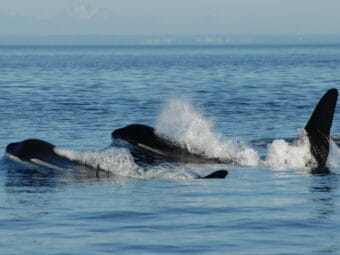
A killer whale surfaces in Barnes Lake during the live stranding rescue effort. (Photo courtesy of Jared Towers, collected under National Marine Fisheries Service Permit Number 24359)

Late this summer, two killer whales swam into an ocean-fed lake on Prince of Wales Island and got trapped. The effort to free the whales took a collaboration between scientists and residents of the remote island town of Coffman Cove — with some extra help from the whales’ friends.

It’s possible to get into Barnes Lake from the ocean, but only at high tide, in a small boat.

Doug Rhodes lives around the corner in Coffman Cove, an ex-logging town with a winter population of around 100 people. He says those entrances are the only way to get to the lake, and they’re only passable by small boats at high tide.

“The north entrance is like a class four rapids at maybe two hours after the tide, and the south entrance is a waterfall,” Rhodes said.

So it was a bit of a surprise when two killer whales found their way into the lake in mid-August. Rhodes says at first, people were more curious than concerned.

“It was kind of a novelty thing, you know, ‘There’s whales in Barnes Lake!’ Everybody just figured they’d get out on their own,” he said.

But the window around high tide is short, and the entrances to the lake are small. The whales didn’t get out on their own. After a couple of weeks, folks in Coffman Cove called the experts.

Mandy Keough from the National Oceanic and Atmospheric Administration whale stranding hotline gathered a group of researchers and scientists with experience in orca live strandings. They were concerned about the whale’s body condition. The lake is freshwater fed, so it’s less salty than the ocean, and orcas need salt water to survive.

Jared Towers is a killer whale specialist with Fisheries and Oceans Canada. He says he knew it was possible the whales could get out on their own, but there was another possibility.

“They end up dying in there,” he said. “And dying a slow death because they’re basically starving to death.”

That’s because these were Bigg’s, or transient, killer whales. They eat mammals, not fish. Barnes Lake is full of salmon, but not many seals and sea lions.

The response team decided that their best chance of getting the whales out was during the big tides in late September, a few weeks away.

They would need boats on the lake — more than a dozen. And the researchers said they needed at least three people in each boat. That meant nearly half the town would be out on the lake. Rhodes says that wasn’t a problem.

“As it went on the energy level in town kept building, and more and more people wanted to get involved,” he said.

They would use nets in the water, which the whales experience as a barrier. And they would herd the whales using sound — by submerging metal pipes in the lake and banging on the exposed end. Each required special equipment, which the volunteers made with what the had around town.

The townspeople kept the scientists updated on the whale’s health with photos. From the photos, Towers was able to identify the whales as T051, a 42-year-old male, and T049A2, a 16-year-old male. Towers even knew which orcas they’d traveled with in the past. Not only that, he had actual recordings of those travel partners. The recordings could be played under water to lure the stranded whales toward the sound, a technique called “playback.”

Chloe Kotik studies Bigg’s killer whales for her doctorate degree at the University of Alaska Fairbanks. She says the barrier nets and sounds of metal pipes are stressful to whales. She says playbacks can be really effective, but they’re also stressful.

“When you play a recording of a killer whale that isn’t really there, for them, it’s like seeing a ghost,” Kotik said.

Kotik and Towers arrived with two other scientists a few days before the high tides. More than six weeks after the whales were spotted, 14 small boats filed into Barnes Lake.

Towers and Kotik started the playbacks, luring the whales toward the north channel. Volunteers in the boats banged the submerged pipes to urge them on.

At first, it seemed to be working. The whales responded to the playbacks by breaching and slapping the water with their tales. They followed the sound and entered the north channel. The boats lowered nets to keep the whales from turning back. But a thick kelp bed was blocking the entrance to the channel.

Time was short — the tide was going out. Towers says they knew it was their only shot that day.

“If that whale and the other one didn’t make it through the kelp, our window was over,” he said.

Then the bigger whale turned and swam back into the lake, ignoring the nets and sounds of the pipes. The younger whale was close behind. Towers says even the boats were in danger of getting stranded in the lake. Rapids were forming in the channel.

“We just radioed the others and said, you know, our time’s up,” he said.

Kotik says based on the weather forecast, they likely only had one more day to get the whales out. But more than that, she was worried that they’d already asked too much of the volunteers.

“These people in Coffman Cove have already given us so much of their time and their energy and their help,” she said. “And we didn’t get them out today, how much can we really ask them, and are they going to be willing to help us out with this?”

But when they got to the dock at Coffman Cove, the volunteers were waiting, ready to make plans for the next day.

“It was such a weight off of my shoulders to realize like oh my god, they’re still in it with us,” she said. “They haven’t lost faith in us. They haven’t lost hope.”

The next day they started at the south entrance, which was free of kelp. This time, when the whales heard the playbacks, they were all business. Rhodes and Fecko were in a boat with nets.

“And so they got out in the middle and played this playback, and we looked up and we see the whales coming towards us, and they were picking up speed as he was playing the whale sounds,” Rhodes said.

“There was a bow wake in front of these whales, they were just bookin’ it!” laughed Fecko.

As they charged toward the playback of their friends, the whales called out. The scientists’ underwater microphone picked up the sounds.

“We were just standing there hearing whale sounds across the water as they came by and, oh geez, there were people whooping and hollering and cheering, there were people crying out there.”

As they neared the southern entrance, one the whales dove deep.

They had to wait to deploy the nets until they were both past and in the channel.

They got the net out behind the whales. But Rhodes said it hardly seemed necessary.

“At that point, those guys were probably going ten knots. They didn’t think twice, they just busted right on out of there,” said Rhodes.

The playback boat led the whales through the channel. The southern entrance is long and winding and rocky. Towers said it took 10 to 15 minutes to pass through.

“I was holding my breath for a long time,” he said. “I told myself, ‘Okay when they’re past the maple tree we’re good,’ because there’s this beautiful big Canadian maple on the shoreline at the beginning of the south channel.”

They passed the maple. They kept swimming, out into Lake Bay, and then beyond. The boat followed them for a couple hours.

Kotik says they weren’t sure how the pair would adjust to their freedom.

“Then we saw a kind of shift into this much more quiet, purposeful swim,” she said. “And I think it was because they were starting to hunt. And that moment of seeing that shift was such a relief of like, ‘I really do think they’re going to be okay.’”

Towers and Kotik skiffed back to Coffman Cove. They found a celebration in full swing. Doug Rhodes and Cheryl Fecko said the local bar got plenty of business that night.

“You couldn’t you couldn’t hear in that bar. Everybody was just chattering away,” said Fecko.

“The bar was hopping, everybody was in there. I don’t know if the scientists bought a drink that night at all,” laughed Rhodes.

Scientists don’t know where the pair is now, but they will be spotted eventually. Researchers keep tabs on killer whales through photos sent in by scientists and civilians.

Avian influenza death of Alaska polar bear is a global first and a sign of the virus’ persistence

A polar bear walks along the shore in Alaska on Sept. 6, 2019. A different animal discovered dead in October near Utqiagvik is now confirmed to be the world’s first documented case of highly pathogenic avian influenza in a polar bear.(Photo provided by U.S. Fish and Wildlife Service)

A polar bear found dead on Alaska’s North Slope is the first of the species known to have been killed by the highly pathogenic avian influenza that is circulating among animal populations around the world.

The polar bear was found dead in October near Utqiagvik, the nation’s northernmost community, the Alaska Department of Environmental Conservation reported.

The discovery of the virus in the animal’s body tissue, a process that required sampling and study by the North Slope Borough Department of Wildlife Management and other agencies, confirmed earlier this month that highly pathogenic avian influenza was the cause of death, said Dr. Bob Gerlach, Alaska’s state veterinarian.

“This is the first polar bear case reported, for anywhere,” Gerlach said. As such, it was reported to the World Organisation for Animal Health and has gotten attention in other Arctic nations that have polar bears, he said.

This was also the first Endangered Species Act-listed animal in Alaska known to fall victim to the disease. Polar bears, dependent on sea ice that is diminishing because of climate change, were listed as threatened in 2008.

While polar bears normally eat seals they hunt from the sea ice, it appears likely that this bear was scavenging on dead birds and ingested the influenza virus that way, Gerlach said. Numerous birds on the North Slope of various species have died from this avian influenza, according to the Department of Environmental Conservation.

Dr. Bob Gerlach, Alaska’s state veterinarian, stands outside the Department of Environmental Conservation lab in Anchorage on May 13, 2022. (Photo by Yereth Rosen/Alaska Beacon)

However, the bear need not have directly eaten an infected bird to have become sick, Gerlach said.

“If a bird dies of this, especially if it’s kept in a cold environment, the virus can be maintained for a while in the environment,” he said.

The polar bear death is a sign of the unusually persistent and lethal hold that this strain of highly pathogenic avian influenza has on wild animal populations two years after it arrived in North America, officials said.

“What we’re dealing with now is a scenario that we haven’t dealt with in the past. And so there’s no manual,” said Andy Ramey, a U.S. Geological Survey wildlife geneticist and avian influenza expert.

No longer just a poultry problem

Highly pathogenic avian influenza is called that because it spreads rapidly in flocks of domestic poultry, often requiring massive culls to control the contagions. Such outbreaks have been of concern in the past because of their economic consequences for global agriculture. Until recently, wild birds were afterthoughts. Though they were known to carry the viruses, ferrying them between domestic poultry populations, they were largely unaffected.

That has changed dramatically. The prior U.S. outbreak of highly pathogenic avian influenza, in 2014-15, resulted in some wild bird infections, and some influenza-caused bird die-offs occurred in Europe shortly thereafter.  But the current version is considered unprecedented in its effect on wild birds and other wildlife.

“Across North America, and really around the world, lots of wild birds these days – I mean, thousands of wild birds these days, tens of thousands in some cases — are dying because of these highly pathogenic avian influenza viruses,” Ramey said.

The deaths are of particular concern when they occur in populations that are already vulnerable, he said. An extreme example he cited is the highly endangered California condors, with a population of just a few hundred. After 21 influenza deaths were documented, federal wildlife officials launched what promises to be a challenging vaccination program in that population.

U.S. Geological Survey wildlife geneticist Andy Ramey, standing at University Lake in Anchorage on May 18, 2022, is a leading authority on avian influenza. (Photo by Yereth Rosen/Alaska Beacon)

The disease has also killed a variety of mammals around the world.

In Alaska, three foxes, a black bear and a brown bear have died from this avian influenza. Elsewhere, more bears have been found dead after being infected by the virus, along with skunks, raccoons, mountain lions and large numbers of seals in eastern Canada and off the coasts of Maine and Washington state, as well as outside of North America.  The nation’s first detection of the disease in a squirrel was confirmed earlier this month in an animal found in Arizona.

To Gerlach, the polar bear case was not surprising, considering that black and brown bears have died. It is possible that more polar bears succumbed to the disease, but in remote places out of the view of people to record the events, he said.

“You’re really dependent on the public that’s out there, or the wildlife biologists that are doing surveillance,” he said. Documenting cases in any wild mammal population can be difficult, he added: “How long is a carcass going to be in the wild before it gets scavenged or eaten by something else?”

Aside from the large and wide-ranging death toll in the wild, the current outbreak has some other differences, particularly its durability, as seen in its persistence away from domestic flocks.

The virus that caused the 2014-15 outbreak spread in the wild bird populations for a while, but it “sort of fizzled out,” Ramey said, probably because it was eventually stamped out in poultry operations.

But this one continues to be maintained in the wild, as evidenced by monitoring in Western Alaska, a place far from any big farms raising chickens or turkeys, he said.

Gerlach gave the same assessment. “After the second year, that all of sudden disappeared,” he said of the 2014-15 version. “It didn’t stick around, where this virus seems like it’s sticking around.”

Rather than winding down, it is continuing to spread across the world, he noted, even into bird populations in Antarctica, as has been recently documented. There are signs that it is now endemic in the wild, a fixed feature into the foreseeable future, he said. If so, “it’s not going to go away. It’s going to be here, and we have to have some way to deal with it,” he said.

Alaska a disease crossroads

For Alaska, “a mixing area” for global bird migrations, spread of avian diseases is always an issue, Gerlach said. “Alaska is a catchall area for birds from North America or the Americas, as well as from Asia,” he said.

The highly pathogenic avian influenza of 2014 and 2015 was introduced from Asia to North America by wild birds migrating through Alaska. The current influenza is also crossing continents through Alaska, though from multiple directions, Ramey’s research has found.

In a newly published study, Ramey and his research partners found what is likely to have been three separate and independent introductions of highly pathogenic avian influenza into Alaska last year. His research, with colleagues from the USGS and other agencies, used genetic analysis to trace one form of influenza to North America and two to Asia.

“To have three introductions in Western Alaska, two from East Asia and one from the Lower 48, I mean, we haven’t seen anything like that before,” he said. “It really, I think, exemplifies how these viruses now are clearly able to be maintained.”

That study examined birds harvested in the fall of 2022 by hunters in the Izembek National Wildlife Refuge area at the southern tip of the Alaska Peninsula. Ramey and his colleagues found only a tiny number of hunted birds that were infected with the currently active highly pathogenic influenza virus: out of 811 swab samples taken directly from birds and another 199 samples from feces, the only harvested birds identified as infected were eight pintails, one cackling goose and one widgeon.

Pacific black brant fly above Izembek Lagoon at Izembek National Wildlife Refuge on Dec. 27, 2013. The refuge is used as a migratory stop for nearly the entire global population of Pacific black brant. Black brant are among the wild birds in Alaska found to have been infected with the highly pathogenic avian influenza virus, according to state records. (Photo by Kristine Sowl/U.S. Fish and Wildlfie Service)

It can take months to get test results from samples, so what happened to those harvested birds is unknown, he said. But their meat was safe to eat as long as it was properly cooked to the recommended 165 degrees, he said. “Heat is remarkably good at deactivating viruses,” he said. Along with the cooking advice, there are other longstanding recommendations about safely handling hunted birds, such as regular handwashing and avoidance of obviously sick animals.

There is little evidence that the current avian influenza wave poses an infection risk to humans. Only a few cases have been documented in the world, and those were general among people working with poultry.

For Alaskans dependent on wild game, this highly pathogenic influenza poses a different type of risk: possible food-security problems. If large numbers of birds wind up dying, that might mean less food on the table in rural Alaska, Ramey and Gerlach said.

“Obviously, less birds could equate to less availability, and also less resiliency in the population from things like disease, or climate change, or toxins, et cetera, that could in fact, impact these populations of birds,” Ramey said.

Plenty of stressors already exist in wild populations, he said, “so adding another threat to these populations isn’t doing them any favors.”

Western Arctic Caribou Herd population decline continues

A group of Western Arctic Herd caribou pause in front of mountains in Kobuk Valley National Park during fall migration in 2016. The Western Arctic herd, one of the largest in the world, has been in decline for the past two decades. The 2023 census shows that the decline is continuing. The population is now only about a third of what it was in 2003. (Photo by Kyle Joly/National Park Service)

The caribou herd that used to be the largest in Alaska and, at times, the largest in North America has continued to shrink, fitting an Arctic-wide pattern that scientists have linked at least in part to climate change.

The Western Arctic Caribou Herd population now stands at 152,000, down from 164,000 last year, according to the most recent survey conducted by the Alaska Department of Fish and Game and its partners.

The herd’s population numbers and trends were detailed last week at the annual meeting of the Western Arctic Caribou Herd Working Group, an advisory organization representing village residents and hunting and conservation organizations.

The herd, which roams over a vast territory that ranges from the North Slope and Chukchi Sea coast to Interior Alaska, has long been a source of food and culture in many Indigenous communities. That makes its welfare an issue of food security and cultural preservation in some areas.

This year’s count, calculated through photographic records, represents a continued downward trend since 2017, when the herd size was estimated at 259,000.

“Within that short timeframe, we’ve lost 100,000 caribou within this population, which is significant,” Alex Hansen, Fish and Game’s Kotzebue-based biologist who monitors the herd, told the working group last Wednesday during the Anchorage meeting.

The Western Arctic herd size peaked at 490,000 in 2003. Over the past half-century, its size has veered between extremes, nosediving from 242,000 in 1970 to 75,000 in 1976 before rebounding after strict hunting rules were put in place.

Hunting has also been sharply restricted in recent years, and the working group endorsed continued limits.

Caribou herd forage in 2019 on vegetation at the ledge of a hill adjacent to the Hulahula River in the Arctic National Wildlife Refuge. The Porcupine herd may now be the largest in Alaska. (Photo by Alexis Bonogofsky/U.S. Fish and Wildlife Service)

It is not just the number of caribou hunted that’s important to the herd’s potential recovery, Hansen stressed in his presentation. It is also important to avoid taking females out of the population, he said.

“One cow has a lot of potential to produce more caribou,” he said. The message in his PowerPoint presentation was boiled down to a succinct phrase: “Let cows live.”

But Hansen acknowledged that there are reasons that some hunters might prefer to target cows during their harvests, which tend to be in autumn, when the bulls are hormonally charged and geared toward mating.

“Cows are fat. They’re better to eat. Nobody wants to eat a rutty bull,” he said.

Working group members said they believe tools exist to help turn around the decline.

“By slowing down the decline now, hopefully it won’t bottom out at the low level that it did in 1976,” said Charles Lean, a working group member from Nome.

Within the total population estimates, there are other trends.

For adult females, survival rates are lower than the long-term average. However, the rate of birth of new calves is a bit above the long-term average.

Migration patterns have changed significantly over recent years, Kyle Joly, a National Park Service biologist who studies the herd, said in a presentation to the working group.

Caribou in the herd are generally staying farther north in the fall and winter, according to monitoring conducted by radio collar signals. A much smaller percentage of collared animals even venture south far enough to cross the Kobuk River, a site that used to be a regular transit point during the fall migration, the data shows. Among those that do cross the river, the season’s first crossings are now a month later than they were 10 years ago, he said.

Herds declining across North America

The Western Arctic herd’s decline is part of a wider pattern.

Caribou herds across North America have been shrinking, as are wild reindeer herds in Arctic Eurasia. Scientists say climate change and industrial development are factors adding to what are the normal wide swings in population. Climate change adds risks like increased rain-on-snow events, which makes travel and food foraging difficult, and is replacing low-lying lichen and other vegetation that caribou eat with woody shrubs. Meanwhile, industrial development is fragmenting habitat, creating roads and other infrastructure that have become impediments to caribou movement.

Some of the most extreme caribou herd crashes have been in Canada.

The George River Caribou Herd, which ranges in land in Quebec and Labrador, was about 800,000 animals in the 1990s but is now down to only 7,200 as of last year. It was once the world’s largest herd.

The Bathurst Caribou Herd in Canada’s Northwest Territories declined from 186,000 in 2003 to 6,240 in 2021, according to the territorial government. Some Canadian herds have already been declared extinct, and several are classified by the government there as at risk.

Along with the Western Arctic herd, other major Alaska herds have declined, as Joly pointed out in a presentation to the Western Arctic Caribou Herd Working Group.

The Fortymile herd in eastern Interior Alaska has declined by over 50% in six years; the Nelchina herd, also in eastern Interior Alaska, has dropped by over 80% in four years; and the Mulchatna herd in Western Alaska is down by 98% from its 1990s size, according to his presentation.

With declines in the Western Arctic and other herds, that leaves the Porcupine Caribou Herd as potentially the largest in North America. The Porcupine herd ranges between northeastern Alaska and neighboring parts of Canada, and it is known for using the narrow Arctic National Refuge coastal plain for annual calving.

However, recent figures for the Porcupine herd are not available. The last official photo census, which put the population estimate at over 218,000, was in 2017.

Like the Porcupine herd, two other North Slope herds appear to have bucked the decline trend.

The Central Arctic Caribou Herd, which has fluctuated widely in its size over the years, peaked in 2010 at 68,000 animals, then shrank to 23,000 in 2016 before increasing to over 34,000 by 2022, according to the Alaska Department of Fish and Game. The Teshekpuk Caribou Herd, which spends the entire year on the North Slope, The Teshekpuk Caribou herd grew from 40,000 in 2011 to 61,500 as of 2022, according to the Alaska Department of Fish and Game and the U.S. Bureau of Land Management.

This story originally appeared in the Alaska Beacon and is republished here with permission.

Rare fin whale found dead near Kodiak

The fin whale washed up on her own without needing to be dragged higher onto the beach. (Courtesy Matt Van Daele/Sun’aq Tribe)

A fin whale washed up in the Pasagshak State Recreation Area, near the end of Kodiak Island’s road system, late last month. It’s unclear how it died, but the whale was in remarkably poor health.

Fin whales are the second largest whale species in the world after blue whales and are usually pretty rare around Kodiak.

Matt Van Daele is the natural resources director for the Sun’aq Tribe in Kodiak. Fin whales can live up to 90 years in the wild but Van Daele said this one was between 10 and 14 years old.

“She was extremely emaciated,” he said. “She was basically like a 53-foot-long snake and that was very sad to see.”

He said when they found the lone whale, she had several bruises all along her body.

“It’s possible that she may have stranded while she was still alive and then died during the night before anyone found her,” he said.

In all, about 40 people including volunteers, veterinary staff, and staff from the Sun’aq Tribe came to help with the necropsy last week.

Van Daele said whales dying near town used to be pretty rare for the island but now this is the second severely unhealthy whale they’ve done a necropsy for this year. The Sun’aq Tribe organized a necropsy for a humpback whale in September.

There isn’t enough data for biologists to declare a trend yet, but these whales are being found on the heels of an unusual mortality event for gray whales in the Pacific Ocean. Van Daele said these two starved whales in a single year doesn’t bode well for populations near the Kodiak Archipelago.

“I personally and scientifically am concerned about what we’re going to be seeing in the next couple of years with our local whales, if these things actually do turn into trends,” he said.

For now, all biologists can do is monitor populations and wait for their samples to get their lab results. Van Daele said the fin whale’s corpse is still on the beach for now, but they plan to bury it in the hopes they can save the skeleton to assemble and display in town.

“Nowhere in Alaska actually has a fin whale skeleton and we’d really like to have this be a community landmark,” he said. “That’d be pretty neat for our fin whale to stay home here so that we can enjoy it.”

The ground in the area is frozen after several days of freezing temperatures, but once it’s buried it will take a few years for it to decay to just a skeleton. Van Daele said while the whale might have had a sad death, they hope displaying it can be a source of pride for the community.

Site notifications
Update notification options
Subscribe to notifications