Wildlife

An empty-nest mama bear just won Fat Bear Week

July 8: 128 Grazer is photographed before putting on hundreds of pounds of weight. (Naomi Boak/NPS)

She didn’t need to win to prove anything. She just needed to eat hundreds of pounds of salmon so she could survive hibernation. But the bear known as 128 Grazer chomped and she romped, and now she is a Fat Bear Week champion.

“She has been putting in the work,” ranger Felicia Jimenez said as the 2023 bracket was unveiled. “She was quite dainty in early summer, but now she is huge.”

A dominant bear, 128 Grazer brooked no nonsense at Brooks River in Katmai National Park and Preserve this summer: “For example, a large adult male, 151 Walker, regularly avoided her approach,” the park noted.

Sept. 14: 128 Grazer is well-known as a tough bear, competing for the best fishing spots. Without cubs to care for, she grew to a huge size this summer. (Naomi Boak/NPS)

Grazer took care of business at the ballot box as well, trouncing rival bears at every stage of the tournament. She dispatched past champions 747 and Holly to reach the final and a faceoff with 32 Chunk, an enigmatic and immense bear. Grazer earned 108,321 votes to Chunk’s 23,134 to win her first championship.

Grazer, identified by her trademark big blonde ears, was a fan favorite coming into the competition, both for the staggering transformation she pulled off this summer and for her personal journey.

Grazer is a skilled and versatile angler, known to keep pulling in fish into the night. She has successfully raised two sets of cubs, and this year — finally — she’s an empty nester.

“She hasn’t had to worry about providing for anybody but herself, so she has really made some massive gains,” Jimenez said.

Like an ursine Sarah Connor, Grazer is one tough mother, known to preemptively attack huge males that might threaten her offspring. She’s also an expert at preparing for the future, thanks to her ability to catch and eat mass quantities of salmon.

Even without cubs, the park said “many other bears remembered her reputation and Grazer maintained a high level of dominance even though she was single.”

This year’s tournament benefited from a new surge of interest, with nearly 1.4 million votes cast. Two years ago, some 800,000 votes were cast in Fat Bear Week.

The annual competition is a celebration of the bears, which must pack on hundreds of pounds in order to survive their lengthy hibernation, as well as highlighting their thriving environment. In recent years, the area has seen record-setting salmon runs, with more than 60 million sockeye salmon, according to the Department of the Interior.

Copyright 2023 NPR. To see more, visit https://www.npr.org.

Post-mortem shows that a local humpback calf was killed by a large boat

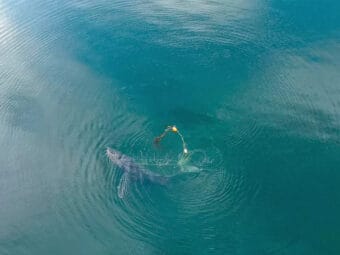
An aerial photo of Tango, and his mother Sasha, from a NOAA permitted drone assessment on July 20, 2023 – approximately one month before Tango died (Photo by Jacek Maselko, NOAA Permit #24359)

A humpback whale calf known as Tango that washed up dead near Auke Bay earlier this summer was killed by a large boat, according to the post-mortem exam. 

The fatal injuries included deep lacerations on the calf’s body and pectoral fin, likely caused by a propeller. And according to NOAA Marine Mammal Specialist Suzie Teerlink, Tango also had scarring from past injuries caused by smaller boats. 

“This calf had interactions with several vessels during the course of its short life,” Teerlink said. “We see these sub-lethal interactions unfortunately pretty frequently.” 

Tango was born this year to Sasha, a well-known whale that returns to the Juneau-area annually. Sasha herself is easily recognizable due to a distinct scar from entanglement in fishing gear.  

“That’s I think a testament that they can survive lots of these human interactions,” Teerlink said. “But there’s a lot of risks out there.”

NOAA does not keep a formal record of vessel strikes or entanglement incidents in the region, but Teerlink said the area where Sasha and her calves tend to feed has high boat traffic. And she added that both the whale population and the number of boats in the Juneau area have been increasing in recent years, which could cause more injuries. 

“There sometimes can be a misconception that whales know where boats are at all times,” Teerlink said. “They do pay attention to their surroundings. But you know, it’s not foolproof.” 

Teerlink said the best way to keep whales safe is to reduce speeds. That gives whales more time to adjust and gives mariners more time to take a look around the area. NOAA guidelines also call for vessels to stay at least 100 yards away from whales. 

Heft, fluff and salmon: Katmai’s Fat Bear Week finals are upon us

Brooks Falls at Katmai National Park and Preserve (Brian Venua/KMXT)

Voters from around the world will decide the winner of Katmai National Park’s Fat Bear Week. Returners and newcomers alike spent the summer catching salmon and packing on pounds before hibernation.

Park staff don’t measure bears with a scale though. Park spokeswoman Cynthia Hernandez says that like beauty, fatness is in the eye of the beholder.

“We rely on visitors and viewers of the bears to decide who is the fluffiest, who has put on the most weight since July,” Hernandez said. “You can compare who looks to be the heaviest right now, who looks to be the most round, or who you think is the cutest.”

Fatness, Hernandez says, is a measure of survival success before bears hibernate, when they sometimes lose up to one-third of their body weight. Female bears, too, are more likely to have cubs if they gain enough weight during the summer.

On Monday the park’s bracket was down to its final four, with votes being taken until 5 p.m. Alaska time to determine Tuesday’s competitors for fattest bear.

This year’s contenders included newcomer Bear 806, a year-old cub who won the Fat Bear Junior contest earlier this month. 806 went against Bear 32, Chunk, who has a distinctive muzzle scar and hefty hind quarters. Chunk won, and is in the finals now.

Bear 128, Grazer. (Katmai National Park and Preserve)

Bear 128, Grazer, Hernadez says, is another fan favorite. She’s recognized by a round belly that hangs in the water when she fishes. Bear 128 is known for confronting much larger bears to protect her cubs.

Hernandez says past winners are also popular. Bear 435, Holly, won in 2019. She adopted and raised a cub alongside her own in 2007, and is back in the running.

“She is looking splendid this year as well. She’s a large adult female and her ears are blonde and we love to see her come back every year,” she said.

Bear 435, Holly. (Katmai National Park and Preserve)

Of course, the old man of the falls and four-time champion, Bear 480, Otis, has returned. The 27-year-old bear lost to Bear 901 on Friday.

Bear 901, with her blond, triangular ears, is about 20 years his junior.

The famous Brooks Falls is a prime fishing ground for hundreds of bears. According to Hernandez, bears prefer different spots of the salmon-rich area, sometimes depending on age and skill.

“Due to the geology of the space, the short six-foot fall, there are several opportune spaces for the bears to fish. So there’s a location called the Office, which is on the lower section of the falls where some of the salmon congregate. It’s shallower there,” she said.

Bear 480, Otis. (Katmai National Park and Preserve)

Hernandez says older bears, like Otis, tend to fish in the Office. Younger bears, on the other hand, are a little more active.

“Some of the younger bears who may not know the most efficient fishing methods will hang out a little further downstream and run and try to catch the fish as they’re swimming,” she said.

Fat Bear Week graces the social media feeds of hundreds of thousands of fans with images and videos of the park’s fluffy carnivores. But Hernandez says the week also celebrates Katmai’s robust ecosystem.

“There’s so much to celebrate this week. Not just the fat, amazing, cute bears but also the health of the park and the ecosystem and Bristol Bay – the waters that feed into the Katmai ecosystem and in the Brooks River. It is one of the largest and healthiest salmon runs left on the planet,” she said.

Fans can vote for the 2023 winner at fatbearweek.org.

Images of Bear 128, Bear 435 and Bear 480 were taken with permission from: https://www.nps.gov/katm/learn/fat-bear-week-2023.htm

Scientists looked at nearly every known amphibian type. They’re not doing great.

A study published in the journal Nature found that the status of amphibians globally is “deteriorating rapidly,” earning them the unenviable title of being the planet’s most threatened class of vertebrates. Here, an endangered Agalychnis annae, commonly known as a Blue-Sided Leaf Frog, is seen at National Biodiversity Institute of Costa Rica, INBio, in Heredia, Costa Rica. (Kent Gilbert/AP)

When JJ Apodaca was starting graduate school for biology in 2004, a first-of-its-kind study had just been released assessing the status of the world’s least understood vertebrates. The first Global Amphibian Assessment, which looked at more than 5,700 species of frogs, toads, salamanders, newts and other amphibians became “pretty much the guiding light of my career,” said Apodaca, who now heads the nonprofit group Amphibian and Reptile Conservancy.

Nineteen years later, a second global assessment of the world’s amphibians has been completed.

“It’s a gut punch,” said Apodaca, who was not involved in the study but has reviewed its findings. “Here we are 19 years later with things not only not improved but getting worse.”

The assessment, published in the journal Nature on Wednesday, looked at two decades worth of data from more than 1,000 scientists across the world. It assessed the status of nearly for nearly every known amphibian on the planet, “Ninety-four percent,” said Jennifer Luedtke, one of the lead authors on the study. Though, she noted, an average of 155 new amphibians are discovered each year.

Discovered or not, the study found that the status of amphibians globally is “deteriorating rapidly,” earning them the unenviable title of being the planet’s most threatened class of vertebrates.

Forty-one percent of the assessed amphibians are threatened with extinction in the immediate and long-term, Luedtke said. “Which is a greater percentage than threatened mammals, reptiles and birds.”

Habitat loss from agriculture, logging and human other encroachment, was the biggest driver of the deterioration. As was the case in 2004. Diseases like the infectious chytrid fungus were a major threat as well.

But the scientists were struck by how fast climate change is emerging as one of the biggest threats to amphibians globally. Between 2004 and 2022, the time surveyed in the new assessment, climate change effects were responsible for 39% of species moving closer to extinction, Luedtke said. “And that’s compared to just one percent in the two decades prior.”

As global temperatures have warmed, driven by the burning of fossil fuels, the length and frequency of droughts is increasing. Seasons are shifting. Precipitation patterns are changing. Extreme weather events like hurricanes, heatwaves and wildfires are becoming more common.

And amphibians are particularly vulnerable to changes in their environment. Many rely on water to reproduce. They’re cold-blooded and, thus, susceptible to small changes in temperature.

“They don’t have any protection in their skin,” said Patricia Burrowes, a professor of biology at the University of Puerto Rico. “They don’t have feathers, they don’t have hair, they don’t have scales.”

Scientists have documented many species moving to new places, retreating to higher ground, as temperatures have shifted. Burrowes studied the forest coqui, Eleutherodactylus portoricensis, a small, endangered yellow or tan frog, native to the mountains of Puerto Rico. It had been observed moving to higher elevations while some similar Puerto Rican frog species were not. Burrowes and a graduate student found that the specific, already endangered, forest coquis that were moving were more sensitive to small shifts in temperature.

“Patterns aren’t predictable anymore,” Burrowes said.

Salamanders and newts were found to be the most at risk, according to the new assessment. The highest concentration of salamander diversity in the world is in the southeastern U.S. — the Southern Appalachia — where Apodaca, the executive director of the Amphibian and Reptile Conservancy, works and lives.

“This isn’t just a problem of things going extinct in the Global South and Australia and Central America and places like that,” he said. “This is the story of things declining and being endangered right here in our own backyard, so it’s our responsibility, our duty to save these things.”

Copyright 2023 NPR. To see more, visit https://www.npr.org.

After last year’s harsh winter, a herd of wood bison introduced to Alaska is smaller than it’s ever been

Several young wood bison in a clearing
Young Wood Bison that are being transported to join a herd seeded along the Innoko River in 2015. (Alaska Department Of Fish And Game photo)

A project to reestablish wood bison in Alaska suffered a setback last winter when harsh weather caused a major decline in the Lower Innoko and Yukon Rivers herd.

Alaska Department of Fish and Game wood bison biologist Tom Seaton says the latest population survey shows the herd dropped from about 150 to 72 animals over the last year. He attributes the decline to extreme winter weather, with heavy snow on the ground from last October through the end of this past May.

“It was just a bad combination of things: difficult snow to get through, to get to the forage,” Seaton said. “Snow that lasted a long time and snow that was quite deep.”

Seaton says the current population of 72 wood bison is the lowest since state, federal tribal partners working to reestablish the animals in Alaska transplanted 130 from Alberta, Canada in 2015. Another 28 Canadian animals were added in 2022.

But Seaton emphasizes that the herd has seen weather-driven fluctuations since 2015.

“Had a couple years of slow growth, then had a decline from around 140 to near 90 and then had a jump back over a hundred and then back down to ninety something,” he said. “Then a couple jumps above a hundred, all the way up to 150 last year, and then now down to 70-some.”

Meanwhile, planning continues to expand the effort to reestablish wood bison in Alaska. Seaton says the focus is on sites in the Eastern Interior, where snow cover tends to be lighter.

“So, Yukon Flats, lower Tanana drainage, and upper Tanana drainage — all have conditions that are more conducive to bison performance,” he said.

Seaton says they are working with local groups through a public planning process to identify a second wood bison restoration site where animals could be transplanted as early as next summer. The Wood Bison Restoration Project is paid for primarily with federal funds

Looming government shutdown could put Fat Bear Week on pause

Two bears vying for a prime fishing spot near Brooks Falls. (Brian Venua/KMXT)

Last October, Alaskans and other viewers around the world hunkered down on Katmai National Park and Preserve’s website to witness 2022 victor Bear 747 and his competitors pack on weight during the park’s Fat Bear Week.

But this year, with a federal government shutdown potentially going into effect over the weekend, 747 may not even leave the gate.

Park spokeswoman Cynthia Hernandez said in an email Friday that a lapse in government funding during the shutdown would affect next week’s annual event, which drew more than a million views last year as people watched the park’s brown bears fatten up for hibernation.

“Hopefully a lapse doesn’t occur,” Hernandez said. “However, should a lapse happen, we will need to postpone Fat Bear Week.”

According to NPR, a previous shutdown in 2018 left the National Park Service down to essential staff — which didn’t include staffers who operated social media.

The Katmai event relies on web cameras operated by Park Service partner explore.org. But Hernandez said they “will not operate Fat Bear Week since the NPS is necessary for Fat Bear Week’s success.”

“(S)hould there be extended lapse in government funding we will need to further evaluate plans depending on how long it takes for Congress to fund parks,” Hernandez said.

Hernandez declined to answer further questions Friday about the potential shutdown. Posts to the park’s social media accounts Friday morning were still providing updates on the Fat Bear Junior competition, a precursor to Fat Bear Week tracking four brown bear cubs.

Site notifications
Update notification options
Subscribe to notifications