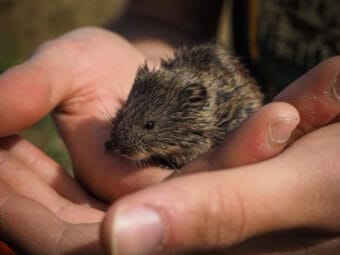
Homer the opossum is an ambassador animal at the Oregon Zoo. (Photo courtesy of Michael Durham/Oregon Zoo)
Homer was born an outlaw.
The 7-month-old opossum is one of the latest arrivals at the Oregon Zoo. His journey to Portland covered three states and involved a monthslong search for loose opossums.
The journey started in Washington state, where his mother snuck aboard a shipping container en route to Alaska. Opossums are considered invasive species in the state — potentially dangerous to native wildlife — and the state removes any that are found.
When authorities noticed his mother, named Grubby, on the streets of Homer, Alaska, about four hours south of Anchorage, officials from the state Department of Fish and Game tried for two months to capture her. The hunt garnered widespread attention, even inspiring the hashtag #FreeGrubby.
Grubby the opossum, seen Wednesday, May 24, 2023 during her capture in Homer. (From Homer Police Department)
Eventually, authorities caught her and sent the opossum to a zoo in Anchorage — but that wasn’t the end of the story.
“Baby opossums started showing up at Homer City Hall,” said Kate Gilmore, an animal curator at the Oregon Zoo.
Homer, named after the city of his birth, ended up in Portland. Gilmore said Homer can help tackle misconceptions the public might have about opossums, North America’s only marsupial.
“When you hear of an opossum or you see one, it’s normally probably on the side of the road as roadkill,” Gilmore said. “They kind of get the reputation of just being these, like, trash eaters, and that’s really not true.”
Homer is the latest addition to Oregon Zoo’s ambassador animal program. These animals are often featured on the zoo’s summer stage, where attendees can get much closer to the animals compared to a normal exhibit and see how they behave.
“It’s a really great way to get guests really engaged, more so than you can get from just watching an animal in its habitat from the outside,” Gilmore said.
First, Homer will have to train to acclimate to the noisy, dynamic environment of a zoo. He’s never seen strollers or heard children scream, so the zoo has to see how he’ll react to those new experiences, Gilmore said.
Gilmore said she hopes Homer expands people’s views on what animals they can expect to find at a zoo.
“Having one on grounds here that we can introduce people to would help them understand a nice part of the local ecosystems,” she said. “A lot of people kind of overlook what’s going on around them.”
A team of wildlife officials collaborated with whale experts to free a humpback whale off the coast of Gustavus, Alaska last month. (Sean Neilson/NOAA MMHSRP Permit No. 24359)
Wildlife officials successfully rescued a humpback whale after it was discovered entangled in a web of crabbing gear and at risk of dying, the National Park Service said.
A pair of residents first spotted the whale on Oct. 10 off the coast of Gustavus, Alaska. Surrounded by Glacier Bay National Park, Gustavus is bordered by the so-called “Icy Strait,” a popular ocean feeding ground for humpback whales in the spring, summer and fall.
But this particular whale wasn’t feeding. It was seen “trailing two buoys, making unusual sounds and having trouble moving freely,” according to an account of the rescue from the park service.
“In a sense, the whale was hogtied”
When park staff were able to assess the situation from a boat, they found a heavy fishing line winding from the whale’s mouth to its tail, ending in a glob of tangled lines at its tail.
“In a sense, the whale was hogtied,” said Janet Neilson, a whale biologist with the NPS.
“It was curved into a C-shaped posture. The line was so tight that it couldn’t swim in a straight line,” she told NPR.
Neilson and her colleagues called the owners of the crabbing gear, who confirmed that a 300-pound crab pot had gone missing, along with 450 feet of heavy line. The whale had likely been entangled for about three days.
In general, humpback whales get entangled more often than people realize, Neilson said.
“Usually they can get out of the gear pretty quickly on their own, just by breaching and shaking loose with energetic behaviors.”
But the longer time passes, the more likely the whale is to panic, rolling and twisting until those entanglements become messier and increasingly life threatening.
In those cases when human intervention could save a whale’s life, one agency authorizes a rescue operation: the National Oceanic and Atmospheric Administration’s Marine Mammal Health and Stranding Response Program.
How do you untangle a 35-ton marine mammal? With a lot of patience
Rescue teams spent an entire day working to cut the whale free from 450 feet of heavy fishing line. (Sean Neilson/NOAA MMHSRP Permit No. 24359)
NOAA had a team of trained experts assembled by the following morning.
In a stroke of good luck, a few of the rescuers were able to spot the whale and its trailing buoys while flying in from Juneau, Alaska. The animal had managed to travel about a mile from where it was spotted the day before.
Neilson joined two other rescuers in a small boat while three others monitored and advised from a bigger research vessel nearby. A seventh person stood onshore to operate a drone camera, providing a bird’s eye view of the coiled whale. The team analyzed those images with the help of experts as far away as Hawaii.
The sea was calm and the sky sunny, but the forecast for the coming days contained gale-force winds, adding another layer of pressure to the puzzle.
At first, the whale tried to evade the rescuers, mustering its energy to shimmy away from the approaching boat.
But with the crew’s persistence, the whale calmed and acquiesced, allowing the team to start chipping away at the lines with long-handled cutting equipment, freeing the animal bit-by-bit as it surfaced for 30 second chunks in roughly nine-minute intervals.
Some seven hours later, with daylight fading, the crew cut the last line — a rope wrapped around the whale’s tail.
The rescuers cheered, Neilson said, but it wasn’t exactly the dramatic moment you might imagine.
“On social media, there’s stories of whales acknowledging [disentangle crews] in some way or breaching as a way of saying thanks, but that’s not exactly what happens,” she said.
The victory didn’t sink in until the whale disappeared from the crew’s sight.
“That meant the whale was free and probably wanted nothing more to do with us,” she said. “It just bolted.”
The crab pot, on the other hand, fell to the seafloor. It hasn’t been recovered, NOAA reported.
Researchers were able to identify the whale as a young, Glacier Bay newcomer
The fluke of whale SEAK-5490, as seen in July 2023 in Glacier Bay. (C. Gabriele/NPS Photo / NMFS Scientific Research Permit No. 27027)
Back on shore the following day, Neilson plugged photos of the rescue into HappyWhale, a website that uses image processing algorithms to match photos of a whale’s tail with images contributed from previous sightings.
Researchers think the whale is relatively new to the Glacier Bay area. The animal was first spotted in the region in July after having previously been seen in Frederick Sound, some 100 miles south.
SEAK-5490 is believed to be the same whale that a marine biologist measured about a year ago. At 32 feet long, Neilson expects it to be about 3 or 4 years old — that’s quite young, given the average lifespan of a humpback whale is 80 to 90 years.
SEAK-5490 also has a scar on its back, which was likely caused by being hit by a boat’s propeller in a previous incident, the NPS reported.
Both Glacier Bay park staff and NOAA personnel plan to keep a close eye on HappyWhale’s sightings trackers.
“We’re really, really hoping we see 5490 in our waters again, but it’s possible he or she will pop up again elsewhere through confirmed sightings,” Neilson said.
A word of warning: leave whale disentanglements to the experts
But while she’s hopeful this story will have a happy ending, Neilson offers a word of caution for anyone eager to be part of their own.
If you come across a tangled whale, “don’t do what social media tells you to do, which is jump in and try to be a hero with a knife in your hand,” she said.
It should go without saying, given their size, but whales can be extremely dangerous to humans. And humans can be extremely dangerous to whales.
Some people have the impulse to cut away the heavy buoys trailing the whale, NOAA said, but that can actually make it worse — lethal lines may still be intact while the whale itself becomes harder for rescue teams to locate.
The Steller’s jay, Cooper’s hawk, and Wilson’s warbler will all get renamed under a new plan to remove human names from U.S. and Canadian birds. (Mick Thompson, Tom Murray, Jerry McFarland/Flickr Creative Commons)
Get ready to say goodbye to a lot of familiar bird names, like Anna’s Hummingbird, Gambel’s Quail, Lewis’s Woodpecker, Bewick’s Wren, Bullock’s Oriole, and more.
That’s because the American Ornithological Society has vowed to change the English names of all bird species currently named after people, along with any other bird names deemed offensive or exclusionary.
“Names have power and power can be for the good or it can be for the bad,” says Colleen Handel, the society’s president and a research wildlife biologist with the U.S. Geological Survey in Alaska. “We want these names to be powerful in a really good way.”
The move comes as part of a broader effort to diversify birding and make it more welcoming to people of all races and backgrounds.
“We’ve come to understand that there are certain names that have offensive or derogatory connotations that cause pain to people, and that it is important to change those, to remove those as barriers to their participation in the world of birds,” she says.
The project will begin next year and initially focus on 70 to 80 bird species that occur primarily in the United States and Canada. That’s about 6 or 7 percent of the total species in this geographic region.
The society has promised to engage the public, and says that birds’ scientific names won’t be changed as part of this initiative.
The effort represents a huge change for the birding community, and those involved expect a certain amount of opposition from long-time birders.
“I’ve been seeing some of these birds and using these names every year for the last 60 years,” says Kenn Kaufman, a prominent author of field guides. He says he initially opposed the idea of changing so many names, but has come around.
“It’s going to feel like a bother to some people, but I think it’s actually an exciting opportunity,” says Kaufman. “It’s an exciting opportunity to give these birds names that celebrate them — rather than some person in the past.”
While the society also has authority over English names of Latin American birds, it is planning a broader set of discussions with ornithologists and organizations in Latin America before proceeding with Latin American name changes.
“There are birds in South America that were named for friends of mine,” adds Kaufman. “I would like to think that they would accept this, for the benefit that it brings.”
The American Ornithological Society and its predecessor organization have maintained a list of the official English-language names for birds in North America since 1886. Occasionally, bird names have been changed, most often for scientific reasons.
This bird used to be named for Confederate General John McCown, but in 2020, it was renamed the Thick-billed Longspur. (Aaron Maizlish/flickr Creative Commons)
One notable exception came in 2000, however, when the society renamed a bird that’s now called the Long-tailed Duck because of concerns that its previous name was derogatory to Native Americans.
“That was the first that I’d ever really recognized or heard of a name that was offensive,” says Handel, who says at that point in time, concerns about injustice wasn’t a traditionally accepted reason for changing bird names.
That really started to change in 2020, when police officers killed George Floyd in Minneapolis. On that same day, a white woman in Central Park called the police on black birder Christian Cooper, claiming he was threatening her.
Less than a month later, a group called Bird Names for Birds wrote to the leadership of the society, pointing out the potential problems that come with eponymous honors and demanding change.
They noted that a 2019 proposal to rename a small prairie bird that had previously been named for Confederate General John P. McCown had been rejected.
In 2021, the society officially gave that bird the name “Thick-billed Longspur,” after amending its naming guidelines to explicitly consider social justice reasons, says Handel.
“Because of those associations with racism and slavery, it was decided that this name needed to be changed,” she explains.
Renaming a bird here and there was one thing. But the idea of renaming a whole slew of birds to remove names associated with historical figures? That took more mulling over.
“This proposal was so different because it was asking us to change an entire group of names instead of one by one,” says Handel.
A diverse group of ten experts met to consider it, says Erica Nol, a biologist at Trent University in Canada who co-chaired this ad hoc committee.
“The membership was carefully chosen to reflect broad perspectives. And it really did,” she says. “We all came to the decision in our own way and over time and quite slowly, actually, because the final decision is fairly radical.”
Kaufman, who was not involved in making the decision, says that initially, he thought that just a few really offensive bird names should be changed.
“I knew the young people who had started this Bird Names for Birds movement, and I tried to talk some sense into them,” he recalls. “But the longer we discussed this, the more I came around to seeing their viewpoint.”
Trying to do this bird by bird would mean engaging in divisive debates about individual people and the merits of whether or not they should have the honor of having a bird named after them, he realized.
“That just seemed like it would lead to endless arguments,” he says, adding that he didn’t think the birding community should become the morality police for people who lived two centuries ago.
Renaming the birds, in contrast, offered an opportunity to highlight unique features of the birds themselves. Unlike “Wilson’s warbler,” for example, the names “Yellow Warbler” or “Golden Winged Warbler” offer up a useful description, he says.
Take Brewer’s sparrow, says Kaufman. “What would be a good descriptive name for that? We can’t call it Sagebrush Sparrow, even though it is in the sagebrush,” he says, “because there is a sagebrush sparrow already.”
Nol says she recently was visiting some salt marshes this summer and saw a common bird there that’s called Wilson’s Snipe, which has a long bill and engages in dramatic displays such as flying in high circles, which produces a whistling sound as air flows over specialized feathers. “And I thought, what a terrible name,” she says. “I mean, Wilson was the father of modern ornithology in North America, but this bird has so many other evocative characteristics.”
She says people have pointed out to her that the birds don’t care what their names are.
“Names are important for humans. And this is absolutely a human-driven exercise,” she says. “They’re important for the people who watch birds and the communities who may or may not feel very welcome, if all the birds are named after these old European ornithologists.”
Orcas spotted in the Bering Sea in August 2023. (Courtesy Dustin Unignax̂ Newman)
The Center for Biological Diversity is preparing to sue the federal government for allegedly failing to protect killer whales from trawlers in the Bering Sea.
The trawl fleet in the Bering Sea and Aleutian Islands has come under fire in recent weeks. The backlash follows a report from the National Oceanic and Atmospheric Administration that said 10 orcas were hauled up in trawl nets over the last year, nine of which died.
The conservation group said in a Monday statement that NOAA Fisheries must uphold its duty to protect the killer whales, which are protected by the Marine Mammal Protection Act.
The national conservation group said the trawlers are catching lots of non-targeted species, or bycatch, in defiance of conservation laws.
It’s not a new issue for orcas to get caught up in fishing gear, but the recent numbers are a jump up from previous years. The trawl fishery association Groundfish Forum said their boats have reported a recent uptick in orca encounters. Climate change may play a role in the increased sightings, as many ocean species adapt to new conditions.
The conservation group announced they would file a lawsuit if NOAA Fisheries did not adequately address the allegations within 60 days.
Stella has regained 11 pounds since being rescued, and she’s getting lots of extra treats. (Meredith Redick/KCAW)
Stella Mahoskey looks like your typical golden retriever. At age 13, her muzzle has grayed, and her hips sway a little when she walks. She has a trove of stuffed toys, and she loves getting chunks of Tillamook cheese as a treat. If you look close, you’ll see a long scar across her belly and left leg. That’s one of the only clues Stella gives about her 65 days lost in the wilderness this summer.
On July 7 of this year, Stella was lounging on her back deck with her family – Sarah and Jerome Mahoskey, and kids Kai and Quinn, when a burst of fireworks sent Stella bolting into the woods. The family searched until dark, but they were certain Stella would be on the porch in the morning.
The next day, though, they started to get worried – especially when a neighbor shared some ominous news.
“They said, Did you hear that there was a bear that attacked a dog last night?” Sarah said. “We had the windows open in the back of the house and my wife heard this altercation that sent chills up her spine. And basically, I don’t think your dog could be alive.”
The Mahoskeys didn’t give up hope.
After Stella disappeared in July, Sarah and Jerome’s friends started hiking the trails around where she went missing. Community members reported possible sightings. The Mahoskeys investigated every report. After two months of this, Sarah told a friend, “I feel like there’s a 1% chance that she’s out there, and so I cannot let go.”
The Mahoskey family cuddles with Stella at their home a few days after she was found. (Photo provided by Sarah Mahoskey.)
In early September, they got one final call – from Tim Eddy, a friend of Jerome’s who was working at the quarry that day.
“He said, do you have a golden retriever? And Jerome said, Well, we did have a golden retriever. And he says, Well, I think this is your golden retriever.”
Jerome called a friend to watch the kids, revved up his four-wheeler, and drove over. At first, he didn’t see anything except an expanse of rock.
“She was on this cliff side and it was basically this ash and rock that was the same exact color as her,” Sarah said. “She totally blended in. The fact that Tim saw her – I just kept saying to him, how did you see her?”
Stella likely hadn’t been at the rock pit long – there wasn’t much in terms of food and water – but the Mahoskeys say the sounds and smells of the quarry may have felt like home to Stella, who grew up around Jerome’s excavation business.
“She knows those sounds, and those sounds are safe to her,” Sarah said. “They sound like, you know, sounds she’s been around her entire life since she was four years old.”
Stella was down to 30 pounds, about half of her normal body weight. She had a wide gash across her left side.The Mahoskeys haven’t confirmed that the gash was from a bear, but they believe that’s the most likely explanation.
“We think she probably hunkered down for quite a while, and just probably wasn’t able to move a lot and knew that it needed to heal,” Sarah said. “She obviously found a safe space, because the fact that she was bleeding and wasn’t found by that bear or another bear again is quite a miracle.”
“Miracle” is not an exaggeration. The hazards for pets lost in Alaska under these circumstances are myriad. But Stella has a knack for surviving against the odds. In 2015, not long after the Mahoskeys adopted Stella from a couple in Port Alexander, she rode with Jerome to work on a rainy August morning.
Here’s former KCAW reporter Rachel Waldholz reading the news that morning:
“Heavy rains triggered what now appear to be at least six landslides in Sitka Tuesday morning, prompting the city to declare a state of emergency.”
The series of landslides that day killed three people and rocked the Sitka community. Jerome narrowly escaped the landslide, but the truck – with Stella inside – was crushed. He assumed the worst.
Then, just a few minutes before rescuers suspended their search due to unstable conditions, “rescuers did manage to pull a dog alive from the debris.”
Stella’s surviving a landslide in 2015 could be attributed to luck. Her recovery from the wild in 2023 was luck – and something more. Sarah says Stella likely survived by foraging.
“She has always picked her own berries when we are out hiking,” Sarah said. “And she loves dandelion roots.”
On the advice of her vet, Stella was on a strict diet for the first ten days after she was reunited with her family. Now, she’s eating well. She is up to 41 pounds, and she’s getting deliveries of venison bone broth and salmon from friends.
“Fried eggs with breakfast, whatever she wants,” Sarah said.
Stella isn’t revealing much about what happened during her time away, but she hasn’t changed much. The only difference, Sarah says as she cuts another chunk of cheese off of the block for Stella, is that she’s definitely a little hungrier than before.
The historical range of the Bachman’s warbler included Alabama, Florida, Georgia, North Carolina, South Carolina, and Tennessee. (U.S. Fish and Wildlife Service)
Twenty-one species, including birds, a bat and several mussels, have been labeled extinct, the U.S. Fish and Wildlife Service said Monday.
The species were previously on the national list of threatened and endangered species.
The extinct species include:
Eight Hawaiian honeycreeper birds
Bridled white-eye bird of Guam
Mariana fruit bat of Guam
San Marcos gambusia, a one-inch long fish from Texas
Scioto madtom, a small catfish found exclusively in the Big Darby Creek in Ohio
Bachman’s warbler, a black and yellow songbird found in several Southern states and Cuba
“Our determinations of whether the best available information indicates that a species is extinct included an analysis of the following criteria: detectability of the species, adequacy of survey efforts, and time since last detection,” the U.S. Fish and Wildlife Service said.
The U.S. Fish and Wildlife first proposed the species be taken off the endangered and threatened list in 2021, as they had not been seen since as early as 1899 and as late as 2004.
There are now 650 species that have gone extinct in the U.S., according to the Center for Biological Diversity, which says factors such as climate change, pollution and invasive species contribute to species loss.
Between 2004 and 2022, climate change effects contributed to 39% of amphibian species moving closer to extinction. About 3 billion birds have been decimated in North America since 1970, Fish and Wildlife said.
Still, 99% of the animals on the endangered and threatened list have not reached extinction. Fifty-four have been taken off the list due to recovery efforts, while 56 have been downgraded from endangered to threatened, Fish and Wildlife said.
“Federal protection came too late to reverse these species’ decline, and it’s a wake-up call on the importance of conserving imperiled species before it’s too late,” Fish and Wildlife Director Martha Williams said. “As we commemorate 50 years of the Endangered Species Act this year, we are reminded of the Act’s purpose to be a safety net that stops the journey toward extinction. The ultimate goal is to recover these species, so they no longer need the Act’s protection.”
The Hawaiian honeycreepers are now extinct due to their forest habitat being cut down for development and agriculture. Mosquitoes, which are not native to Hawaii, also spread avian pox and avian malaria.
Other Hawaiian birds, such as the ‘akikiki, are also on the brink of extinction, with as little as five known pairs in the wild, the Center for Biological Diversity said.
According to the Center for Biological Diversity, the Bachman’s warbler was also lost to habitat destruction and the bridled white-eye and Mariana fruit bat was lost to an invasive brown tree snake.
The Mariana fruit bat was also compromised by agriculture and overconsumption as food. The San Marcos gambusia suffered from water overuse that impacted groundwater supply and spring flow. The scioto madtom was lost to runoff and silt buildup from dams.
Copyright 2023 NPR. To see more, visit https://www.npr.org.
Close
Update notification options
Subscribe to notifications
Subscribe
Get notifications about news related to the topics you care about. You can unsubscribe anytime.