Wildlife

Katmai’s Fat Bear Junior competition kicks off this week

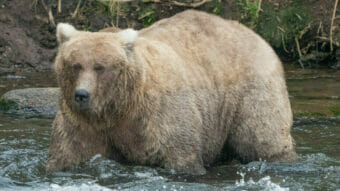
A brown bear in Katmai National Park (Courtesy explore.org)

Fat Bear Week, the annual celebration of brown bears gearing up for hibernation at Katmai National Park and Preserve, kicks off this week with its junior bear competition. Pitted against one another for the highest number of votes, four bear cubs will face off in a tournament-style bracket to take home the crown of Fat Bear Junior Champion. The winner has a chance to compete against their senior bear counterparts next week.

The junior competition began in 2021 as a way to get people excited about Fat Bear Week, the nine-year-old festival that brings attention to Katmai’s brown bears with the help of livestream cameras in the park. It focuses on first-year cubs and yearlings, or bears that are about 18 months old.

“Fat is the fuel that powers the survival of brown bears during hibernation, and a fat bear is a successful bear,” said Mike Fitz, a resident naturalist with Explore.org. “Fat Bear Week and Fat Bear Junior is a way for us to celebrate the success of brown bears as they prepare for hibernation. It also celebrates the ecosystem and the health of it that supports these bears, especially the sockeye salmon coming from Bristol Bay into the Naknek River Watershed.”

In addition to a pair of first-year cubs, this year’s junior bear competition will showcase a yearling cub and a singleton first-year cub. It will also feature a junior cub who was separated from her mother and raised by her aunt.

“Adoption is rare among brown bears, and the circumstances that lead to it are often mysterious or unknown,” Fitz said. “What I think led to the adoption this year was the sociability between those bear families and those mothers last year.”

Fitz and rangers at the national park have been keeping tabs on the bear cubs all summer. They can tune in via Explore.org’s livestream bear cams, which provide insight into the lives of the bears living near Katmai’s Brooks River Falls.

While this week’s focus is on the fattest bear cub, Fitz says that they shouldn’t get all of the credit. The junior winner will prove to be a hat tip to the mother who raised it. He spoke of the singleton spring cub who was brought up by a second-time mother.

“The cub itself wasn’t quite comfortable standing on the bank of Brooks River on its own, but the cub really wanted to be next to mom,” Fitz said. “Even when it was only a few months old and got out into the river, sometimes it would get swept downstream. We saw it fall over Brooks Falls several times this year. It’s grown a lot, its overall size shows that bear cubs single, they don’t have litter mates, have advantages because they have access to all of mom’s food.”

Located in the Bristol Bay region of Alaska, Katmai National Park and Preserve is home to the largest and healthiest runs of sockeye salmon left on Earth. The region also has more brown bear inhabitants than humans.

“Each bear in Fat Bear Junior is an individual with a unique story to tell about life and survival,” Fitz said. “This is a really unique wildlife watching opportunity to get to know animals as individuals rather than as populations.”

Fitz says that Fat Bear Week not only showcases the health of the bears, but is a way to raise awareness around the world about the health of the Bristol Bay region.

“Each one of them showcases a slightly different way of living, a slightly different way of surviving, and I think that’s a really special opportunity,” he said. “When we watch wildlife, generally, we don’t know anything about those individuals.”

Online voting for the Fat Bear Junior competition begins on Thursday at 8 a.m. You can vote at explore.org.

Activists urge reforms after Bering Sea trawlers hauled up 9 dead orcas this year

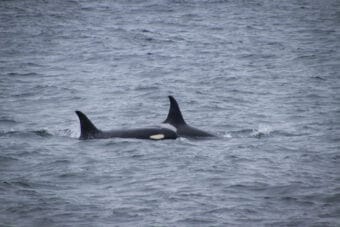
Orcas spotted in the Bering Sea in August 2023. (Courtesy Of Dustin Unignax̂ Newman)

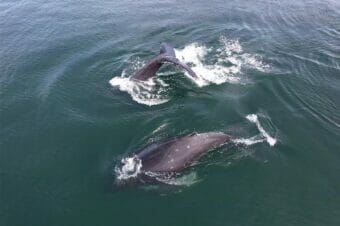
Federal officials are looking into the deaths of nine orcas that were hauled up by groundfish trawlers in Bering Sea and Aleutian Islands fisheries this year, and conservation groups say more needs to be done to prevent such deaths.

According to NOAA Fisheries, a tenth whale was released alive, but the nine other orcas incidentally caught in trawl nets weren’t so lucky.

“NOAA Fisheries is analyzing collected data to determine the cause of injury or death and determine which stocks these whales belong to through a review of genetic information,” said Julie Fair, public affairs officer with the federal agency’s Alaska office, reading from a statement published Thursday. She declined to be interviewed, except to read the statement aloud.

Killer whales are protected under the Marine Mammal Protection Act, which requires boat owners or operators to report the deaths and injuries of the mammals during commercial fishing and survey operations.

Fair said NOAA Fisheries monitors bycatch of protected species to determine whether the animals were dead before being caught or were killed or seriously injured by commercial gear.

The vessels involved in these incidents weren’t named, but Fair said the boats involved were all required to carry two federal observers on board.

This isn’t the first time killer whales have been caught in trawl gear off Alaska, but the numbers seem to have spiked this year.

“Nine, ten killer whales is too many,” said Shari Tarantino, head of the Seattle-based advocacy group Orca Conservancy, which advocates for the endangered Southern Resident killer whale population that roams from California to Southeast Alaska. “And if it’s just this year, something needs to be done in the future to mitigate these atrocities, frankly.”

Chris Woodley, head of the Groundfish Forum — the Seattle-based association that represents Bering Sea trawlers — declined to be interviewed, providing a written statement to KUCB instead. In it, he said that vessels are experimenting with gear modifications that may prevent whales from entering trawl nets, and that the Amendment 80 trawl boats voluntarily stopped fishing on Sept. 9, with more than three months left in the season, because of the orca bycatch.

Fishing boat encounters that harmed or killed orcas in Alaskan waters were rare until recently, according to the statement, first reported by the Anchorage Daily News. NOAA reported just seven killer whale mortalities or serious injuries resulting from fishing gear entanglement between 2014 and 2020.

“In 2023, our captains have reported an increase in the number of killer whales present near our vessels, where they appear to be feeding in front of the nets while fishing,” the statement reads in part. “This new behavior has not been previously documented and marine mammal scientists are not sure why this change has occurred.”

Tarantino said it’s important to protect orcas for future generations.

“We’re not saying stop trawling, even though I think trawling is unbelievably devastating to the ocean animals and the beings that live there,” she said. “But to continue taking this bycatch is just insane. It’s destroying our future, in my opinion. You know, if the ocean goes, we go.”

Biologist Deborah Giles, the science and research director for the Washington-based nonprofit Wild Orca, said she wasn’t surprised when she heard about the nine orca deaths.

“I was glad that [NOAA was] finally recognizing it publicly,” she said. “Of course, my cynical brain wonders how often this is happening when it was not reported — or at least not released publicly. I’m very glad that this is going to be investigated.”

Giles said the industry needs to figure out a safe way to keep animals from interacting with fishing vessels and reduce bycatch of non-targeted species.

“We’d ask NOAA to come up with some new protocols for ensuring that this doesn’t happen again in the future,” she said. “NOAA is responsible for marine mammals, like killer whales, and they’re also responsible for making sure that the fisheries are not jeopardizing non-targeted species. And especially in the trawl industry, bycatch is massive. And it’s unsustainable. Initially, what we need to know is what are they doing about this? What steps are going to be taken to minimize this?”

Activists with the “Stop Factory Trawler Bycatch” campaign planned to hold a protest Thursday outside the annual meeting of Genuine Alaska Pollock Producers at Seattle’s Four Seasons Hotel.

“Nothing I have seen yet clearly states which trawl vessels were involved,” anti-bycatch activist David Bayes said in a text message.

Genuine Alaska Pollock Producers did not immediately respond to a request for information Wednesday afternoon.

In a written statement, NOAA spokesperson Julie Fair said the agency is working quickly to evaluate the orca-harming incidents and will share findings as soon as possible.

Alaska bears’ doughnut heist makes international news: ‘I’m still getting phone calls,’ store manager says

This Tuesday, Sept. 12, 2023 photo provided by Shelly Deano shows two bears getting into a doughnut truck in Anchorage. (Courtesy of Shelly Deano)

Two bears climbed into a Krispy Kreme delivery van and spent about 20 minutes eating doughnuts and ripping apart packaging last Tuesday morning at Joint Base Elmendorf-Richardson in Anchorage.

The driver had left the van’s doors open while making a delivery to a gas station convenience store called JMM Express.

Store manager Shelly Deano says he won’t be leaving those doors open anymore.

Deano says it’s a lesson learned for the driver and store employees, who are used to seeing bears in the area.

Listen:

The following transcript has been lightly edited for clarity.

Shelly Deano: Normally, we didn’t really think anything of it, until that day, when we saw the mama bear walked by the van. And it was in the morning, so it was dark. I tried to bend down to see where she was, because we have gas pumps out there and there were customers. And then all of a sudden I heard, like, movement in the van. Then I heard her breaking open the packages of doughnuts, and then the baby there followed suit. And they just started eating all the doughnuts. Not all of them, but about half of them. So we tried to get them out. We were banging on the van. No luck. They were probably in there for good, maybe, 20 minutes. We then had to call security police. They sounded off their loud sirens. Took them a few minutes to get out of the van, and then they just kind of lingered in front of the store for a little bit. But it took them a little bit, the security police, to get them to move on into the woods right by our building.

Casey Grove: Do you guys see bears out there pretty often?

Shelly Deano: Oh, yeah, we do. We have to take the garbage out three times a day. We close at midnight, so we do the last garbage takeout closer to midnight. We try to go in pairs if we can. But yeah, they usually frequent around here, because we’ve got woods on all sides of us. And apparently they know where to come.

Casey Grove: Yeah, I was wondering, I mean, when you saw the first bear, the mama bear, and then kind of realized it was in the van, were you worried or were you surprised? Or what?

Shelly Deano: I was, I don’t know if I was surprised. I was more worried about customers taking pictures from so close to the van. And so I had to go out there and say, “You guys need to be careful.” And then I proceeded to go out there and take pictures. But she wasn’t paying attention. She was just eating the doughnuts. It’s like she didn’t care. And so I wasn’t really worried. It was amusing, is what it was.

(Courtesy of Shelly Deano)

Casey Grove: Hard to blame them though, right? I mean…

Shelly Deano: Yeah.

Casey Grove: So I called the, you know, base public affairs folks to ask them about this. The woman there kind of chuckled for a second, but she didn’t really think it was quite as funny as I think like the rest of us do.

Shelly Deano: Yeah.

Casey Grove: Did they convey to you, or did the base convey to you that, you know, they don’t want the Krispy Kreme truck doors left open or anything like that?

Shelly Deano: No, but I mean, Krispy Kreme has taken measures, and we’ve also told them the doors need to be closed, obviously. And now he’s gonna start delivering in the back of our store. He usually delivers out front, because it’s easier for him. But he’s gonna go to the back from now on. And he has since started closing his doors, because we just, we never thought about it, honestly, before. You always think of bears and garbage, and always make sure your garbage is taken out, make sure garbage is put inside your house or anything like that. But never did I think about closing the van doors. I didn’t think about that, honestly.

Casey Grove: Yeah. Well, there’s a first time for everything, right?

Shelly Deano: Yeah.

Casey Grove: It sounds like you’ve gotten a few phone calls from people like me that are are interested in it. Who all have you heard from?

Shelly Deano: So NBC and CBS. Of course, our local news, Alaska’s News Source. It’s aired on CNN. I got a phone call yesterday from someone in the UK. And then I got the Washington Post last night. It’s in the Seattle Times. Someone from the Associated Press, and, you know, Insider
Edition I want to say.

Casey Grove: Oh, Inside Edition.

Shelly Deano: Yeah. So, and then, of course, you, and then our own, we have a thing called the Exchange Post just within our company. So that was today also. So it just keeps going viral.

Casey Grove: Yeah. I guess I’m the last one to call then. Maybe I’m not doing a very good job here.

Shelly Deano: It’s OK, you’re the second phone call today. I was like, “Oh, I’m still getting phone calls.”

Casey Grove: Maybe it’ll, it’ll quiet down for you soon.

Shelly Deano: Yeah, I’m sure.

In a statement, JBER public affairs officials said, “Wildlife may be our neighbor, but they should not be attracted to our human food sources. Please use caution when storing or disposing of food to ensure you are protecting our wildlife and yourselves.”

Scientists baffled by golden orb found in Gulf of Alaska

The Okeanos Explorer live streams a lot of their expeditions. (Courtesy of Okeanos Explorer crew)

The Okeanos Explorer, an exploratory vessel operated by the National Oceanic and Atmospheric Administration, discovered an unidentifiable golden orb deep in the Gulf of Alaska late last month. The orb ended up making national headlines for stumping the ship’s scientists.

The attention came as a surprise, said expedition coordinator Sam Candio.

“I’m not even sure that that was the most interesting thing on that dive,” he said. “We, aboard, pretty much forgot about it. And then once it started getting all the media attention, it was just like, ‘Oh, that’s what everybody’s focused on.’”

Researchers still haven’t been able to identify the golden orb.

“We don’t know what it is, and I haven’t gotten any compelling ideas from people ashore. But a lot of theories right now are kind of the same ones that we had when we first came across it,” he said. “It could be some sort of sponge, maybe a coral, I’m kind of on the egg-case train.”

It was found about about 2 miles under the ocean’s surface during the ship’s work along Alaska’s coastline.

Underwater, the orb was a bit more circular and had kind of a golden shine, but when their drone brought a sample to the surface, it was a matte brown and had a flaky texture with a hard center.

Scientists used an aquatic drone to bring it to the surface for testing. (Courtesy of Okeanos Explorer crew)

Scientists aboard the ship took several photos and ran tests. Candio said the crew will have to send the orb along with a myriad of other potential new species to the Smithsonian National Museum of Natural History in Washington, D.C., for further analysis.

“We got a lot of things that are new to science, which is really exciting,” he said. We’re processing them, making sure that we get them all packed away safely.”

He said while the orb intrigued the crew, they were more fascinated on this particular dive by seeing octopi tending to eggs – that’s previously been a rare sight. In their time in Alaska, the scientists found several octopi tending to eggs, with 10 mothers off the coast of Kodiak Island.

The Okeanos Explorer is about to complete its work in Alaska. The ship’s last stop is in Seward, and then the crew will head to San Francisco for the winter. Candio said he was glad to visit so many places around the state.

“Just seeing how incredible all the life and the landscapes and the geology and how diverse and beautiful it was with crazy coral forests and chemosynthetic communities, and pretty much everything you could hope to see,” he said. “It’s amazing to see that both on land and at sea.”

The boat is scheduled to begin mapping waters around Hawaii next year.

Southeast Alaska harvest data shows moose moving to new areas

A bull moose photographed by an Alaska Department of Fish and Game game camera on Mitkof Island in 2018. (Courtesy of Dan Eacker/ADF&G)

The moose hunt near Petersburg, Wrangell, and Kake opened on Friday, Sept. 15. It’s a month-long hunt that includes several islands in central Southeast as well as some areas on the mainland.

The antler moose hunt allows hunters to take bull moose with certain antler configurations. There is no quota. The hunt liberalized in 2009 from requiring three brow tines on one side to allowing two brow tines on both sides.

Frank Robbins is the state wildlife biologist for the area. He says the hunt has been successful by all accounts. Over the last nine years, the harvest has been over 100 bulls.

He spoke with CoastAlaska’s Angela Denning about the upward harvest trend. He says moose are being harvested where they’ve never been before.

Listen:

Frank Robbins: We’re currently harvesting moose in areas where they weren’t harvested just 10-15 years ago. For example, Kuiu Island 10-12 years ago, there was a nominal harvest if any harvest at all. Last year, nearly 30 bulls were harvested Kuiu, it made up 25% of the total harvest. So it’s a dynamic situation, you know, there’s moose present in areas where they just weren’t present in the numbers that they are now.

Angela Denning: That to me sounds like a good sign like the population could be expanding?

Frank Robbins: I think that there’s a bit of an increase in the distribution of moves. And there’s been some good productivity. We don’t have a means by which we can estimate population. We manage largely on harvest and trends in harvest. And these these coastal rainforest areas it is very difficult to survey.

Angela Denning: It’s just the trees and the mountains make it too dense to see from, say, an aerial survey.

Frank Robbins: Right. We have some hopes they were experimenting with trail cameras now. We hope in the future, we’ll be able to adopt that technology. It’ll give us more information. But currently, we largely manage on harvest alone. That’s what our best at is. So, but yeah, you’re right, the moose harvest has increased over time,  hunter success has increased. 15 years ago, higher success was around 11% for the time. 10 years later, it was up to about 14%. And now we’re 17% success, rate. So harvest is increased, hunter success is increased. So yeah, it looks good.

Angela Denning: But you can’t definitively say that the population has increased, but you can say that is the distribution has increased.

Frank Robbins: I don’t have data to present that demonstrates an increase in population. I have harvest data that shows that the harvest has increased, hunter’s success has increased and indirectly suggests that not only have we had an expansion in the distribution of the moose, but there’s more moose available. So they’ve been kind of moving of course from the mainland westward across the islands, across Kupreanof Island to Kuiu Island.

Angela Denning: Any thoughts on the expansion? Is it just kind of a natural evolution?

Frank Robbins: I’ve been told that is a natural expansion. That it’s just taking that long for moose to inhabit those areas since the glaciers receded. It’s just taking that much time for them to get there. Yeah. It’s not a topic that I’ve studied directly so I don’t know.

Angela Denning: I’ve heard similarly, that traditionally the diet was more deer and moose was just hardly ever.

Frank Robbins: That’s right, yeah. So I don’t remember exactly but I think maybe the first moose was sighted on Kupreanof in the 70s. So there’s just been a slow expansion of this distribution. So it’s an interesting dynamic, moose hunt.

Hoonah gives residents bear-resistant trash cans, but most of Southeast Alaska can’t afford them

A brown bear at Sitka’s bear shelter, Fortress of the Bear, tests out one of the bear-resistant trash bins. (Photo courtesy of Fortress of the Bear)

Listen to the audio here:

Bears getting into trash is a problem throughout Southeast Alaska. To deal with it locally, the City of Hoonah started distributing free bear-resistant trash bins to residents at the beginning of the month. But most towns in the region can’t afford them.

In the fall, bears are interested in one main thing: getting fat to survive the winter. They do that by gorging on salmon, grazing on berry bushes, and at times getting into trash bins.

“Almost daily from this time into late November,” said Hoonah’s City Administrator Dennis Gray.

Hoonah is a small community on the northeastern side of Chichagof Island. The island has the world’s densest population of brown bears. Gray says in the fall, bears are a daily problem.

“We have thousands of brown bears and less than 1,000 people,” he said. “Bears have been here for a long time and we have constant conflicts.”

It’s a familiar problem all over Southeast. Haines killed nearly 30 brown bears in 2020. The following year, Sitka euthanized 14 brown bears. In Ketchikan and Petersburg, black bears are the ones getting into trash, but it’s still a problem every year.

But so far, Hoonah is the only community in Southeast that’s providing bear-resistant trash cans. Gray thinks they’ll be a game changer for the community.

“I’m pretty excited about this,” he said.

The City of Hoonah provided each household with two of these bear-resistant trash bins. (Photo courtesy of Dennis Gray)

The bear bins were too expensive for Hoonah until a large grant came their way — $2 million from Norwegian Cruise Lines. The company gave Hoonah the money during COVID. The city used it to purchase 660 bins at $136 a pop. They’re smaller-sized because they must be lifted and dumped by a person since Hoonah doesn’t have a mechanical collection truck.

In Sitka, such bear bins have been cost prohibitive. Sitka created a bear task force, which met about 10 times last year. They recommended that the city and borough invest in bear-resistant cans. But Sitka would need to spend around $1.5 million to replace all its residential bins.  It boils down to money for other towns in the region too, who instead rely on laws and citations to encourage residents to keep trash secured.

Stephen Bethune with Alaska Department of Fish and Game in Sitka says brown bears have been getting into local trash bins for many years.

“The bears have keyed in on that and roam the neighborhoods at night looking for cans with trash in them,” he said.

Bethune is one of the people who euthanize Sitka’s problem bears. He says it’s not pleasant and it’s a lot of extra work.

“It’s often in the middle of the night,” said Bethune. “There’s a lot of follow up that happens when you have to kill a bear.  We salvage the hides and skulls for our fur auction in Fairbanks every year so a lot of late nights in the warehouse skinning bears.”

The bear bins are kind of like water-resistant clothing. They help for a while.

“There’s no such thing as bear-proof, that’s why we call them bear-resistant,” Bethune said.

And they have proof of this. At a local bear shelter in Sitka — the Fortress of the Bear — staff tested out many so-called bear-resistant trash bins. The very best one lasted only 12 minutes. But Bethune says that’s enough.

A brown bear at Sitka’s bear shelter, Fortress of the Bear, tests out one of the bear-resistant trash bins. The tests were viewed by the public at the shelter’s annual Community Bear Awareness Day, when the shelter partners with the Alaska Department of Fish & Game and the Defenders of Wildlife to help educate the public on ways to reduce bear-human conflict. (Photo courtesy of Fortress of the Bear)

“I don’t foresee realistically a bear spending 10 minutes on one trash can trying to get into it,” Bethune said. “They usually just knock over the can, it spills open and they grab a bag that falls out and run off with it into the woods. So even a very resistant can is going to not provide that immediate food resource and the bear’s eventually going to learn that coming into town isn’t paying off for him. It’s too big of a risk.”

He said 10 minutes matters. Even five minutes matters.

But bears are more than just a problem. They’re important to the region culturally and economically. Hoonah is a mostly Lingìt community with cultural ties to bears. And City Administrator Dennis Gray says the town has grown its tourist industry, receiving nearly 600,000 visitors a year. Many come to see the brown bears in nearby streams.

“Cruise ship tourism people pay big bucks to go out the road, look at bears,” Gray said. “And so shooting bears is not a great thing to be doing.”

Purchasing bear-resistant trash bins is just one step Hoonah is taking with the grant money. The city also bear-proofed its landfill with concrete blocks. They purchased bear-resistant metal dumpsters and kits for hanging deer safely in the fall. And they’re bringing in a team of Karelian bear dogs from Fairbanks for two weeks to scare the bears away. Gray says if it works, they’ll bring the team back next year.

Site notifications
Update notification options
Subscribe to notifications