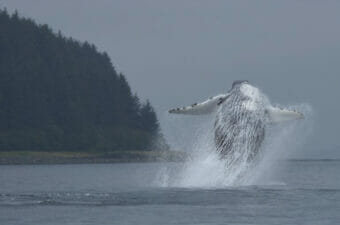
Tango, the whale calf that was found dead Friday evening near Juneau, pictured on August 21, 2023. (Photo courtesy of Suzie Teerlink, NOAA Research Permit 20648)
The body of a local humpback whale calf named Tango was found Friday evening on the shore of Hump Island, about 10 miles northwest of Auke Bay. NOAA is still investigating what happened to Tango, but a post-mortem exam on Saturday revealed injuries consistent with a vessel strike.
Mandy Keogh, who coordinates NOAA’s response when whales get stranded or struck, described collisions between boats and humpback whales in Southeast as “fairly common.”
“Unfortunately, vessel strikes with humpback whales do occur,” she said. “You can not see a whale until you are very close to them, or until you unfortunately might run into them.”
Keogh said Tango was born this year to Sasha, a local whale who visits Juneau in the summer. A statement from NOAA said Sasha had been seen near Juneau over the weekend and did not appear to be hurt.
Keogh said NOAA received two reports of vessel strikes in the days before Tango was found. Biologists searched for any animals that were acting unusual or showed signs of injury.
“In total, we found about 10 animals, and none of them had any evidence of any injuries,” she said.
Koegh said she doesn’t yet know if those reports are related to what happened to Tango. They also cannot say what kind of vessel struck Tango, but Koegh says all vessels operating in Alaska should be following NOAA’s guidelines for operating around whales.
“These are legal requirements that vessel operators have to undergo whenever they’re around a humpback whale within Alaska. And that includes maintaining certain distances,” she said.
Theguidelines, which call for vessels to stay 100 yards away from whales and to avoid disturbing their normal activities, can be found on the NOAA Fisheries website.
Marine scientists Jan-Olaf Meynecke attaches video-enabled tracking tags to humpback whales near Brisbane, Australia. While collecting data for a larger project on the whales’ migration patterns and climate change, Meynecke and his colleagues discovered a new behavior they call “sand rolling.” (Jan-Olaf Meynecke)
Studying what whales do underwater has always been hard, but thanks to new video and geolocation technology, scientists are now able to snag little glimpses of life beneath the sea and bring them to the surface.
And what they’ve seen can be surprising and delightful — like humpback whales exfoliating themselves on the shallow ocean floor.
“There was definitely no intention to capture whales rolling in sand,” says Jan-Olaf Meynecke, who described the behavior in a recent paper in the Journal of Marine Science and Engineering. “The best thing about science is that you never know what you’re actually looking for.”
The new discovery reveals how innovative deployment of more precise instruments can help expand our understanding of elusive marine species. Behaviors once hidden from sight, like the humpbacks’ “sand rolling,” will help paint a more complex picture of their health needs and social life — and could help inform policy debates about offshore habitat conservation.
Meynecke did not set out to study cetacean skin care regimes. The marine scientist has been tracking the migrations of humpback whales since 2010, from his scientific home base at Griffith University in Brisbane, Australia.
It’s difficult and expensive work, often requiring long hours in boats under rough conditions.
In 2019, Meynecke and his colleagues started attaching tracking tags called CATS cams to humpbacks for brief periods, as they swam along the Australian Gold Coast, either heading north to warmer tropical waters for breeding, or south toward the colder waters off Antarctica, where they feed.
At a basic level, the digital data prove that migrating whales don’t travel in a straight line, coming up only to breathe or breach every once in a while. They’re busy under the water, doing all sorts of mammalian things: courtship, friendship, fights over females, and simply hanging out.
“We’ve seen whales that are just, you know, swimming around each other,” Meynecke says. “And they’re in no rush because they’re actually just spending some time together.”
The tags can capture a humpback’s fine-scale movements underwater, helping Meynecke and other researchers build a more accurate model of how the humpbacks backtrack, detour, and meander on their migrations. Through that, they can understand more about what habitats they frequent, and how much energy they spend along the way.
A humpback with the CATS cam digital tracker attached. The tags can be set to detach after a few hours of collecting data, and can then be retrieved. (Jan-Olaf Meynecke)
Meynecke explains that this research is critical because climate change will begin to impinge on their usual patterns: “The tropical waters will get too warm (above 28°C is not suitable for humpback whales) and Arctic waters will have less food to offer.”
It’s serious, data-driven work. But in a serendipitous surprise, video footage from these digital trackers revealed a previously unknown new behavior: humpback whales rolling and rotating in the sand and gravel in Australia’s Gold Coast Bay.
What were the humpbacks doing?
Although visually exciting, the video footage isn’t the focus for this particular project. Meynecke referred to the footage as a useful “add-on” that helps verify the other data, such as the whale’s speed and direction, and the depth and temperature of the water.
The team first caught the whales engaged in “sand rolling” while reviewing some footage from August 2021.
“I remember sitting there with my colleagues and we were laughing about it,” says Meynecke, “Like, what? What are the whales doing? Like, why are they rolling on the sand?”
At first Meynecke wondered if the whale was trying to scrape the digital tag off of its dorsal fin. But the camera simultaneously captured another whale nearby, untagged, also spiraling through the sand. So it couldn’t be that.
Marine scientist Jan-Olaf Meynecke waits for an opportune moment to attach a modified CATS cam digital tag near the dorsal fin of a migrating humpback off the Gold Coast of Australia. (Jan-Olaf Meynecke)
But what was it?
Video from two later expeditions also revealed humpbacks, both tagged and untagged, engaged in sand rolling.
Pieces of skin could be seen falling off the whales, and in some videos, fish known as silver trevally were observed eating the skin or darting in to pick skin directly off the whales.
The importance of skin care
The oceans are rich with microbes and parasites, as well as larger hitchhikers that ride on whales, like barnacles and remora suckerfish.
“One of the biggest problems for the whales is that there is constant shedding necessary, so that they can reduce infection from bacteria and viruses,” Meynecke says.
Shedding of skin seems to increase as whales migrate between colder and warmer waters. So the sand rolling may be a way for humpbacks to actively speed up that exfoliating process.
But it may also help remove young barnacles from hard-to-reach skin crevices in the head region, according to Meynecke. In the sand rolls captured on video, the whales were “slowly moving forward with their head first into the sand followed by rolling to one side or a full roll.”
One theory of why whales breach is that they’re trying to knock excess barnacles off when they land. Sand rolling might be another technique, Meynecke says
“From my experience, the whales definitely don’t want those barnacles on them,” he says. “They’re a burden when it comes to the dynamics. The swim speed is reduced and it’s weighing them down.”
Marine versus terrestrial mammals
Among terrestrial mammals — even the largest — scratching, rolling and other skin-care behaviors are well known, says Bruce Schulte, a biologist specializing in elephant behavior and conservation, and an associate vice president at Western Kentucky University.
“The epidermis is the largest organ that we have in the body. So you’ve got to take care of it,” he says.
Elephants cope with insects like mites and ticks by water-bathing with their trunk, rubbing against trees, and rolling in mud. The layers of mud help prevent bites, and also shield them from sunburn, Schulte says. If mud isn’t available, elephants, like many other species, will use dust — or add dust on top of the mud, to strengthen the coating.
A young elephant calf frolics in the mud near its family at a waterhole at Voi Wildlife Lodge in Tsavo East National Park, 2019. From an early age calves learn to wallow in the mud which helps with cooling down on hot days and protection from the sun and biting insects. (Lynn Von Hagen/Denver Zoo)
Among marine mammals, orcas have been observed rubbing up against rocky beaches in the Pacific northwest, and bowhead whales “rock-nosing” in the eastern Canadian arctic.
Could whale spas enhance social relationships?
Sand rolling by humpbacks in deeper waters is a newer discovery, and could help inform what scientists know about their social needs, in addition to their health.
“They all were in a similar area where they were rolling,” Meynecke says. “And it was always in a context of socializing as well. So they were not just doing it by themselves.”
The cameras captured a courting male and female sand rolling together, as well as three bulls who went sand rolling after an hour-long fight over a female.
“It was a very severe, heavy fighting with ramming into each other. It looked definitely brutal.”
Meynecke says if those three males sustained cuts or scrapes in the fight, then the sand rolling could help clean out the wounds. It’s a theory, he says.
But the fact that the adversaries dove underwater and went sand rolling together is intriguing, he adds.
“If they have these fights, then it would make sense that they also have a reset moment,” he says, especially considering that humpback whales are a highly social species, compared to other whales.
“It’s not like that they’re upset with each other for the rest of their lives,” he says. “They keep seeing, you know, the same individuals and keep meeting up again over the years. So we’re very certain that there [are] relationships amongst many, many of these individuals.”
These discoveries help underscore that seemingly-simple behaviors can have multiple benefits, says Bruce Schulte, the elephant specialist.
“Does it start out, sort of evolutionarily…to make you feel better, to get parasites off, to make you healthier?” he asks.
“But then because there might be better areas to do this than others, does it also become a bit of a social event?”
Making the case for hygiene habitats
A mud wallow used by elephants, or a coastal area with the right kind of sand for exfoliation, and helpful fishes — these are habitats that may be just as crucial for species health as areas used for feeding, breeding and migrating.
“These types of discoveries, where we find areas that aren’t used a lot, but they’re used critically, are really important for understanding what we need to conserve,” says Schulte.
This bull pauses for a rub on some dead wood after emerging from mudding in a waterhole at Ngutuni Wildlife Conservancy, Tsavo East National Park in 2021. Elephants use all types of objects (including each other) to scratch or rub, often as a way to respond to itches from biting insects. Some objects become favored scratching spots are rubbed smooth. (Lynn Von Hagen/Denver Zoo)
In future research, he wants to continue to map the locations that whales use for sand rolling, to ensure that these “whale spas” are protected and preserved.
“If we started dredging sand in these areas or if we have a lot of boating activity, well, that means the whales can’t go there or they won’t go there,” Meynecke says.
Copyright 2023 NPR. To see more, visit https://www.npr.org.
A NOAA Fisheries marine mammal specialist examines a dead Steller sea lion pup found on a beach in the Copper River Delta. (NOAA Fisheries)
More than 20 endangered sea lions have been found dead in the Copper River Delta this summer, many with gunshot wounds. The National Marine Fisheries Service has now quadrupled the reward for information on the illegal killings to $20,000.
Sadie Wright, a biologist with the agency, said the dead animals were found during surveys of the area east of Cordova. This year, she said, it’s an unusually high number.
“We’ve done this for a number of years,” Wright said. “And this year we’ve found a big spike in the number of dead sea lions on the islands there.”
As of June 2, they’d found seven dead sea lions in the area. Since then, at least 15 more have been reported. Wright said by this time in previous years they’d found about three or four.
Steller sea lions are protected under the Marine Mammal Protection Act and the Endangered Species Act. Killing them is illegal — the only exception is for subsistence hunting by Alaska Native people. Wright said the animals found in the Copper River Delta didn’t appear to have been harvested for food or craft.
NOAA Fisheries Sadie Wright uses a metal detector to examine a dead Steller sea lion found on a beach in the Copper River Delta. (NOAA Fisheries)
This isn’t the first time numerous sea lions have been killed in the area. Wright said in 2015, fishermen illegally shot sea lions they saw as a threat to their livelihood. She said it’s still unclear what is behind this year’s spike.
“In this case, I don’t know,” she said. “We’re not sure why people would injure or harm or kill sea lions in the area.”
The endangered sea lion population is already facing challenges like the marine heat wave, and Wright said these killings hurt their chances of recovering.
“A lot of these animals that we’re seeing out there dead are young animals in their prime,” she said. “So it’s sad to see them die when there doesn’t seem to be a good cause for it.”
Wright said people can report harm or harassment of marine mammals to NOAA law enforcement at 1-800-853-1964.
A walrus patient was admitted to the Alaska SeaLife Center Wildlife Response Program August 1, 2023 from the North Slope of Alaska. (Kaiti Grant/Alaska SeaLIife Center)
A wayward walrus calf, just one month old, was rescued from the North Slope and flown to the Alaska SeaLife Center in Seward, where the staff is now providing “round-the-clock cuddling” to the 200-pound pinniped.
Dr. Carrie Goertz, director of animal health at the SeaLife Center, said the walrus is improving and taking to his new caregivers.
“He follows people around and as soon as they sit down, he’ll be laying up against them,” she said.
The center says workers on the North Slope spotted the baby walrus on tundra, about four miles inland from the Beaufort Sea.
Pacific walrus are marine mammals and don’t normally venture so far from the coast.
“Observers reported a notable ‘walrus trail’ on the tundra close to a road where he was discovered, although it is unknown how he arrived inland,” a press release from the SeaLife Center says. “Walrus calves depend on maternal care for their first two years of life, and with no adults in the vicinity, it was apparent that the wayward calf would not survive long without intervention.”
Several organizations rallied to help the animal, including ConocoPhillips and Alaska Clean Seas. With approval from the U.S. Fish and Wildlife Service, the calf was moved to a warehouse overnight. ConocoPhillips flew the calf to Seward Tuesday in a company plane.
Veterinarians at the SeaLife Center found the young male walrus was suffering from dehydration, malnutrition and a cloudy eye. The SeaLife Center is now providing 24-hour care.
“Walruses are highly tactile and social animals, receiving near-constant care from their mothers during the first two years of life,” the SeaLife Center said in a written statement. “To emulate this maternal closeness, round-the-clock ‘cuddling’ is being provided to ensure the calf remains calm and develops in a healthy manner. Calves tend to habituate quickly to human care, and staff report that he is already eating formula from a bottle.”
The rescued calf is only the 10th walrus ever admitted to the SeaLife Center in its 25-year history.
A western bumblebee. (Creative Commons photo by Liz Osborn)
A special denizen of the upper Lynn Canal might be hiding in plain sight, undocumented by science. Derek Sikes, a professor of entomology in Fairbanks, wants to know if the western bumblebees are in Haines.
Sikes is looking for a bee with one feature. The western bumblebee has that fuzzy bumblebee look. It has some yellow on its thorax, but its abdomen is all black, except for a splash of white at its very end.
“It has this very distinctive white butt,” he said.
Western bumblebees were once common throughout Western North America. As global warming progresses, Sikes says the bees are disappearing from the southern part of their range. But so far, biologists are not seeing them move north to follow their preferred temperatures. This means their range is shrinking.
Sikes says if current trends continue, they could go extinct by the end of the century. The US Fish and Wildlife Service is considering listing the species as endangered.
To determine if these bees occur in Alaska, biologists are modeling their current habitat.
“Looking at all the parameters like temperature, precipitation, and a whole lot of other things. And then seeing, ok, this is where it occurs, where might it also occur?” he said. “What other parts of the world have the same niche, the same basic habitat?”
This is what has led Sikes to Skagway and Haines. He says currently the western bumblebee population peters out in British Columbia, at the latitude of Southern Southeast. Much of the panhandle is too wet for the species. Hoping to find them, Sikes went to Haines last summer, and a colleague went to Skagway. They headed for the flower patches to collect some specimens.
“The basic method is we go around, we look for flowers, we net them, we move on to another site, and we try to cover as much of the road system as possible in the short time that we are there,” he said.
To assist in the search, the biologists have enrolled some local volunteers. Haines resident Patty Kermoian is one of them.
“He came down to Haines, and I met with him briefly, and he set me up with a bee net and some collecting vials and told me what to do, and gave me paperwork,” she said.
So far, no luck.
“Mostly, it’s when I’m out, I look at all the bees, I’ve caught a few in my net but they weren’t the right ones, so I let them go,” she said.
Sikes says after searching for two summers in a row, he is confident he has a representative sample of the upper Lynn Canal bee population. He says so far he has identified six different species of local bees, but found no western bumblebees.
He says if those bees do occur in Skagway or Haines, they probably came through the Interior and traveled along the road system.
“In our surveys, virtually all the bees were found feeding on introduced plants like ox eye daisies, and clover, and orange hawkweed and all these other non-native plants that grow along the roads,” he said.
Sikes says the roads probably help the bees by mimicking their original meadowland habitat.
“Because they don’t occur in the dark, cold forest. They like it sunny and warm,” he said. “And the road system, as artificial as they are, is like an incredible advantage to these bumblebees. And all these invasive plants. We tend to think negatively of invasive plants, but they are providing a lot of food for these bumblebees.”
To assist Sikes in his search, anyone can take a picture of a bee and upload it to iNaturalist, a free app. A good image of the abdomen is crucial.
Sikes says if the bee was caught in a net, put it in a cooler. When it comes out, the bee will move slowly for a moment while it warms up. This allows you to get a better picture. He’d like to see it. You can send the picture to dssikes@alaska.edu
Tony Fiorillo and Yoshitsugu Kobayashi measure and record a dinosaur track at Aniakchak Bay in the Aleutians in 2022. This year, the two paleontologists are focusing their attention on the Interior, where scientists reported a trove of dinosaur tracks in 2013 somewhere along the Yukon River. (Emily Schwing/KYUK)
A team of scientists was in Fairbanks this week making final preparations for a three-week expedition. The goal of the trip is to locate and document a treasure trove of dinosaur tracks discovered along the banks of the Yukon River a decade ago.
“When I started this project 24 years ago, I think the number of dinosaur sites known from Alaska you could count on one hand, maybe with a couple of extra fingers,” said New Mexico Museum of Natural History and Science Executive Director Tony Fiorillo. He’s an expert on dinosaurs in Alaska’s arctic and subarctic.
After dozens of field seasons along the Aleutian chain and on the North Slope, Fiorillo will explore new territory along the middle section of the Yukon River.
“We’ve got a geologic map. We know where the rocks of interest intersect with the river, and that’s what we’re going to do: we’re going to let the geology and paleontology determine what happens while we’re on the river,” Fiorillo said.
Back in 2013, a team from the University of Alaska Fairbanks reported finding thousands of tracks from at least two dinosaur species somewhere along the Yukon River between the villages of Ruby and Kaltag. It’s unclear if anyone has been back since, and it’s also unclear what the people who live along the river know about them, which is a question Fiorillo also wants to answer.
“These communities may actually have something just because they’re up and down that river. And those people see stuff, and they’ve had to have seen stuff, and maybe they have an explanation. What does that mean to them?” Fiorillo said. “And so if these communities have those stories, and if they’re willing to share them, I would love to hear them.”
Fiorillo is joined by Yoshitsugu Kobayashi, a paleontologist with Japan’s Hokkaido University. Paul McCarthy, a paleopedologist, or expert in ancient soils, from the University of Alaska Fairbanks is also on the team.
The rocky outcrops the team will target are from the Cretaceous Period and are up to 100 million years old. They also hold fossilized plant material, small clues that can help the team piece together the story of the dinosaurs that once roamed the Interior. The expedition will cover up to 250 miles of the middle Yukon over the next three weeks.
Editor’s note: Emily Schwing is traveling with this group of researchers for the duration of the project. Her flight from Fairbanks to Galena was covered by funding for the project.
Close
Update notification options
Subscribe to notifications
Subscribe
Get notifications about news related to the topics you care about. You can unsubscribe anytime.