Wildlife

One of the oldest — and most beloved — bears at Katmai National Park finally returns to Brooks Falls

Bear 480, Otis, matched his latest appearance to the falls yet. The last time he appeared on cameras this late was also on July 26, back in 2021. Photo from July 2023. (F. Jimenez/National Park Service)

Katmai National Park has a 24-hour live stream of Brooks Falls every summer. Hoards of bears gather there to catch salmon and it’s a popular spot for crowds to watch them. Bear 480, also known as Otis, arrived at Brooks Falls on July 26, the latest he’s been noticed yet.

Fans feared the bear had passed away, but the elderly ursine just slept in before making his first appearance on the national park’s cameras. Otis has become sort of a fan favorite and a consistent contender for the fattest bear.

Felicia Jimenez, a media ranger for Katmai National Park, said his late appearance is most likely because of a later salmon run in Bristol Bay.

“Things are a little bit slower to wake and we’re definitely seeing that with the salmon run,” Jimenez said. “The water level’s a little bit higher, the water has been colder, so we’re seeing the salmon a little bit slower to arrive – I’d say about a week or two late.”

Bear 480 usually comes out in late June or early July. Some fans thought he might not have survived the winter, but Otis finally showed up on the park’s cameras last week.

Bears aren’t the only wildlife that can be seen from the live stream, several birds also scavenge on leftovers. (Brian Venua/KMXT)

Jimenez said most bears that get to that age usually rely more on scavenging or begging for fish from other bears, but the public ought not worry about Otis. Bears usually live to about 20 years old, but she said he’s still pretty spry for a 27-year-old.

“There’s still really good signs that we’re seeing from him,” she said. “He’s super old, but he’s still very active. When he showed up, he was immediately catching fish and those are positive signs. He’s still active, he’s still moving around.”

Viewers of the park’s live cameras can identify him with a few grey and white swirls in his brown coat and some damage to his left ear.

“He is also missing a lot of teeth – he only has about two teeth,” Jimenez said. “So if you see a bear with a floppy left year, who’s pretty old and he’s got like two teeth, that is definitely 480.”

Otis is also a consistent contender for the title of fattest bear at the falls during the national park’s annual Fat Bear Week in early October. Park rangers create a bracket of some of the biggest bears that wander the area and the public can vote online for the fattest bear around.

“That competition is pretty subjective,” Jimenez said. “Some people vote for their favorite or which bear they think embodies fat, healthy bears the most. And so even though he’s not the fattest bear anymore, he’s usually up there in the finalists pretty much every year.”

Two bears vying for a prime fishing spot near Brooks Falls. (Brian Venua/KMXT)

Otis has won four times so far. Some of his rivals for the title include Bear 747, sometimes called Bear Force One, who won last year, and Bear 435, also known as  Holly.

With a later arrival though, Otis will have his work cut out for him if the old man wants to be declared the park’s fattest bear a fifth time.

Nome’s urban musk oxen have residents worried about their safety

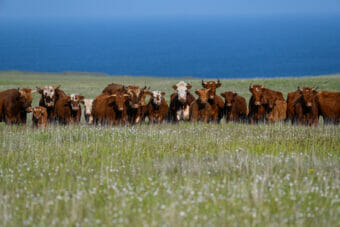
A group of musk oxen near Nome’s Dredge 7 Inn in 2021. (Courtesy Kim Knudsen)

Nome residents are worried about their safety as musk oxen hang around within city limits.

Musk oxen have been spotted in various places around town, including the elementary school and neighborhoods. Musk oxen have reportedly killed or antagonized animals, and they’re keeping people from visiting the cemetery.

And in December of 2022, a musk ox killed a state court services officer as he was trying to haze it off his property’s dog lot near Nome.

Musk oxen disappeared from Alaska by the beginning of the 1900s but were bred in the Bering Strait Region in the 1970s and transplanted to the mainland.

According to the Alaska Department of Fish and Game, the population has grown from 750 musk oxen in the 1970s to more than 4,000 today.

This year, the state is offering 30 musk ox hunting permits for the inner and outer Nome areas. Sarah Germain, a wildlife biologist with Fish and Game, said this should help control the musk ox population in town.

“Hopefully, now that there’s a cow season, folks may be encouraged to harvest a musk ox in the fall,” Germain said. “And we’ll have to assess and see if that does help the nuisance musk ox situation.”

Germain said musk oxen have been coming into town since 2007.

“Since that time, we’ve periodically gotten calls about dog and human conflicts with musk ox,” she said. “I don’t really know that I’d say that it’s increased over time.”

She said residents have used tactics to help deter the animals off personal property, and some are more effective than others.

“Fish and Game staff have learned a lot about getting musk ox enout of an area through time, but it seems like you could yell, you could try to use sirens, there’s water guns,” she said. “Folks have tried various things, but all those things are temporary compared to a fence.”

Sarah Swartz, a Nome resident since 2006, remembers driving down Beam Road to view musk oxen when she first moved to town. But a personal encounter six years later changed her perspective.

“Back in 2012, my dog, in that short time of folding my laundry, he did get gored,” Swartz said. “And that was very, very traumatizing because this big animal who had just attacked my dog was angry and he wouldn’t move. And I couldn’t find my dogs.”

The increasing presence of musk oxen in town prompted Swartz to adapt her daily routines around musk oxen, specifically around her home. She said she goes outside every morning to make sure there are no musk oxen hiding, so she can safely leave her house.

Fish and Game advises residents living in musk ox country to clear brush around their homes to improve visibility and reduce potential encounters with musk oxen. But Swartz said not all Nome residents have the financial means or tools to clear brush or build a fence.

“That takes a tremendous amount of time and money because of resources and stuff that I have to use,” she said. “I really don’t feel like we should be paying for it.”

Swartz said she can’t find a management plan for musk oxen in the Seward Peninsula, but has found plans for other Arctic regions, including Greenland. She said there’s enough land in the region for the musk oxen to be moved and recommends a musk ox farm.

“It’d be great for tourism, and it would be safer for the community and everybody else,” Swartz said. “We could actually get to a point where we could have a higher population and end up having some of those animals harvested for food and it can go to communities in need.”

Nome police didn’t immediately answer a request for comment Friday.

Germain said that Fish and Game will be performing a musk ox survey around the Seward Peninsula next spring that will assess the results of the new bag and cow limits. Limits will be reevaluated for the next hunting season based on those results.

Audubon Alaska launches virtual birdwatching trail for Southeast Alaska

The Southeast Alaska Birding Trail flags Petersburg’s Sandy Beach Park as a birdwatching hotspot.(Photo by Shelby Herbert/KFSK)

Birdwatching is one of the fastest-growing nature-based tourism sectors in the world — and the hobby is soaring in popularity in Alaska. That’s according to a 2022 study from the University of Alaska Fairbanks.

In 2016, nearly 300,000 birdwatchers visited Alaska and spent $378 million, supporting thousands of jobs. Now, Audubon Alaska is swooping in on the virtual bird boom. The organization partnered with the U.S. Forest Service and the Alaska Department of Fish and Game to create the Southeast Alaska Birding Trail — a free virtual guide to 18 communities across the bird-rich region.

Lauren Cusimano is a spokesperson for Audubon Alaska. She says Southeast’s unique biodiversity is what put the region on her organization’s radar.

“It’s just a distinct area of the country, and of the world,” Cusimano said. “It has the largest gathering of bald eagles in the world. It’s home to the largest national forest in the country. It just kind of calls for this kind of attention.”

Southeast hosts nearly 400 bird species, many of which are in decline. The region is a global destination for migratory birds. It’s also a global destination for a certain category of migratory eco-tourists: the kind with binoculars.

So, how does the app work? It helps users keep track of the species they’re spotting. And it shares a bit about regional geography and cultural history. Cusimano said it can even tell you about the trail under your boots.

“Things like amenity details,” said Cusimano. “Like, are there restrooms? Is there parking available? What’s the accessibility situation? Are there entry fees?”

Petersburg is a major destination on the birding trail. The app highlights 18 distinct birding sites nearby.

“Mitkof Island is obviously huge, as far as birding in the Inside Passage,” said Cusimano. “So, we’re talking Petersburg Creek, Sandy Beach — I feel like every community in Southeast has a Sandy Beach — Little Dry Island…places like that.”

Cusimano said Audubon Alaska plans to ride the new eco-tourism wave. The project’s mission is to support industries that rely on healthy, intact ecosystems.

“We want to help contribute to the growth of these local economies by bringing attention to the birding opportunities that are in the area,” said Cusimano. “This is a way to generate economic needs away from maybe, like, timber sales and development.”

With the goal of inspiring environmentally-conscious economic growth, Audubon Alaska’s next step is to flock together with small outdoor recreation businesses to promote the app in Southeast’s heavy tourism stopovers.

Correction: This story has been updated to correct the spelling of Lauren Cusimano’s name.

Two humpback whales freed after entanglements near Juneau

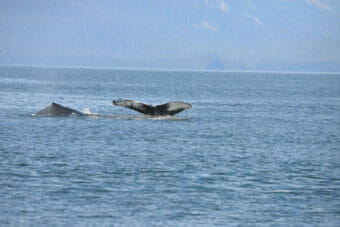
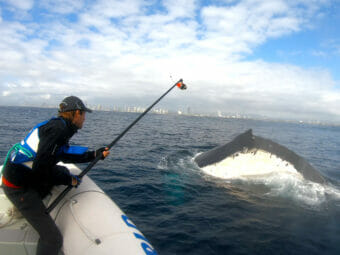
Humpback whales Juneauite on the left and Herbert, the entangled calf, on the right (Photo courtesy of NOAA Fisheries/Suzie Teerlink, NMFS Permit #24359)

Whale experts with NOAA Fisheries have successfully freed two humpback whales, including a well-known calf called “Herbert” that became entangled in fishing gear near Juneau last week.

Herbert’s was the third reported humpback whale entanglement in the area this month. 

Sadie Wright is the coordinator for NOAA’s large whale entanglement response program. She said her team had fielded more entanglement reports than usual for July.

“We’re definitely above average this year for large whale entanglements in Alaska, and in the Southeast,” she said.

Herbert’s entanglement in a recreational crab pot line was reported by a researcher at Auke Bay Laboratories early last week. 

A NOAA team member makes cuts to the fishing line to free Herbert, a humpback calf. (Photo courtesy of NOAA Fisheries/David Gann, NMFS Permit # 24359)

A local whale watching company shuttled NOAA biologists out to Herbert and his mother, Juneauite, while the whales fed near Favorite Reef. The biologists were able to cut loose most of the fishing gear from their boat. Drone footage later confirmed that the calf shook off what was left.

Juneauite is often seen outside of Juneau. This was the second entanglement for one of her calves, following a similar incident in 2016.

Wright also confirmed that another resident humpback whale, nicknamed Manu, was able to free himself after an entanglement in crab pot gear around Fritz Cove earlier this month. The response team tracked the gear using a satellite tag.

“All of the gear that he was entangled in is accounted for,” Wright said. “But we’re interested to see if he has injuries or if he is able to forage properly.” 

The team is asking for recreational boaters, whale watch tour managers and researchers to keep an eye out for Manu around Frederick Sound.

A third, unidentified whale that was entangled in a gill net earlier this month has not been spotted since.

Entanglement in fishing gear can be life-threatening for whales. Heavy, floating gear can cause exhaustion and limit feeding. The risk of entanglement is higher for free floating lines. 

Wright said fishermen can reduce the risk of entanglement by using weighted lines and removing fishing gear when it’s not in use.

Author Nick Jans revisits Romeo, the friendly wolf, in new book

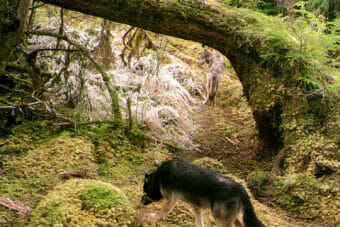
Nick Jans holds a copy of his new book during a visit to the Chilkat Valley News office. (Lex Treinen/Chilkat Valley News)

Local author Nick Jans has a new a photo storybook that retells the tale of a wolf that forged friendships with dogs and owners alike near Mendenhall Glacier. “A True Alaska Tale: Romeo the Friendly Wolf” follows the six years between 2003 and 2009 that Romeo became part of the Juneau community. It was released last week.

Jans published his New York Times bestseller novel “A Wolf Called Romeo” in 2014. Jans said “Romeo the Friendly Wolf,” published almost a decade later, has the added advantage of distance and perspective. He said making it accessible was another priority.

“I want adults to read it to their kids… kids matter most of all. They’re the ones that make change in this world,” said Jans. He also hopes that the book will be able to reach cruise ship passengers who don’t speak English.

This is Jans’ 14th book, and his first that features photography more than writing. “I’m a writer who takes pictures and the pictures help tell the story,” he said.

Jans came to Alaska in 1979 looking to live around big wild animals in a big wild place. He lived more than 20 years in small Inupiaq villages along the Kobuk River in the Northwest Arctic. He worked as a big game guide, trading post manager, and high school teacher. In the late 1990s, he met his wife and moved to Southeast Alaska but still returns to his home near Ambler for a few months each year.

“I didn’t come [to Alaska] to be a writer, I came here to live,” said Jans.

In Juneau, Jans and his wife Sherrie built their house on the shore of Mendenhall Lake. They met Romeo while walking their dog, Dakotah, and a connection was instantly formed between dog and wolf.

“Usually you have contact with a wild animal and you never see them again,” said Jans.

However, Romeo kept coming back.

“At times during the winter he would come and go but sometimes he’d be there for a period of weeks, and have dozens of interactions with dogs,” said Jans. But then one day, Romeo did not come back.

Romeo often played with Dakotah, Nick Jans' yellow lab. (Photo courtesy Nick Jans)
Romeo often played with Dakotah, Nick Jans’ yellow lab. (Photo courtesy Nick Jans)

Years later, reminiscing on Romeo brought tears to Jans’ eyes on more than one occasion. His voice trembled with emotion as he recalled the impact that Romeo had on the people who grew to love him.

“That this book is coming out is proof that he’s not going anywhere. His story trots on,” he said.

The story of Romeo has proved to be an inspiration for many. Jans said he still gets letters from people around the world who read “A Wolf Called Romeo,” which has been translated into seven languages. An exhibit for Romeo was built in 2017 at the Mendenhall Glacier Visitor Center, and last year the Orpheus Project, a Juneau non-profit, hosted a festival of sorts celebrating Romeo’s life.

Todd Hunt, artistic director for the Orpheus Project, said the celebration included “many different artists and their interpretation of what Romeo means to them.” He read Jans’ first book as soon as it came out and realized it “needed some musical treatment,” prompting him to compose a cantata that became part of a two-act piece named “Wolf Songs.”

“I always thought that what I should do is to make the life and death of this exceptional wolf count for something,” said Jans.

He said he wants to keep telling Romeo’s story through his new book, which he said speaks to the heart of humanity’s relationship to the wild.

“If you can make friends with a wild wolf, and he made friends with us, then we need to at least metaphorically make friends with nature,” said Jans.

This story originally appeared in the Chilkat Valley News and is republished here with permission.

Roadside assistance? Alaska DOT helps sheep stuck along the Seward Highway

A hook on the boom arm of an Alaska Department of Transportation truck pulls rockfall mesh away from a steep wall near a Dall sheep that was stuck along the Seward Highway near Beluga Point on July 20, 2023. (Courtesy Alaska Department of Transportation and Public Facilities)

The newly installed mesh on steep rock faces along the Seward Highway is intended to catch falling rocks. Last week, it caught a sheep instead.

A member of the public spotted the sheep on Wednesday near mile marker 111.5 of the Seward Highway, which is near Beluga Point. The person called it in to the Alaska Department of Fish and Game.

Assistant area biologist Cory Stantorf said at first, they couldn’t find it.

“A lot of times on those ledges, if they lay down, they completely disappear from sight,” he said. “You could drive the road and not see them. And that’s exactly what happened. By the time DOT got out there, just before, they had no idea where it was because it wasn’t standing up any more. It was laying down, and you could just see its head poking up between vegetation there.”

A ranger with Chugach State Park was able to spot it on Thursday, Stantorf said. He headed down to the scene for the rescue, along with state troopers and state Department of Transportation workers.

Stantorf said it was an adult female Dall sheep. The ewe looked relaxed at first, but got a little stressed when a truck with a boom arm got involved.

A hook on the boom arm of an Alaska Department of Transportation truck pulls rockfall mesh away from a wall near a Dall sheep that was stuck along the Seward Highway near Beluga Point on July 20, 2023. (Courtesy Alaska Department of Transportation and Public Facilities)

DOT workers used a hook on the boom to pull the mesh away from the rock face.

“After about 45 minutes of you know, trying a couple of different spots where he pulled the screen back, we finally were able to kind of show her a path that she wanted to finally take,” Stantorf said. “And as soon as she did that, it was a matter of, you know, 5 seconds and she was out.”

The rescuers shouted encouragement and cheered as it headed into the open.

“In the time that I’ve been in this position, which is like, 7 or so years, this is a new one on me,” Stantorf said.

DOT spokesperson Jill Reese says the netting is a new addition to the highway. She said time will tell if wildlife issues like this are a recurring issue.

The rescue limited highway traffic to one lane around the scene for about an hour.

Stantorf encourages the public to use the “report wildlife encounters” button on the Fish and Game website if they spot an animal in distress.


Site notifications
Update notification options
Subscribe to notifications