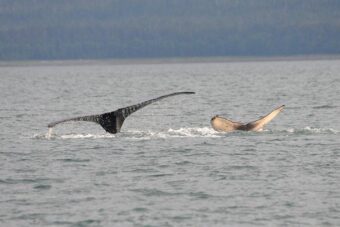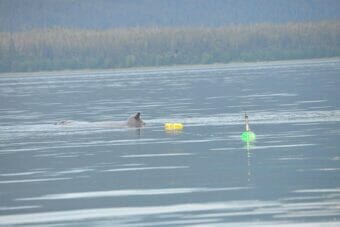
A gray beluga whale calf and three adults swim together in Cook Inlet. A newly released population estimate shows signs of recovery, or at least stablization, among the endangered whales. The unprecedented marine heatwave known as The Blob is believed to have taken a toll, but the population has increased since that heatwave dissipated. (Photo by Paul Wade/NOAA Alaska Fisheries Science Center)
The number of endangered beluga whales swimming in Alaska’s Cook Inlet increased slightly in the past four years, providing “a glimmer of hope” for a population that crashed in the 1990s and remained at a low number long after that, according to a new estimate released on Thursday by federal biologists.
The latest population estimate for endangered Cook Inlet belugas is between 290 and 386, with a median estimate of 311, the National Oceanic and Atmospheric Administration said. That compares to NOAA’s’ Alaska Fisheries Science Center 2018 median estimate of 279 and a range of 250 to 317 animals.
The new population estimate is based on aerial surveys conducted in the summers of 2021 and 2022.
In a NOAA Fisheries statement, one of the biologists who compiled the new estimate expressed tempered optimism.
An educational sign about endangered Cook Inlet belugas is seen on March 7 at the small boat launch Anchorage’s Port of Alaska. The sign was designed and erected to raise public awareness, part of a wide-ranging strategy to help the endangered whales recover. Cook Inlet belugas’ habitat overlaps with a lot of human uses, including those at the port. (Photo by Yereth Rosen/Alaska Beacon)
“While this is certainly encouraging news, it is important to recognize that abundance estimates can vary from year to year due to a number of factors,” Kim Goetz, an Alaska Fisheries Science Center marine mammal biologist listed as the lead author of Thursday’s report, said in the statement.
Cook Inlet belugas numbered about 1,300 in 1979, according to NOAA. The steep decline that started in the 1990s was blamed on overhunting, but even after Indigenous subsistence hunting ceased, the population continued to decline. In 2008, Cook Inlet belugas were listed as endangered.
Now, a slight upturn of less than 1% a year appears to have been happening for at least a few years, according to the new population estimate.
Recent analysis of the past two decades shows that there was likely a steady increase in Cook Inlet beluga numbers from 2004 to 2010, but the population dropped over the next eight years before increasing again.
While the reasons for the 2010-2018 decline are yet unknown, the report said, a likely suspect has emerged: the sustained and unprecedented northeast Pacific marine heatwave that disrupted fish stocks and triggered die-offs in various wild populations.
Informational sign at Anchorage’s Earthquake Park, seen on Jan. 27, describes the belugas and salmon found in Cook Inlet. Salmon make up much of the belugas’ diet, so the endangered whales suffer when runs are poor. (Photo by Yereth Rosen/Alaska Beacon)
Among the cascading effects of that heatwave, which became known as The Blob, were a near-total loss in the northern Gulf of Alaska of capelin, an important and oil-rich forage fish; mass die-offs of birds, including Alaska’s biggest die-off of common murres on record; a die-off of large whales; and a sharp decline in Pacific cod, which triggered some Gulf of Alaska commercial harvest closures. Cod are also important to Cook Inlet belugas, the report noted.
There may have also been overlapping human-caused problems for the belugas during the period of decline, said the report. Nonetheless, the increase in abundance since 2018 shows signs that the population is slowly growing or at least stable, the report said.
Cook Inlet belugas live in Alaska’s most populous and developed region. Scientists say they face a myriad of threats and potential disturbances from forces like climate change, habitat degradation, pollution, industrial noise and ship traffic in Alaska.
At the same time, they have also been the subject of numerous conservation and protection efforts. A task force with representatives from multiple government agencies, businesses, academia and other organizations has been guiding recovery work.
Alaska Pacific University professor of marine biology David Scheel examines an octopus, cyanea, near Mo’orea, French Polynesia. (Sy Montgomery)
Octopuses are mysterious sea creatures to many people, including in Alaska, where more commercially viable and — dare we say — charismatic animals get the most attention.
After all, octopuses do live mostly solitary lives, hiding under rocks, changing color and shape to blend into their surroundings, grabbing prey with their sucker-lined arms and pulling it into their sharp beaks.
But our understanding of their biology and behavior has advanced greatly in the last three decades or so, thanks in part to a professor of marine biology at Alaska Pacific University, Dr. David Scheel. Scheel has a book out called “Many Things Under A Rock: The Mysteries of Octopuses,” which is the culmination of many hours spent investigating octopuses underwater and in tide pools, with help from coastal Alaska’s Indigenous people.
Listen:
The following transcript has been lightly edited for clarity.
David Scheel: Yeah, so the study started as an oil spill-related study. But in the end, we weren’t able to say very much about the impact of the oil spill on the octopuses, because there really wasn’t any pre-oil spill data or studies. And the people who had been most interested in the octopuses in Alaska, pre-oil spill, seem to have been the Alaska Natives, because that’s an important part of their subsistence culture in many of the coastal communities. And so in the early days of my work with octopuses, some of the elders took me out foraging and collecting octopuses. And that was how I learned to find them, initially. And so I designed my early study around the ways that the Alaska Natives harvested the octopuses and, you know, they’re just doing it the same way it’s been done for a long time. And so they’re not using scuba diving gear, right? So that’s how it started. But then, when I was getting funding from my early work, I was asked by the funding agency to add scuba diving.
Casey Grove: It seems like there were a lot of unknowns there. And maybe part of that was, you know, the unknown of your own safety in that situation.
David Scheel: You have to bear in mind, my divers have four limbs, the octopus has eight. So we’re at a disadvantage to begin with. And so it was a question for me to try and solve is, ‘How big do these guys get?’ You know, that’s not a question with a definitive answer, but the Alaska Pacific octopus does routinely get up to about 100 pounds or more, and occasionally much larger. And so that’s a size that’s big enough that we wanted to be careful how we handled them, because we didn’t want to put anyone at risk. But we also weren’t interested in killing or harvesting the octopuses. We wanted to weigh them, measure them, find out whether they’re males and females and put them back.
Casey Grove: And then, is it fair to say, I mean beyond that, that you’ve discovered they have a certain intelligence?
David Scheel: Yeah, a lot has been written about octopus intelligence, and for the most part, that hasn’t been a central subject of my research. But, you know, the stuff that I do, particularly up here in Alaska, is looking at what they’re eating and how they’re choosing their diet, and things like that. And even there, you can see threads of behavior that reveal how their cognition works and what kinds of choices they’re making.
And one of my favorite examples that I talked about in “Many Things Under A Rock” is octopuses prefer larger species of prey. And so they’re eating small crabs, but they’re choosing the bigger species of the crabs in Prince William Sound. And so what does that actually mean the octopus is doing? Well, first of all, they have to be able to judge size, but then they’re also using restraint. We know that they’re passing up small, immediate rewards in order to look for larger rewards in the future. They are very clever animals. But really, I think the building blocks of octopus intelligence are really curiosity, persistence and flexibility. So they’re always exploring things. They’re reluctant to give up. And if one thing doesn’t work, they’ll try something else. And I really think that’s where a lot of intelligence comes from, including in humans.
Casey Grove: That’s interesting, yeah. So there are many ways that that yourself and other researchers have gone into the ocean to look at different animals, and in your case octopuses, and then you sort of famously also have had an octopus living in your house.
David Scheel: Yeah, you’re referring to the PBS documentary “Octopus: Making Contact.” And that was originally envisioned as sort of “a scientist and the octopus he keeps in his home.” But fortunately, my daughter Laurel — who’s the illustrator for the book, by the way, she has done some marvelous drawings to put the book — she kind of bonded with Heidi (the octopus). And so that really changed the whole nature of of that documentary and made it, in some ways, this this charming piece about a girl and her octopus, which I think was much better story than a scientist and his octopus.
Casey Grove: Well, I can imagine that you both had a lot of interactions with Heidi. And so I wondered, I mean, were there things that you felt like by having her in your home that you learned that you would not have otherwise?
David Scheel: Yeah, Heidi was great to have in the home. And one of the things that happened is that she really wanted to interact with us. And I was surprised to find- I had my desk setup, when I would work from home, where I could have a really good view of the aquarium that Heidi was in. And Heidi would get up, she would see me at my desk, and she would get up out of her den and come to the nearest corner of the tank, and then she would go up and down, from the surface of the water to the bottom, from the surface of the water, up and down until I would look up. And then she would, you know, she didn’t wave or anything like that, because that’s not a natural behavior for octopuses, as far as we know, but she would change her behavior a little bit, notice me noticing her, and she wanted me to get up and come and play with her. And if I didn’t, if I tried to get back to work, out of the corner of my eye, I would see her doing that pacing behavior again.
Casey Grove: One interesting thing about octopuses — I mean, other animals as well — but they they dream, right? And how can you tell that they’re dreaming?
David Scheel: Yeah, the question of octopus dreaming is a fascinating one. And I got involved with it through making that PBS documentary,.The cinematographer there, the photographer, was just brilliant. He caught this lovely sequence of Heidi asleep and going through all these bodily changes. And if you look at it, there’s only one thing that you think is happening, you think the octopus is dreaming. You know, what we know about dreaming is anchored in part in having a dream and then talking to people about dreaming so it’s anchored in language. But it’s not entirely anchored in language. There are other things that reveal dreaming. If you can know how the body pattern of an octopus changes in different contexts that are ecologically relevant in their life, like the difference between foraging for prey and escaping a predator, then those body patterns are mimicked in the proper order during sleep, that is very suggestive of dreaming. And studies in humans have shown that our eye movements during REM sleep will actually track what we’re looking at in our dreams. So if you’re dreaming of a tennis match, for example, your eyes during REM sleep are going back and forth following the ball. And so we know that humans do this kind of thing. Their sleep behavior while dreaming reveals content of the dream. So why wouldn’t that be true for octopuses as well?
Casey Grove: It seems like people, you know, with certain animals and how we think about them, for humans, it’s like easier to relate to another primate. And obviously, octopuses are very different from that. And as people sort of begin to understand and begin to acknowledge the intelligence in this creature, are they then, I guess, more obligated to help protect them?
David Scheel: Well, I think it’s very easy for us to identify with octopuses. I mean, they’ve got the same kind of vision we do. And they’re particularly, once you learn to work with them a little bit, they’re very enamored of touch. And we are, too, and so they become very endearing animals. And when you add to that, sort of this notion of octopus awareness — right? — that they have inner lives, that they experience hunger and fear or, you know, that they might be dreaming and having dreams and nightmares, then it becomes very easy to identify with them.
But in terms of what does that mean, how should we behave? That’s a question that’s more about us than it is about octopuses themselves. So maybe, you know, you get to a point where, like me, you think, “Well, I’m just not going to eat any of these animals that I, you know, feel attached to.” I don’t eat octopuses anymore because their behavior. You know, that’s more interesting to me than any culinary experience I could have with an octopus. But that really says something about our culture, particularly. And then if you look at Indigenous cultures was harvest some of these animals, they have a very different relationship, right? Because to them, this is part of their cultural heritage. It’s part of how they relate to the world. It’s part of how Indigenous cultures see people, not as separate from nature, but as part of nature. Octopuses have to eat, right? And they eat clams and crabs. Well, people have to eat as well. And so when you’re looking at these choices, my feeling is that you have to place them in the proper context. The properties of the animal alone do not determine how we should relate to that animal.
Two of Grubby’s joeys arrived at the Alaska Zoo on Friday. (Lori Stackhouse/Alaska Zoo)
The Alaska Department of Fish and Game caught another baby opossum in Homer late last week, bringing the total to five since the capture of their mom, Grubby, in late May. But Jason Herreman, a wildlife biologist at Fish and Game, said the search isn’t over. Opossum litters are usually eight or nine joeys — and can be as many as 13.
“It’s possible there’s more out there, it could be that we’re getting towards the end of them,” Herreman said. “But if you go off the average litter size, that would suggest we still got four or five more to catch out there.”
Opossums aren’t native to Alaska — Grubby arrived in a shipping container from Washington state. Biologists like Herreman are concerned that if Grubby’s kids aren’t all captured they’ll start breeding and establish a population here. Herreman said it’s likely they could survive the winter. Opossums have spread as far north as Canada.
“You look at where their home ranges have expanded to in the Lower 48, and the environmental conditions in the winter aren’t that much different than what you can find in downtown Homer,” he said.
Herreman isn’t an opossum expert – before this March, there were no opossums in Homer. But these past few weeks, he’s been reading up. He said he always enjoys learning about new animals, but he just wishes he’d had more time to prepare for this.
Since their litters are so big, Herreman said even a handful of rogue opossums have the potential to explode into an invasive population, and they could pose a threat to local wildlife. Opossums could spread diseases, as well as eat local insects, rodents and birds — potentially disrupting the ecosystem.
Herreman said there’s no way to know if the saga of Grubby and her family is over.
“No matter what, unless we catch 13 of ’em, I wouldn’t ever really be comfortable to say we got them all,” he said.
Herreman said Fish and Game still has traps out around Homer. He encouraged people to report any opossum sightings to the agency at 907-235-8191, and to the Homer Police Department after business hours at 907-235-3150.
Grubby the opossum perches on a branch in the infirmary at the Alaska Zoo. (Lori Stackhouse/Alaska Zoo)
Homer police have said that placements would be found for all of Grubby’s offspring. So far, Grubby and two of her babies have been taken to the Alaska Zoo, and two more will be heading there in the next few days. Fish and Game said one baby opossum did not survive.
Only Grubby is taking up permanent residency at the zoo in Anchorage. According to Fish and Game, one of the babies will move to the Alaska Wildlife Conservation Center, and two more have confirmed placements at zoos in the Lower 48. It’s still unclear where the fourth will go.
Northern pike are not native to Southcentral Alaska. But in the decades since the fish were illegally introduced into some Kenai Peninsula lakes, biologists have been hard at work eradicating local pike populations. Now, they know pike can travel between freshwater systems via Cook Inlet — raising concerns about how pike can spread. (Courtesy Of Kristine Dunker/Alaska Department Of Fish And Game)
It was a very ominous discovery back in 2019: invasive northern pike in Vogel Lake, at the tip of the Kenai Peninsula.
And it raised some red flags for biologists with the Alaska Department of Fish and Game. Soldotna-based Fisheries Biologist Eric Wood said before the Vogel discovery, biologists on the peninsula had only found pike in lakes that were accessible by car. Those pike had likely been illegally put there by anglers.
That didn’t explain why there were pike in Vogel — a remote lake near Point Possession, accessible by float plane or snow machine.
Now, for the first time, researchers have concrete evidence that the fish could use the ocean to move between freshwater habitats, introducing new questions about where those fish can travel and what scientists can do to keep their numbers under control.
“This discovery kind of opened the door to a whole bunch of other concerns and questions and things we need to figure out,” Wood said.
Northern pike are native to interior and western Alaska, not Southcentral.
But they’re a popular species among anglers. As the story goes, sport fishermen started introducing pike into lakes in the region in the 1950s and then in Kenai Peninsula lakes in the 1970s, likely by way Fairbanks — causing problems for other fish species. Pike dominate any system they’re in, eating salmon and degrading local fish populations.
Invasive pike pose a threat to native fish species, like salmon. (Courtesy Of Kristine Dunker/Alaska Department Of Fish And Game)
Invasive Species Biologist Kristine Dunker said pike have been found in 150 bodies of water in the region, overall. In the Matanuska-Susitna Borough, researchers have had a hard time getting populations under control.
But on the Kenai Peninsula, the problem has been more manageable. Dunker said over two decades, biologists from a handful of local, state and federal agencies worked hard to eradicate pike on the peninsula.
“And we thought we had. In 2018, we finished a project in the Tote Road area and thought that that was it — that all known populations were gone at that point,” she said. “And it was like, ‘Yay!’ — for about a week.”
That’s when the department heard from an angler who had found the pike in Vogel. The department was also getting word from some set netters that they were catching pike in Cook Inlet.
With a researcher in Fairbanks, Fish and Game started testing pike for signs they had traveled through saltwater. They looked for signs in their otoliths, or ear bones — which can absorb traces of the fish’s environment.
“When we got the results back, you could see on the graph that this fish actually came from somewhere, spent time in saltwater, and then went to a different freshwater location,” Dunker said. “That was very eye-opening to us.”
Biologists first found a pike in Vogel Lake, shown above, in 2019. (Courtesy Of Kristine Dunker/Alaska Department Of Fish And Game)
Wood said that ocean pathway could complicate efforts tocontain pike, and he said inlet conditions could become more favorable for the freshwater fish as glaciers continue to melt.
“As to where they came from, how they ended up where they ended up, we don’t know that for sure,” Wood said, adding that the Susitna River seems to be the obvious point of origin, since pike are so widespread there.
Wood and Dunker both said from the research side of things, the new discoveries are fascinating. Now, they’re finding marine signatures in pike from other systems too, including two lakes in Anchorage earlier this year — Campbell Lake and Westchester Lagoon.
But the findings create more challenges on the management side.
Dunker said since pike disperse, it’s important to prevent populations from spreading.
“The big challenge for us now is to try to figure out — How do we do that well? When you have a scenario where pike could be moving around marine estuary corridors, that makes it a much more difficult problem. But it doesn’t make it an impossible one,” she said. “It just means we have to be kind of smart about it and anticipate where they might be going.”
Already, Wood said Fish and Game has put a weir at Miller Creek, which flows out of Vogel Lake, to stop northern pike from entering the system there. But he said that’s not a permanent solution .
“The reality of it is, there’s so much money, so much tradition and everything tied up with salmon in this area, that this could have the potential to wipe out so much,” Wood said. “So it is scary, in that way.”
With many questions remaining, Dunker said every fish they can test and study is helpful. She said anglers and fishermen who catch pike should report their sightings to Fish and Game and bring in retained pike, when possible. The number to report invasive pike is 1-877-INVASIV.
Killer whales are pictured during a storm in the fjord of Skjervoy in 2021 off the coast of northern Norway. Researchers say orcas are stepping up “attacks” on yachts along Europe’s Iberian coast. (Olivier Morin/AFP via Getty Images)
Scientists and sailors say orcas, also known as killer whales, are stepping up “attacks” on yachts along Europe’s Iberian coast, with one skipper who’s been pursued by the marine mammals on two separate occasions suggesting that their tactics are becoming more stealthy.
Delivery skipper Dan Kriz, who had to be towed into port after orcas destroyed the rudder on a boat he was on in 2020, had an almost identical experience in April.
“My first reaction was, ‘Please! Not again,'” Kriz told Newsweek.
Unlike last time, the orcas made a stealthier approach without the characteristic squeaks they normally use to communicate, he says. They made quick work of the two rudders on the catamaran Kriz was delivering. “Looks like they knew exactly what they are doing. They didn’t touch anything else,” he said.
Most marine scientists have characterized hundreds of encounters between boats and orcas that have sunk at least three vessels and damaged dozens of others over the years as a “fad,” implying that the animals will eventually lose interest and resort to more typical behavior.
But if that’s the case, there are few signs this behavior is going out of style anytime soon. According to a June 2022 study published in the journal Marine Mammal Science, orcas have stepped up the frequency of their interactions with sailing vessels in and around the Strait of Gibraltar, the busy waterway that links the Mediterranean Sea with the Atlantic Ocean.
Some researchers think it’s merely playful behavior
As NPR first reported last August, many scientists who study orca behavior believe these incidents — in which often one or more of the marine mammals knock off large chunks of a sailboat’s rudder — are not meant as attacks, but merely represent playful behavior.
One hypothesis put forward by Renaud de Stephanis, president and coordinator at CIRCE Conservación Information and Research, a research group based in Spain, is that orcas like the feel of a boat’s rudder.
“What we think is that they’re asking to have the propeller in the face,” de Stephanis told NPR last year. “So, when they encounter a sailboat that isn’t running its engine, they get kind of frustrated and that’s why they break the rudder.”
A picture taken on May 31 shows the rudder of a vessel damaged by killer whales (Orcinus orca) while sailing in the Strait of Gibraltar and taken for repairs at the Pecci Shipyards in Barbate, near Cadiz, southern Spain. (Jorge Guerrero/AFP via Getty Images)
In another recent encounter, Werner Schaufelberger told the German publication Yacht that his vessel, Champagne, was approached by “two smaller and one larger orca” off Gibraltar.
“The little ones shook the rudder at the back while the big one repeatedly backed up and rammed the ship with full force from the side,” he said.
The Spanish coast guard rescued Schaufelberger and his crew, towing Champagne to the Spanish port of Barbate, but the vessel sank before reaching safety.
The encounters could be a response to past trauma
Since 2020, there have been more than 500 encounters between yachts and orcas in the area, according to one of the study’s co-authors, Alfredo López Fernandez, a biologist at the University of Aveiro in Portugal and a representative of the Grupo de Trabajo Orca Atlántica, or Atlantic Orca Working Group.
López Fernandez believes that a female known as White Gladis, who leads the group of around 40 animals, may have had a traumatizing encounter with a boat or a fishing net. In an act of revenge, she is teaching her pod-mates how to carry out revenge attacks with her encouragement, researchers believe.
A worker cleans Champagne, a vessel that sank after an attack by orcas in the Strait of Gibraltar and was taken for repairs at the Pecci Shipyards in Barbate, near Cadiz, southern Spain, on May 31. (Jorge Guerrero/AFP via Getty Images)
“The orcas are doing this on purpose, of course, we don’t know the origin or the motivation, but defensive behavior based on trauma, as the origin of all this, gains more strength for us every day,” López Fernandez told Live Science.
It’s an intriguing possibility, says Monika Wieland Shields, director of the Orca Behavior Institute.
“I definitely think orcas are capable of complex emotions like revenge,” she says. “I don’t think we can completely rule it out.”
However, Shields is not ready to sign on to the “revenge” hypothesis just yet. She says that despite humans having “given a lot of opportunities for orcas to respond to us in an aggressive manner,” there are no other examples of them doing so.
Deborah Giles, the science and research director at Wild Orca, a conservation group based in Washington state, is also skeptical of the hypothesis. She points out that killer whale populations in waters off Washington “were highly targeted” in the past as a source for aquariums. She says seal bombs, small charges that fishers throw into the water in an effort to scare sea lions away from their nets, were dropped in their path while helicopters and boats herded them into coves.
“The pod never attacked boats after that,” she says. “It just doesn’t ring true to me.”
Shields says it’s important to remember that whatever the motive is for the behavior of the orcas off the Iberian coast, it isn’t being transmitted to pods in other parts of the world.
“We’ve had folks here in Washington [asking] ‘is it safe to go out in the water here with these orcas?'” she says. “While this is kind of an ongoing situation in that specific place, I don’t think there’s any reason to think it’s going to start spreading to other populations of orcas.”
Copyright 2023 NPR. To see more, visit https://www.npr.org.
A moose has tested positive for rabies in Western Alaska.
The Norton Sound Health Corporation’s Office of Environmental Health is encouraging residents of the region to make sure that their pets are vaccinated against the rabies virus after a moose tested positive for the virus in Teller.
According to a release from NSHC, on June 2, residents in Teller — a community of about 250 people, roughly 70 miles northwest of Nome — reported that a moose was acting aggressively toward people and showing other signs of the virus.
The Alaska Department of Fish and Game responded, and the moose later tested positive for rabies.
The rabies-positive moose is the first confirmed case in Alaska. The virus detected is the same variant of the rabies virus that has been found in red foxes, which according to Fish and Game, suggests the moose was most likely infected by a fox.
Fish and Game encourages anyone who finds a dead mammal or sees a mammal exhibiting signs of rabies, to report their sighting immediately to Fish and Game.
Signs of rabies include sudden behavioral changes, such as staggering, aggression, fatigue, excessive drooling, uncoordinated movements, biting at themselves, chasing vehicles, or acting unaware of their surroundings. Photos and videos can be helpful to evaluate the animal, but it is most important to keep your distance to avoid exposure.
All dogs and cats should be vaccinated against rabies at three months old, again one year later, and every three years after that.
To contact Fish and Game to report anything wildlife-related, call 907-443-2271. To reach out to NSHC regarding pet exposure or vaccinations, call 907-434-1659 or 907-434-0543.
Close
Update notification options
Subscribe to notifications
Subscribe
Get notifications about news related to the topics you care about. You can unsubscribe anytime.