Wildlife

Alaska’s most wanted possum is settling into her new home at the Alaska Zoo

Grubby is currently in quarantine. (Sam Lavin/The Alaska Zoo)

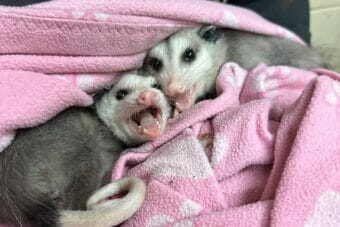
Grubby, Alaska’s most wanted opossum, was settling into her new home Friday at the Alaska Zoo in Anchorage.

She arrived Wednesday night from Homer, and is the first opossum to reside at the zoo. Curator Sam Lavin said Grubby has been adhering to her nocturnal instincts by sleeping during the day and tearing up cardboard when she’s awake. Lavin said she’s working to win Grubby over.

“Mainly we’re doing trust building right now, getting her to associate us with food,” said Lavin. “Seeing people is less stressful when she associates them with food.”

It’s been two months since Grubby’s unexpected arrival in Alaska. She was a stowaway in a shipping container from Washington state that was bound for Homer in March. Once she got to the Kenai Peninsula town, she immediately caused a stir as she wandered around and evaded traps. Some people wanted her captured and killed because opossums are invasive to Alaska. But other rallied around her, launching the hashtag #FreeGrubby.

Police ultimately caught Grubby early Wednesday, and biologists decided to send her to the Alaska Zoo.

Right now, Grubby is technically in quarantine at the zoo. She’s living in an infirmary, and visitors can see her through a window. Her neighbors include a ground squirrel who’s also new to the zoo.

The zoo plans to keep Grubby after she is done quarantining, but staff still need to decide how to design her exhibit.

“Since they don’t live in Alaska, we’re going to have to keep in mind how she’ll do in the wintertime,” said Lavin. “We’re surprised that she survived out in Homer as well as she did considering the winter we had this year.”

Zoo staff estimate Grubby is about 2 years old. They say the zoo has received various donations in the past 24 hours from Grubby’s supporters and her fanbase over social media has continued.

Homer’s elusive possum, finally captured, will not be killed after all

Grubby the opossum in a garbage can after its capture by Homer police. (From Jason Herreman/Alaska Department of Fish and Game)

Grubby, an opossum that wandered Homer for more than a month, has officially been captured and taken to the Alaska Zoo.

Grubby arrived in the Kenai Peninsula community in March after hitching a ride on a shipping container from Washington state. The visitor quickly divided the community. Some wanted it captured and killed because it’s an invasive species. But others took a liking to it, launching the hashtag #FreeGrubby.

Grubby the opossum’s last moments of freedom, on May 24, 2023. (From Homer Police Department)

Grubby was on the lam for weeks until Wednesday.

Alaska Department of Fish and Game biologist Jason Herreman said Officer Taylor Crowder was able to capture the female opossum.

In a whimsical Facebook post, Homer police confirmed the capture of the “wanted fugitive and somewhat local celebrity” near Lakeside Drive and Smokey Bay at about 5:30 a.m. Wednesday.

“Officer Crowder attempted to contact the suspect alone, who then fled the area, ultimately coming to a dead end, cornered in front of a local business,” police wrote. “Officer Crowder, without any fear or hesitation, attempted to apprehend the suspect, who then let out a little hiss and growl and bit our officer in the hand.”

Homer police officer Taylor Crowder is sworn in on May 14, 2021. Grubby bit him on the hand. (From City of Homer)

Crowder and others were able to place the opossum in a garbage can.

Herreman said biologists had originally planned to euthanize the opossum because of the dangers — ranging from predation to disease transmission — invasive species can pose to indigenous animals.

“We don’t want invasive species in the state, because of the problems that come with them, and the disruption to the ecosystem that could cause so we do our best as an agency to limit them,” he said.

According to Herreman, the fate of Grubby – named because she was discovered near Homer’s Grubstake Avenue – had become a hot topic among locals.

“There was folks who were interested in making sure this animal wasn’t necessarily destroyed, but had a chance to be re-homed or sent back to where it came from,” he said. “And then we have other folks who understand the invasive-species issues and don’t have any issues with the animal possibly being put down for the good of the ecosystem.”

After checking with regional animal facilities, Herreman said the Alaska Zoo in Anchorage volunteered to take the animal in.

Zoo director Pat Lampi said Thursday that Grubby arrived Wednesday night and will undergo an examination by zoo veterinarians.

“It’s another rescue, not something native to Alaska, but they do get as far north as into Canada,” Lampi said. “And so we decided we would go ahead and try to make a home for it.”

Because opossums are common in the Lower 48, Lampi said Grubby is likely to remain in Alaska — possibly as part of an exhibit on invasive species in the state, rather than being transferred to another zoo.

“I think it’s the first opossum that’s ever been turned in here to my knowledge,” Lampi said.

Gray whales find haven in Sitka Sound

A gray whale surfaces while feeding near Shoal’s Point, west of Sitka. (Photo by Blain Anderson)

While reports of gray whale strandings along the Pacific coast have jumped since 2019, there’s at least one place where these whales seem to be thriving. Hundreds of gray whales migrating from Mexico to their Arctic feeding grounds are stopping in Sitka along their route.

Gray whales have often visited Sitka, but over the past few years, boaters and biologists have seen an unusual increase in gray whale activity.

“I was just talking to somebody up in the parking lot who said at one point last year, he estimated over 700 whales – gray whales,” said Blain Anderson, captain of the sailboat Bob.

Seven hundred might be on the high end, but whale biologist Lauren Wild says the number of gray whales in Sitka Sound used to hover around 10 or 20. Since 2019,  it’s been closer to 150.  As Wild put it, “it’s whale soup out here.”

Most of the news about gray whales in recent years has been pretty dismal. In May 2019, the National Oceanic and Atmospheric Administration declared an ongoing  “unusual mortality event” due to elevated strandings of West-coast gray whales. Before that, a 2015-2016 marine heat wave, sometimes referred to as “the blob,” devastated Pacific-coast fauna from whales, to seabirds.

In Sitka, though?

“If people have been seeing them, they’re seeing whales rolling around and playing with each other,” Wild said. “They’re seeing a lot of feeding behavior, a lot of social behavior. Some people are seeing what looks like mating behavior.”

Like humpbacks, which are commonly seen in Sitka Sound, gray whales use baleen to feed. Unlike humpbacks, gray whales feed in the shallows, filtering silt and sand to get to tiny critters, like shrimp. Gray whales are smaller and often covered in parasitic barnacles and long scars from rolling around on the rocks.

Wild usually studies humpbacks and sperm whales, but the gray whale influx has piqued her interest. While it’s not entirely clear what is bringing this barnacle-covered baleen bonanza to the waters of Sitka Sound, Wild has a few ideas.

“We sort of wondered if the marine heatwave maybe disrupted some of the the reliability of food in the Bering Sea and Chukchi seas in the summer,” Wild said. “And if that possibly, sort of prompted these whales to be looking for more opportunistic places to forage along their migration routes, so they weren’t relying so much on those food sources.”

The food source? Likely herring eggs along the outer coast of Kruzof island.

“If you look at a map, the tip of Cape Edgecumbe is right along the outer coast,” Wild said. “If whales are migrating by and they just happen to be there at the right time, they might sort of start seeing more of that herring spawn, and it might pique their attention.”

Pacific herring spawn each spring in the waters around Sitka, and these fish – and their eggs – are an important food source for marine organisms and humans alike. Herring roe in Sitka is already a hotly contested resource, and now these motivated mysticetes may have joined the competition.

Wild said that the timing and location of gray whale sightings correspond to areas of herring spawn. She also pointed to observations from Alaska Department of Fish and Game spawn surveys:

“They’ll be diving and see gray whales around their dive boat and stuff,” Wild said. “So they’re certainly in the same area that those eggs are. And then they’ve seen a few times, you know, kelp beds that look sort of shredded like, and they’re imagining that is probably gray whales coming through and sucking up eggs off the kelp and rolling around in it.”

Wild hopes to confirm exactly these whales are eating – even if the fieldwork gets messy.

“Obviously you don’t know when they’re going to defecate,” Wild said. “So you kind of have to be at the right place at the right time. And we’ll use a little skim, almost like a fish pond net, that’s fine mesh, to just sort of scoop it up. You can also scoop it up with water in a Nalgene or something.”

A gray whale shows flukes as it dives. (Photo by Blain Anderson)

Understanding what these whales eat is one part of the puzzle. Wild is also hoping to start building a catalog to identify and track individual whales to figure out which whales are coming to Sitka, and where else they’re going along their migration route.

In the meantime, both Wild and Anderson urge boaters to be cautious around gray whales, which may be more likely to approach humans than the average Sitka humpback. In Mexico, boaters can legally approach – and interact with – gray whales.

“They get chin scratches,” Anderson said. “And you know, I’ve seen pictures of people kissing them.  And it’s something that perhaps they’ve gotten used to.”

The whales may ignore political borders, but Alaska boaters are still required to follow the Marine Mammal Protection Act – to avoid harassing whales, NOAA encourages boaters to stay 100 yards away and put engines into neutral if a whale approaches.

We don’t know what will happen in the future with these new visitors, or what the implications are for the West-Coast gray whale population as a whole, but for now, it seems that this struggling population has found a haven in Sitka feeding, socializing, and even — as Anderson has observed a few times — mating.

As Anderson noted, “It was all supposed to happen down to Mexico, but it does seem like they’re continuing their frisky ways up in – as we call it – romantic Sitka Sound.”

To report a stranded, injured, entangled, or dead marine mammal, call the NOAA Fisheries Alaska Statewide 24-hour Stranding Hotline: (877) 925-7773.

Bird-calling competition brings beautiful, mysterious and wacky calls to Homer

A contestant identified as Mr Oystercatcher imitates the local bird. (Corinne Smith/KBBI)

Five-year-old Cassidy Allmendinger confidently walks to the mic on a makeshift-outdoor stage. She’s the first contestant of Homer’s annual bird-calling competition.

“First I will be doing the sandhill crane,” she says. “Coooh coooh coooh.”

Allmendinger says she learned that one from her grandmother. It’s a special spring call many Homerites recognize, as the striking gold and gray cranes return to mate on the shores of Kachemak Bay.

The bird-calling competition is a fan favorite of the annual Kachemak Bay Shorebird Festival, which includes four days of guided tours, presentations and family activities for birding enthusiasts. The competition featured locals and visitors of all ages showcasing their favorite bird calls — beautiful, mysterious and whacky alike.

A large crowd gathered outside the Homer Brewing Company for the competition, loudly cheering each contestant. Some have just come from birding workshops or kayak trips as part of the four-day Shorebird Festival.

Marina Steffy, 17, mimics a seagull call. (Corinne Smith/KBBI)

Seventeen-year-old Marina Steffy steps up with another distinct and familiar call — a seagull.

The bird-calling competition draws contestants of all ages. Some have bird-themed T-shirts and binoculars still hanging around their necks. Four judges, seated at a table to the front, are all decked out in bright feather boas.

Some bird calls are serious, some are funny. Some are easily identified, while others leave the crowd guessing.

That was a golden-crowned sparrow, known for its distinct three-note trill. There’s also a dramatic impression of a European starling, complete with a costume jacket glued with plastic stars. One contestant, who introduced himself as Mr. Oystercatcher, wears red leggings and black feather boa, with a bright orange beak glued to a hat.

“I didn’t plan to participate, but when you show up to a bird calling contest dressed up as a bird, people are going to have expectations,” he said. “So here’s my best oyster catcher impression…Chee chee chee chee.!”

“Hopefully there’s points for flair,” he said, and the crowd cheered.

After a long and careful deliberation, the judges announce the winners. Penny Gage of Anchorage took home one of the top prizes for her eagle call.

“I practiced that call in Sitka working on a tour boat in the summer, and I’m really glad to see it come into use today,” she said laughing. “And I love the shorebird festival, and I love migratory birds, and I’m really happy to be here!”

One of the judges is Cindy Mom, a bird guide and owner of Seldovia Nature Tours. She’s holding pages of notes on the contestants.

“Like, everybody has a star! Look at how many we circled!” Mom said. “Yeah it was all so good, we were like how are we going to do this?”

Cassidy Allmendinger, 5, competes in the bird-calling competition with sandhill crane, chickadee and owl calls. (Corinne Smith/KBBI)

Steffy — who did that memorable seagull impression — was also a prize winner.

“I did the gray jay, I did a raven, and then I did the seagull, which is a pretty easy one. And then I did a magpie,” she said.

She says she grew up birding on her grandparents property in Kenai. This is her first bird-calling competition, and she says she hopes to learn more bird calls and compete again.

“I’m into a lot of birds,” Steffy said. “Because I had chickens growing up, and I have a turkey right now. But I love birds, like the robbins and the chickadees, I even rescue birds now and then.”

There were many ties and runners up. Judges handed out prizes including specialty chocolate, bird T-shirts and gift certificates to venues around town.

As a light rain starts to fall, the crowd disperses, some heading to more festival events. Others turn in for the night, preparing for more early morning birding the next day – excited to experience the birds of Kachemak Bay.

Listen to one of the largest trees in the world

Pando began with a single seed and now contains over 40,000 “stems.” (Lance Oditt)

If you journey to Fishlake National Forest in Utah, you’ll be surrounded by a high-elevation behemoth.

It’s one of the largest life forms on the planet: a quaking aspen so colossal it has a name — Pando, which is Latin for “I spread.”

You might mistake Pando for a swath of forest of thousands of individual trees. But in reality, it’s all one tree connected by a single root system.

In a sense, Pando “redefines trees,” says Lance Oditt, who directs the nonprofit Friends of Pando.

What started as one seed now spans 80 football fields and weighs some 6,000 tons.

“They look like tree trunks to us, but stems is the proper scientific term,” he says. “They go 80 feet into the sky.”

Oditt is always searching for better ways to get his head around a tree this enormous. And he started wondering: “What would happen if we asked a sound conservationist to record the tree? What could a geologist, for example, learn from that, or a wildlife biologist?”

So about a year ago, Oditt invited sound artist Jeff Rice to visit Pando and record the tree.

“I just dove in and started recording everything I could in any way that I could,” says Rice, who made his pilgrimage to the mighty aspen last July.

Rice says that sound recordings aren’t just works of art.

“They also are a record of the place in time, the species and the health of the environment,” he says. “You can use these recordings as a baseline as the environment changes.”

Microphones attached to Pando. (Jeff Rice)

In mid-summer, the aspen’s leaves are pretty much at their largest. “And there’s just a really nice shimmering quality to Pando when you walk through it,” says Rice. “It’s like a presence when the wind blows.”

That’s what Rice wanted to capture first — the sound of those bright lime green leaves fluttering in the wind.

He attached little contact microphones to individual leaves and was treated to this sound in return:


The leaves had “this percussive quality,” he says. “And I knew that all of these vibrating leaves would create a significant amount of vibration within the tree.”

Rice then set out to capture that tree-wide vibration in the midst of a thunderstorm. “I was hunkered down and huddling, trying to stay out of the lightning. When those storms come through Pando, they’re pretty big. They’re pretty dramatic.”

All that wind blowing through the innumerable leaves offered Rice a sonic opportunity to record the tree.

“We found this incredible opening in one of the [stems] that I’ve dubbed the Pando portal,” he says.

Into that portal, he lowered a mic until it was touching the massive tangle of roots below.

This was the result:


“As soon as the wind would blow and the leaves would start to vibrate,” Rice says, “you would hear this amazing low rumble.”

The vibrations, he says, were passing through Pando’s branches and trunks into the ground.

“It’s almost like the whole Earth is vibrating,” says Rice. “It just emphasizes the power of all of these trembling leaves, the connectedness, I think, of this as a single organism.”

He also captured the bark:


And, finally, the landscape:


Rice and Oditt are presenting these recordings at this week’s Acoustical Society of America meeting in Chicago.

“This is the song of this ecosystem, this tree,” says Oditt. “So now we know sound is another way we can understand the tree.”

In fact, the recordings have given Oditt research ideas, like using sound to map Pando’s labyrinth of roots. But above all, they’re a sonic snapshot of this leviathan at this moment in time.

“We have to keep in mind,” says Oditt, “that it’s been changing shape and form for like 9000 years. I call it the David Bowie problem. It’s constantly reinventing itself!”

And now, we’ve managed to turn up the volume to hear Pando as the baritone soloist it’s always been.

Copyright 2023 NPR. To see more, visit https://www.npr.org.
Pando is actually a clone, which means all the individual “stems” seen here are genetically identical. (Jeff Rice)

Bred to hunt, Karelian bear dogs touted as tool for conserving wildlife

(KHNS photo)

In 2020, The fish runs were small in the Chilkat Valley. The berry crop was, too. It was an especially difficult year for the Chilkat Valley’s bears. They resorted to feeding from trash, breaking into cars, some broke into homes. Close to fifty bears were shot.

Last week in Haines, the Takshanuk Watershed Council organized an event aimed to advance one conversation: how we can share our valley respectfully with our furry neighbors?

There were opportunities to practice using bear spray, discounts on electric fences, and talks by bear behavior experts. And three dogs traveled to the event from Fairbanks. They were there to teach the community a new trick.

“These are Karelian bear dogs,” said Nils Pedersen, the director of the Wind River Bear Institute. “It’s a primitive big game hunting dog from eastern Finland and western Russia. These dogs are traditionally used for hunting big game like moose and grizzly bears. So we are taking that instinct they have and using it for conservation.”

Pedersen’s organization has been working in the western U.S. and Japan to reduce conflict between humans and wildlife, and the dogs are their favored tool. Pedersen claims no person or dog has been harmed in the 27 years of the organization’s existence. And many bear lives have been saved.

Pedersen said the Wind River Bear Institute tries aims to change bear behavior. It uses many tools to chase bears away from trouble. The organization’s founder developed the original bear spray. Pedersen says he has used rubber bullets to chase bears. But the dogs are his silver bullet.

“I do think these dogs are the most versatile tool out there,” he said. “The dogs could be used to find the bears quickly in the dark, in areas of poor sight lines, using scent detection. What we can do is drive around with these dogs in the back of the truck, so they are going to sniff and bark when they smell a bear. Thereby we can cover a lot more ground and determine if that bear is in the area quickly and effectively.”

Once a bear has been located, Pedersen and his crew — ideally two people and two dogs — proceed to push the bear away.

“Getting between that bear and the area we want to defend, outnumbering it, stacking the odds against it,” he said. “We want these bears to know they can leave, they have to leave, and this is the way out.”

Some bears get the message fairly quickly. Others need to be reminded. Pedersen says some of his most important work is to teach sows to stay away from human activity.

“Cubs learn everything from their moms,” he said. “So we actually specialize in working with sows with cubs because they are the future of human-bear conflict. You have to be real careful and not ask them to do things that they aren’t able to do. You have to give them time. Cubs are often pretty pesky, you have to let mom manage them and put the pressure on them but allow her to do as she needs to do to get out of the situation that she is in.”

The Wind River Bear Institute breeds the bear dogs and provides training for handlers. This way, communities can develop their own wildlife K9 capacities. Pedersen says with well trained dogs and well trained handlers, it is possible to produce well trained bears.

“We almost never have aggression from bears,” he said. “We make it so easy for them to do the right thing. For folks who think we should be shooting every bear around, we can talk to them about other tools that we have at our disposal, like dogs. It just changes the conversation about bears.”

Bear tracks have recently been seen near the beach at the mouth of the Chilkat river. Bears are waking up from hibernation. Pedersen says the first thing we can do to keep bears safe is to deny them access to our food and secure our garbage.

Site notifications
Update notification options
Subscribe to notifications