A wolverine kit at the Alaska Zoo on Friday. (Matt Faubion/Alaska Public Media)
A trio of male wolverine kits are this year’s first animal births at the Alaska Zoo in Anchorage, where keepers and visitors have been watching the brothers grow and play.
The kits were born in early February. Their parents are Jumbo and Olga, transferred to Alaska from zoos in Sweden and Russia.
The zoo formally announced the birth of the still-unnamed kits on Thursday on social media. Zoo director Pat Lampi said the zoo wanted to wait for the newborns to grow and get acclimatized. He said they’ve been getting a great reception from visitors, especially in recent weeks.
“People have really enjoyed them,” he said. “They were born over a month ago, but you didn’t see them out.”
Zookeeper Taleah Goodwin has been working with the kits. She said wolverines are highly adaptive animals, well-suited to Alaska, and share a playful demeanor with relatives like mink and ferrets.
“They’re very smart. They’re very intuitive, and so they’re awesome to work with,” she said. “I love them.”
Wolverines are omnivorous scavengers, so their diet at the zoo has included everything from chicken and red meat to fruits and vegetables
A wolverine takes a rest. (Matt Faubion/Alaska Public Media)
Lampi said they’re also beginning to develop individual personalities.
“One of the keepers had a great video when the baby kind of came right up to the fence, and was growling and snarling and acting like he was a real tough guy,” Lampi said.
This year’s litter is the second successfully born at the zoo in two years. Olga delivered a male and a female kit in 2022. Lampi credits the consecutive births to the zoo’s husbandry staff, who created breeding and denning spaces in the wolverine enclosure through a process of trial and error.
“Not every place has success, and we tried for several years without any success,” Lampi said. “But then it finally happened – nature finds a way.”
Wolverines reside in the wild throughout Alaska.
A wolverine peeks out from a denning area. (Matt Faubion/Alaska Public Media)
But the kits at the zoo likely won’t stay here for too long. Lampi said expects they’ll be transferred to other zoos in need of wolverines once they mature, with weaning at 10 weeks of age and independence from their mother at six months. Wolverines are considered adults by their first winter.
It’s not yet known where the kits will go. According to Lampi, zoos in North America and Europe maintain a species survival plan for reintroducing captive wolverines to the wild, with zoos in need requesting animals from successful breedings. Several other factors also have to be considered, he said, ranging from health certificates for the animals to tarmac temperatures during transfer flights.
“There’s a period of time in the summer, if they’re going long distances or through very high-temperature areas, that animals cannot be transported,” he said. “So it’s all about the safety and concern for the health of the animals.”
A baby wolverine yawing. (Matt Faubion/Alaska Public Media)
The best chance for visitors to see the kits in the wolverine exhibit is in the morning hours just after opening, when zoo traffic is calmer. The zoo’s current hours are 10 a.m. to 5 p.m., expanding to 9 a.m. to 6 p.m. starting May 1.
Alaska Public Media’s Matt Faubion contributed to this story.
The red fox is found throughout much of Alaska. (Lisa Hupp/U.S. Fish and Wildlife Service)
From January through this April, more than a dozen red foxes in the Nome area have shown signs of rabies and tested positive for the virus.
According to Alaska Department of Fish and Game wildlife veterinarian Dr. Kimberlee Beckmen, during a typical winter there are usually only two or three positive rabies cases from the Nome area.
“There’s been 16 total red foxes, if you count Nome and the surrounding area — plus there was one each in Unalakleet, Shishmaref and we diagnosed one and Brevig Mission,” Beckmen said.
The case in Brevig Mission was diagnosed on Wednesday, April 26.
Preliminary 2023 results already show differences from samples taken two years ago. Of 11 foxes this year that were found dead or killed in Nome by dogs or because they appeared rabid, all were positive for the virus.
Of the 61 red foxes counted in and around Nome between February and March 2023, nearly one quarter were positive. This is an increase over the 17% of positive foxes during a similar period in 2021.
Norton Sound Health Corporation, the City of Nome, the Office of the State Veterinarian, and the National Park Service assisted in the research.
This year, the Centers for Disease Control donated Bionote rabies test kits to the state. Beckmen said that with those kits, officials can confirm in minutes if rabies is present in fox brain tissue, rather than the hours previously required.
“If it’s positive, we can get that positive result right away and make sure that the dog or person that was exposed is notified right away,” Beckmen said. “They get the appropriate treatment and boosters.”
If someone believes they have been exposed to rabies, they are advised to immediately seek medical attention.
Beckmen said dog-to-human infection by the rabies virus — after a dog has encountered a rabid fox — is of concern.
“We have had cases even this winter where a red fox attacked a person,” Beckmen said. “Most of the time, people recognize that this is not a good thing and they seek medical care. (But) if a dog gets attacked by a fox or tangles with a fox, and people don’t know about it, and then the dog becomes rabid and then bites a person, that’s an unknown exposure, so the person doesn’t get treated.”
According to the health corporation, no cases of rabies in humans has been detected since January.
Beckmen said if Western Alaskans see a fox acting aggressively or afraid, or trembling or having what looks to be seizures and aggressively biting at an inanimate object, the best advice is to put it down.
“If they see a fox like that then they should shoot it and submit it to Fish & Game,” Beckmen said.
Alicia Reitz, with Norton Sound Health Corporation, says dogs and cats in the region can get vaccinated at no cost.
“We have one in almost every village who can vaccinate for rabies, and it’s free,” Reitz said. “We have vaccinators in Nome that we have trained through Norton Sound Environmental Health.”
Reitz added that keeping dog food and garbage away from foxes helps to limit their presence in towns and villages. Making sure pets are always supervised or tied up and unable to interact with potentially rabid foxes is another important factor.
Rabies vaccines for pets are free. In Nome, contact the Nome Animal House at (907) 443-2490 or Rural Alaska Animal Resources (907-443-5697) to vaccinate your pet. Outside of Nome, contact NSHC’s Office of Environmental Health at (907) 443-9767 for when vaccinations will be available in your community.
Bumblebee checks out a lupine at Eagle Beach State Recreation Area. (Photo by Matt Miller/KTOO)
Two weeks ago, a caddisfly was reportedly seen circling a Haines light bulb. A few days ago, a large mosquito was observed landing on a pile of wood.
The insects of the northern Lynn Canal are coming out.
Bob Armstrong was a biologist for Fish and Game. He retired decades ago, but he’s since turned his attention to the insects around his home in Juneau. Armstrong says some of the early insects we are seeing have spent the winter in their adult form.
“Caddisflies, there are some that overwinter under the bark of trees as an adult. And then when spring arrives, they go into their mating ritual,” he said. “And there is another one called a snow midge that comes out in midwinter and its sole purpose is for mating. And they run about on the ice and mate with one another. They are very tiny, look like a little fly.”
Armstrong says the mourning cloak butterflies also overwinter as adults. They have dark red wings with a yellow edge and are the first butterflies out in the spring.
Mourning Cloak Butterfly pausing on Spruce bough in Southcentral Alaska. (Creative Commons photo by Up North Photos)
Some spiders also stay active throughout the winter.
“There is quite a few that come out on the snow to hunt,” he said. “There are insects that come out and run about on the snow and they go after them in winter.”
Armstrong says spiders tolerate frost, but only to a certain point.
“Once they do their hunting, they have to go back down into the ground below the snow,” he said. “And from what I understand if they are out and about and we get some rain or things start to melt a little bit and then the temperature plummets, they can’t go back down into the ground, and they end up freezing and dying.”
Armstrong says willow catkins, the budding flower clusters on willow branches, are already attracting a lot of bugs near his home in Juneau
“And there is one fascinating insect called the willow weevil, which is a beetle with a big snout,” he said. “And they mate on the willow catkins, and then the female lays her eggs on them. And then the larva eats the inside of the catkin.”
That is just one link in the food chain. Armstrong says some birds have learned to recognize an infested catkin by its curved shape. He has observed birds feasting on catkins full of larvae.
Other iconic bugs are feeding on the willows. The spotted tussock moth spends its youth as a black and yellow caterpillar known as the wooly bear.
“They are toxic. So birds won’t eat the caterpillars. But when they go into their cocoons they lose that toxicity,” Armstrong said. “Chickadees have learned to target them and eat the larva inside, so that is why have learned to build their cocoons under rocks where other creatures can’t get to them.”
Wooly bear caterpillar tries to escape its glass prison located in a North Douglas kitchen in August 2019. Wooly bear caterpillars become spotted tussock moths. (Photo by Matt Miller/KTOO)
As adults, the moths make a clicking noise that helps prevent them from being eaten by bats. The clicking acts like a warning flag. Armstrong says there is some evidence the clicking interferes with bat sonars.
“But probably the most important insect in Alaska is the queen bumblebee,” he said.
Armstrong says those important pollinators overwinter by themselves in the ground. In the spring they have to rush to eat enough food to be able to lay eggs.
“There is a plant called an early blueberry that blossoms probably any day now. And you’ll see quite a few bumblebees coming to the flowers and feeding on them. At this time of year, they would be the queen bumblebee,” he said.
Blowflies are also pollinators. Those metallic-looking flies spend part of their youth as maggots in salmon carcasses.
“Then the maggots maybe go through up to six stages and then burrow into the ground and pupate and emerge as adults,” Armstrong said. “And I read one report where they determined they were more important than bumblebees.”
After watching insects closely for many years, Armstrong says he sees their individual personalities.
“Most interesting is I did quite a bit of work with crab spiders,” he said.
These spiders do not weave a web. They hunt on flowers. Bumblebees are a prized catch for the females because that gives them enough food and energy to lay their eggs.
“It’s just fascinating to watch the different bumblebees that will approach a flower with a crab spider on it. Some of them will hover there looking, and going around the flower and so on and zoom away, and some others will just land on the flower and feed and get caught,” Armstrong said.
Bob Armstrong is a retired fisheries biologist who still spends a lot of time observing Juneau’s wildlife. (Photo by Bridget Dowd/ KTOO)
Armstrong says nowadays he sees fewer insects than in past years. Studies around the world confirm this observation.
“There is quite a bit of evidence worldwide that a lot of insects are declining because of climate change. Almost everywhere they looked there’s been up to a 70% decline in insects. So it’s pretty sad what is happening,” he said.
A friend of Armstrong’s in Gustavus also has observed a decline in bumblebees. He tied it to the decline in willows, an important food source. He says a large moose population has been feeding on the willow, reducing their number.
“Probably what is needed is to eliminate the wolf predator control program, so it will help control the moose, so the bumblebees will survive better,” Armstrong said.
Armstrong says life is complicated, and humans often get it wrong. Maybe observing our insect neighbors more closely can help us get it right.
Three moose rest on a lawn in a Midtown Anchorage neighborhood on Oct. 14, 2022. More than 1,000 moose live in or travel through Anchorage, and many of them are leaving antibiotic-resistant microbes in the scat that they drop around town, University of Alaska Anchorage research shows. (Photo by Yereth Rosen/Alaska Beacon)
The moose that amble through Alaska’s largest city are leaving more in their wake than piles of nugget-shaped feces.
Within that scat, researchers from the University of Alaska Anchorage have discovered, is something troubling: microbes that are resistant to several varieties of antibiotics.
Antibiotic-resistant Escherichia coli, a pathogen commonly abbreviated as E. coli, and other antibiotic-resistant microbes have been found in moose scat collected from locations throughout Anchorage and in some areas beyond – by waterways, in parks, in backyard in residential neighborhoods, in parking lots near medical facilities and elsewhere. Possibly most concerning is the discovery of antibiotic resistance in moose scat collected from wooded areas used for camping by homeless people, said Grace Leu-Burke, the assistant UAA College of Health professor leading the research project. That is what has struck her students, Leu-Burke said. “They’re really worried about the homeless people. Because the first thing is they don’t have access to clean water. And it’s right there,” she said.
Grace Leu-Burke, UAA assistant professor, stands on March 13, 2023 at a trail site near her office where she and her students collect moose scat for testing. (Photo by Yereth Rosen/Alaska Beacon)
Among the hot spots for moose scat collection is a wooded pathway just south of the UAA Health Sciences Building, where her office and lab are located. There, by a bridge that crosses a small creek on a sunny March morning, was a small pile of food containers and other trash left, evidence of a makeshift campsite.
“When I see this, I just worry,” Leu-Burke said, indicating the debris. She and her students have even found drug-injecting needles in some scat-collection sites, she said.
More than 1,000 moose live in or walk through Anchorage, it is estimated. There is no sign that the presence of antibiotic-resistant microbes is causing any health problems for them, Leu-Burke said.
But the pathogens could make their way to people, and the most likely transmitters would be dogs, she said.
Three moose stand in deep snow on Feb. 13 and graze on trees in a Midtown Anchorage neighborhood. (Photo by Yereth Rosen/Alaska Beacon)
Pharmaceutical antibiotics have been in use for about a century. In 1928, penicillin derived from mold was found to kill many bacteria that historically led to illness and death. Over time, their use expanded beyond human health to agricultural purposes, including mass-scale dosing of livestock. While antibiotics are valuable for human and animal health, their widespread use has an unfortunate side effect: evolution of resistant bacteria that do not respond to various types of antibiotics. That has led medical and agricultural policymakers around the world to develop more careful protocols for antibiotic use. There are now national and international programs working on ways to combat the spread of antibiotic resistance.
Antibiotic resistance has caused health problems for people in Anchorage, as has been the case elsewhere. Six Alaska hospital patients have been identified since the start of 2022 with serious infections of antibiotic-resistant pathogens, according to a recent bulletin from the state Division of Public Health’s epidemiology section. A decade ago, antibiotic-resistant infections were linked to deaths of some Alaska hospital patients.
Leu-Burke, who is program director of medical laboratory science at UAA’s School of Allied Health, started her UAA moose surveillance work in 2018. For consistency, samples are collected at the same time of the year, in the spring, when snow is softening. Samples are frozen for a year before being cultured. As of this spring semester, there will have been over 300 scat samples cultured, she said.
Results from samples collected from 2018 to 2020, which Leu-Burke presented on February 28 at a One Health conference hosted by the University of Alaska Fairbanks, show about 40% of the collected scat had E. coli that survived the year of freeze. Among those, there was resistance to all types of antibiotics tested.
Moose scat is seen on April 15 on the groomed Besh Loop ski trail in South Anchorage. Ongoing research at the University of Alaska Anchorage is tracking the prevalence of antibiotic-resistant microbes in the moose scat distributed around town. (Photo by Yereth Rosen/Alaska Beacon)
Those findings may be disheartening, but they are not surprising, said Christina Ahlstrom, a geneticist with the U.S. Geological Survey’s Alaska Science Center who has been studying antibiotic resistance in Alaska birds.
“It’s not good. But I think this is just the world that we are living in at the moment,” said Ahlstrom, who has been working with USGS colleagues to track gulls at various Alaska locations.
What they have found in their studies of gulls is consistent with other studies: Where there is more human presence, such as in cities with big, open, bird-attracting landfills, there is more likelihood that that gulls will carry antibiotic-resistant microbes. Gulls can also carry those microbes over long distances as they migrate, the USGS scientists have found.
Even Arctic terns, which fly between the Arctic and Antarctic and are the world’s longest-distance migratory birds, can carry antibiotic-resistant microbes, other research has found.
While Ahlstrom said she does not know of any studies of antibiotic resistance in Alaska mammals other than Leu-Burke’s work, there have been studies of mammals in somewhat similar environments.
A moose crosses the Tony Knowles Coastal Trail near Earthquake Park on April 28, 2022. Moose are commonly encountered on local trails. (Photo by Yereth Rosen/Alaska Beacon)
A 2021 study detailed “widespread” presence of antibiotic-resistant microbes in harbor seals and harbor porpoises in Washington state’s Salish Sea, for example. A 2021 Swedish study of wild bears that analyzed both modern animals and museum specimens dating back as far as 180 years found a pattern reflecting human use of antibiotics. There was some good news in the study: It found that antibiotic resistance levels in bears decreased in recent years, suggesting that recent controls on antibiotic use and management have had a positive effect.
Ahlstrom pointed out that there is some natural antibiotic resistance in the environment, but it is usually associated with bacteria that does not carry diseases that infect people or animals. When the resistance shows up in bacteria like E. coli, it has probably been introduced by humans in some way, she said.
“It really shouldn’t be there, and we really don’t know what the consequences are for the ecosystem,” she said.
Tracking the precise pathways of human-introduced antibiotic resistance is difficult.
For Anchorage moose, likely deliverers are birds like those being monitored by the USGS scientists, Leu-Burke said. “That’s the most common, and that’s really a strong indicator,” she said.
That is logical, she said: Birds fly around source sites like local wastewater streams and, if they have migrated from the south, big agricultural operations, and they share space in Anchorage with moose. Evidence of the link is in the discoveries made by her team of overlap in the type of antibiotic-resistant microbes carried by moose and birds, especially along waterways.
A moose grazes on April 16 near the FedEx terminal at the Ted Stevens Anchorage International Airport. Moose are found throughout Anchorage. (Photo by Yereth Rosen/Alaska Beacon)
But her group has also found some differences in the bacterial types, indicating non-bird sources. Leu-Burke said it makes her wonder if there are possible effects to bark-eating moose from pesticides being sprayed on trees to protect them from beetle infestations.
On the positive side, the work has become effective hands-on education for enthusiastic student researchers, who are able to do lab work that goes beyond an academic exercise and has real-life significance, Leu-Burke said. Her students carry fecal-collection kits in their backpacks, even during spring break, a prime collection period, and she is also busy during that time of the year. “That’s why I’m never off on spring break,” she said.
Though moose in highly traveled Anchorage remains the main focus, some students have branched out to other locations and to other mammals.
Caribou scat samples collected by one student from the Tok and Chicken areas, for example, produced results that were inconclusive but raised enough questions to warrant further investigation. Bear scat collected by another student by Eklutna Lake tested positive for some antibiotic resistance microbes.
As the surveillance work continues, important lessons are emerging, she said. One is to consider environmental factors as well as risks of prescription-medicine overuse.
“What I try to impress upon the medical community is that we have to stop thinking that all our antimicrobial resistance is coming from misuse of antibiotics,” she said.
Grace Leu-Burke, a University of Alaska assistant professor leading the project that is monitoring antibiotic resistance in moose scat, holds one of the cultured petri dishes in her lab. The bacteria on the dish, seen March 13, is Klebsiella ozaenae, a gram-negative bacilli in the Enterobacteriaceae family. This isolate is resistant to multiple antibiotics: penicillin, cephalosporins and macrolides. (Photo by Yereth Rosen/Alaska Beacon)
Another lesson is that Anchorage-area residents should handle moose scat in the same way they handle any potential infectious agent, she said. That means the Alaska tradition of using moose nuggets as garden fertilizer might no longer be a good idea, she said.
“I don’t think it’s a safe use for compost at this time, at least in the Anchorage Bowl area,” she said. “I’m all one for doing natural stuff, but it’s got more things in it than I suspected.”
That goes for another once-accepted use of moose nuggets — the crafting of them into gift items like necklaces and cocktail swizzle sticks.
“There is no zero-risk anymore, is what I’m saying. We can no longer make jewelry out of moose scat,” she said.
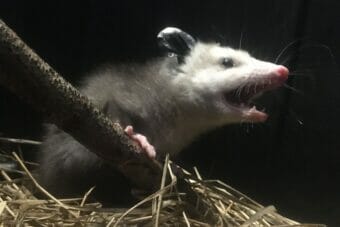
A North American possum perched on a branch (Cody Pope/Wikipedia)
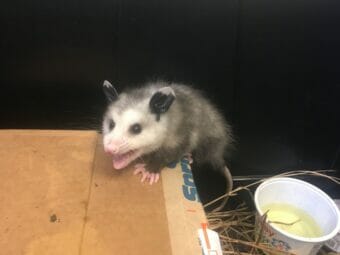
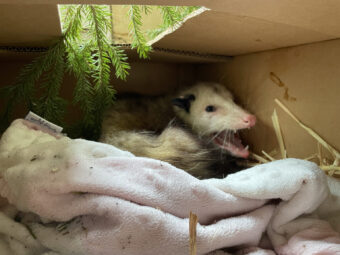
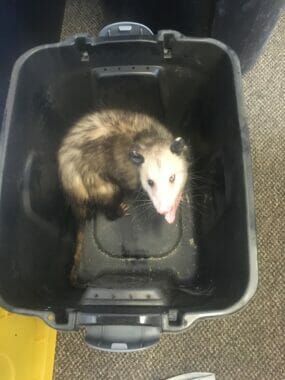
There’s a wild opossum in the Homer area.
Many, including the Alaska Department of Fish and Game, want it dead. That’s because the opossum is an invasive species.
On the other hand, it’s just weird enough for some Homerites to rally around. They’ve named it “Grubby.” The hashtag #FreeGrubby has been making the rounds on social media.
Megan Pacer with the Anchorage Daily News wrote about the Grubby saga recently. And Pacer says, as far as anyone can tell, it’s not like Grubby the Opossum even wanted to come to Alaska.
Listen:
The following transcript has been lightly edited for clarity.
Megan Pacer: So this opossum apparently made its way to Alaska on a shipping container from Washington State. We don’t know exactly where in Washington State, but it turned up in the back of a shipping container that Spenard Builders Supply in Homer had ordered. It just had supplies in it. And as they were unloading the supplies, that’s when they saw it in the back of the container and thought, “OK, what do we do?” And they called the shelter, and it all kind of unraveled from there. But, yeah, the little guy or gal made it all the way from Washington State.
Casey Grove: I don’t want to guess what the reaction was, but I’m sure it was something like, “Hey, that doesn’t belong here.” Right?
Megan Pacer: Pretty much, yeah. From what I understand, because I spoke with the director of the animal shelter in Homer, they were contacted, SBS staff basically said, “What do we do here? This isn’t normal.” And from there, the shelter staff called the Alaska Department of Fish and Game, because they weren’t sure what to do either. And that’s when Fish and Game advised, “Well, hey, it’s not great that it’s here. It’s an invasive species. If you could try and trap it, we will take care of it from there. We’ll handle it.” And so the opossum, according to the director of the animal shelter, was initially trapped but managed to escape and has been on the lam ever since. And that’s kind of when the hubbub started.
Casey Grove: Yeah. So what’s the problem with an opossum being in Alaska? I mean, you noted in your story, you’re not allowed to own them as pets. But, you know, this is just like one that randomly made it here. So what’s the big deal with that?
Megan Pacer: Sure, I guess you could argue it’s not the biggest deal in the world. But what Fish and Game told me is that it is an invasive species. And with any invasive species, there is a serious connotation with that. They don’t want non-native plants or animals to be messing with native flora and fauna in Alaska. So some of the specific concerns Fish and Game shared with me were that possums could potentially be preying on local birds, native birds to the Homer area. You know, if it was a female opossum that happened to be carrying babies at the time, you know, I was told the last thing we want to do is start a population, because that could grow and really kind of start to wreak havoc. And another big concern was that opossums could spread diseases to local wildlife.
Casey Grove: The dispute now is that Fish and Game wants to catch this animal, to be clear, to get rid of it. And then there are some folks in Homer that are, like, supportive of this possum. So tell me about that.
Megan Pacer: Sure. So to back up just a little bit, it actually showed up at the end of March. And it wasn’t something that was broadly known in the community until it had escaped. And then it was spotted running around near the police station on Grubstake Avenue. And so the police department, in kind of a funny PSA, posted on Facebook, “Hey, someone’s missing their possum, we just saw it run by.” That is how it got its name, Grubby, because it was on Grubstake Avenue.
Then at that point, the division really started. The shelter director told me that it had completely divided the town. There was pro-Grubby people and people agreeing, yes, you know, this is invasive, this is an issue. And it really mostly played out on social media. Businesses got in on it. There were sales being advertised, “If you come into our establishment and mention ‘free Grubby,’ you get 20% off.” There were people selling T shirts. There were flyers. “Grubby for mayor,” “Grubby for president,” even.
So, you know, one person I talked to surmised maybe this all has to do with cabin fever. People are still in the throes of winter. They need something to do. People really got galvanized over this little invader. And, yeah, people absolutely disagreed on on what to do with it. And I guess I should mention, Fish and Game is not actively out searching for this animal. There’s not a hunt on for Grubby or anything like that. They basically said, “You know, it’s not great that it’s out there. If it were to be trapped and presented to us, we would handle it.” But it’s not high enough on their list of priorities to go out seeking it.
A black bear walks through the woods bordering the Jensen-Olson Arboretum in August. (Photo courtesy of Merrill Jensen/City and Borough of Juneau)
Juneau’s black bears are starting to wake up for the spring. And Roy Churchwell, a local biologist with the state department of fish and game, says they’ll be hungry.
“The whole time that they’re out from the den, their most important thing is to find food,” he said. “So as soon as they come out in the next few weeks, that’s kind of the first thing on their mind.”
Bears usually start to emerge from hibernation in April. And right on time, reports of bear sightings around Juneau started showing up on social media last week.
Churchwell says the hungry bears should be looking for spring greens like sedges and skunk cabbage, but the smell of trash could distract them.
“And they can become dependent because it’s just easier for a bear to bulk up on pizza and things like that,” Churchwell said.
Bears are often protective of their food. So a bear that gets in the habit of snacking on neighborhood trash can become more dangerous. Often that’s what leads to Fish and Game killing problem bears.
Juneau does have waste management ordinances to minimize confrontation between bears and people. Public service officer Alicia Sell, with the Juneau police department, says enforcing those rules is an important way to keep people safe in bear country.
“The more secure our trash is, the less bear action we have,” Sell said. “So therefore, we’re not going to have them in the neighborhoods in the residential areas, you know, walking down the street when our kids are going to school.”
Under city rules, trash can only be put out on the curb after 4 a.m. on pick-up days, and that trash must be secured in a bear-resistant container.
That could be a garage, a locked shed or garbage cans that can only be opened with tools, not with force.
Sell says that people get in the habit of neglecting the rules while bears are hibernating, especially by leaving trash cans out overnight.
“The problem is, now that the bears are starting to wake up, people are still forgetting,” she said. “And that’s when they’re going and hitting all the trash cans.”
Residents who fail to meet the city’s trash rules can be fined $50 for their first offense.
Churchwell says the popular rolling cart trash cans that many Juneau residents have are considered bear-resistant by city standards. But the cleverest bears can still find creative ways to tip them over and squeeze them open.
“Bears definitely learn behavior. And so once they find something that works, they’ll try it again and again,” Churchwell said.
Residents should also try to minimize the odor of the trash they put out by double-bagging it, deodorizing cans with bleach or by separating wet garbage — things like food scraps — in more air-tight containers.
While garbage is the biggest issue, Churchwell says there are other bear attractants that can cause problems this time of year — things like bird feeders, pet food, compost or grills that haven’t been thoroughly cleaned.
Close
Update notification options
Subscribe to notifications
Subscribe
Get notifications about news related to the topics you care about. You can unsubscribe anytime.