Suburban moose on Roxie Rd. in Fairbanks. (Courtesy of Ian Dickson)
A Wasilla man sentenced for storming the U.S. Capitol on Jan. 6, 2021 is asking a judge to loosen a condition of his probation.
He wants to be allowed a firearm, to protect himself from moose.
A federal judge in Washington, D.C. sentenced 43-year-old Aaron James Mileur to two years of probation last month. He pleaded guilty to a charge of demonstrating or parading in the Capitol building. Three other charges were dismissed in exchange for his guilty plea.
Not possessing firearms was a condition of probation.
But Assistant Federal Public Defender Eugene Ohm wrote that, within days of his sentencing hearing, Mileur saw a moose on his property. Moose can be dangerous, the Washington, D.C.-based lawyer wrote, citing two commercial websites.
“Mr. Mileur thus respectfully requests that the conditions of his probation be modified so that he may defend himself and his property against potential moose on his property,” Ohm wrote.
He included two photos of Mileur’s backyard moose.
Surveillance footage showed Aaron Mileur and his cousin in the Rotunda of the U.S. Capitol. (From DOJ sentencing memo)
Federal prosecutors oppose the request. They wrote that Mileur lives in a suburban neighborhood, not the wilds, and that moose rarely need to be shot in self-defense.
“Many residents … consider a visiting backyard moose to be a pleasurable diversion; a cause to pull out a camera and boast to friends and neighbors when a particularly majestic specimen appears,” they wrote.
The question is pending before U.S. District Court Judge Randolph Moss.
Mileur was arrested after someone called an FBI hotline to report that he’d posted video and photos on Facebook showing himself inside the Capitol during the riot.
His attorney did not respond to an emailed interview request for this story. But the sentencing briefs shed more light on the case. They say that Mileur, an Air Force veteran who installs rain gutters, was on vacation in Baltimore on Jan. 6, visiting a cousin. They decided to go to then-President Donald Trump’s rally protesting his election loss, but they arrived too late and instead went to the Capitol.
By their own account, they were among the first throng to enter the building from the East Plaza of the Capitol.
The riot interrupted the certification of the Electoral College vote.
The judge also ordered Mileur to pay $500 to compensate for damage to the Capitol Building.
Officials announced Thursday plans to return Lolita — an orca that has lived in captivity at the Miami Seaquarium for more than 50 years — to its home waters in the Pacific Northwest. Here, trainer Marcia Hinton pets Lolita, a captive orca whale, during a performance at the Miami Seaquarium in Miami, March 9, 1995. (Nuri Vallbona/AP)
Nearly five decades after being captured and held in the Miami Seaquarium, Lolita the orca will finally be able to return to the Pacific to live out the rest of her days.
During a news conference Thursday, the Miami Seaquarium announced its plans to move the nearly 5,000-pound killer whale — who was initially called Tokitae, or Toki — to her original home in the waters of the Pacific Northwest.
And after years of growing pressure from animal rights activists calling for Lolita’s release from the Miami aquarium, officials announced their plans for the “process of returning [Lolita] to her home waters.”
The news conference was held in part by Miami Seaquarium, the Florida nonprofit Friends of Lolita and the philanthropist and owner of the NFL’s Indianapolis Colts, Jim Irsay.
“This is a very special day,” Eduardo Albor, CEO of the Dolphin Company, said during the news conference. “It is amazing to see how many things you can achieve in one year when actions take place of words.”
The Seaquarium signed a deal with Friends of Lolita to relocate the orca, in addition to receiving financial assistance from Irsay.
“I’m excited about being part of Lolita’s journey,” Irsay said. “Ever since I was a little kid I’ve loved whales, just loved whales because [of] the power, the greatness of them and how gentle they are.”
Irsay told reporters that the cost to relocate Lolita could be a “big number,” as officials haven’t disclosed a specific budget or number tied to her relocation. As of now, the plan for Lolita is to build her an ocean sanctuary with netting, where she will receive constant care from trainers.
“She’s lived this long to have this opportunity and my only mission … is to help this whale to get free,” Irsay said.
Lolita was captured from the Pacific coast near Seattle nearly 50 years ago at the age of 4. The orca, who is believed to be 57 years old, was finally able to retire last spring from exhibition shows under an agreement with federal regulators.
She is currently the oldest orca to be held in captivity.
Over the last decade, animal rights groups have held demonstrations and filed lawsuits seeking to improve Lolita’s conditions at the Seaquarium. Members of the Lummi Nation near Bellingham, Wash., have even threatened to sue for her release.
Copyright 2023 NPR. To see more, visit https://www.npr.org.
We have just passed the equinox. The snow is melting fast, and the land is waking up around us — and bird activity is increasing noticeably. KHNS spoke with some local bird enthusiasts to find out who is doing what.
Stacie Evans is the science director at the Takshanuk Watershed Council, and an avid birder. She heard a varied thrush a few days ago.
“One of those really obvious noises that we hear in the spring,” she said. “So they are around. And sometimes they’ll even be around earlier than now, you just don’t detect them because they are not making their mating call yet.”
Varied thrush. (Photo by Bob Armstrong)
Evans says varied thrushes spend the winter not very far south of here, so they come back early. She has also heard pacific wrens and dark-eyed juncos, who have returned to the upper Lynn Canal to breed.
She expects we will start seeing robins soon.
“They are starting to overwinter in more northern habitats than they used to, so they are pretty close and they might take advantage of a warm period to hop over here and take advantage of whatever food might be available. So it’s not totally unusual to see a robin in the winter, but it’s becoming more common,” Evans said.
Dan Egolf is a longtime local birder and a naturalist guide at the company he owns, Alaska Nature Tours. He also has stories of birds stretching their seasonal habits.
“One year we had a hummingbird, I think it was Anna’s hummingbird that stayed around way into the winter. The person that had the hummingbird feeder put a heat light by it so that it would kind of warm-up,” he said.
Egolf mentions some of his favorite summer residents.
“There’s pigeon guillemots that nest underneath Port Chilkoot dock,” he said. “They are an interesting little bird that has a lifestyle like a duck but doesn’t at all look like a duck — it has a little pigeon beak. They probably start nesting in May, and then later in the summer by around June or July we see the parents and a fledgling flying around underneath the dock.”
Birders flock together on Facebook. There is a group called Haines Birders where members share photos and observations. Evans says she recently received a video of a killdeer on the Chilkat beach. That is another early arrival.
Other birds are just passing through. There are reports of groups of snow buntings in Haines.
“They are interesting because the males tend to pass through really early to get to their northern breeding grounds because territory is fairly scarce, and they can tolerate quite a bit of snow on the ground,” Evans said.
She says soon the beaches will be crowded with migratory birds. The shores of the upper Lynn Canal are the last stop before those birds enter the interior.
“Migratory birds have flown a really long way to get here,” Evans said. “They have exhausted a lot of resources and energy and we are the terminus of the marine resources they have on their migratory route, so that when they are here, it is sort of their last chance to really fuel up before they have to fly all the way to the high Arctic.”
It is a delicate time for those birds. Evans says beachgoers can help them along their journey by giving them space.
“It’s really important that we try not to disturb them as much as possible, maybe do your best to try not to flush the birds that are trying to feed there,” she said.
Dan Egolf says the Lynn Canal is at the edge of the pacific flyway. Most birds remain on the outer coast, where they can be carried by steady winds. He says he has been there at the height of the migration, when 10,000 birds per hour passed overhead.
Egolf says some migrators sometimes linger in the Lynn Canal.
“Occasionally we’ll get a lot of shorebirds in town,” he said. “The mountain passes have late spring storms and it jams the birds down here. I recall a time when there was a bunch of Dunlins on the parade grounds, so we keep our eyes peeled.”
Some birds choose to not travel at all — notably eagles and ravens. Some are already starting to nest. And chickadees are well adapted to the cold despite their small size. To survive they have to eat constantly. Crossbills and grosbeaks also feast all winter.
“They feed on the high bush cranberries,” he said. “High bush cranberries will freeze right on the brush and be there throughout the winter, and they fly down and eat what looks like little popsicles.”
Whatever their lifestyles, birds seem to bring joy to us.
Evans says this is the case for her.
“You know there has actually been some studies that have shown that bird song is linked to better mood or better mental health, so it’s not just the light coming back that gives us a little bit of a boost. Sometimes it’s just hearing those bird songs again,” she said.
More birds are expected to arrive in the coming weeks.
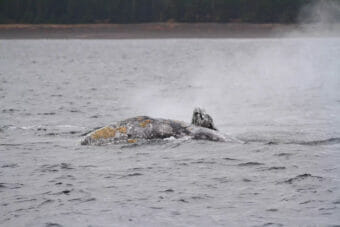
A humpback whale strains krill in the waters of Southeast Alaska. (Photo provided by NOAA)
The 2014 to 2016 Pacific marine heat wave, nicknamed “the Blob,” devastated Alaska’s marine ecosystem.
It turned seastars to goo and caused dead seabirds to wash up on beaches. Researchers also believe it killed almost half the resident humpback whales in Glacier Bay and Icy Strait.
But wildlife biologist Janet Neilson with Glacier Bay National Park says things are looking up for Southeast Alaska’s humpback whales.
“The good news is that whales are very resilient,” Neilson said. “They are really capable of rebounding.”
Glacier Bay and Icy Strait are an essential feeding ground for humpback whales. They fuel up before migrating to winter breeding grounds in Hawaii and Mexico. During the heat wave, cold-water fish and plankton species declined, causing what Neilson calls an “underwater famine.”
In the years since, almost 50% of humpback regulars in Glacier Bay and Icy Strait have gone missing — and they haven’t been located anywhere else. Most are presumed to have died because of the heat wave.
Though temperatures cooled down after 2019, Neilson says that for several years, her team kept seeing devastating survey results.
“We almost call it like the hangover of the heat wave,” Neilson said. “Things actually got worse after the heat wave ended before they started to get better.”
But the 2022 update, which was released last week, shows sure signs of improvement. Whales are fattening up again, and they’re staying longer in Glacier Bay and Icy Strait than they did during the heat wave — which points to a much-needed improvement in feeding conditions.
“We’re seeing less emaciated whales. Less skinny whales,” Neilson said.
Southeast humpbacks are also reproducing more successfully, with fewer sudden calf deaths. But birth rates still have not returned to pre-heat wave levels. Scientists don’t know the exact cause, but Neilson says that may mean female whales have not recovered enough nutrition to support pregnancies.
“A lot of females that we would expect to have calves. They’re just not coming back with calves,” Neilson said. “We’re not sure what’s the problem there.”
And for adult whales, the threat of vessel strikes still looms. 2022’s survey documented at least one death of an adult female whale near Angoon. The survey found only 165 adult humpbacks total in Glacier Bay and Icy Strait, so one death can matter a lot.
As the ratio of whale watching boats to individual whales in Southeast is increasing, researchers fear the risk of disturbances is rising too. Too much boat activity can stress humpbacks, which makes proper feeding even more difficult.
Neilson says that avoiding extra stress and deaths for humpbacks will be especially important as climate change increases the chance of future marine heat waves. But for now, she says Southeast’s humpbacks are on a good track.
“Things definitely are still not back to where they were,” Neilson. “But there are positive signs.”
Friday’s withdrawal and Monday’s court dismissal are the latest in a years-long debate over wildlife management in the 2-million acre refuge. (Sabine Poux/KDLL)
The federal government is walking back a proposal that would have allowed brown bear baiting and reversed other restrictions on hunting and trapping in the Kenai National Wildlife Refuge — one of two decisions in the last week that environmental groups say is a win for the refuge and its wildlife.
As it stands, the practice of taking brown bears at bait stations is not allowed on the nearly 2-million acre refuge, as outlined in an Obama-era regulation known as the Kenai Rule. In 2020, the Trump administration tried to reverse those protections in a proposed new rule that also would’ve opened up access in the refuge to more bicycles and snowmachines.
But those rule changes never passed. And on Friday, the U.S. Fish and Wildlife Service — which manages the refuge — announced it was withdrawing the proposal, citing the tens of thousands of comments submitted in opposition to the rule change over concerns about wildlife and visitor safety.
The service also said it considered “new information on recent annual levels of human-caused brown bear mortalities on the Kenai Peninsula, and additional scientific literature” in its decision about brown bear baiting.
“Allowing the harvest of brown bears over bait on the Refuge has a high potential to result in adverse impacts to the Refuge’s brown bear population, and that a cautious approach to management of Kenai Peninsula brown bears remains scientifically warranted,” the service said in its decision.
The withdrawal isn’t the only victory for those commenters. The U.S. Supreme Court decided Monday not to take up a legal challenge from the State of Alaska and Safari Club International on the Kenai Rule — halting a case that has been working its way through the court for seven years.
“This week was a big week in terms of the movement on these protections,” said Nicole Schmitt, executive director of the Alaska Wildlife Alliance.
She said the decisions show the federal government does have authority to manage wildlife on refuge lands, including for the purpose of maintaining natural diversity.
“The second big point is that through the decision to rescind the 2020 rule, I think the refuge really listened to and took a hard look at what those changes would really mean on the ground,” she said.
In its decision, Fish and Wildlife cited concerns about public safety related to brown bear baiting and increased access for hunters, for example.
But advocates of the 2020 rule, including the State of Alaska and Safari Club, have a different take.
Alaska has argued its authority to manage wildlife on federal lands within the state. And it said brown bear baiting does not pose a risk to public safety.
“Wildlife management decisions should not be made based on the number of public comments, but on the best available science,” said Safari Club’s Ben Cassidy in a written statement. “And the best available science supported the proposed rule.”
A sea otter floats on its back. (Photo by Theresa Soley/KTOO)
John Ryan lives in Hollis, on Prince of Wales Island. He’s seen the island’s population of sea otters soar over the last handful of years, and he’s worried. Residents like Ryan worry the boom will shut down profitable dive fisheries — like sea cucumbers and geoduck.
“The quota has gone down over the years, and it’s hurting people’s livelihoods,” he said. “That money that’s generated from that, it’s going through and it’s raising families and puts food on families’ tables.”
Sea otters have a critical place in the ecosystem. Scientist and University of Alaska Southeast professor Barbara Morgan said otters eat shellfish that would otherwise decimate vital kelp beds — which would be a big blow to the ecosystem. The sea urchin is the main predator for a kelp bed, and they happen to make up a large portion of the sea otter diet.
“Kelp beds are hugely important to the environment that they are in,” Morgan explained. “They provide protection for the coast that they are along. They break the power of waves as they come onshore. So that really limits how much the wave can affect the coast.”
But there wasn’t always a healthy population in Southeast. Russian fur traders overharvested the animals in the 18th century, and years later, wildlife officials started to try and build the population back up. Now, there’s thought to be more than 25,000 animals around the region.
Now that otters’ numbers are growing rapidly, Morgan said one specific concern is that established populations on the western outer coast of Southeast Alaska will make their way into the inner channels of the Alexander Archipelago.
“And that would put them into areas that have really active shellfish fisheries, crab, in particular, shrimp, and people don’t want the sea otters to impact harvests of those fisheries and wipe them out,” Morgan explained. “Totally understandable. I’m not sure that we’re an imminent threat, though.”
But Ryan said he wants to get ahead of the issue before it becomes a bigger problem. He shared his concerns in a proposal to the Board of Game, asking the state to devise a plan to manage otter populations.
The board dismissed the proposal out of hand before the meeting began. They said they don’t have jurisdiction. That’s because sea otters are protected under federal law by the 1972 Marine Mammal Protection Act.
“It’s not something that’s going to be put into place overnight,” Ryan said. “It’s going to take years. But there needs to be a harvest.”
So Ketchikan’s Borough Assembly highlighted it as a key federal policy issue during a recent lobbying trip to Washington, D.C.
Borough Mayor Rodney Dial says local officials want to see the federal government manage otter populations more aggressively — or turn over management to the state.
“So we’re just asking for a dialogue,” Dial said. “We’re asking for the federal government to be involved in the process, to listen to people on the local level, and hopefully, that we can all work together to, you know, — because everybody loves sea otters. And, you know, we just need to find a way to balance the population so that the sea otter population doesn’t wipe out populations of other creatures.”
As it stands, sea otter populations are managed by the U.S. Fish and Wildlife Service. Current protections allow Alaska Native people to harvest sea otters for subsistence food purposes, and use their fur to create goods and sell them in the form of handicrafts. Federal regulations state that an individual has to have at least one-fourth blood quantum to be a qualified hunter, and they must be from a coastal area.
Anyone who is not Alaska Native is federally prohibited from harvesting the animals, or selling or buying their pelts.
Fishermen have raised concerns over otter populations before — in 2010, then-Congressman Don Young introduced a bill that would roll back some restrictions on the sale of sea otter pelts in response to pressure from fishermen.
Grant EchoHawk, one of the assembly members who traveled to Washington with Dial, said the goal is simply to find balance, and strike up a conversation.
“What we’re looking for is to make sure that … the pendulum isn’t swinging too quickly in the wrong direction,” EchoHawk said.
EchoHawk said he wanted to make sure that lawmakers had the most up-to-date data on otters in Alaska, since the populations have risen considerably since the species came under federal control. A 2015 University of Alaska Fairbanks study found that Southeast Alaska’s sea otter populations have grown by 10% to 15% each year.
“Ultimately, we just want to make sure there’s smart decisions being made,” he said.
No matter what happens, Ketchikan’s tribe says that area tribes need to be involved in the decision-making.
“Anybody who’s proposing changes in the regulations should be talking about the tribes before they propose regulatory changes,” said Tony Gallegos, Ketchikan Indian Community’s cultural resources director.
Gallegos said that tribes are best able to manage the sea otter population, as part of their traditional lifestyle. He said that right now, he doesn’t want to see any changes to the federal law protecting the otter — at least, not until scientists have better data.
“There needs to be a determination on what a good optimal population size is and then try to maintain the sea otter population at that level,” he said. “And that’s probably going to require culling those populations by hunting.”
Whether any changes are coming, though, is an open question. Officials at the U.S. Fish and Wildlife Service declined to say whether they’re exploring options for otter management.
A previous version of this story had an incorrect current population estimate for sea otters in Southeast Alaska. The number has been corrected.
Close
Update notification options
Subscribe to notifications
Subscribe
Get notifications about news related to the topics you care about. You can unsubscribe anytime.