Wildlife

Alaskans have grounds to sue over predator-control killing of bears, court rules

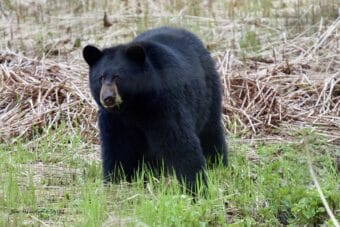
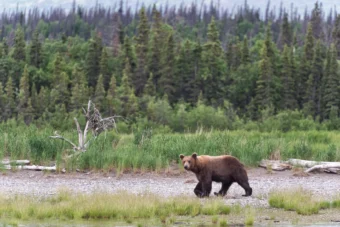
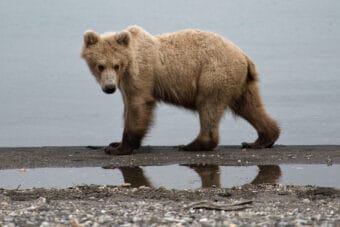
A bear sits in the grass in 2023 in Katmai National Park and Preserve. A state predator control program aimed at helping the ailing Mulchatna caribou herd may have killed bears that use the national park, thus affecting people who enjoy Katmai bear viewing and giving them legal standing to challenge the state program, the Supreme Court said. (Photo by F. Jimenez/National Park Service)

Alaskans who enjoy watching bears and other wildlife have legitimate grounds to sue the state over predator-control programs that may put those same animals at risk, the Alaska Supreme Court ruled on Friday.

The ruling reinstating a lawsuit, dismissed earlier by a Superior Court judge, that challenged a state program that is killing bears and wolves to try to boost a faltering Western Alaska caribou herd.

Michelle Bittner, the Anchorage attorney who filed the lawsuit in 2023, does have legal standing to challenge the controversial program that has killed nearly 200 bears so far, the Supreme Court found.

Standing, in legal terms, is the authority to challenge an action or law in court.

Bittner argued that her visits to Katmai National Park and Preserve, a destination famous for its brown bears and bear-viewing opportunities, gave her sufficient authority to sue in court to overturn the state’s predator-control program aimed at helping the Mulchatna Caribou Herd.

At a hearing last summer, Bittner told the justices about her feelings about wildlife, her experiences at Katmai and her understanding, from talking to park staffers, that the Mulchatna predator control program had killed some of the bears that roam into the park.

The Supreme Court agreed that Bittner’s travels to Katmai and her attachment to the bear-viewing experience there gave her standing to sue the state.

“We hold that because the resident returned to Katmai National Park after the bear population was allegedly reduced by the State’s program, she has alleged an injury to her interest in viewing bears there sufficient to demonstrate standing,” the decision said.

The justices rejected the state’s argument that Bittner lacked legal standing because she did not travel to the exact area where the bear- and wolf-culling program was carried out. “As long as it is plausible that the harm caused by the predator control program extends to the area of Katmai that Bittner visited, her allegation is sufficient to support interest-injury standing,” the ruling said.

Bittner’s complaint had been dismissed on Oct. 31, 2023, for lack of legal standing.

The court did not rule on the merits of Bittner’s case against the Mulchatna bear-culling program. Instead, it sent the case back to the Superior Court level to sort out those questions.

Tim Peltier, a regional supervisor for the Alaska Department of Fish and Game’s Division of Wildlife Management, declined to comment on the Supreme Court ruling. He cited the case’s status as active litigation.

A caribou walks by the Hulahula River in the Arctic National Wildlife Refuge in 2019. Information about extinct woolly mammoths could help shed light on the history of Alaska’s modern caribou. (Photo by Alexis Bonogofsky/U.S. Fish and Wildlife Service)

Bittner’s lawsuit was one of two filed in 2023 that sought to overturn the Mulchatna predator-control program. The other lawsuit was filed by the Alaska Wildlife Alliance. That case is still pending in Superior Court and is before the same judge who dismissed Bittner’s complaint in 2023. Oral arguments in that case are set for March 3.

The Alaska Board of Game authorized the Mulchatna predator-control program in 2022. In May and June of 2023, the department killed 94 brown bears, five black bears and five wolves, carrying out the program’s first year of operation. In its 2024 operation, the department killed another 81 bears and 14 wolves. The program is authorized to continue to 2028.

The program is highly controversial.

The Alaska Department of Fish and Game has argued that it is needed to help a caribou herd that crashed from a peak of about 200,000 in 1997 to less than 13,000 in recent years. Hunting for Mulchatna caribou was closed in 2021.

The goal is to get the caribou population back up to at least 30,000, according to the department. Removing predators that feed on caribou, especially on caribou calves, is a tool to help achieve that goal, the department has argued.

Peltier, commenting by email, said the effects of last year’s predator control work is still being studied, “however at this point it appears that the treatment had a positive effect.”

“Our intention is to repeat the treatment this spring for the third year and to continue to assess the effects,” he said by email.

But several scientists argue that factors other than predation, mostly a habitat transformation caused by climate change, are behind the Mulchatna herd’s decline.

Among those changes is the spread of woody shrubs to an area once dominated by open tundra. The vegetation changes have benefited moose, which have boomed in population, because moose feed on those shrubs. But they harm caribou, which depend on lichen and other tundra plants.

Other factors cited by biologists as contributing to the herd’s decline include the freeze-thaw cycles that have become more common with climate change but create difficult, icy conditions for caribou, outbreaks of brucellosis, a bacterial disease, and illegal hunting,

The way that the Alaska Board of Game approved the program is also at issue in the two lawsuits. Bittner and the Alaska Wildlife Alliance allege that the approval was rushed and failed to provide adequate notice for public comment.

Bittner disagreed with the department’s suggestion that the bear and wolf kills carried out to date have helped the herd. Numbers are about the same now as they were previously, she said.

She said Gov. Mike Dunleavy should instruct Doug Vincent-Lang, the commissioner of the Department of Fish and Game, to pause the program until the legal case is resolved. “Otherwise, Alaskans, the country, and the world will know that over 200 bears and countless wolves were killed on his watch when bears and wolves are declining all over the country and the world,” she said by email.

St. Paul is working toward an Indigenous-led conservation plan

Northern fur seals at a haul-out on St. Paul Island in October, 2024. (Theo Greenly/KUHB)

Everyone around St. Paul knows Zinaida Melovidov as Grandma Zee. She grew up working in the community’s blubbering shop, back when the local economy revolved around the commercial fur seal harvest. Even then, she said, people worried about what would happen if the island’s seals, birds and other marine life disappeared.

“My mom and dad used to talk about this years ago,” she said. “I didn’t understand. Now I know. No more seals, no more food, no more birds.”

St. Paul Island, in the Bering Sea, is home to vast marine ecosystems that have supported the Unangax̂ community for generations. But the island’s most iconic species — the northern fur seal — has been in steep decline for decades.

“They’re all declining,” Melovidov said. “I remember rookeries used to be millions, thousands in every rookery around the island — all full of seals. Now it’s empty.”

With approximately 400 year-round residents, St. Paul bills itself as “the largest Aleut village.” (Theo Greenly/KUHB)

About half of the world’s northern fur seals breed in the Pribilofs. The population fell sharply when Russian fur traders set up an outpost in the Pribilofs in the late 1700s. And numbers kept falling in the twentieth century — the Pribilof Island population dropped by about 50% between the 1950s and 1998, prompting the National Oceanic and Atmospheric Administration to classify them as “depleted” under the Marine Mammal Protection Act.

But a recent push to protect St. Paul’s sea life met with strong resistance, especially from fishing interests. Now, St. Paul’s tribal government is moving forward with a new plan — one that prioritizes local and traditional knowledge in managing the island’s rich marine resources.

A push for a national marine sanctuary

St. Paul Island is 30 miles from the Eastern Bering Sea shelf. The surrounding waters are among the most productive marine environments globally, supporting dense populations of pollock, crab, and other marine species. In 2022, the community’s tribal government — the Aleut Community of St. Paul Island — announced plans to seek a federal designation as a national marine sanctuary to protect those resources. It would have been the first marine sanctuary in Alaska, giving the tribal government a seat at the table with state and federal resource managers.

A blue Arctic fox on the rocks above a St. Paul beach in November, 2024. (Theo Greenly/KUHB)

But the proposal faced significant pushback, prompting the tribe to change its approach. Commercial fishing groups were among the most vocal critics. Regional communities like Unalaska, whose economies rely heavily on fishing, also opposed the sanctuary. Even within St. Paul, some residents worried that the federal designation could jeopardize local fishing practices.

“People think, ‘Oh, federal and state governments would have the power, and they can regulate my fishing,’” said Destiny Bristol Kushin, who works with the tribe’s conservation office. “It’s more of, I call it a fear — a fear because fishing is a big part of our history, and you don’t really want to lose that.”

Tribal leaders repeatedly stated that the sanctuary would not curtail commercial fishing. Under the National Marine Sanctuary Act, fisheries management councils still would have had final authority over fishing regulations. But the assurances weren’t enough to calm critics.

Tribal Council President John Wayne Melovidov said the tribe ultimately decided in October to pause efforts to pursue the federal designation.

“We didn’t want to move forward with something that would be so controversial and potentially tear people apart instead of bring them together,” he said.

The proposed sanctuary will remain on NOAA’s nomination list, though tribal leaders said it is unlikely to go through without community support. NOAA expects to make a final decision within the next five years.

A new approach

Last fall, the tribe began holding listening events to hear from residents about how to protect the island’s ecosystems from threats such as climate change and overfishing. The eventual goal behind that work is designating the waters around St. Paul Island as an Indigenous marine stewardship area.

Kushin said the designation would allow the community to take control of its waters.

“It essentially gives the power to the people in the community,” she said. “And it gives us the opportunity to incorporate traditional knowledge into the decision making within this protected area.”

The tribal government says the stewardship area designation would give it greater authority to protect the region’s vast ecosystems and resources, including rich fishing grounds and habitat for the federally protected northern fur seal. (Theo Greenly/KUHB)

Indigenous marine stewardship areas are less common than government-declared protection areas, but their numbers are growing, following a global trend. California tribes created the first one in the U.S. in 2023. The designation lacks the legal framework and enforcement power of a national marine sanctuary, but it does emphasize local leadership while bringing in less federal and state oversight.

Tribal leaders have not firmed up details like what the boundaries and regulations would be. Melovidov said the tribe is still working with community members to develop a cohesive plan. And he said local participation will be key to its success.

“Nobody else is going to come in and save the day,” he said. “So, we feel the need to take it upon ourselves to do something about the downturn of the ecosystem in our backyard.”

Wildlife Conservation Center raises 30,000 bucks to rebuild deer shelter

A male deer licks a tree branch at the Alaska Wildlife Conservation Center on Friday, Jan. 10, 2025. (Matt Faubion/Alaska Public Media)

The Alaska Wildlife Conservation Center raised over $30,000 in less than two days to rebuild an animal shelter after it was destroyed by high winds Monday. No animals were harmed.

The facility cares for injured and orphaned animals from across the state, like bison, caribou and muskox.

The Sitka black-tailed deer shelter was demolished by a windstorm that swept through much of Southcentral Alaska last week. Wind gusts in the Portage area peaked at 82 mph, according to the National Weather Service.

A shelter in the Sitka black-tail deer enclosure was destroyed by high winds in the Portage area Monday. (Alaska Wildlife Conservation Center)

The center, about an hour south of Anchorage, launched a fundraiser Wednesday to raise $30,000 to rebuild the shelter, and they exceeded their goal in about 36 hours. The executive director, Sarah Howard, said she was blown away by the support.

“Just super gracious for everyone’s support in the help that we’re now going to be able to immediately start building on Monday,” Howard said.

Nearly $32,000 had been raised by Friday afternoon.

Photos posted by the facility Wednesday show the shelter’s roof completely detached and its walls scattered across the enclosure. The shelter is used during harsh weather, feeding, and as a recovery area for deer after medical procedures.

There are five deer at the center, and they’re known as the friendliest animals at the facility. Howard said the Sitka-deer have been on alert since the windstorm and have been hanging out in the back of their enclosure.

“They’re some of the friendliest animals we have on the property, but they’re also very aware of their surroundings,” she said. “I’m sure when this building started to creak and crack, that probably freaked them out quite a bit.”

There are an estimated 200,000 of the species in Alaska, concentrated in Southeast Alaska. It’s the most-hunted big game species in the region, according to Fish and Game. The average life-span of a Sitka black-tail is between 10 and 15 years.

Environmentalist group sues to gain information about Alaska trawler toll on marine mammals

Two killer whales are seen breaching in Alaska waters on June 9, 2005. (David Ellifrit/NOAA Alaska Fisheries Science Center)

The federal government has failed to give adequate information on deaths of killer whales and other marine mammals that become entangled in commercial trawling gear in Alaska waters, claims a lawsuit filed on Thursday in U.S. District Court in Anchorage.

The lawsuit, filed by the environmental group Oceana, targets the National Marine Fisheries Service, an agency of the National Oceanic and atmospheric Administration.

The whales and other marine mammals killed in fishing gear are subjects of what is known as bycatch, the unintended, incidental catch of species that are not the harvest target.

The lawsuit focuses on three Freedom of Information Act requests filed by Oceana from 2021 to 2023. Oceana asked for records, photographs and videos of animals that have been killed as bycatch in Alaska fisheries. The agency denied some requests and provided information in response to others, but that information was heavily redacted, with photographs blurred and made unrecognizable through a pixelation technique and text blacked out, the lawsuit said.

Distorted photos sent to Oceana included images of whales, Steller sea lions, a walrus, and bearded, fur and ribbon seals, according to the complaint, which seeks to compel the agency to provide more complete information.

NMFS justified the redactions and image distortions as necessary to protect confidentiality, according to the lawsuit. But Oceana, in its lawsuit, said those redactions “are not based on any valid legal requirement to protect confidential information and are not consistent” with applicable laws: the Freedom of Information Act, the Magnuson-Stevens Fishery Conservation and Management Act and the Marine Mammal Protection Act.

“Public access to information is essential to hold the government accountable and ensure U.S. fisheries are managed sustainably,” Tara Brock, Oceana’s Pacific legal director and senior counsel, said in a statement issued by the organization. “The unlawful withholding of information by the Fisheries Service related to the deaths of whales, fish, and other ocean life is unacceptable. People have the right to know how commercial fisheries impact marine wildlife.”

Oceana filed a related lawsuit on Thursday in the U.S. District Court of Central California over bycatch of various species of mammals and fish by the halibut trawl fishery that operates off that state’s coast.

An altered photo of a killer whale that died as bycatch in Alaska trawl gear is part of the evidence presented by Oceana in a lawsuit against the National Marine Fisheries Service. The lawsuit, filed onThursday, cites this an other photos provided by NMFS as evidence that the agency is withholding important information about marine mammal deaths in the Alaska trawl fisheries. (Photo courtesy of Oceana)

That halibut harvest “catches enormous quantities of marine species as bycatch,” which “results in the injury and death of thousands of fish and other animals,” including Dungeness crab, giant sea bass, elephant seals, harbor porpoises and cormorants, among other species. That halibut fishery “has the highest bycatch rate in the nation,” and it discards about 77% of the fish it catches, the lawsuit said.

The National Marine Fisheries Service declined to comment on the lawsuits filed Thursday.

The legal actions follow a period with an unusually high number of killer whales ensnared in trawl gear used to harvest Bering Sea fish. Nearly a dozen killer whales were found dead in 2023, compared to 37 cases of killer whale deaths in fishing gear that were recorded in Alaska from 1991 to 2022.

A different environmental organization, the Center for Biological Diversity, last year filed a notice of intent to sue NMFS over the trawl bycatch of whales and other marine mammals.

So far, no such lawsuit has been filed, said Cooper Freeman, the center’s Alaska director. Instead, his organization has been meeting with NMFS to try to find ways to reduce the dangers to marine mammals from trawling, he said.

“At this point we have not decided to bring a lawsuit although we continue to have very, very serious concerns about the fisheries and are tracking the harms,” Freeman said.

The agency has pledged some corrective action, Freeman said. It has committed to reassess harms to endangered species and it has promised to analyze Alaska’s killer whales as separate populations, one in the Bering Sea and the other in the Gulf of Alaska, he said. Lumping the two populations as one can understate the impacts of bycatch deaths, he said.

New study of salmon abundance prompts a rethink of endangered killer whale decline

A killer whale, also known as an orca, swims in Alaska waters on July 25, 2013. (Photo by Kaitlin Thoreson/National Park Service)

King salmon, or chinook, are a critical part of the diet of Southern Resident killer whales. The population of Southern Residents has been dangerously low for decades, at around 75 members.

Research into this problem focuses on the habitat, and especially the availability of chinook. There is a preponderance of evidence correlating, for example, low birth rates among Southern Residents to years of low abundance of chinook. There are also statistical models that point to the same conclusion: Southern Residents aren’t getting enough of what they need to thrive.

But no one has ever gone out and counted the chinook in the Southern Resident habitat – until now.

“And what we found was the opposite of what we expected, what was predicted,” said Dr. Andrew Trites, “the prevalence of chinook was double in the Southern Resident Killer Whale habitat.”

Trites is the director of the Marine Mammal Research Unit at the University of British Columbia. He expected his research to confirm the premise that Southern Residents lacked a readily available supply of chinook – not upend it.

“I think it undermines the premises for a lot of that research,” said Trites, “and I think it undermines how quickly some people have jumped to conclusions. They’ve connected dots that should not be connected, and they’ve had huge leaps of faith in doing that.”

Trites’s study was conducted over three years (2018-2020), and was funded by Fisheries and Oceans Canada (DFO), the Canadian equivalent of the US National Marine Fisheries Service. His credibility, or the integrity of his project, isn’t in question. But in science, one study is never definitive. Misty MacDuffee is the Director of Salmon for the Raincoast Conservation Foundation, who specializes in chinook. She considers Trites’s paper a valuable contribution to understanding the availability of chinook in a particular area in summer and fall, but she doesn’t think the study solves the entire puzzle, when it’s only just a piece.

“I think the concerns start with extrapolating that [Trites’s paper] means that Southern Resident killer whales aren’t prey-limited,” she said.

Because there is no baseline study of the availability of chinook in the Salish Sea, as the waters between Washington state and Vancouver Island are known, Trites decided to compare the numbers of fish in the southern part of the Salish with numbers in the northern part, where the killer whale population is actually growing. MacDuffee, however, believes the study misses the big picture.

“[To captur] the level of abundance that Northern Residents have access to in that time period in the Salish might be adequate for Southern Residents – but that the study wasn’t set up to answer that question,” said MacDuffee. “So extrapolating that from what the study methods were and the study design were, is just too much of a stretch.”

MacDuffee was one of many scientists whose research supported a lawsuit brought in 2020 by the Wild Fish Conservancy, a Washington state conservation organization, against the National Marine Fisheries Service. NMFS carefully regulates certain commercial fisheries, like the Southeast Alaska chinook troll fishery, when they have an impact on endangered species.

The lawsuit nearly brought an end to chinook trolling, which has been the backbone of the Southeast Alaska economy for a century.

“Yeah, we feel vindicated,” said Matt Donohoe, former president of the Alaska Trollers Association, which filed a brief in support of NMFS. Donohoe feels Trites’s paper is confirmation of his industry’s position: the problem for Southern Residents is not in Alaska.

“The fish that don’t come up here, that are vital to killer whales,” he said, “the troll fishery was responsible for those killer whales’ decline? I mean it [the premise of the suit] was absurd on the face, even if the nutrition issues were correct.”

Donohoe believes the lawsuit was a fundraising tactic, and deflected attention from the genuine threat of marine contaminants in Puget Sound.

Andrew Trites is aware that his work doesn’t unravel the problem of why Southern Residents seem to be at capacity, when their Northern neighbors are growing. If anything, his study suggests that more answers about the health of Southern Residents may lie outside of Puget Sound and the Salish Sea, and along their likely winter range on the Oregon and California coasts.

“Part of our message from this paper is that we want people to, yes, protect your backyard, but you need to also consider protecting the other areas that the whales use when you don’t see them,” said Trites. “And almost no research attention or management attention is being given to what they need when they’re not in the Salish Sea.”

Trites uses an analogy of a bird feeder in Alaska: If one summer you notice that you have far fewer birds returning to your feeder, he says “do you assume that there’s something wrong with your backyard?”

What killed a harbor seal found headless at Letnikof Cove? It’s a mystery, federal scientists say

A dead harbor seal on Friday, Nov. 22, 2024, near Letnikof Cove in Haines, Alaska. (Rashah McChesney/Chilkat Valley News)

A recently dead harbor seal at Letnikof Cove is missing its head. Well, most of it. The skull bones are still there and intact.

The phenomenon has appeared a few times throughout the state.  The National Oceanic and Atmospheric Administration’s regional stranding coordinator said they have not quite figured out what is killing the seals, or getting to them after they’ve died.

“We have seen it before. I just don’t know what’s going on,” Mandy Keogh, said. “We often see scavengers go in for the eyes, or if there’s an opening or a hole somewhere. But we’ve seen it a few times where it’s a pretty clean skull but the rest of the body looks intact. Somebody, probably a scavenger, probably cleaned off the meat.”

She speculated that it might be one specific type of scavenger.

What happened post-mortem is only part of the mystery. The other part: what killed the animal in the first place?

“The rest of the body seems to be in good condition,” Keogh said of the Letnikof Cove seal after viewing photos of the carcass.  Typically, this is when citizen science and reports can help. Keogh said anytime someone sees a marine mammal in distress, federal scientists encourage them to report it to a 24-hour hotline (877) 925-7773.

“Dead animal, live animal, entangled. Any marine mammal. Even if you’re not sure and you think there’s an animal in distress, a marine mammal, you call that hotline,” she said.

They’ll ask questions about location and the type of animal. Keogh said taking lots of pictures is helpful too — particularly with something that gives an idea of the scale of the animal.

“Dogs are good, people will send us that. They’ll say ‘my dog’s in the photo and it weighs 70 pounds.’ But it’s better if there’s something that we can use for length. So if it’s like a shoe or a glove or something you have with you and if we have an idea of what that length is, then we can extrapolate. Especially with harbor seals, the time of year and the length might give us an indication of whether it’s an adult, a juvenile, or this year’s pup,” she said.

The ideal is that NOAA could send a volunteer or response team out to handle each reported stranding or death.

“We often collect skin for genetics, which helps us understand the population and things like that, and then to take more measurements and look for other things that might give us an indication of cause of death.”

But some of the remote parts of Alaska, Haines included, no points of contact or a stranding organization that do that work, though occasionally state Fish and Game staff will step in and help.

Keogh said tracking these types of deaths helps scientists keep an eye out for unusual cases or an emerging threat. The response to a stranding often depends on whether there are volunteers in the region who can do a site visit. They collect samples, like viral swabs, to look for diseases, especially with fresh dead animals because that means they’re not too decomposed.

“It’s likely that the sample is of a quality that if we can, if it’s going to have a virus there, it’s detectable. We do collect often for avian influenza and other pathogens that might be of interest and look to see just for prevalence.”

The spread of avian influenza, or avian flu, is something many scientists track because as it  spread around the world, questions have been raised about how it spreads to other animals and potentially humans.

A teen in British Columbia recently tested positive for an avian flu infection, which officials in Canada believe may be the first human case caught in the country.

So far, in Alaska, there are no known cases of humans catching the virus and very few cases of the flu spreading beyond birds.

Still, Keogh said it’s best to avoid handling a dead or dying marine mammal.

“Especially if it’s a dead animal. Something caused it to die and we don’t know at that time what that was,” she said.

And, Keogh said the more people who know, the more likely it is they could find an explanation for the unusual deaths like the seal at Letnikof Cove.

“It’s a mystery to me, but maybe there’s other folks or there is someone with traditional knowledge who has a better understanding of what’s going on, and I’m just not familiar with it,” he said.

Site notifications
Update notification options
Subscribe to notifications