Angela Denning, CoastAlaska

Angela Denning is CoastAlaska's regional news director, based in Petersburg. CoastAlaska is our partner in Southeast Alaska. KTOO collaborates with partners across the state to cover important news and to share stories with our audiences.

Alaska tribes bring cultural items home with federal grants

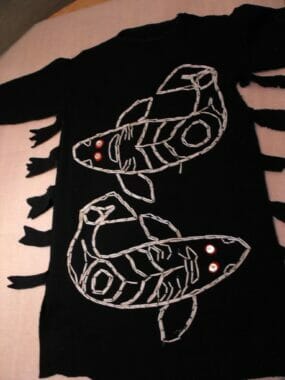
This mudshark shirt is being repatriated from the Minnesota Museum of Art to the Central Council of the Tlingit and Haida Indian Tribes of Alaska. (Photo courtesy of Central Council of the Tlingit and Haida Indian Tribes of Alaska)

Objects that are culturally important to tribes in Alaska, like ceremonial masks and drums, are scattered throughout the collections of museums across the globe. A new round of federal grants worth $357,000 will help two tribes and two museums in the state bring some items home.
Anthropologist and explorer Ted Banks collected items from the Aleutians in the 1940s. Some were human remains.

“Like human bones and skulls and jaw bones and things like that,” said Chris Price, CEO of Qawalangin Tribe of Unalaska.

The Qawalangin Tribe is receiving about $15,000. The money will help them bring back items from the Museum of the North at the University of Alaska Fairbanks.

“Lots of different archaeologists and explorers over time have come to Alaska,” Price said. “And they removed sacred objects, including human remains.”

The Qawalangin Tribe plans to bring some of the items back to their island and others will stay at the museum for research. The returned remains will likely receive a ceremonial burial, depending on what the tribal council decides.

This Qawalangin Tribe of Unalaska cultural item is being repatriated from the Museum of the North at the University of Alaska Fairbanks. (Photo courtesy of Chris Price)

Carter Price writes grants for the Qawalangin Tribe of Unalaska. He says culturally, it’s very important to get ancestors’ remains back to their homes. He says museums and others are more understanding of that now.

“There has been a shift with some of these organizations with wanting to return items,” said Carter Price. “I think there’s a recognition that housing some of these items isn’t morally correct. So we’re seeing more work with the tribes and trying to get the artifacts back.”

Alaska’s grants are part of $3.4 million awarded to tribes and museums throughout the country through the Native American Graves Protection and Repatriation Act or what’s called NAGPRA, a law that was passed by Congress in 1990.

The Central Council of Tlingit and Haida Indian Tribes of Alaska is receiving two federal repatriation grants totaling about $144,000. The Tribe has been awarded similar grants over the past three decades and have worked with museums in California, Minnesota, Pennsylvania and Maine to return items. So far, they’ve repatriated more than 140 objects.

“They were either bought by the museums or donated from individuals that acquired them, sometimes illegally,” said Desiree Duncan, who oversees the NAGPRA program for the Central Council of Tlingit and Haida Indian Tribes of Alaska.

Duncan says they repatriate and store the cultural items in Juneau and then loan them out to clans for memorial parties.

This mudshark shirt is being repatriated from the Portland Art Museum to the Central Council of the Tlingit and Haida Indian Tribes of Alaska. (Photo courtesy of Central Council of the Tlingit and Haida Indian Tribes of Alaska)

The Central Council of Tlingit and Haida Indian Tribes of Alaska has over 36,000 tribal members and several clans. The grants help elders and clan leaders travel to the museums where they look through archive rooms and identify items that belong to their people.

Duncan says it’s very moving.

“Looking at the objects and just seeing them come to life and be in there with the clan leaders and elders,” Duncan said. “It’s just very, a very powerful experience. It’s very emotional. . . you go through different emotions while you’re in there.”

She says they just repatriated a killer whale shirt from the Minnesota Museum of American Art to Juneau. And they’re in the process of getting several more items back — a wolf clan mask, a ceremonial mask, a shaman figure, blankets, a box drum, and totem poles that were taken from communities across Southeast.

Duncan says they are grateful for the funding, which has increased over time, but it’s not enough to do all the work. She says Tlingit and Haida is always looking for more opportunities to bring their culturally important items back home.

Other grant recipients in Alaska include the University of Alaska Fairbanks and the Alutiiq Museum and Archaeological Repository in Kodiak.

Sites announced for 7 new Tongass and Chugach recreation cabins

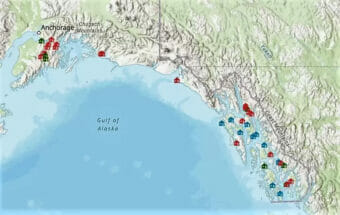
Screen shot of the USFS map of cabins — those proposed and up for repair — in the Tongass and Chugach National Forests. (from www.fs.usda.gov)

The U.S. Forest Service says it will build 25 new recreation cabins in the Tongass and Chugach National Forests.

The cabins won’t all be built at once. The first seven cabins are out for bid and will be constructed next summer. That first wave of new cabins will be spread across Southeast Alaska and the Kenai Peninsula. They’re all on the road system, except for one, which is a rebuild of a cabin at the Anan Bear Observatory near Wrangell that was crushed by a tree during a storm over the winter.
Other sites in the Tongass will be at Mendenhall Campground in Juneau, Signal Creek Campground at Ward Lake in Ketchikan, and El Capitan Interpretive Site north of Naukati on Prince of Wales Island. In the Chugach, cabins will be at Trail River in Moose Pass, at Porcupine Campground in Hope, and at Meridian Lake in Seward.

Dawn Collinsworth is deputy director of recreation lands and minerals for the Alaska region. She says the Forest Service received over 1,000 comments on where the cabins should go.

“Where we’re siting these cabins is really where the public would like to see them,” she said. “Because that just means they’re going to get more use, which is the goal.”

Collinsworth says the new cabin sites are more accessible than many of the existing ones, which are only reachable by boat or plane or extreme hikes.

“What we wanted to make sure that we’re doing is providing cabins that are more accessible and reach sort of a broader cross-section of the public who would like to recreate, but perhaps don’t have the physical capabilities of taking a long hike up a mountain,” she said.

Congress appropriated the money for the cabins. Over $14 million for the years-long project is coming from the Bipartisan Infrastructure Law passed in 2021. The Forest Service is also getting around $3.7 million from the National Forest Foundation for the cabins project.

After building the first seven cabins next summer, the agency plans to build 18 more over the coming summers. They don’t know where all 18 will go, but they plan to have at least one in every district – that’s eight districts in the Tongass and three districts in the Chugach.

The agency has an interactive map of the chosen cabin locations and some of the proposed ones.

Rachel Weston is the regional recreation planner for the Forest Service.

“The cabins that were selected for this first round were the furthest along in the planning process,” Weston said. “They were kind of the most ready for construction. The remaining cabin locations are still being ground truthed to determine if it’s viable to put a cabin in that spot. And the districts are still working through that.”

Districts with higher public demand might get more than one cabin, depending on the viability of the locations.

Forest Service cabins in Alaska rent for $35 – $75 a night.

Alaska harvesters and scientists are concerned about the health of black seaweed

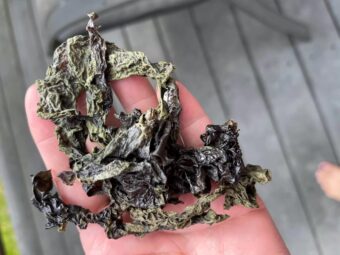
This dried, black seaweed has a light green color that traditional harvesters say isn’t normal and “tastes off.” (Photo courtesy of Irene Dundas)

Irene Dundas has harvested black seaweed her whole life – near Kake when she was young and near Ketchikan as an adult. The harvest happens in May when the seaweed is exactly the right size. Dundas and family members travel by boat to specific large rocks far from shore. It must be low tide so they can pull the seaweed off the rocks.

“When you’re grabbing it in your handful, it looks like you’re grabbing a handful of long, thick black hair,” Dundas said.

Black seaweed is found in more treacherous areas. It needs nutrients that only come from lots of moving water.

Dundas harvests about 50 gallons to share with family and friends. Processing is lengthy, drying the seaweed into bite-sized pieces.

“It’s kind of crunchy like a piece of popcorn,” she said. “But the flavor is like the black seaweed that you put on sushi. It’s that exact flavor. So delicious.”

Dorian Dundas, Irene Dundas’ daughter, collects black seaweed. (Photo courtesy of Irene Dundas)

She transfers the wet seaweed in pillowcases and puts it outside on several large tables to dry. But in the years 2021 and 2022, she noticed something was wrong.

“The seaweed that I picked had a very distinct strong, strong smell,” Dundas said. “There was a discoloration, this light green color. I felt like it had a little bit more metallic taste to it.”

To get any good seaweed this year, she traveled for hours by boat near the Canadian border. Her past harvests, she threw away.

“I was alarmed and very, very, very upset,” said Dundas. “I had no clue what was going on.”

Keolani Booth has similarly concerns. He collects black seaweed on the outer waters near Metlakatla and southern Prince of Wales Island.

“This year, I hardly had anything of a harvest,” he said. “I usually give out quite a bit to our community members that can’t go out. And I was only able to get a minute amount and it was kind of heartbreaking because you know, some of these people depend on me to bring them some seaweed for the year.”

Booth says black seaweed could be like a canary in a coal mine – a warning of what could come from climate change.

“It’s a very hard seaweed to try to cultivate,” Booth said. “It’s very sensitive, which you know, you realize that in the open ocean, it’s a precursor to all the things that are stronger in the ocean.”

The Metlakatla tribe got a grant to start researching the problem two years ago. That research is ongoing. And last month, Dundas and Booth carried their concerns to a meeting in Juneau, hosted by the Sealaska Heritage Institute. Harvesters and scientists discussed what to do.

Jennifer Clark from Vancouver brought a Western science perspective. She works for a kelp company but studied the effects of climate change on seaweed for her Ph.D.  In a post-doctoral project, she worked with Indigenous groups in central British Columbia about black seaweed disappearing there.

“In 2016, it’s almost completely missing from the intertidal shoreline,” she said.

Clark’s research linked the disappearance to an enormous hot water mass in the Northern Pacific known as The Blob. In 2014-2015, The Blob moved from the Gulf of Alaska down to California. It was followed by more heat from El Nino, which elevated seawater one to two degrees, enough to destroy the black seaweed.

“These heat waves are kind of unprecedented,” said Clark. “They just cause disruptions in life cycles and disturbances in the intertidal, which most of the seaweeds that you find are intertidal-subtidal, so they’re getting extreme changes in their habitat.”

She learned that black seaweed couldn’t survive past 64 degrees. As temperatures cooled in the years after The Blob and El Nino double whammy, BC’s seaweed started to come back. But not like before. Clark doesn’t know if Alaska’s black seaweed problem was also affected by The Blob – she says it would take more research. But she does know that black seaweed anywhere has challenges ahead if climate predictions come true.

“I think if it was persistent, like if we were to increase two degrees – 2050, I think that’s the projection is one and a half degrees – then maybe they won’t be so resilient, and they’ll just kind of exist as much as they can until they’re, they’re wiped out,” Clark said.

Wet black seaweed dries on tables outside. It will be ground into bite-sized pieces. Harvesters in Southeast Alaska collect it by the gallons. (Photo courtesy of Irene Dundas)

Rosita Worl is the president of Sealaska Heritage Institute. She says the seaweed is critical to many communities in and out of Alaska because it’s shared and traded.

“Black seaweed is really important to us as a food source, but also for its cultural components,” Worl said. “It’s like a glue that binds our community together through our widely sharing patterns. It also has spiritual dimensions. Black seaweed is distributed and consumed during our ceremonies.”

Sealaska Heritage Institute is creating a committee comprised of harvesters and scientists to start researching the problem. They’re also documenting the historical practices of the harvest and how it’s changed in recent years.

They hope the information will help them figure out if there’s any way to save black seaweed.

Alaska Marine Highway System plans for 3 new ferries in 4 years

The M/V Tustumena pulls away from Kodiak on Jan. 11, 2020. The Tustumena’s replacement is already underway and will cost $250 million. (Kavitha George/KMXT)

Federal transportation dollars are pouring into the Alaska Marine Highway System. It’s saving the state money now. But Alaska’s ferry board is looking far into the future and helping to draft a 20-year plan. It includes three new ferries in the next four years.

“The purpose of this whole plan is really to guide us, you know, in our capital and operating investments going all the way out through 2045,” said Craig Tornga, Alaska’s marine director.

He was speaking with the board that makes recommendations to the state during a lengthy meeting, July 14. He said the plan seeks to standardize the fleet and terminals for efficiency.

The state is working with marine engineering firm Elliot Bay Design Group out of Seattle. The first phase of the draft plan is set to be shared with the Alaska Legislature in August.

The long-range plan lists many changes that are needed before the ferry service can be reliable once again.

The Alaska marine highway connects 33 coastal communities. But services and funding have steadily declined over the past decade.

Ferry board members have discussed improving the system since the board was created by the Legislature and started meeting two years ago. At their last meeting, members like Wanetta Ayers emphasized the importance of the marine highways.

“I’ve sat in many, many community meetings, and heard over and over and over again from people about the importance of the ferry system in terms of their medical travel,” Ayers said. “That many people cannot get on a small plane to get out of their communities to get to the next level of medical care.”

But passengers likely won’t see better service until more ferry workers are hired and the aging fleet is improved. Crew shortages, especially licensed crew, continue to be a problem. AMHS hired only 12 new people last year and lost 11.

The plan seeks to keep eight vessels serving 35 ports of call over the next three years, and one vessel in maintenance. However, only six ferries are running this summer. There are no reserve ferries on standby for emergencies or unplanned maintenance needs. And that will continue to create reliability issues until the fleet size is increased, the plan states. That’s supposed to happen in the next few years. Three new ferries are to be added to the fleet by the end of 2027. One of them will be a hybrid model, and one will be electric.

Two new ferries will replace two 60 years old ferries– the ocean-class Tustumena and the mainliner Matanuska. The Tustumena Replacement, TRV as it’s called, is already underway and will cost $250 million. It will be the state’s first diesel-battery powered hybrid ferry. Like the Tustumena, it would also serve communities in Kodiak, South Central, and Southwest Alaska.

With federal funds, an all-electric ferry will replace the 20-year-old dayboat Lituya, which is the state’s smallest ferry, serving a route between Ketchikan and Metlakatla. The Lituya could then be used on a short run somewhere else, yet to be decided.

Before the new ferries are done, the Tazlina is scheduled to return to service after crew quarters are added. The ferry, along with its sister ship, the Hubbard was built five years ago in Ketchikan for $60 million. But they didn’t include crew quarters, limiting them to short day trips. After construction, it was decided that crew quarters were needed. The Hubbard got those quarters for $15 million and started serving the Lynn Canal in May.

The state’s plan calls for the Tazlina to be back in service sometime next year.

The next phases of the long-range plan will look at demographics and demand for all marine highway communities and seek input from stakeholders. A draft of the 20-year plan is expected to be finalized next summer. Board member Norm Carson encouraged the engineers to get data from locals. He’s lived in Pelican on Chichagof Island since 1967 and says the population fluctuates.

“The community probably at least doubles in size between April and say, October,” said Carson. “So, what you see on a census data is not nearly accurate, get a hold of myself, the mayor, or somebody like that for more information.”

Juliette Lehman with the engineering firm assured the board that getting local feedback is part of the process. She said they’ll be checking with stakeholders to make sure the data in the plan meshes with reality.

“To receive input from community members to ensure that the data set is a collection of information that is accurate and up to date,” Lehman said. “Like you said, maybe some of our sources don’t have the nuance that a community member would have firsthand knowledge of.”

Federal dollars are expected to continue coming to the state’s marine highway system through the Infrastructure Investments and Jobs Act. The state of Alaska spent just $7.5 million operating ferries last year. That’s over $100 million less than it spent in 2015 when it budgeted $120 million on ferry operations. That’s because the federal government is sending transportation money throughout the country – including nearly $97 million to Alaska ferries last year.

Federal dollars for ferries are expected to continue coming to the state through the Infrastructure Investments and Jobs Act. About $1 billion is allocated to ferry projects in the country with routes greater than 50 miles, which places Alaska in the position to get a lot of the funds.

Forest Service identifies nearly 700 Tongass stream crossings that could block migrating fish

An old culvert built for past logging projects obstructed Logjam Creek on Prince of Wales Island. (Photo courtesy of USFS)

Nearly 700 sites along Tongass National Forest streams could obstruct fish from migrating. That’s according to a new report from the U.S. Forest Service. But there is a plan to deal with the old roads and culverts causing the problems.

Back in the 50s and 60s, timber was harvested throughout Southeast Alaska without plans for how all the construction — like roads, culverts, and bridges — would affect fish habitats as they deteriorate in the years to come. And that deterioration has proved to be a big problem for fish.

“Fish migrate, so we need to ensure that they have that opportunity,” said Sheila Jacobson, fisheries program manager for the U.S. Forest Service.

Jacobson is leading a new project that seeks to restore all 700 of the crossings on the Tongass that aren’t up to federal standards. She says migrating fish — including salmon, steelhead, and trout — swim into human-caused barriers left over from those days of heavy logging.

“This project really is aimed at restoring fish passage across roads and motorized trails, which are fragmenting fish habitat across the entire forest,” Jacobson said.

The federal agency has been documenting these stream crossings since the early 1990s. The Forest Service has tried to restore them one by one as funding allows. Now, they’ve compiled all of them into one project, the Tongass National Forest Fish Passage Restoration, which can be added to as more crossings are identified.

Jacobson says it should make for a more streamlined process.

“It sets us up well for being able to capitalize on some of the new funding streams that have been coming up in the past year or so,” she said. “And then partners are able to help us with grant opportunities as well. So, we are definitely being able to get more project funding for this particular issue.”

This culvert on Logjam Creek on Prince of Wales Island has been restored to improve fish passage. (Photo courtesy of USFS)

The Forest Service isn’t the only one restoring streams on the Tongass. The agency has several partnerships, including the Hoonah Native Forest Partnership. Ian Johnson runs the environmental department for the Hoonah Indian Association. For the past five years, they’ve run programs that have local workers restoring watersheds in the area. Hoonah is on the northeast side of Chichagof Island.

Johnson says streams there have been affected by past logging.

“When fish are passing through a culvert, if there’s a meter perch or something on the backside, people can see that,” Johnson said.

Johnson says around six years ago, the tribe surveyed the community about environmental issues, and stream restoration was ranked number one. He says some community members had worked for the logging industry in the past.

“There were a lot of folks here who were a part of the logging and, you know, experienced the logging,” Johnson said. “And those that had concern at the time about the effect of logging right up to the stream.”

Now, workers with Hoonah Native Forest Partnership fix culverts and bridges and reintroduce wood into watersheds that lost that natural process through logging. Johnson says healthy streams are important — especially for communities that rely on the land around them.

“Hoonah as a community relies on subsistence resources, to meet many of its needs, especially around protein,” Johnson said. “and needs to have a landscape that can provide those resources.”

The Forest Service wants to grow partnerships like the one with Hoonah. Fixing 700 stream crossings is a lot. It’s a plan that spans nearly the whole Southeast region, except for Prince of Wales Island. That island has 2,000 miles of mostly logging roads and has its own restoration plan.

Many of the bad logging practices started changing in 1976 with the passage of the National Forest Management Act. It regulated the timber industry, limiting the size of clear cuts and how far away from streams they could be.

Alaska state ferry Columbia tied up for repairs

The 418-foot-long Columbia ferry is docked at the Vigor shipyard in Ketchikan, getting repairs, June 21, 2023. (Photo by Mikko Wilson/KTOO)

The 50-year-old state ferry Columbia is out of service for at least a week for two maintenance issues — a bow thruster problem and leaking pipes. The ferry was scheduled to sail through Southeast Alaska and south to Washington state all summer. Now, it’s in the Vigor shipyard in Ketchikan until at least June 28.

“The Coast Guard was on board the vessel, they inspected it,” said Sam Dapcevich, spokesperson for the state Department of Transportation. “We make sure that our vessels are safe to operate. So that’s the focus right now.”

The Columbia is the largest of the state’s mainline ferries. It stretches 418 feet and can carry nearly 500 passengers. Last week, the crew noticed leaks in pipes that carry salt water for the fire suppression system. Dapcevich said that’s been an ongoing issue with the old ship.

“They would fix one section but then locate it in another section,” he said. “So the permanent repairs that were made are good, but we found more rust in a couple other areas or more corrosion.”

Then, while the Columbia was in Skagway on June 19, workers noticed one of the bow thrusters having issues. The part is needed for guiding the large vessel while docking. Ferry system managers decided to send the Columbia from Skagway to the Ketchikan boatyard with no passengers on board. Some passengers in Skagway were able to take another ferry — the Hubbard — to Haines or Juneau. Others had their trips canceled.

A fire main valve on the Alaska state ferry Columbia. (Photo courtesy of Alaska DOT)

All Columbia sailings through June 27 are canceled. Dapcevich said before the ferry can sail through international waters on its way south, the fire main pipes must be tested for pressure. After repairs, the ferry is scheduled to resume sailing to Bellingham, Washington on June 28.

This week, Governor Mike Dunleavy vetoed $10 million in Alaska Marine Highway money from the operating budget that the Legislature approved. Dapcevich said the veto isn’t short-changing the ferry service. He said it was contingency money in case new federal funding came in low.

“That veto was done so that they wouldn’t tie up general funds on an unneeded contingency,” he said.

Dapcevich said if the expected federal funding doesn’t come through, the state could use money from passenger fares to make up the difference.

Site notifications
Update notification options
Subscribe to notifications