Angela Denning is CoastAlaska's regional news director, based in Petersburg. CoastAlaska is our partner in Southeast Alaska. KTOO collaborates with partners across the state to cover important news and to share stories with our audiences.
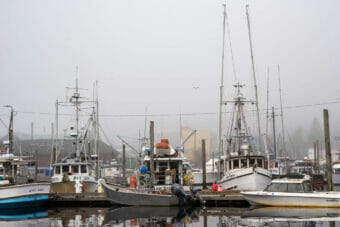
Trollers wait in Ketchikan’s Thomas Basin on Oct. 8, 2022. (Eric Stone/KRBD)
Ketchikan got nearly seven inches of rain on Tuesday, which broke the record for most rain that day.
Grant Smith is a meteorologist with the National Weather Service in Juneau. He says it was a rainy day — but for Ketchikan, not that rainy.
“Ketchikan airport’s overall record, that’s the 14th wettest day,” he said. “So I mean, this wasn’t even a top 10 event for Ketchikan. That just kind of shines some light on just how wet the Ketchikan area can get in those extreme rain events.”
Remnants of Typhoon Bolaven brought the rain from the Pacific. The typhoon has been bringing rain to the Southeast region for days.
“A lot of moisture was just wrapped up in it,” Smith said. “Everything lined up yesterday to just get Ketchikan almost seven inches of rain in one day.”
Ketchikan is one of the rainiest communities in the state. The one-day record is nearly nine inches, set on Oct. 11, 1977.
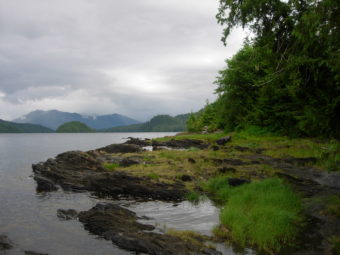
On average, Ketchikan gets nearly 150 inches of precipitation a year.
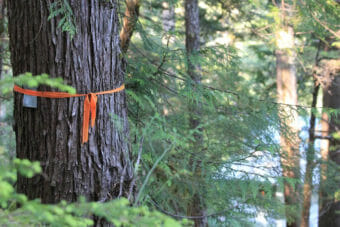
The Tongass National Forest near Ketchikan, Alaska. (Creative Commons photo by Mark Brennan)
Ketchikan’s tribe wants to change the community’s designation under federal subsistence rules to give residents more access to subsistence resources. The tribe is asking to change from urban to rural status, which would apply to all 14,000 residents in the Ketchikan Gateway Borough — and the tribe hopes that recent changes to the designation process will help it win approval.
Most communities in Alaska are designated by the federal government as rural, recognizing a lifestyle that is inextricably tied to the land. But there are urban exceptions, like Anchorage, Juneau and Ketchikan. It’s a status that’s overseen by the Federal Subsistence Board.
The urban communities don’t have a subsistence priority like the rest of the state. That means they have limited access to subsistence resources on federal lands.
Tony Gallegos is with the Ketchikan Indian Community.
“It’s an unfairness to the system because we’re urban,” he said. “We’re not considered to have access to those resources.”
For example, Ketchikan residents, including tribal members, can’t fish for eulachon in the Unuk River while residents from smaller nearby communities can — even though their ancestors have been harvesting the little smelt species for thousands of years.
Gallegos has been working on a proposal to change the community’s status from urban to rural through the Federal Subsistence Board.
“The tribe wants to remove impediments from their access to traditional foods that they depend upon. And by being in a community that’s considered urban, nobody in the community has the designation of a federally recognized subsistence user, and therefore cannot hunt and fish and gather under subsistence regulations,” he said.
Rural and non-rural status go back to 1980, when the Alaska National Interest Lands Conservation Act or ANILCA was put into law. It designated more than 100 million acres of federal land in Alaska into parks, recreation areas and refuges. And it was then that communities were labeled rural or urban.
“It’s a big deal to rescind these things,” said Brent Vickers, an anthropologist with the federal Office of Subsistence Management. His office will make a recommendation on the proposal next fall. He says the process to change a community’s status now takes at least four years, much longer than it used to.
That’s because public input is now a major part of the process. Until 2015, it was decided mostly by numbers – things like the average household income and the number of hotels and grocery stores in a community.
“It really didn’t have opportunities for much input. It was really just based on these kinds of quantitative metrics,” Vickers said.
The process changed in 2015, after complaints and a review, to a more comprehensive approach. Now, Vickers says the board considers more factors and relies heavily on the recommendations of the Subsistence Regional Advisory Councils.
“Now, the analysis will look at all sorts of things – basically painting a picture of what these communities are like, what it’s like to live in these communities,” he said.
In Ketchikan’s case, there are about 14,000 people in the borough. But it’s also isolated on an island, off-the-road system. The community has a large Indigenous population. The tribe has over 3,000 members living locally and there are residents who belong to other tribes as well.
But the rural status wouldn’t just affect tribal members. It would qualify all Ketchikan borough residents as subsistence users, no matter their background, as long as they have been a resident for one year. Wildlife officials also would be required to prioritize their needs over commercial and sport users.
Gallegos says it’s the third time the Ketchikan tribe has sought a change. But he hopes for a different result this time. He says both Ketchikan’s city and borough have passed resolutions in support of the change.
“Right now, the tribe is trying to work within the system as it’s structured with the rules and regulations that are in place, trying to see if we can go ahead and break down this barrier,” he said.
Since the designation process changed in 2015, the federal subsistence board has only considered one proposal in Alaska. That was for the community of Moose Pass near Seward on the Kenai Peninsula. It had been considered part of the urban Seward area but gained rural status in 2021.
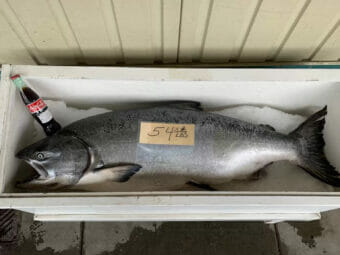
A king salmon is displayed outside a fish processor in downtown Petersburg in 2019. (Photo by Angela Denning/CoastAlaska)
Wild king salmon stocks are in decline all over the North Pacific Ocean and Alaska. Outside Alaska, some are trying to conserve the fish by limiting sport fishermen to hatchery-only kings. That’s being studied as a possibility for Southeast Alaska, too, but the idea is receiving a chilly reception so far.
British Columbia, Washington, and Oregon use what’s called mark-selective sport fishing to help conserve wild king salmon or chinook. Anglers can only keep hatchery kings that have their fins clipped, a marking practice done at hatcheries before the juvenile fish are released.
“It’s really about trying to vet another approach,” said Judy Lum, the Alaska Department of Fish and Game’s supervisor for sport fishing in Southeast Alaska. “So it was, ‘Okay, well, they do it down here. Can it work for us? And if it can work for us, in what situations? What conditions? Or can it be broad brush? Or does it have to be very specific?’”
Lum stresses that they are only studying the possibilities. They don’t know if a mark-selective fishery would help or hinder king salmon stocks or whether the benefits outweigh any potential costs.
“We have all these tools in our toolbox, so to speak for management,” said Lum. “And this would be just one additional tool to the toolbox.”
The question originated with the Pacific Salmon Commission. The commission is a regulatory group of U.S. and Canadian governments overseeing the fairness of salmon management in both countries. Alaskans involved with the commission asked the state’s Department of Fish and Game to consider the potential for a mark-selective fishery in Southeast. The department contracted with the University of Washington to do the study using grant money.
But so far, Alaskans haven’t been receptive to the idea. The state has held community engagement meetings in Juneau, Ketchikan, Klawock, and Sitka. And Lum says they’ve heard a lot of concerns.
Derek Anderson attended the meeting in Klawock.
“A lot of people are upset,” he said.
Anderson and his wife own a fishing lodge in Craig on Prince of Wales Island. He says the meeting was standing room only and full of emotion — subsistence, commercial and sport users came together.
“The main voice was no, this is not a good program for Southeast Alaska, in any way, shape, or form,” he said.
Anderson says they’d rather keep things the way they are and fish by harvest limits, which recently has been a few fish per day for residents and two to three fish per season for non-residents. He says targeting just hatchery kings would hurt more fish.
“There’s just not enough hatchery fish in our waters to make that whole thing viable,” Anderson said. “If you’re out there having to fish for hours on end to look for hatchery fish, and you’re turning back wild fish after wild fish after wild fish, a lot of those fish end up dying.”
Fishermen in Sitka felt the same. Roughly three dozen people participated in the community meeting, including 74-year-old Eric Jordan. He is a life-long troller and says everyone was cordial, but no one wanted the program.
“I think there was a lot of skepticism in the audience that this would be a good way to go here,” said Jordan.
Jordan is a self-described conservationist and has participated in fish policy for decades, from local fish advisory councils to the state Board of Fish. He says for the program to work, it would have to address the harm of catch and release.
“In the salt waters of Southeast Alaska, you’re going to need to change the rules to minimize mortality,” he said.
How many kings in Southeast are wild or come from hatcheries varies by location. It’s complicated because most of the kings (63%) originate in non-Alaska areas — both wild and hatchery stocks — and not all hatchery fish are marked.
Lum, with Fish and Game, says incidental bycatch is also a big concern for the state. Starting up a mark-selective sport fishery would be a years-long process that would require a lot of buy-in.
And there isn’t hard data that the program is working elsewhere. Mark-selective fisheries have been ongoing for about 20 years in some locations in Washington. But has it really been successful? The jury is still out, according to Anne Beaudreau. She’s an associate professor at the University of Washington conducting the state’s study.
“There’s so many different variables to that.” she said. ” And it’s actually been a really hard question to answer.”
So she says something like a mark-selective sport fishery may or may not work in Alaska.
“Mark-selective fisheries are not a one-size-fits-all approach,” said Beaudreau. “The way that they have been implemented, and the way that they’ve been managed has been different, depending on where they’ve taken place.”
The study results are expected to be completed by next spring.
Another opportunity for Southeast Alaskans to learn about the study and comment on it is coming up Wednesday, Oct. 4 at 7 p.m.
Ketchikan’s City Council meets on Thursday, June 16, 2022. (Screenshot by Eric Stone/KRBD)
A candidate running for Ketchikan City Council has gotten a protective order against another candidate.
On Sept. 18, Ketchikan District Court Judge Kristian Pickrell approved a one-year protective order requested by Judy Zenge against Brian Buchman. Zenge was concerned about Buchman stalking her.
The protective order stems from an incident on Aug. 30 when Buchman was outside of a mall handing out copies and taking donations for a street newspaper he publishes called “The Homeless Changed.” He told the court he’d been doing that off and on for about three years and had permission. Zenge said Buchman did not have permission.
Zenge manages the mall and asked her husband to ask Buchman to leave. An argument ensued inside Zenge’s office, which included Buchman refusing to leave. The court found that Buchman faked a medical emergency to intimidate Zenge.
The Ketchikan Daily News reports that during a hearing on the incident, Judge Pickrell added details to the protective order allowing Buchman to participate in election activities as long as he didn’t interact directly with Zenge. For example, he would need to be at opposite ends of the stage or a table during a candidate event.
Buchman filed similar protective orders against the Zenges, but the judge denied them, stating that the Zenges’ testimony was more credible.
Eight candidates are running for three open seats on Ketchikan City Council. The municipal election is on Oct. 3.
—
Editor’s Note: Judy Zenge’s campaign is underwriting on KRBD, but that does not involve the newsroom.
A bull moose photographed by an Alaska Department of Fish and Game game camera on Mitkof Island in 2018. (Courtesy of Dan Eacker/ADF&G)
The moose hunt near Petersburg, Wrangell, and Kake opened on Friday, Sept. 15. It’s a month-long hunt that includes several islands in central Southeast as well as some areas on the mainland.
The antler moose hunt allows hunters to take bull moose with certain antler configurations. There is no quota. The hunt liberalized in 2009 from requiring three brow tines on one side to allowing two brow tines on both sides.
Frank Robbins is the state wildlife biologist for the area. He says the hunt has been successful by all accounts. Over the last nine years, the harvest has been over 100 bulls.
He spoke with CoastAlaska’s Angela Denning about the upward harvest trend. He says moose are being harvested where they’ve never been before.
Listen:
Frank Robbins: We’re currently harvesting moose in areas where they weren’t harvested just 10-15 years ago. For example, Kuiu Island 10-12 years ago, there was a nominal harvest if any harvest at all. Last year, nearly 30 bulls were harvested Kuiu, it made up 25% of the total harvest. So it’s a dynamic situation, you know, there’s moose present in areas where they just weren’t present in the numbers that they are now.
Angela Denning: That to me sounds like a good sign like the population could be expanding?
Frank Robbins: I think that there’s a bit of an increase in the distribution of moves. And there’s been some good productivity. We don’t have a means by which we can estimate population. We manage largely on harvest and trends in harvest. And these these coastal rainforest areas it is very difficult to survey.
Angela Denning: It’s just the trees and the mountains make it too dense to see from, say, an aerial survey.
Frank Robbins: Right. We have some hopes they were experimenting with trail cameras now. We hope in the future, we’ll be able to adopt that technology. It’ll give us more information. But currently, we largely manage on harvest alone. That’s what our best at is. So, but yeah, you’re right, the moose harvest has increased over time, hunter success has increased. 15 years ago, higher success was around 11% for the time. 10 years later, it was up to about 14%. And now we’re 17% success, rate. So harvest is increased, hunter success is increased. So yeah, it looks good.
Angela Denning: But you can’t definitively say that the population has increased, but you can say that is the distribution has increased.
Frank Robbins: I don’t have data to present that demonstrates an increase in population. I have harvest data that shows that the harvest has increased, hunter’s success has increased and indirectly suggests that not only have we had an expansion in the distribution of the moose, but there’s more moose available. So they’ve been kind of moving of course from the mainland westward across the islands, across Kupreanof Island to Kuiu Island.
Angela Denning: Any thoughts on the expansion? Is it just kind of a natural evolution?
Frank Robbins: I’ve been told that is a natural expansion. That it’s just taking that long for moose to inhabit those areas since the glaciers receded. It’s just taking that much time for them to get there. Yeah. It’s not a topic that I’ve studied directly so I don’t know.
Angela Denning: I’ve heard similarly, that traditionally the diet was more deer and moose was just hardly ever.
Frank Robbins: That’s right, yeah. So I don’t remember exactly but I think maybe the first moose was sighted on Kupreanof in the 70s. So there’s just been a slow expansion of this distribution. So it’s an interesting dynamic, moose hunt.
A brown bear at Sitka’s bear shelter, Fortress of the Bear, tests out one of the bear-resistant trash bins. (Photo courtesy of Fortress of the Bear)
Listen to the audio here:
Bears getting into trash is a problem throughout Southeast Alaska. To deal with it locally, the City of Hoonah started distributing free bear-resistant trash bins to residents at the beginning of the month. But most towns in the region can’t afford them.
In the fall, bears are interested in one main thing: getting fat to survive the winter. They do that by gorging on salmon, grazing on berry bushes, and at times getting into trash bins.
“Almost daily from this time into late November,” said Hoonah’s City Administrator Dennis Gray.
Hoonah is a small community on the northeastern side of Chichagof Island. The island has the world’s densest population of brown bears. Gray says in the fall, bears are a daily problem.
“We have thousands of brown bears and less than 1,000 people,” he said. “Bears have been here for a long time and we have constant conflicts.”
It’s a familiar problem all over Southeast. Haines killed nearly 30 brown bears in 2020. The following year, Sitka euthanized 14 brown bears. In Ketchikan and Petersburg, black bears are the ones getting into trash, but it’s still a problem every year.
But so far, Hoonah is the only community in Southeast that’s providing bear-resistant trash cans. Gray thinks they’ll be a game changer for the community.
“I’m pretty excited about this,” he said.
The City of Hoonah provided each household with two of these bear-resistant trash bins. (Photo courtesy of Dennis Gray)
The bear bins were too expensive for Hoonah until a large grant came their way — $2 million from Norwegian Cruise Lines. The company gave Hoonah the money during COVID. The city used it to purchase 660 bins at $136 a pop. They’re smaller-sized because they must be lifted and dumped by a person since Hoonah doesn’t have a mechanical collection truck.
In Sitka, such bear bins have been cost prohibitive. Sitka created a bear task force, which met about 10 times last year. They recommended that the city and borough invest in bear-resistant cans. But Sitka would need to spend around $1.5 million to replace all its residential bins. It boils down to money for other towns in the region too, who instead rely on laws and citations to encourage residents to keep trash secured.
Stephen Bethune with Alaska Department of Fish and Game in Sitka says brown bears have been getting into local trash bins for many years.
“The bears have keyed in on that and roam the neighborhoods at night looking for cans with trash in them,” he said.
Bethune is one of the people who euthanize Sitka’s problem bears. He says it’s not pleasant and it’s a lot of extra work.
“It’s often in the middle of the night,” said Bethune. “There’s a lot of follow up that happens when you have to kill a bear. We salvage the hides and skulls for our fur auction in Fairbanks every year so a lot of late nights in the warehouse skinning bears.”
The bear bins are kind of like water-resistant clothing. They help for a while.
“There’s no such thing as bear-proof, that’s why we call them bear-resistant,” Bethune said.
And they have proof of this. At a local bear shelter in Sitka — the Fortress of the Bear — staff tested out many so-called bear-resistant trash bins. The very best one lasted only 12 minutes. But Bethune says that’s enough.
A brown bear at Sitka’s bear shelter, Fortress of the Bear, tests out one of the bear-resistant trash bins. The tests were viewed by the public at the shelter’s annual Community Bear Awareness Day, when the shelter partners with the Alaska Department of Fish & Game and the Defenders of Wildlife to help educate the public on ways to reduce bear-human conflict. (Photo courtesy of Fortress of the Bear)
“I don’t foresee realistically a bear spending 10 minutes on one trash can trying to get into it,” Bethune said. “They usually just knock over the can, it spills open and they grab a bag that falls out and run off with it into the woods. So even a very resistant can is going to not provide that immediate food resource and the bear’s eventually going to learn that coming into town isn’t paying off for him. It’s too big of a risk.”
He said 10 minutes matters. Even five minutes matters.
But bears are more than just a problem. They’re important to the region culturally and economically. Hoonah is a mostly Lingìt community with cultural ties to bears. And City Administrator Dennis Gray says the town has grown its tourist industry, receiving nearly 600,000 visitors a year. Many come to see the brown bears in nearby streams.
“Cruise ship tourism people pay big bucks to go out the road, look at bears,” Gray said. “And so shooting bears is not a great thing to be doing.”
Purchasing bear-resistant trash bins is just one step Hoonah is taking with the grant money. The city also bear-proofed its landfill with concrete blocks. They purchased bear-resistant metal dumpsters and kits for hanging deer safely in the fall. And they’re bringing in a team of Karelian bear dogs from Fairbanks for two weeks to scare the bears away. Gray says if it works, they’ll bring the team back next year.
Close
Update notification options
Subscribe to notifications
Subscribe
Get notifications about news related to the topics you care about. You can unsubscribe anytime.