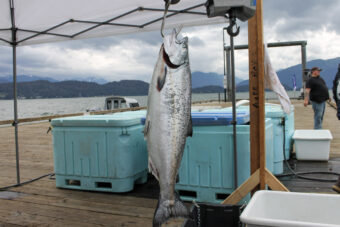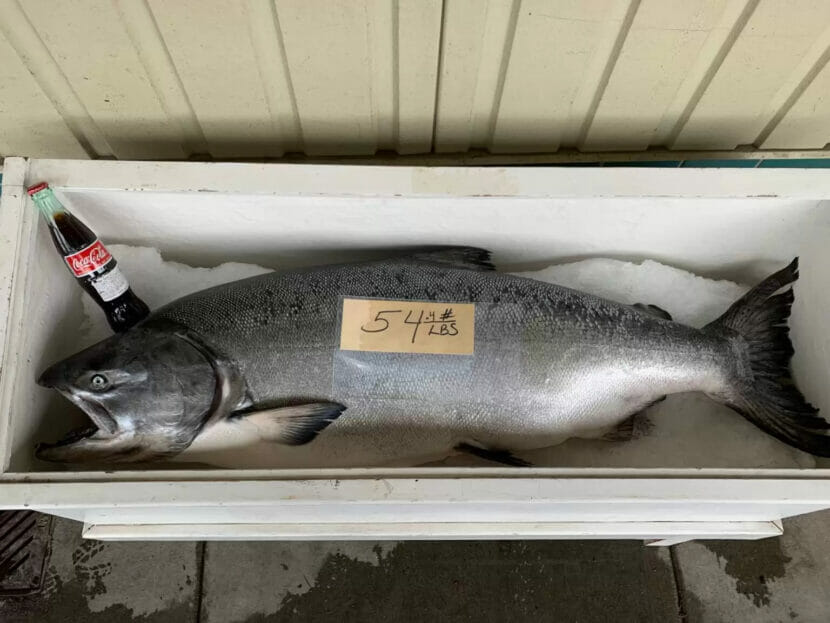
Wild king salmon stocks are in decline all over the North Pacific Ocean and Alaska. Outside Alaska, some are trying to conserve the fish by limiting sport fishermen to hatchery-only kings. That’s being studied as a possibility for Southeast Alaska, too, but the idea is receiving a chilly reception so far.
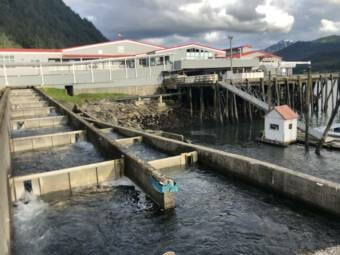
British Columbia, Washington, and Oregon use what’s called mark-selective sport fishing to help conserve wild king salmon or chinook. Anglers can only keep hatchery kings that have their fins clipped, a marking practice done at hatcheries before the juvenile fish are released.
“It’s really about trying to vet another approach,” said Judy Lum, the Alaska Department of Fish and Game’s supervisor for sport fishing in Southeast Alaska. “So it was, ‘Okay, well, they do it down here. Can it work for us? And if it can work for us, in what situations? What conditions? Or can it be broad brush? Or does it have to be very specific?’”
Lum stresses that they are only studying the possibilities. They don’t know if a mark-selective fishery would help or hinder king salmon stocks or whether the benefits outweigh any potential costs.
“We have all these tools in our toolbox, so to speak for management,” said Lum. “And this would be just one additional tool to the toolbox.”
The question originated with the Pacific Salmon Commission. The commission is a regulatory group of U.S. and Canadian governments overseeing the fairness of salmon management in both countries. Alaskans involved with the commission asked the state’s Department of Fish and Game to consider the potential for a mark-selective fishery in Southeast. The department contracted with the University of Washington to do the study using grant money.
But so far, Alaskans haven’t been receptive to the idea. The state has held community engagement meetings in Juneau, Ketchikan, Klawock, and Sitka. And Lum says they’ve heard a lot of concerns.
Derek Anderson attended the meeting in Klawock.
“A lot of people are upset,” he said.
Anderson and his wife own a fishing lodge in Craig on Prince of Wales Island. He says the meeting was standing room only and full of emotion — subsistence, commercial and sport users came together.
“The main voice was no, this is not a good program for Southeast Alaska, in any way, shape, or form,” he said.
Anderson says they’d rather keep things the way they are and fish by harvest limits, which recently has been a few fish per day for residents and two to three fish per season for non-residents. He says targeting just hatchery kings would hurt more fish.
“There’s just not enough hatchery fish in our waters to make that whole thing viable,” Anderson said. “If you’re out there having to fish for hours on end to look for hatchery fish, and you’re turning back wild fish after wild fish after wild fish, a lot of those fish end up dying.”
Fishermen in Sitka felt the same. Roughly three dozen people participated in the community meeting, including 74-year-old Eric Jordan. He is a life-long troller and says everyone was cordial, but no one wanted the program.
“I think there was a lot of skepticism in the audience that this would be a good way to go here,” said Jordan.
Jordan is a self-described conservationist and has participated in fish policy for decades, from local fish advisory councils to the state Board of Fish. He says for the program to work, it would have to address the harm of catch and release.
“In the salt waters of Southeast Alaska, you’re going to need to change the rules to minimize mortality,” he said.
How many kings in Southeast are wild or come from hatcheries varies by location. It’s complicated because most of the kings (63%) originate in non-Alaska areas — both wild and hatchery stocks — and not all hatchery fish are marked.
Lum, with Fish and Game, says incidental bycatch is also a big concern for the state. Starting up a mark-selective sport fishery would be a years-long process that would require a lot of buy-in.
And there isn’t hard data that the program is working elsewhere. Mark-selective fisheries have been ongoing for about 20 years in some locations in Washington. But has it really been successful? The jury is still out, according to Anne Beaudreau. She’s an associate professor at the University of Washington conducting the state’s study.
“There’s so many different variables to that.” she said. ” And it’s actually been a really hard question to answer.”
So she says something like a mark-selective sport fishery may or may not work in Alaska.
“Mark-selective fisheries are not a one-size-fits-all approach,” said Beaudreau. “The way that they have been implemented, and the way that they’ve been managed has been different, depending on where they’ve taken place.”
The study results are expected to be completed by next spring.
Another opportunity for Southeast Alaskans to learn about the study and comment on it is coming up Wednesday, Oct. 4 at 7 p.m.
Here is information about meeting and the study.
Here is a link to the video meeting.