Angela Denning, CoastAlaska

Angela Denning is CoastAlaska's regional news director, based in Petersburg. CoastAlaska is our partner in Southeast Alaska. KTOO collaborates with partners across the state to cover important news and to share stories with our audiences.
Alaska’s ferry system receives $177.4 million in federal funds

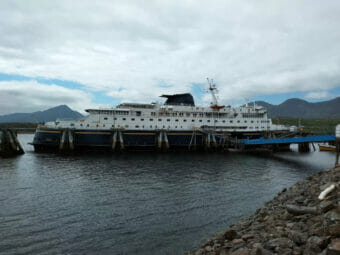
The 418-foot-long Columbia ferry is docked at the Vigor shipyard in Ketchikan, getting repairs, June 21, 2023. (Photo by Mikko Wilson/KTOO)

The Alaska Marine Highway System has been awarded $177.4 million to go towards operational costs, bringing WiFi to passengers and replacing the oldest ferry in the fleet.

Alaska’s Congressional Delegation announced the new funds on Friday.
Alaska Department of Transportation spokesperson Sam Dapcevich said they don’t yet know all the details of how the money will be spent. However, a big portion – $106.4 million – will go towards replacing the 60-year-old Tustumena or “Tusty” that serves Kodiak, Homer, and the Aleutian Islands.

“That caps off our funding needed for the current estimate to replace the Tusty,” Dapcevich said.

The price tag for the project, called TRV for Tustumena Replacement Vessel, is over $315 million. The rest of the cost will come from federal money the state has already received. The ferry build is scheduled to be completed in 2027-28.

$66 million of the new federal funds is going to “support sustainable operations for rural communities.” Dapcevich said the state hasn’t yet determined exactly how that money will be spent, but that it will be used for operational costs.

$5 million is earmarked for setting up WiFi on all the ferries. Starlink is already available for crew and operations, but this would extend internet access to passengers.

“It requires adding access points throughout the vessel – you can’t just drop one router on top and everybody has service,” Dapcevich said. “So, that’ll take some time to, you know, wire everything in, and it would need to be firewalled from operations. So, it’ll take a little bit of time to implement, but I think in the long run, it’ll be a lot like Alaska Airlines, where a person can hop on and have a connection.”

Up until a few years ago, federal funding for Alaska’s ferry system came through the Federal Highway Administration. Now, it’s through the Federal Transit Administration, which Dapcevich said helps separate the ferry system from other transportation needs.

“AMHS used to come out of the same pot as the regular highways and airports and all that, and now it’s coming out of the FTA, which I think is an improvement,” he said.

Recent federal awards come from the Bipartisan Infrastructure Law, which has designated $700 million to Alaska’s ferry projects over the last three years.

Alaska Senators Lisa Murkowski and Dan Sullivan, and Rep. Mary Peltola lauded the latest funding, voicing their support for the marine highway system.

Southeast tribes seek a pause on Canadian mine near B.C. border

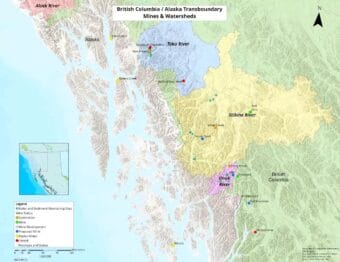
More than a dozen working and legacy mine sites are located in watersheds that are shared between British Columbia and Southeast Alaska. (Image courtesy of B.C. Ministry of Energy, Mines and Petroleum Resources)

For many years, tribes in Southeast Alaska have been concerned with nearby mining projects across the Canadian border in British Columbia. The headwaters of three major rivers – the Taku near Juneau, the Stikine near Wrangell, and the Unuk near Ketchikan — are in B.C. but flow into Southeast watersheds.

Louie Wagner lives in Metlakatla near the mouth of the Unuk River. He’s concerned about the Eskay Creek Mine, a large gold and silver mine up a Unuk tributary.

“There (are) already two mines working and the third one which could be the second to third largest mine in the world,” Wagner said. “And where they’re going to put their retaining wall for their mining tailings is pretty scary.”

Eskay Creek Mine was an underground mine producing gold from 1994-2008. The mine’s new owner, Skeena Resources, wants to start again using open-pit extraction that it estimates will produce 2.8 million of ounces of gold and 80 million ounces of silver over a dozen years. The company plans to build a tailings dam to hold millions of tons of mine waste — forever.

Subsistence users, like Wagner, believe the Unuk River’s ecosystem is too vulnerable.

“During the spring and summer the water is so shallow, it really can’t handle any pollution,” he said. “Doggone, we lose all our wildlife. It’ll be lost forever.”

Wagner is part of the Southeast Alaska Indigenous Transboundary Commission (SEITC), which represents 17 tribes in Southeast and has been fighting the mine’s development and others like it. This month, the commission requested a pause in mining operations, fearing the mine’s waste could contaminate the river. Their worries stem from past events. Ten years ago, a tailings dam broke at B.C.’s Mount Polley mine, spilling millions of gallons of mine waste into a nearby river that supported Southeast Alaska salmon runs. The B.C. government declined to sanction the mining company over the spill.

According to the commission, the B.C. government hasn’t heard their concerns. The commission has been working with attorneys from the nonprofit environmental group Earthjustice. Mae Manupipatpong is one of the attorneys.

“Really the crux of this case is just to ensure that these SEITC member tribes who could be potentially impacted by this project have a voice in the process and are not sidelined just because they are on the other side of an arbitrarily drawn border,” Manupipatpong said.

In an email, David Karn with B.C.’s Ministry of the Environment declined to comment writing that “it would be inappropriate for government to provide any further commentary at this time,” because the proceedings are ongoing.

Earthjustice is looking to a Washington D.C. based human rights organization to help out. They submitted a 47-page request to the Inter-American Commission on Human Rights to pause the Eskay mine. The request calls the mine’s impacts “serious” and “a foreseeable, imminent, and significant threat.”

Manupipatpong said B.C. law requires informed consent from Alaska’s nearby tribes because their ancestors have historically used the Unuk watershed.

“We’re hoping that the commission can pressure B.C. and Canada to do the right thing,” she said. “Of course, as an international body, they can’t force them to, but we are attempting to use this mechanism just as another way to get B.C. to listen.”

The legality of the transboundary mines has long been controversial. Six years ago, the tribal commission filed a 215-page petition with the Human Rights Commission asking the group to investigate transboundary mines. Then, two years later, they filed another petition focused on six mines near the Taku and Unuk rivers. The Human Rights Commission agreed to look into the matter and found last year that the transboundary mines could violate the rights of Southeast tribes. This February, the tribes submitted another request to the commission asking for a formal hearing. Now, Southeast tribes want the Eskay Creek Mine paused.

The state of Alaska has put the issue on the back burner. During former Governor Bill Walker’s administration, Lt. Governor Byron Mallot was tasked with seeking better communication with B.C. In 2015, Alaska and B.C. signed a memorandum of understanding to increase the state’s role in transboundary mine decisions. However, those discussions haven’t continued – at least not publicly.

A few years ago, the tribes conducted a study documenting their ancestral use of the watershed. It was financed by international conservation group, Re:wild. Since then, Re:wild has been backing the tribes’ efforts. Re: wild works in over 80 countries and touts well-known actor Leonardo Dicaprio as a founder. Nina Hadley is also with the organization.

“We’re particularly interested in protecting the Alaska – British Columbia transboundary region because it’s among North America’s top ecological hotspots,” Hadley said.

Re:wild credits the region’s Indigenous populations for safeguarding biodiversity for thousands of years. Hadley said that’s one they support “deep consultation” between Canada and the downriver tribes.

“What I mean by that is a formal dialogue between the tribes and the B.C. government that aims to build trust, that aims to build respect, and aims to build that shared responsibility. That kind of consultation is just not happening.”

Time is limited — Skeena Resources completed a feasibility study last year and is waiting on the government to release an environmental assessment. BC already has an agreement with the Canadian tribe, Tahltan Central Government, which owns the territory near the mine.

Service gaps persist in proposed winter ferry schedule

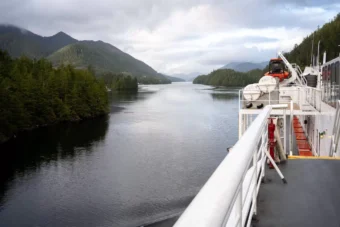
The M/V Kennicott travels south in the Wrangell Narrows near Petersburg on April 15, 2024. (Photo by Angela Denning/CoastAlaska)

The state has released its draft winter ferry schedule, which covers Oct. 1 through April 30. Residents might find the schedule familiar.

“It’s pretty similar to last year’s winter schedule,” said Sam Dapcevich, spokesperson for the state Department of Transportation. “We’re dealing with the same fleet and the same crewing situation.”

As in recent years, there will be one ferry serving the main route through Southeast Alaska from Skagway to Bellingham, Washington. That means most communities will see one ferry stop going north and south each week. Sitka, however, will see only one ferry going in one direction each week. Dapcevich said it might be north or south throughout the winter.

“There’s a little bit of variability there,” he said, “but it always stops in Sitka in one direction or the other.”

The Kennicott will be sailing through Southeast in October and then the Columbia will run November through April.

There will be no service for Prince William Sound, including Cordova and Valdez, from October through December when the Aurora is docked for maintenance. The Homer and Kodiak region will have no ferry service from January through March. That’s when the 60-year-old Tustumena will be getting annual maintenance.

“When that ship is in its annual overhaul, it’s inspected by the Coast Guard or by the American Bureau of Shipping,” Dapcevich said. “They go over that vessel with a fine toothcomb. These vessels are very closely looked at.”

The state plans to replace the Tustumena in 2027 with a hybrid diesel-electric ship that’s larger and faster. It’s expected to cost at least $300 million.

The Tustumena is just one of the state’s old ferries. Four others are nearly 50 years or older and their age means more maintenance. The Matanuska has remained in overhaul status for expensive repairs since January of last year. Dapcevich said deciding whether to fix that vessel or any of the aging fleet isn’t easy.

“They’re tough decisions,” he said. “Like, how many more years do you get? The Matanuska is 60 years old – if you plug $40 million into it, will it be a stopgap vessel? Will it keep you going? Or are you going to continue to fight with other issues?”

For the long-term outlook, Dapcevich said next year should see a similar schedule. But they’ll start adding crew quarters to the Tazlina, which would bring another vessel to potentially fill service gaps to the Southwest region in 2027.

As for ferries connecting to Prince Rupert, BC like they used to, that service has stopped.

The public can send in written comments by the end of the day on Tuesday. DOT will be holding two Zoom meetings on Wednesday when the public can also comment. The meeting for the Southeast region is at 10 a.m. and it’s at 1 p.m. for the Prince William Sound and Southwest regions.

This story has been corrected to show that the Aurora is scheduled for maintenance Oct-Dec and the Tustumena is scheduled for maintenance Jan-March.


Comments can be emailed to dot.amhs.comments@alaska.gov, or faxed to 907-228-6873.

Zoom virtual meeting for Southeast Alaska:
When: June 26, 2024 10:00 AM AKDT
Please click the link below to join the webinar:
https://us06web.zoom.us/j/89091551528
By phone: (253) 215-8782
Webinar ID: 890 9155 1528
International numbers available: https://us06web.zoom.us/u/kdIogA0i7f

Zoom virtual meeting for Southwest and Southcentral Alaska (PWS):
When: June 26, 2024 01:00 PM AKDT
Please click the link below to join the webinar:
https://us06web.zoom.us/j/84466431382
By phone: (253) 215-8782
Webinar ID: 844 6643 1382
International numbers available: https://us06web.zoom.us/u/kdIogA0i7f

U.S. Forest Service considers higher fees for new Alaska cabins

Petersburg resident, Brian Richards, stands outside of West Point Cabin located on the north side of Kupreanof Island on May 4, 2024. (Photo by Ola Richards)

The U.S. Forest Service is planning to build a few dozen new cabins in the Tongass and Chugach National Forests in the coming years. The agency is proposing higher fees – $75 a night – to help keep up with the increased cost of maintenance.

Life-long Petersburg resident Brian Richards and his wife stay at Forest Service cabins every summer. The 40-year-old said they reserve several cabins that they travel to by boat.

“It’s like a bucket list,” Richards said. “We want to use them all. I’d say we prefer cabins by lakes or rivers, you know, water, it just kind of adds another element.”

The couple sees their cabin stays as good for their mental health. Richards calls it “natural therapy” that helps them reconnect.

“The more we get out there and walk around and look at the trees and listen to the birds and just, you know, disconnect from civilization, I think it’s just incredibly beneficial,” he said.

Richards is excited to see more cabins coming to the area. The Forest Service plans two new cabins in the Tongass this year at El Capitan Interpretive Site and Mendenhall Campground, and four next year at Herbert Glacier in Juneau, Woodpecker Cove near Petersburg, Little Lake near Wrangell and Perseverance Lake near Ketchikan – they’re mostly on the road system for increased accessibility. Similarly, there are six new cabins scheduled for the Chugach, with half built this year at Porcupine Campground in Hope, Meridian Lake near Seward and McKinley Lake near Cordova, and half next year at Granite Creek and Turnagain Pass. That means the Forest Service needs to set the nightly fees for the cabins soon. The agency is required to have fees set six months before they charge them.

“It can be tricky,” said John Suomala, the recreation program manager for the Tongass.

Suomala helps set the cabin fees. He uses a cost analysis that looks at several factors such as local economies and what similar cabins are going for.

“Part of it too is just, you know, local expertise, from the districts, people that live in these communities,” said Suomala. “Just kind of thinking about, you know, what are the prices within these communities now and what do you think your neighbors are willing to pay.”

The nightly fees for staying at a Forest Service cabin in Alaska mostly range from $35 to $75. All of the new cabins are proposed for $75 a night except for two – one near Ketchikan is $65 and one at Juneau’s Mendenhall campground is $125 because it has electricity and nearby showers.

The new cabins are just a fraction of what’s available to the public. The Tongass has 142 cabins just in Southeast. Most are remote and get visitors less than 10 nights a year. Last year, it cost the Forest Service $700,000 to maintain them. The nightly fees covered about $500,000.

Suomala said the popular, more accessible cabins help subsidize the remote ones – and that’s their hope with the new cabins coming on board. But ultimately, he said, the public will help set the price.

“We want feedback to, you know, to get an idea, like are we way off here?” Suomala said. “Do you think it should be higher? Do you think it should be lower? We can’t raise the fee based on feedback from the public but we can lower it.”

As for Richards, he said $75 a night won’t be a deal breaker for him and his wife, Ola.

“Because, it’s worth it for us,” he said. “I guess my concern is for a lower-income family. I would hate to think that someone wouldn’t stay at a cabin because they can’t afford it. I think that’s a real shame.”

The deadline for public comments on the proposed cabin fees is July 2. People can comment in person, online, by phone, email or snail mail.

Southeast Alaska not ready for a hatchery-only king fishery, study finds

""
King salmon landed in the commercial troll fishery in the summer of 2019. (Photo courtesy of Matt Lichtenstein)

Should Southeast Alaska have a hatchery-only king salmon sports fishery? Researchers recently tried to answer that question as a possible solution to a declining number of wild kings.

Chinook or king salmon are the largest and most valuable salmon species. They’re sought-after by sport, commercial, and subsistence fishermen alike. But in recent decades, their harvest has become more restricted as populations plummet. A recent study considered if a new Southeast fishery could help – one that allows sport fishermen to keep only hatchery king salmon and release wild ones.

“And an important question there is could this actually be done within the current management context? And is this something that is desirable for folks in Alaska?” asked Anne Beaudreau, who led the study, which took about a year.

Beaudreau is an associate professor with the University of Washington’s School of Marine and Environmental Affairs. The study was initiated and funded by the Alaska delegation of the Pacific Salmon Commission. Members asked the Alaska Department of Fish and Game to explore the possibility of a hatchery-based sports fishery, and the state then contracted with the university.

As part of the study, Beaudreau helped run several public meetings throughout Southeast. Dozens of people participated.

“We heard a lot of concern brought up at these meetings,” she said.

In theory, a hatchery-only fishery – or what’s called a ‘mark selective fishery’ – could provide more sport fishing opportunities. All types of fishing for wild kings are highly restricted because of a treaty that the U.S. has with Canada. It sets harvest limits to make sure that both countries get kings every year. And hatchery king salmon don’t count toward the U.S. treaty allocation.

But the study found that a lot would have to be in place for such a fishery to work. For starters, not all hatchery king salmon in the region are marked. Marked kings have their adipose fin removed, making them easily identifiable. In fact, even a few wild kings in Southeast are also marked that swim to spawn in transboundary rivers leading into Canada. So, in order for a hatchery-only fishery to work, there would have to be buy-in from all the region’s hatcheries. But Beaudreau said some just aren’t set up for marking all of their fish right now.

“The more fish you mark, the more successful you can be in actually implementing a mark-selected fishery,” she said. “It would also require hatcheries to support the idea of mass marking for a mark-selected fishery. And that’s not the case presently.”

Southeast residents also worried about other ramifications – like how such a hatchery sport fishery might affect commercial fisheries. And charter boats concentrating their efforts near hatcheries that locals rely on. And how the management of it might divert resources away from other issues like habitat and bycatch.

Beaudreau said a major concern that arose from the study was incidentally killing wild kings while targeting the hatchery fish. It’s estimated that 16% of catch and release sport-caught king salmon in Southeast die.

“One thing that has risen to the top over and over again, especially in conversations with community members, is these concerns about incidental mortality, the mortality of those unmarked fish that are released,” Beaudreau said.

Also, Southeast’s king salmon fishing is complicated because there is a mix of fish swimming towards many different destinations. Some wild kings are heading to Alaska spawning grounds and others are here temporarily until they return to spawn in British Columbia or the Lower 48. And some are hatchery-produced, returning to where they were released. The fish’s origin varies and depends on the time and location.

Ketchikan sport fisherman Russell Thomas questioned the study’s lack of data on the rate of encountering wild versus hatchery kings.

“It just seems to me like without that information, how do you ever really evaluate what the feasibility is?” he asked at one of the public meetings.

Beaudreau admitted that the study was a high-level overview of the region. Researchers didn’t drill down on how a sport fishery like this could work in specific areas.

Staff from the state’s Sports Fish Division agreed. They said there are too many unknowns right now to start a new fishery in Southeast. Patrick Fowler, a regional fisheries management coordinator, addressed Russell’s concerns.

“I would just say at this time, the Department doesn’t intend to advance a particular proposal,” he said.

But Fowler added that if residents wanted to pursue a local fishery the state department could help gather data for that specific area for a future proposal.

Here is a summary of the study and online meetings.

Forest Service seeks public input in revising its long-term plan for the Tongass

A view of the Tongass National Forest near the U.S. Forest Service’s Raven’s Roost Cabin on Mitkof Island. (Angela Denning/CoastAlaska)

The Tongass National Forest is a 17 million-acre temperate rainforest covering most of Southeast Alaska. It’s managed by the U.S. Forest Service, which is revising its long-term plan for the Tongass. The previous plan is 25 years old and was revised in 2016. It’s 516 pages long.

The agency will spend the rest of this year gathering public input and then take the next couple of years to finalize a new plan. The U.S. Forest Service is partnering with Spruce Root and Juneau Economic Development Council to help with public engagement. Spruce Root is a regional non-profit focused on the economy, and it’s sharing a survey to find out what people think about the Tongass.

Barb Miranda is the Deputy Forest Supervisor for the Tongass. She spoke with CoastAlaska’s Angela Denning about the Forest Service’s process to make a new plan. She says the entire thing relies on public input.

Listen:


Barb Miranda: For the first time in over 25 years, we’re gonna go through a major overhaul of the Tongass Forest Management Plan. So, the things that have changed in those 25 years — think about every town in Southeast Alaska, their economy, the tourism demands that have changed. The way we’ve extracted resources from the Tongass has shifted remarkably, in those 25 years. 25 years ago was the end of the pulp mill industry. Now we’re looking at second growth, wood and how to utilize that in our local economies and for local sawmills, the climate, our understanding of climate change, and how that’s impacting the forest around us and the waterways around us has changed. Our population has shifted, and there’s an increased demand for recreation, conservation and restoration on our Forest lands. So, we’re revising a 25-year-old plan with the new planning rule that will give us a plan for the next 15 or so years.

Angela Denning: So why should somebody in any town in Southeast care about what’s in this plan?

Barb Miranda: Well, I mean, as we all know, those of us that live here in Southeast, the Tongass is our backyard, our playground, and most of the land surrounding our small communities is the Tongass National Forest. So if you care about what happens, you know what kind of actions can take place in the area immediately around your town, or those places that are special to you and special to all of us, where we go berry picking, foraging, the access to cabins, all those things are going to be included in this in this high level plan and will guide how the Tongass is managed for the next 15 or so years.

Angela Denning: What is the public process like for this long-term plan? I know community meetings have been held throughout Southeast in April. How can the public get involved now?

Barb Miranda: Yeah, great question. We’re in a marathon, not a sprint for the forest plan. We are in the first phase of forest plan revision. And we’re in a phase called assessment. Like you said, we just completed our community workshops across Southeast Alaska. We’ve got a couple left. But we’ve done about 25 community workshops. And everybody will be able to see the information we’ve received at those workshops synthesized into report out here in the next couple of months. But we also have on our website, webinars, other information, a library, how to be involved, you can sign up to receive notifications about this, in addition to that we have office hours, twice a month, the schedule is on that website, where people can tune in, and our planning team will be there ready to answer any questions folks might have about the Forest Plan Revision.

Angela Denning How long do people have to make comments? And when do you plan to have the plan done?

Barb Miranda: So right now, like I said, we’re in that first phase of planning, which is the assessment phase. It’s open. We are taking comments throughout this whole year, we will have the draft assessment available for review in January of 2025. So, information to feed into the assessments is most valuable between now and then. Hopefully, you know, the fall would be when we’re finalizing, gathering information and then synthesizing those into a document.

Angela Denning: Thanks for sharing a lot of information with us. Is there anything you’d like to add that we haven’t talked about?

Barb Miranda: There’s one more thing. The Forest Service is pretty committed to engaging — robustly — differently than we have in the past. And this plan can’t be created without public input. So, community voices, tribal voices, citizen voices are really important. We can’t create this plan without it. So (we) really want folks to lean in with us to develop this plan together.

Site notifications
Update notification options
Subscribe to notifications