On this episode of Garden Talk, host Bostin Christopher talks with Darren Snyder about how to help your garden deal with too much rainfall.
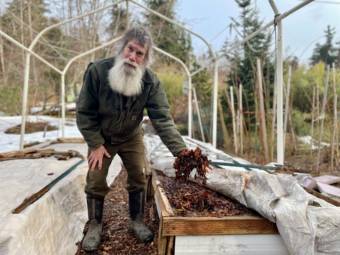
Ed Buyarski holds up seaweed he added to a garden bed, which is still covered with plastic to help warm the soil and protect it from snow and rain (photo by Sheli DeLaney, KTOO)
On this episode of Garden Talk, host Bostin Christopher talks with UAF Cooperative Extension Agent Darren Snyder about how to help your garden deal with too much rainfall.
The conversation examines how excessive rain and strong winds, particularly in Juneau, affect gardens nearing the end of the growing season. Snyder offers practical advice for dealing with the current conditions, such as covering ground crops like potatoes with plastic to prevent cracking, and suggests harvesting crowded annuals to improve airflow and reduce rot. He also shares long-term strategies for future seasons, emphasizing the importance of good soil drainage and utilizing techniques such as mulching, hoop houses, and high tunnels to manage moisture effectively.
On this episode of Garden Talk, host Bostin Christopher talks with Darren Snyder about maximizing your precious harvest and preparing for successful storage.
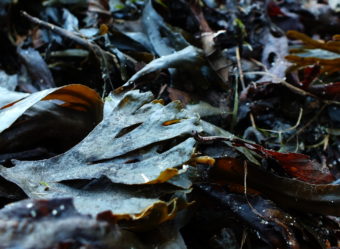
Photo courtesy of UAF Cooperative Extension
This episode of Garden Talk with Bostin Christopher features UAF Cooperative Extension Service agent and Associate Professor Darren Snyder, who discusses making the most of your precious harvest.
As the growing season comes to a close, many gardeners wonder what to do with their bounty. Darren shares insights into proper preparation for successful storage, emphasizing that a bit of planning now can make all the difference.
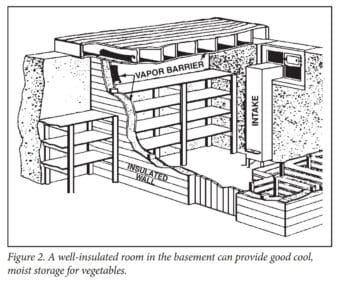
Discover how to preserve your harvest into fresh, crisp and nutritious food that lasts for weeks or even months by replicating a refrigerator’s environment. Learn about the three main concepts for successful cool storage: managing temperature (ideally just above freezing, 32-40°F for many root crops), controlling humidity (often over 90% for most vegetables), and ensuring adequate airflow.
Darren also discusses starting with the best quality produce, strategies like “skinning up” potatoes, and various root cellar options—from modifying a dry crawl space in your home to separate structures or even buried barrels.
On this episode of Garden Talk, host Bostin Christopher talks with Darren Snyder about the various ways to gather, process, and apply seaweed to your fertile garden.
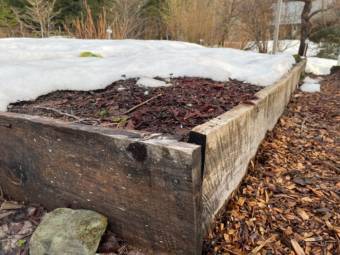
Seaweed and other beach gatherings serve as a mulch in this garden bed featuring recently planted garlic. For empty garden beds, it’s preferable to mix the seaweed into the soil so that it decomposes faster. (Photo by Matt Miller/KTOO)
On this episode of Garden Talk, UAF Cooperative Extension Agent and Associate Professor Darren Snyder discusses the benefits of using seaweed to create a fertile, living garden soil. Snyder shares that seaweed provides essential micronutrients and macronutrients like potassium, which are crucial for plant growth. He offers practical advice on ethically gathering seaweed from shorelines, emphasizing the importance of collecting only detached seaweed. The episode also covers methods for processing and applying seaweed, such as “seaweed tea” or directly incorporating it into the soil as a fall amendment or a protective mulch to enrich the soil and suppress weeds.
For more episodes, visit the Garden Talk page on KTOO, or subscribe in your podcast catcher of choice.
Garden Talk is a production of KTOO. This episode aired first as a live segment on Juneau Afternoon with Bostin Christopher.
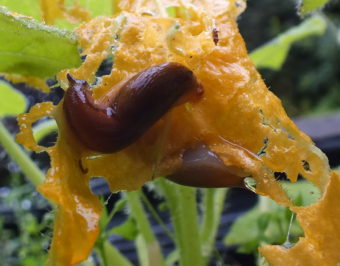
A pair of slugs attack a squash blossom during a break in the summer rains. The devastated flower was removed and both slugs died a horrible death moments after this picture was taken. (Photo by Matt Miller/KTOO)
With all the rain this past week, fear of landslides and flooding has been at the forefront of many minds in Juneau. But what about the gardens? How does one respond to too much water permeating plant roots and garden beds? Master Gardener Ed Buyarski spoke with KTOO’s Chloe Pleznac about potential problems to look for, which plants may be ready to harvest and even shares his anti-slug elixir (it’s ammonia and water).
Listen:
This transcript has been lightly edited for clarity and length.
Chloe Pleznac: With all the rain this week, should gardeners be concerned for their garden beds? I imagine with all the moisture building up, it can destabilize uncovered — and perhaps even covered — gardens.
Ed Buyarski: Yes. And I’ve certainly gotten calls about what do I do? Do I need to pull out my garlic? I’m worried about my potatoes rotting in the ground. Again, this pushes us to go outside to see that our soil is draining well or that we may need to work on digging ditches. That’s assuming that you have a place to drain the water off safely, without draining it onto your neighbor’s property, which gets ugly. But looking at your own, you may need to add some more sand to your garden soil compost mixture. You may need to put up some hoops in plastic to keep things warmer and drier. All that helps.
Chloe Pleznac: Concerning root rot or other symptoms of all of this wetness, what kind of things should gardeners be looking for?
Ed Buyarski: Yes, so certainly just I mean, mold and mildew are always with us. Last summer in July, it was nice and dry. It was wonderful. Things were big, beautiful, healthy. And this year, I mean, rain has beaten down the plants. There’s some of that extra fungus and mold and mildew happening. We need to be aware of that. Depending on the plants, I mean, lettuce does not take this heavy rain very well, though the slugs like it a lot. So what we can do, is raise beds and create raised boxes, that is important for warming our soil and drying out our soil. Again, making sure there’s enough good drainage is good, you don’t have pools out there, or you don’t have your plants in your garden in a low spot in your yard. So again, making some ground higher or if you can move — I mean, literally move — your beds.
Chloe Pleznac: Aside from the weather, it’s now mid-July. What plants are you beginning to harvest in your own garden and for maybe the less experienced gardener — perhaps this is their first year — how can you tell when certain veggies are ready to harvest?
Ed Buyarski: Garlic has several indicators of when it is ready to be harvested, I’ve already harvested our scapes. So, the scapes curl when they first come out and then they uncurl and when the tips are pointing straight up, that’s one indicator that the bulbs are mature enough. I’d also like to see four green leaves still on the top of the plant, the lower leaves will start to turn yellow and or, if we’re lucky dry off or turn brown. But with four green leaves on top. That means there are at least two layers of skin covering the garlic bulb underground, which we want for long-term storage when we carefully dig them up. Don’t pull them up by hand as if your garlic is well anchored, you may break them off at the soil level. Use a garden fork to loosen them. Pull them up gently, brush the soil off, and find a dry, hopefully warm, spot. I’ve used a dehumidifier to help dry out the garlic so that it will store properly for weeks or months or longer. I’ve got one or two bulbs left from last year. With potatoes, looking at the plant again will tell us. Right now, mine are flowering which means little potatoes are forming underground. And because they’ve grown rather well and the rain has hit them, they’ve kind of flopped down on the garden boxes and beds. That’s okay. They’ll keep growing sometimes you’ll get three to four to five-foot-long potato vines. But when the potato vines and leaves start to turn yellow, most likely in September, maybe late August, and maybe even later than that depending on when you planted yours. Or, if we get a frost, the frost will usually kill off the potato plants. And so that is time to know after that to harvest.
Oh! And get out there with the ammonia and water spray and start thinning out the herds of slugs, which are just dancing in the streets or, in this case, the gardens.
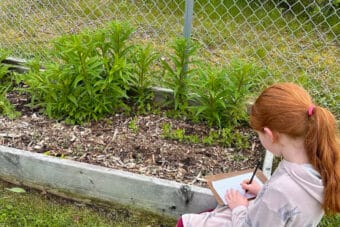
A Discovery Southeast camper creates an observational drawing of the fireweed growing in the garden bed at Kaxdigoowu Héen Elementary School in June 2024. (Photo courtesy of Discovery Southeast)
Joel Bos is a local master gardener who divides his time between his business, working as a naturalist with Discovery Southeast, and serving on the board of directors for Juneau Community Garden.
For this week’s Garden Talk, Bos spoke with KTOO’s Chloe Pleznac about outdoor programs for kids — and about how anyone can get involved in community gardening.
Much of Bos’s work is centered around the Juneau Community Garden in the Mendenhall Valley — work he describes as standing on the shoulders of Juneau’s gardening giants.
“The folks who laid the foundation and are still working on the board and are still maintaining the gardens are just heroes in our community,” he said. “If you haven’t been out to the Montana Creek Road community garden, you should check it out. It’s the closest thing we have to a farm here in town.”
Discovery Southeast campers weeding around potato plants in one of the charity plots at Juneau Community Garden in June 2023. (Photo courtesy of Discovery Southeast)
Bos also works to introduce children to gardening through Discovery Southeast’s free and payment-optional programs.
“They’ll get to explore the gardens, they’ll get to see everything that’s growing, they’ll get to taste, they’ll get to help weed and maintain the plots,” Bos said. “Sometimes they get to harvest and we donate the produce to charity.”
This summer’s camp openings have already filled, but interested youth can get involved through after-school programming this fall or next summer’s camps.
For Bos, watching Discovery Southeast campers get settled and comfortable in these natural settings is rewarding.
Discovery Southeast campers harvesting kale plants to taste and bring home to their families from the Kaxdigoowu Héen Elementary School garden on June 27th, 2024. (Photo courtesy of Discovery Southeast)
“Every once in a while you can get this moment where every kid is working and every kid is quiet and every kid is silently weeding or looking at an insect or just touching a flower pedal,” he said. “It’s just kind of this magical moment.”
You can join the Juneau Community Garden plot waitlist online at juneaucommunitygarden.org. Bos says it usually takes about a year for the waitlist to turn over. You can learn more about Discovery Southeast’s year-round youth outdoor program offerings on their website, discoverysoutheast.org.
Bos suggests that people interested in getting involved with Juneau Community Garden come out for the 29th Harvest Faire on Aug. 24, where they can buy locally grown produce for a good cause, meet other gardeners, and explore the three-acre garden.
Correction: This episode previously gave the wrong date for this year’s Harvest Faire.
Master gardener Ed Buyarski teaching students about pruning. (Darren Snyder/UAF Cooperative Extension Service)
If you’ve listened to Garden Talk before, you’ve heard the term “master gardener.” It’s the title we stick in front of Garden Talk regular Ed Buyarski’s name. This week, KTOO’s Chloe Pleznac decided to finally ask Buyarski just what a master gardener is — and if listeners and readers can become one, too.
This transcript has been lightly edited for length and clarity.
Chloe Pleznac: I’ve heard the term master gardener used both in referring to you and to others within the community. I’m curious if you could explain to me exactly what a master gardener is and how someone can go about becoming one.
Ed Buyarski: Sure. The master gardener program started in Oregon Cooperative Extension Service as a teaching tool, I guess — and also I guess a community service tool. So that here, the Alaska Cooperative Extension Service offers classes every year or every other year depending on demand. And so that’s how people sign up for the classes.
There’s roughly 40 hours of classes and workshops involved, and there is a fee for that. But at least locally, some of the master garden organizations actually offer scholarships for that, for people taking the classes.
There is supposed to be some experience of people who want to become official master gardeners — should have a couple of years of gardening experience beforehand. And then that gives them kind of a foundation or reason to ask more questions about what they’re learning.
And in return, you go through the class and there’s usually a project of some sort — might be a research project or otherwise to do. And folks are also then asked to volunteer back to their communities, 40 hours of community service. And whether that is answering questions from other gardeners who don’t know, What kind of a pest are we looking at? Or, how do I deal with these weeds, or how do I improve my soil — and other things to make their gardens grow better.
So I’ve enjoyed learning — started the first class in Petersburg back in 80s and finished it in the early 90s — took the test, finally, and became a master gardener. I’ve got the pen and had the t-shirt. It’s worn out.
A garden tour held by the Southeast Alaska Master Gardeners Association. (Darren Snyder/UAF Cooperative Extension Service)
Chloe Pleznac: That’s awesome. That sounds like a really interesting process. Do you know off the top of your head who people can reach out to here in Juneau if they want to become involved?
Ed Buyarski: Yes. The Alaska Cooperative Extension Service has an office downtown, and that’s the way — you can look that up online to call. I just helped finish teaching a series of classes this winter and spring. And I know at least our local extension agent, Darren Snyder, usually offers that class every other year and it is both in person and online and virtual. So folks around Southeast and others can participate in the classes.
And then in the alternate years he has more of a, I guess, a beginning gardeners class. A little definitely less formal. And I suppose if folks are interested can go from that one and then sign up for the next master gardener class to follow.
Chloe Pleznac: Is there anything else you want to add about the topic of master gardening or people being interested in that?
Ed Buyarski: Certainly helped educate me. You know, it starts out with basic botany stuff, which I did in college. I’ve got a biology degree, but it has led into lots more, especially, experimental stuff.
I mean, every year is a new experiment, between our weather being different from one year to the other, new varieties of plants — seeds are always available. And so I’m always trying new stuff and learning truly from other people.
And if I go to somebody’s garden to visit, seeing them growing something I haven’t or haven’t thought of. Seeing, “Wow, you’ve got a new pest that I haven’t seen before.” So we need to identify this because things are coming in, pests and diseases are coming in, unfortunately, with plants we import from down south.
So it’s really a great program to help local gardeners.
To find out more about becoming a Southeast Alaska Master Gardener you can email Juneau District Agriculture/Horticulture Agent, Darren Snyder at darren.snyder@alaska.edu.
Disclosure: Darren Snyder is married to Cheryl Snyder, KTOO’s Vice President & General Manager, Music & Arts.
Close
Update notification options
Subscribe to notifications
Subscribe
Get notifications about news related to the topics you care about. You can unsubscribe anytime.