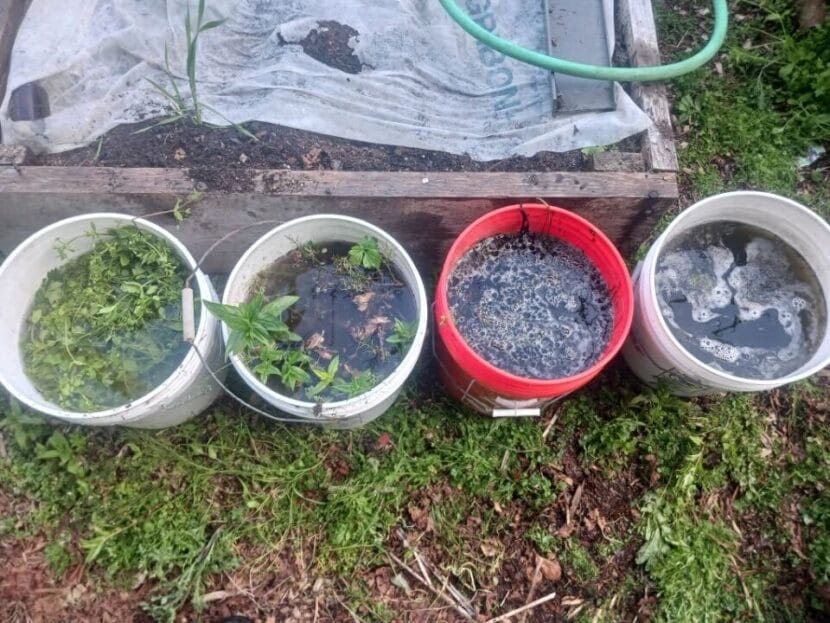
Fresh weeds (left to right: horsetail, buttercup and chickweed) that have been soaked for two weeks. Buyarski says this makes a smelly, brown soup that can be diluted and used to feed plants. (Ed Buyarski)
Yesterday was Summer Solstice. In Alaska, it can feel like a relief to begin losing daylight again — especially for this Morning Edition host, who’s been struggling to get enough sleep. But the solstice also marks an important milestone in the growing season.
This week, I spoke with Master Gardener Ed Buyarski about things to consider in your gardens as we head into July.
Listen:
When asked what he’s been up to in his own garden, Buyarski said, “Oh, pulling weeds, pulling weeds, and pulling some more weeds…”
But Buyarski says those weeds can be useful, post-plucking.
“Take those weeds, put them in a bucket with water, throw in a handful of seaweed, and let them ferment for two weeks so you get this brown, nasty, slimy stuff,” he said. “Take that out, dilute it about five-to-one, and use that to fertilize the plants that we want to grow.”
That liquid fertilizer can be a great way to keep your plants hydrated, as high summer temperatures dry out the earth. Buyarski said that’s especially important for plants in containers.
“You can almost watch them wilt if they are not being watered again and again on these warm, sunny days,” he said.
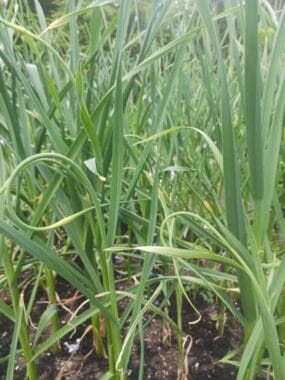
It’s almost time to harvest garlic scapes. (Ed Buyarski)
If you’ve already started harvesting from your garden or just finally found the free time to start thinking about getting something in the ground, Buyarski says it’s not too late.
“We can plant some more broccoli now for later harvest,” he said. “Kale can be planted anytime, and seeds from the mustard family. I did reseed a patch of carrots. The soil is nice and warm, so things are going to sprout quickly, along with the weeds.”
And he says it’s almost time to harvest garlic scapes.
“You can use them just like green onions, but with a garlic flavor for everything from pickling and stir-frying and making pesto,” he said.
Finally, keep your eyes peeled for a full strawberry moon Friday night. It might just break through the clouds.
Companion planting at Tidal Wood Food and Forage in Juneau. (Joel Bos)
Companion planting is a technique gardeners can use to increase their yield, boost soil fertility, and reduce weeds and pests. For this week’s Garden Talk, Joel Bos of Tidal Wood Food and Forage shared his companion planting techniques.
Listen:
This transcript has been lightly edited for clarity and length.
Chloe Pleznac: Let’s talk about companion planting. I first learned about this concept when reading the book Braiding Sweetgrass, by Robin Wall Kimmerer. She talks about the “Three Sisters,” which are beans, squash, and corn. Could you give me some examples of companion planting combinations or techniques that you’ve utilized?
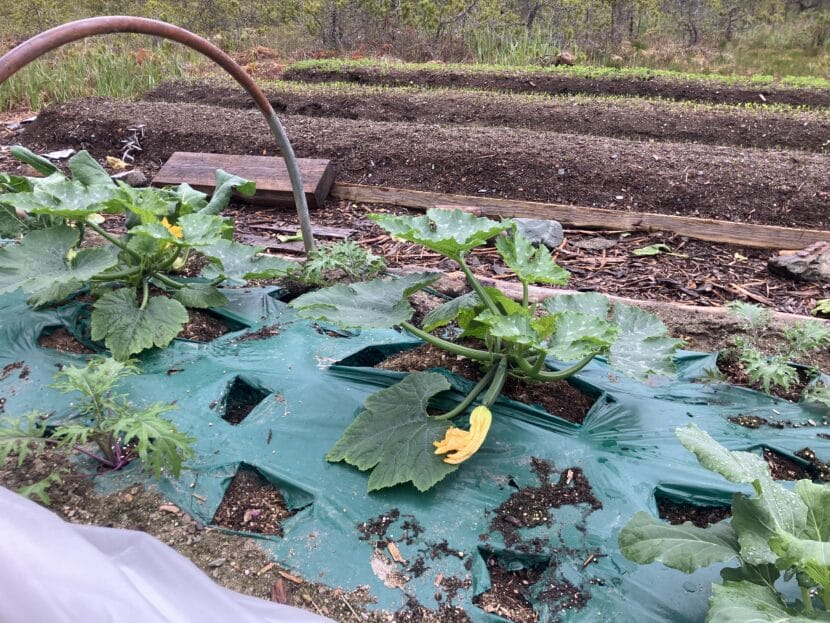
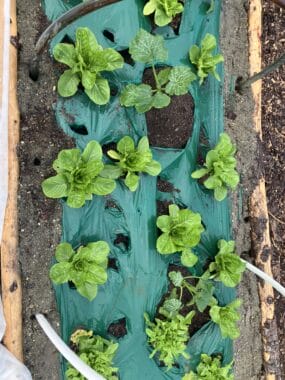
Russian kale planted on either side of zucchini plants. (Joel Bos)
Joel Bos: I use zucchini very often in my gardens, and I make mini hoop houses about three and four feet tall to shield them from some of the rain in the colder weather that we have here in Juneau. I like to grow them with brassica family plants or fast-growing plants like lettuce. And then, because the zucchini will just fill in a whole four-foot-wide bed, each planet, you can plant faster-growing plants on the outside and still be able to crop those before the zucchini spreads in and takes over. So for the home gardener, it’s a great way to utilize a small space and get maximum yield.
The techniques I use to warm up the squash — because squash and zucchini really like warm weather — is to keep the soil dry, which is done in a number of ways. One, you could make a raised bed. I’ll cover it with a green plastic mulch or another name for it is IRT. It’s just a plastic film that allows a lot of warmth through the sun but reflects the wavelengths that weeds need to grow.
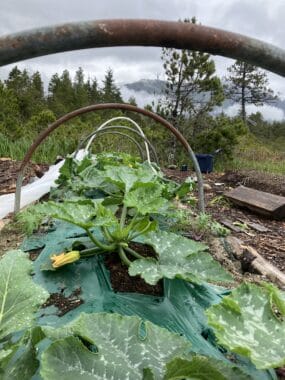
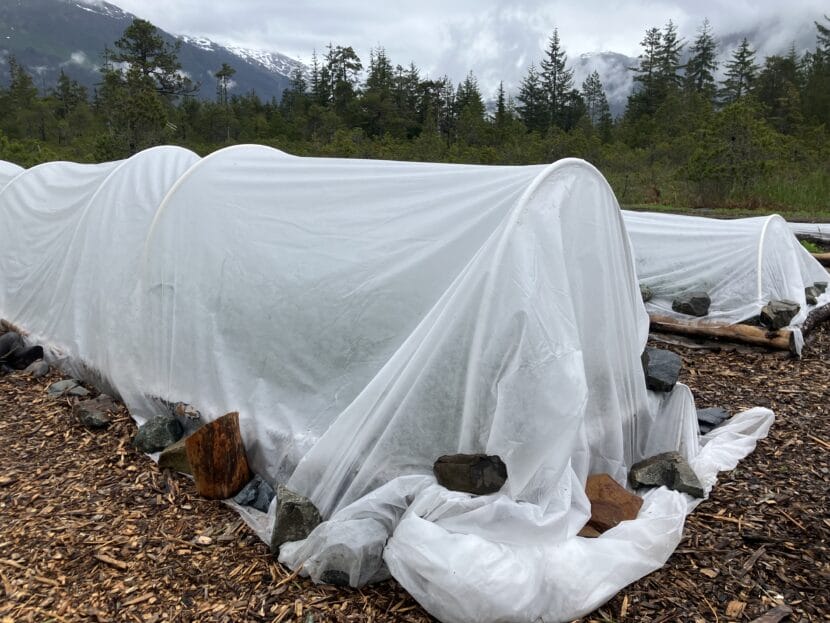
This can do two things for you — slow down the weeds and warm your soil and keep it drier. Over top of that, I’ll make it a hoop house, sometimes out of bent metal conduit or sometimes out of PVC pipes, and then over top of that add what we call row cover, which is kind of like a white fleece, over the top of that.
That’ll do two things. One, it’ll warm it a little bit. It’ll shed some of the rain off but allow some through, and it also keeps the insects from coming into your brassica family plants, like your cabbage and your kale. Then maybe later on in June or July, I’ll take the cover off and crop all the brassica family plants and let the squash really fill in.
A hoop house covered up to keep out root maggots flies from laying eggs in the brassica family plants like kale, cabbage kohlrabi and bok choy. (Joel Bos)
Chloe Pleznac: When you’re sowing these starts, how close are you planting them together? Is there a general rule of thumb that you use?
Joel Bos: On my farm some of the stuff I do is in 30-inch-wide beds because there’s a lot of good tools that work at that width. But when I’m making these hoop houses and growing zucchini, I prefer a four-foot-wide bed. You can do one zucchini every three feet along that right down the middle, and then you can do a row on each side of it, about 12 inches apart, sometimes eight, depending on what plant you’re planting. Some of the lettuces can get closer. Certain kinds of bok choy can grow closer together, too. If you’re trying to do a fast-growing cabbage you may want to give them a foot.
If you’re doing a big red Russian kale, you may want to give those every 18 inches. It gives you a decent crop. I’ve already cropped bok choy back in May that I started indoors, and I’ve replanted another row. I just added some compost and it kept growing, so now that’ll be cropped in late June, and the zucchini went in, with this cold May, only about seven to 10 days ago, and it’s starting to take off.
In last week’s Garden Talk, Michalsen talked about some of the basic principles of respectful harvesting. This week, she talks about some of her favorite books and resources — but also why it’s important to learn directly from experts.
“Plants can teach us a lot,” she said. “We can look at plants as our relatives and our family. And when we look at things that way, it helps us when we think about how we want to treat this area or these plants.”
Michalsen said caring for the plants you harvest is important. That could mean cleaning the areas around them or being an advocate or steward for the land. For Michalsen, gratitude plays an important role.
“Always just, you know, leaving a gift for the plants. Some people also leave a strand of hair, they might leave some tobacco, they might leave a gift or a song or say thanks,” she said. “But part of that is just being present in the moment and being aware of your surroundings and appreciative of everything that we have.”
But Michalsen stresses that going out with an expert is crucial to staying safe and learning to properly identify plants.
“If we’re only relying on the internet or books, we can get ourselves into trouble,” she said. “We might be missing a lot of what the messages and the teachings are of each of these plants.”
A free, printable version of the Respectful Harvesting Guidelines is available on the University of Alaska Fairbanks website. Michalsen acknowledged the other contributors to the project: Trixie Bennett of Ketchikan, Louise Brady of Sitka, Eva Burk of Nenana, Tia Holley of Soldotna, Gloria Simeon of Bethel, and Disney Williams of Juneau.
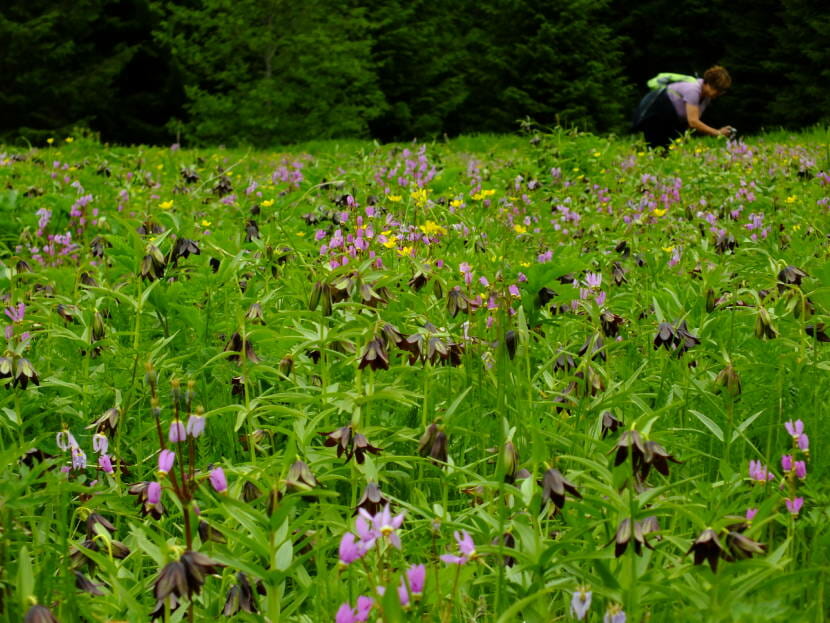
A meadow off Sawmill Creek near Berners Bay. (Photo by Matt Miller/KTOO)
As part of the Kayaani Sisters Council, Naomi Michalsen helped develop a free guide for people who want to learn about how to sustainably and respectfully gather local plants. For this week’s Garden Talk, Michalsen shared some reflections on the practice of respectful harvesting.
“I didn’t really grow up talking about respectful harvesting. We didn’t say, ‘Hey, let’s go out and harvest respectfully!’” she said. “In today’s world, it seems like things are changing so quickly, that it is how we’re talking, and it is how we’re going out.”
She said that starts with building an understanding of the history and culture of the Indigenous people who have stewarded the land where you want to gather plants.
“Starting with our young kids, to kind of start with that idea that before we even go out to harvest — who are the people that live in the land that we’re harvesting? Build a deeper understanding and connection to the people on whose lands you are harvesting,” she said.
Michalsen said people should also feel spiritually prepared before they go out.
“Some people say a blessing or a song — a prayer. They might meditate, they might talk or sing to the plant. They might announce to the ancestors that they’re there,” she said. “Some people even said that their grandmother told stories the night before about the plant that they were going to harvest, and they would dream about this plant.”
Michalsen also emphasized that language is a powerful vessel for expressing gratitude and respect. She explained that learning and using the traditional names of plants is a great way to practice.
“I have a friend in Juneau, George Holly, he’s been working with a lot of the young children, and they’re creating songs around the plants and the environment around them. So it’s okay to create songs as well,” she said.
And she said it’s important to acknowledge one’s teachers.
“For example, Holly Churchill was one of my teachers when I learned how to gather cedar bark. So I always acknowledge that. Rita Blumenstein was one of my teachers around the plants, and so I acknowledge her as one of my teachers,” she said. “So, always acknowledging the people of the land, people that were your teachers — and I always would even gather for them as well, especially when they became older.”
A free, printable version of the Respectful Harvesting Guidelines is available on the University of Alaska Fairbanks website. Come back next week for more from this conversation.
Correction: An earlier version of this post misspelled Michalsen’s last name.
Green things have been sprouting up all over Juneau in the past month and a half. Along with the warmer weather comes a burst of color and life at the Jensen-Olson Arboretum.
Ginger Hudson, the arboretum’s manager, recently spoke with KTOO’s Garden Talk about what the arboretum has planned for Memorial Day weekend.
On Saturday, the arboretum will celebrate both National Public Gardens Day and their own Primula Day. There will be a plant sale starting at 10 a.m. and a guided tour of the garden with members of the American Primrose Society beginning at 11 a.m.
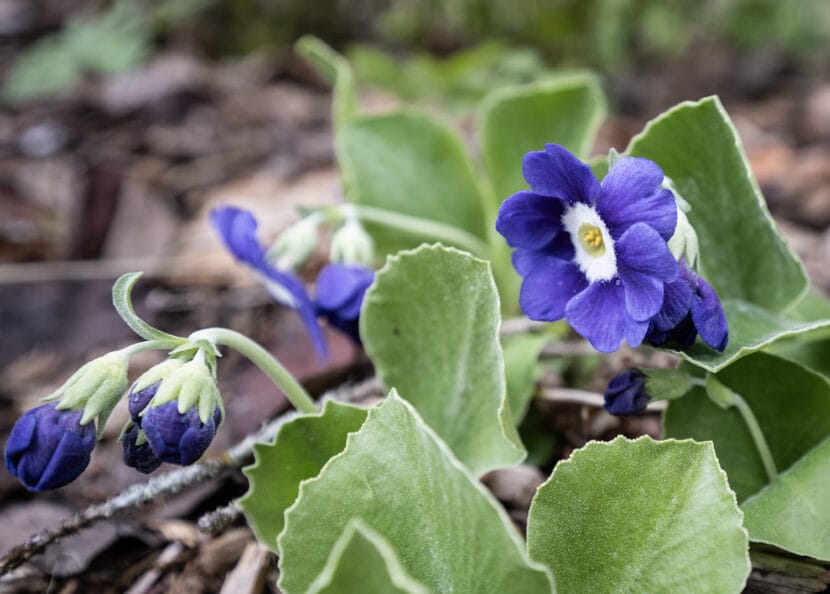
Primula auricula, sometimes called bear’s ears primrose. (Jensen-Olson Arboretum)
Hudson says Public Gardens Day is a recognition of gardens across the country, which she says are like “plant museums” where visitors can explore unique collections. “It’s important to preserve these lands that are unique or special or have special plant collections. Some may have plants on them that are not found anywhere else in the world. And just to let folks know, ‘Look, this is another place you can come and relax or get ideas for your own garden.’” Hudson said.
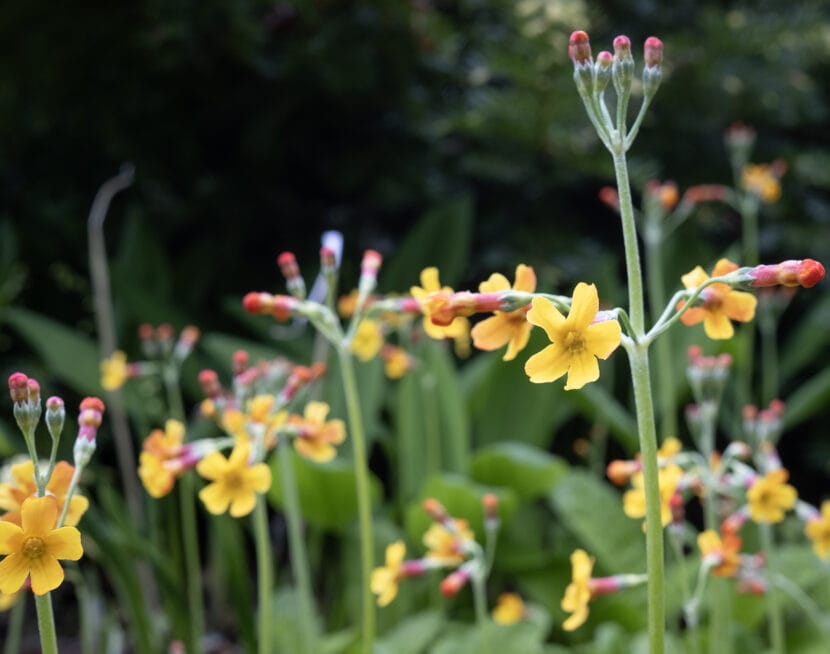
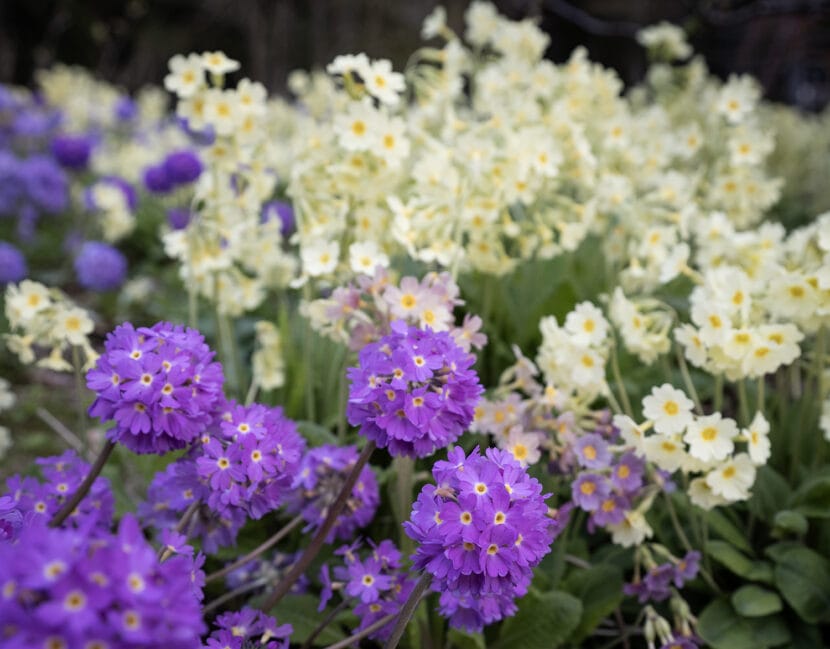
The arboretum’s Primula Day is dedicated to the genus Primula, or primroses. Husdon says the arboretum cares for more than 170 varieties, including some that are considered threatened.
“We’re really excited about that because they grow really well here,” she said.
Hudson said that Caroline Jensen, who donated the arboretum property, loved primroses.
“The previous manager developed her collection into a larger collection for the accreditation acknowledgment — that puts us on the national and international stage. So we collect seeds and plants from all over when we can,” she said.
Visitors can buy their own Primulas from the arboretum during the plant sale. But for people who can’t grow them at home, Hudson says the gardens at the arboretum remain an accessible resource for everyone to enjoy and appreciate nature’s beauty.
“That’s why we have public gardens! If you don’t have a garden at home but you like gardens, well, you need to just come in and hang out here!” she said.
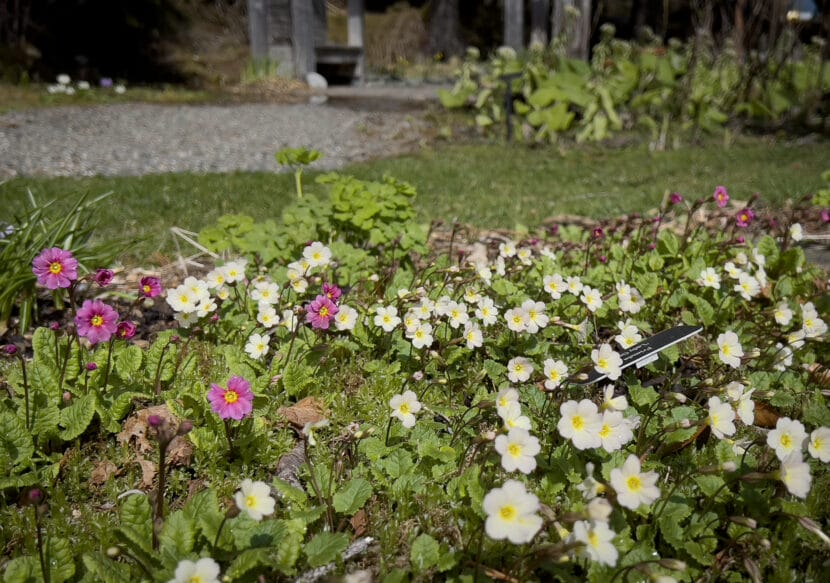
Primula ‘Lady Greer.’ (Jensen-Olson Arboretum)
The Jensen-Olson Arboretum is currently open to the public from 9 a.m. to 5 p.m., Wednesday through Sunday. Admission is free, although donations are always welcome. You can find a full list of the arboretum’s future events online at friendsjoarboretum.org/events.
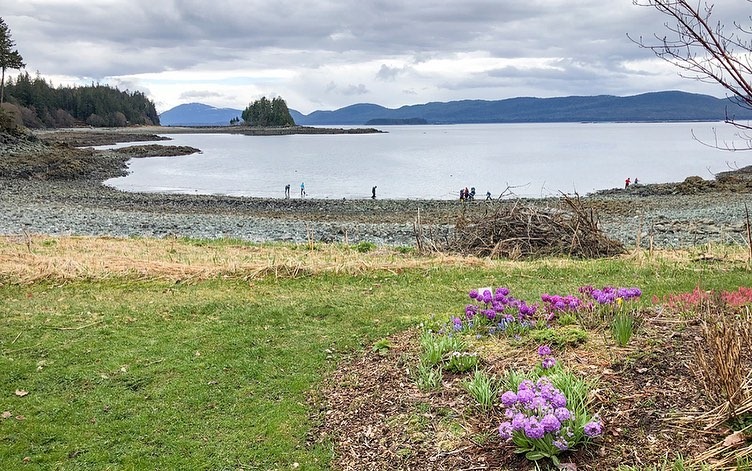
The view from Jensen-Olson Arboretum in Juneau. (Photo courtesy of the Jensen-Olson Arboretum).
Spring is in bloom at Juneau’s Jensen-Olson Arboretum.
Ginger Hudson manages the arboretum, a city-owned garden located out the road just pass the Shrine of St. Therese. She spoke with KTOO’s Garden Talk about spring planting and upcoming events at the arboretum for Alaska Native Plant Month.
“In the Lower 48, Native Plant Month is in April,” Hudson said. “And as everybody knows, our gardens are still waking up.”
Alaska Native Plant Month takes place in May and was established last year to recognize the importance of native species and encourage Alaskans to plant them in their gardens.
On Sunday, the arboretum will host a free native plant walk at 11 a.m. that anyone can join.
The arboretum is home to a nationally-accredited primrose collection. There are more than 170 varieties of primroses on the property today. Hudson says they’re in prime bloom at the moment, so now is the time to see them.
“If you can make it out earlier, the primroses are in prime spectacular color right now,” she said. “But they do bloom from April until frost. There is always some kind of primula growing.”
You can also stop by next Saturday for Public Gardens Day and Primula Day, when the garden will hold a plant sale and host tours.
Hudson also shared recommendations for native plants to grow in local gardens, including flowering and fruit-producing varieties.