Gardentalk

Garden Talk: Good pruning technique can help your trees and bushes reach their potential

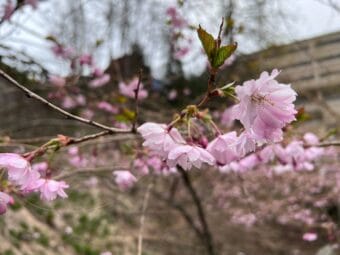
A cherry tree in blossom by the stairs behind Fireweed Place in Juneau on April 24, 2024. Buyarski says the cherry trees downtown are “severely, really thick,” and that pruning would help a lot. (Will Mader/KTOO)

If you’ve taken a walk outside in Juneau lately, you’ve probably noticed the smell of growing things. Maybe you’ve also noticed the budding and blooming trees and bushes.

Master Gardener Ed Buyarski says proper pruning techniques can help your trees reach their full potential. He says to start with some basic rules.

“First, take out any deadwood. The deadwood doesn’t do the tree any good,” he said. “This winter, with some of the heavy snow we had, there’s been a lot of broken branches. So trim those off neat and clean.”

He says that for apple and cherry trees, the goal is to create a “slightly open center,” without branches rubbing each other.

“We want to open the tree enough so the sun gets through to the flowers and the fruit and the leaves,” he said. “They even talk about, well, “A robin should be able to fly through your tree without hitting its wings.”

He also says that it’s important not to prune too much in the spring because that will only lead to more pruning.

“So you don’t want to take too much off. They say 20% maybe, at most,” he said. “If you stimulate too much new growth, that means you have to do more pruning. It’s kind of a vicious circle, this time of year.”

He says that’s not true for pruning later in the year, though.

“There’s actually a time from mid-June to mid-July for pruning, which is going to slow down the growth,” he said. “Because most of the energy in the tree is up in the branches and trunk.”

Buyarski says not to leave stubs, not to seal your pruning cuts with paint or anything rubbery, and not to fill cracks in the trunk.

“That is not beneficial,” he said. “But cleaning tools in between, especially moving from tree to tree, if you have a little container with some 10% bleach solution, you can dip your pruning tools into that or paint them with it so that you’re not transferring diseases from one tree to another.”

Buyarski also emphasized the importance of using clean and sharp tools, fertilizing the trees, and reducing competition from weeds and grass around the roots.

Garden Talk: Transplanting starts and seeding potatoes

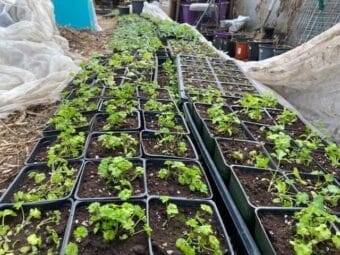
Parsley and flower starts in the process of being hardened off on April 22, 2024. (Photo courtesy of Christina Castellanos/Snowshoe Hollow Farm)

With all of this spring sunshine warming the earth, Master Gardener Ed Buyarski says it’s time to think about starting seeds and transplanting. But before you put your seedlings in the ground, you’ll have to get them ready.
“Hardening them off is slowly getting them used to outdoor conditions,” he said.

Buyarski says it’s best to start taking your seedlings outside when it’s cloudy – or at least put them in the shade.

“And only doing this for a short time like an hour the first day and then two hours tomorrow and then three or four hours the next day,” he said. “You’re gradually getting them used to longer time periods outdoors.”

Once you’re ready to put them in the ground, Buyarski says you can use a horticultural fabric like Reemay or Agribon to help your transplants prosper.

“It provides a little bit of shade, a little bit of frost protection, and holds a few degrees of heat,” he said. “But the rainwater can still go through, the air goes through, some light goes through.”

And as far as seed potatoes go? It may not be as simple as grabbing your winter root cellar rejects, unless you grew those yourself.

“I do not recommend using regular eating potatoes from the grocery store for that purpose,” he said. “Eating potatoes do not have the same inspections for diseases and stuff.”

Buyarski said that if you don’t have your own, you should try to buy certified seed potatoes instead.

Garden Talk: Why silverweed is ‘a beloved plant all throughout the Pacific Northwest’

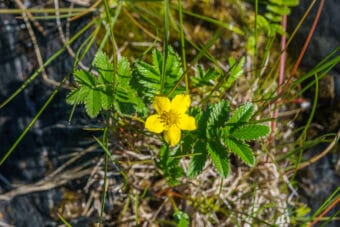
Silverweed in bloom. (Courtesy of Khalil English)

For this week’s Garden Talk, KTOO’s Chloe Pleznac spoke with Khalil English about his research on silverweed, a seemingly inconspicuous plant with deep roots in Pacific Northwest history. English spoke about silverweed’s importance as a food source across the North — and about where it grows in Juneau.
Listen:

This transcript has been lightly edited for clarity and length.

Khalil English: Silverweed first came into my life, I believe, through a book that I got from Professor Daniel Monteith called Haa Atxaayí Haa Kusteeyíx Sitee. It means, “Our food is our Lingít way of life.” And there are some plant foods in there that I had never heard of before, and one of them was tséit or silverweed. And that kind of just grew into something huge. I looked into some of the Lingít uses and how it’s harvested here, and then found, oh my gosh, it’s a beloved plant all throughout the Pacific Northwest and even circumboreal. It’s all around the North, and even in Europe, in Scotland, and Norway, etc. People have loved silverweed. So it ended up becoming a little bit of a self-history search, as well. 

Chloe Pleznac: Can you tell me a little bit more about what some of those traditional uses are and how this plant fits into the history of all the indigenous cultures along the Pacific Northwest Coast? And even the circumpolar north, as you were saying.

Khalil English: A lot of the information that I have been able to learn comes from the Kwakwa̱ka̱ʼwakw, which are just the northern tip of Vancouver Island and a little bit on the mainland. And that’s where the temperate rainforest, it’s just non-stop, summer and winter rain. So we have these huge estuarine river systems, and people would bioengineer the salt marsh. So according to sources from the Kwakwa̱ka̱ʼwakw, there was not a single patch of saltmarsh that wasn’t owned and tended by someone. So it was a very intensively managed crop. There was a lot of food that people got from it. It was very important ceremonially, there was actually a taboo, at least in this area, for not eating the silverweed until, I think it was at least, around December, which has a little bit to do with getting the roots to taste sweeter. And then as far as Scotland, there’s sadly not as much information, but there is still a lot of love. In some of the few stories I could find. There was a little Gaelic phrase that I learned that I’ll share that kind of highlights some of the feelings around it. And it’s, brisgean beannaichte an Earraich, seachdamh aran a’ Ghàidheil. It means “blessed silverweed of spring, seventh bread of Gales.” And so along with millet and rye and wheat, silverweed was very important. And so people, when they were given their allotments for fishing, etc, silverweed patches were a part of that, at least in Scotland. And then when the potato famine happened, people actually returned to eating silverweed.

Chloe Pleznac: Do you know why it kind of has become a little disenfranchised? Why is it not known as well as these other food sources? 

Khalil English: I think it depends on where we’re looking. So, for silverweed in the British Isles, from what I’ve garnered, it’s the fact that it was mostly a food that poor people ate. That’s why it wasn’t recorded so much. When we’re looking at the Pacific Northwest, then we’re dealing with a little bit more of that kind of direct intention to remove people from their food and remove people from the land. So of course, where silverweed grows, is the easiest land to develop. It’s the easiest land to put cows on. And so people were removed from their silverweed fields. There’s quite a few disheartening stories of people kind of giving up on those fields and walking away.

Chloe Pleznac: Where can people in Juneau typically find silverweed and respectfully harvest it? 

Khalil English: Silverweed is abundant. There are actually quite a few subspecies of silverweed. So Pacific silverweed is what I’ve mostly been focusing on. They have the biggest roots and they’re going to be mostly along the oceanside. But even for folks in interior Alaska, or I don’t know, in Utah, there is still silverweed. It prefers more salty grounds. So for us, that’s right on the oceanside, could be at the edge of some lake, down further South. More direct places in Juneau might be Fish Creek. The Mendenhall Wetlands would be the most ideal spot, but of course, I don’t know how safe it is to eat anything out of there given the airport and the waste management system. But pretty much anywhere. Like Sandy Beach, all the edges are covered in silverweed. Any beach, right under that beach rye, that really grayish blue grass that is very thick? Silverweed is right there.

Chloe Pleznac: What time of year is the best time to keep an eye out for this? You were saying culturally, there’s a bit of connection at different times of the year for harvesting, perhaps?

Khalil English: For our area, what I’ve read is mostly people would harvest in the spring. And then what I’ve read for down in Vancouver, people mostly harvested in the fall. But I think it’s a little interchangeable. What they’re going for is once the plant starts growing actively, once you can see anything above ground, the roots are very, very astringent. They become really bitter. There’s a lot of tannins. So, when you harvest either at the very beginning of spring or in the fall, those tannins have reduced a lot. Then when you dry them and store them cold, the tannin content is further reduced. So, in wintertime, you got to kind of familiarize yourself with habitat, and then you can go and look for their dried leaves. They persist pretty well and are easy to recognize. And then you just dig in. 

One last thing I’ll share, and this was a little more of my focus, is something I’ve loved about silverweed, is it really highlights the relationship that people can and have for many thousands of years had with the earth. I think, too often when we’re talking about environmental topics, it becomes really depressing, and we kind of demonize ourselves. But, to me, this really highlights like, oh, we have a place we also are attending the earth as well. And by tending these wild systems, they can become more productive. We can take advantage of it and so can the rest of the wildlife. But in today’s world, of course, it’s a little harder to go out and say start bioengineering our salt marsh here. So, people can bring them into their gardens. They’re very adaptable.

Garden Talk: It’s time to get your garden — and yourself — ready for the growing season

Flowers bloom in the Rainbow Foods garden in Downtown Juneau on April 3, 2024. (Photo by Chloe Pleznac/KTOO)

With the spring equinox behind us and a stretch of sunny, warm days over the last few weeks, it feels like spring has arrived full-force in Juneau. Trees are budding, birds are singing, and things are starting to stir in the earth. 

Master Gardener Ed Buyarski says it’s time to start doing the garden prep that will set you up for success later in the season.

“It’s a time for cleanup in the garden, if we didn’t do cleanup last fall,” he said. “Getting all the old cabbage and broccoli plants out of there, and other slimy stuff. Removing slug habitat is a good start. Greenhouse clean up, tidying up. And, if folks are like me — we had a greenhouse collapse this winter — getting that new greenhouse on order or rebuilt.”

Buyarski also suggests that gardeners should get their own bodies ready for the physicality of the growing season. 

“One thing for me that I have found helpful as I have become rather mature is getting in ‘garden shape,” he said. “That’s doing some stretching exercises each day. Getting the shoulders exercised, stretching out the back and the legs and all of the rest of that.”

And as far as our recent weather? Buyarski says to pay attention to warmer days for opportunities to start the growing season off on a good foot.  

“A gradual warm up is good. That’s what we want. Waking up soil microorganisms if we’re mixing in some compost and some organic fertilizers and making sure to have your garden beds covered with clear plastic right now so the soil can warm up,” he said.. “We’re trying to encourage everything to grow better, whether the clear plastic is directly on the soil, or we have hoops with clear plastic over them, little mini greenhouses — all of that will help.”

If you have questions or ideas for future Garden Talk features, please email chloe.pleznac@ktoo.org or leave a message at (907) 463-6492.

Garden Talk: Planting dreams of spring

Daffodils bloom in a North Douglas flower bed lined with seaweed mulch.
Daffodils bloom in a North Douglas flower bed lined with seaweed mulch. (Photo by Matt Miller/KTOO)

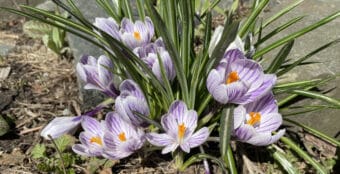
Now is the time to get flower bulbs in the ground before it freezes. For an impressive display of blooms in the spring, plant a lot of them.

Master Gardener Ed Buyarski recommends planting flower bulbs such as crocuses, daffodils, and tulips in a location with good drainage. They don’t need to be in full sun all year long, just in the spring.

“So we can plant them at the edge underneath deciduous trees, which will leaf out in late May and June,” Buyarski says.

Buyarski plants bulbs by the bucketful in the fall. He digs large six-inch deep holes or trenches that wind around his raised beds, scratches in fertilizer, and places bulbs in groups of five to ten. “The mantra is pointy-end up,” he says.

Buyarski suggests packing them in and planning for just one season of blooms.

“With tulips, we’re often treating them like annuals, just because the second year they don’t come back very well. And the third year just leaves.” he says. “You can plant them just about touching, four- or five-hundred bulbs, a spectacular show of color.”

Bulbs
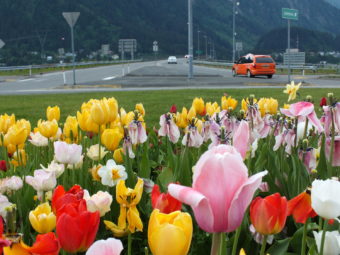
Bulbs bloom in the middle of the Douglas roundabout earlier this spring. (Photo by Matt Miller/KTOO)

If the goal is a spring cutting garden, productivity of bulbs can be extended by strategically planting mid-season and late-season blooming daffodils and tulips varieties in the fall.

“You can have six weeks of cut flowers from that little patch of ground in front of your house.” Buyarski says.

After the daffodil and tulip bulbs are in the ground, he covers them up halfway. “So now you’ve got a three-inch-deep hole,” he says. “You can plant some short bulbs, like crocus and snowdrops and Blue Scylla.”

Although spring is half a year away, planting bulbs now is not only easier before the ground freezes, it also gives gardeners something to look forward to.

“You know, at this time we’re dreaming. We’re hoping and we’re planning all this stuff for six months from now.” Buyarski says. “And you know, we gardeners are an optimistic bunch.”

Garden Talk: The hunt for winter chanterelles

Dave Gregovich, Wildlife Habitat Analyst for ADF&G and local mushroom enthusiast (photo by Sheli DeLaney/KTOO)

Dave Gregovich, Wildlife Habitat Analyst for the Department of Fish and Game, is a mushroom enthusiast on the hunt for winter chanterelles. He starts the search in a forest near the North Douglas highway, and looks for areas with hemlock trees and blueberries.

“It’s not a super specialized mushroom,” Gregovich said. “In most places where you have old growth forest, you have at least a few winter chanterelles.”

Edible mushrooms found in Southeast Alaska can be foraged throughout the fall and into early winter, but winter chanterelles have very distinct characteristics that make them especially easy to identify, especially for beginners.

Winter chanterelles (right) have ridges under the cap, rather than the sharp gills found on other mushroom species (left) (photo by Sheli DeLaney/KTOO)

“A lot of mushrooms have these really sharp blade-like gills on the underside of the cap. But winter chanterelles have these kind of ridges on the bottom of the cap.” Gregovich said. “And they are shaped like a funnel. They’ve got a hole in the top, and it funnels down to a hollow stem.”

Winter chanterelles are small, so it takes quite a few for a meal. And their texture can be pretty wet when you bring them home. But they are really good to eat, Gregovich said.

Winter chanterelles have a funnel-shaped cap, with a hole in the center and hollow stem (photo by Sheli DeLaney/KTOO)

“What I like to do is put them under a fan for an hour or so, no heat,” he said. “And the other thing you can do is you can dry-sauté them. Before you add any oil or butter, put them in the pan just dry and let some of the water kind of evaporate from the mushrooms.”

In the temperate rainforest of Southeast Alaska, mushrooms almost always have plenty of moisture and good growing conditions in their environment.

“But one thing that is the case, you really don’t see most of these mushrooms until kind of the start of August, mid-August, and then they really start to pop.” Gregovich said. “A couple of species, including the winter chanterelle, can be around in November or even December.”

There are hundreds of species of mushrooms around Juneau. But Gregovich advises the average forager stick to the four that are easiest to identify: winter chanterelles, golden chanterelles, porcinis (aka King boletes), and chicken-of-the-woods.

“So you can just stick with those four kinds, and you can get out and find something that’s easy to identify and good to eat,” he said.

Site notifications
Update notification options
Subscribe to notifications