Gardentalk

Garden Talk: Thinning carrots and planting more peas

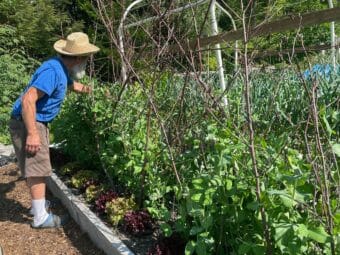
Pea plants with alder bough trellis (photo by Sheli DeLaney/KTOO)

Peas planted this spring are ready to be picked, but it’s not too late to start a second crop. And carrots due for harvest this fall likely need some thinning. With both plants, the shoots, tips and leaves are edible and delicious in salads and sauces.
Master gardener Ed Buyarski’s crop of peas was planted outdoors from seed in early May, then covered with agricultural fabric to protect the sprouts.

“We’re standing in front of my pea patch with all these alder sticks coming up out of it, which are my low-budget pea trellis,” he said. “The peas are blooming and very quickly. In fact, I noticed there are some little tiny peas I’m looking forward to eating.”

Buyarksi prefers the varieties with edible pods, like snow peas or snap peas.

“In my youth I planted and harvested and shelled peas, which is tedious,” he said. “Tasty, but tedious.”

Ed Buyarski holds out a pea shoot with pods and flowers (photo by Sheli DeLaney/KTOO)

In addition to the pea pods, the shoots, tips, leaves and even flowers can be eaten.

“Of course if you eat the flowers, you don’t get peas,” Buyarski said.

Peas are cold-hardy and can be planted even as late as mid-July for a fall harvest. Which is just in time for the carrots to come out of the ground.

“Our regular harvest for carrots for storage is usually after the first frost, so late September, October. I’ve harvested them into November,” he said. “It’s best to do it before the ground freezes because it’s a lot more convenient that way to get the carrots out of the ground.”

Garden box with carrots, ready for a mid-summer thinning. The carrots need a few more months but their tops are edible now. (Photo by Sheli DeLaney/KTOO)

Buyarksi recommends direct-sowing carrots in late April if conditions allow, then covering the bed with plastic sheeting over hoops while the weather warms up. They will need to be thinned to about an inch apart as they grow.

Whatever gets pulled while thinning carrots can be set aside for salads and sauces. As with peas, the leaves and shoots of carrot plants are edible, too.

When Buyarski finds himself short on basil or other greens, he’ll chop up carrot tops, pea shoots or kale to make pesto and chimichurri. He says that every batch is different.

Garden Talk: Botrytis in the soil can take a toll on garlic harvests

Ed Buyarksi points out a garlic plant infected with botrytis. (Photo by Sheli DeLaney/KTOO)

Starting now through mid-August, garlic plants will be ready to harvest. But master gardener Ed Buyarski says gardeners should look out for botrytis, a fungus disease that can spread throughout crops.
“It’s mostly in the soil already, assuming that we’ve been gardening for a while — or even in the wild soil.” he said.

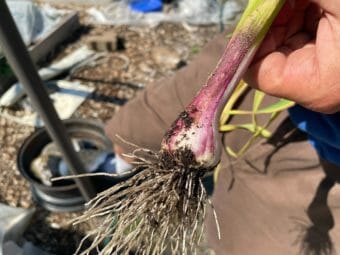
Buyarski pulled a garlic plant that was showing signs rot due to botrytis and pointed out pinkish-red streaks running down the base of the stalk to the bulb.

“Not a good thing this time of year,” he said.

A garlic bulb with the telltale red streaks of a botrytis infection on the skin. (Photo by Sheli DeLaney/KTOO)

Buyarski said each leaf of the garlic plant’s stalk corresponds to a layer of protective skin over the bulb.

“If they’re rotting, they don’t protect it,” he said.

He peeled away layers of red-streaked skins from the stalk to reveal the bulb and its cloves. Those are healthy and can be eaten fresh, but they are too small to be saved for curing.

A garlic bulb with botrytis-infected skins peeled away. (Photo by Sheli DeLaney/KTOO)

Botrytis is very common and attacks plants when conditions are right, such as too much moisture or not enough air circulation. Buyarski said that having good drainage and air flow in beds and greenhouses will help reduce the fungus, and that gardeners should set aside affected plants to prevent more contamination.

“When I am harvesting the garlic a month from now, six weeks from now, I will sort out any of these that I am suspicious of, if I see that red streak going down into the bulb,” he said.

Email Sheli Delaney if you have questions for Garden Talk.

Garden Talk: How to harvest garlic scapes, and some things you can do with them

Outdoor garden beds with full grown garlic plants. (Photo by Sheli DeLaney/KTOO)

Garlic bulbs planted last fall are now full grown and producing scapes. In this week’s episode of Garden Talk, Ed Buyarski talks about what they are and how to use them.

“This garlic in front of us was planted last September or October — covered it over with plastic for the winter and rested till it starts to grow roots, just like tulips and daffodils do in the fall.” Buyarski said. “So they’ve grown almost to their maximum height.”

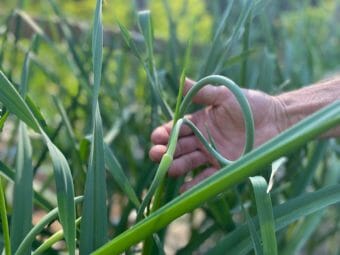
At this point they have formed scapes, which Buyarski says are “weird-looking curly growth out of the center of the plant.”

Beginner gardeners often have questions about what to do with the strange-looking, coiled scapes. If they’re not harvested, scapes will straighten and grow up to five feet tall. Eventually they’ll form rice-sized baubles that could potentially be used to reproduce the plant, in a few years’ time. 

Close-up of a garlic scape growing from the center of a garlic plant (Photo by Sheli DeLaney/KTOO)

But Buyarski believes most people will get the best use out of scapes by eating them. He says they “can be chopped into stir fries, into pasta sauce, you can make chimichurri, pesto.”

He compares them to green onions but garlicky and says “some are spicier than others.”  

Buyarski adds that removing scapes also helps the garlic form bigger cloves by redirecting energy into the bulbs.

Ed Buyarski holds a garlic scape that is ready to harvest (photo by Sheli DeLaney/KTOO)

Garlic scapes can simply be cut or snapped off the plant near the base of the shoot. Buyarkski usually likes to leave them until they just start to curl. However, one day he was out of fresh garlic. 

“So, some of them were cut just as immediately as I saw them.” 

Site notifications
Update notification options
Subscribe to notifications