Gardentalk

Garden Talk: Dividing perennials at Jensen-Olson Arboretum

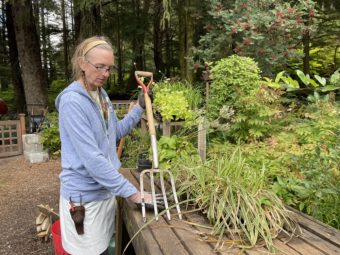
Ginger Hudson displays a digging fork, her preferred tool for removing plants from the ground without cutting their roots (photo by Sheli DeLaney/KTOO)

Early fall is a great time to dig up, divide, and transplant perennials. Plants can better adapt to new locations when the weather is cool and they are finished blooming.
At the Jensen-Olson Arboretum, horticulturist and manager Ginger Hudson demonstrated how to divide Japanese sedge, or Carex morrowii, that she found creeping into a walkway. She removed it from the ground using her preferred tool — a digging fork.

“If you use a shovel — that’s a big knife. You’re just going to cut a lot of roots,” Hudson said. “So a digging fork leaves as many roots intact as possible.”

Hudson used her fingers to loosen the large mass of soil, roots and greenery. At times she needed clippers to release the plants from each other, but she was careful not to cut away too much.

“You want a healthy mass of roots with the plants that you transplant,” she said. “You want large feeder roots, you want little thin hairy roots coming off those bigger roots.”

Plant clump of primula florindae being divided (Photo by Sheli DeLaney/KTOO)

Some other perennials that can be divided this time of year are Primula florindae and Primula denticulata, popular varieties that grow well in Southeast Alaska.

“Because they like living here so well, they really reproduce well,” Hudson said. “They spread by plant clumps, which is vegetative. They also reseed themselves.”

Hudson says Juneau is renowned for being a great habitat for primulas, and the arboretum has a nationally recognized collection.

But they have thick, entangled root systems that take some patience to divide. Hudson works the clumps apart slowly with her fingers, then cuts away dead and damaged parts of the sections she separated.

“This year I have an extra step to add in, and that’s I’m going to be trimming foliage,” she said. “Because the slugs have really done a number on them, and they’re not pretty.”

A newly divided and trimmed primula florindae plant (photo with Sheli DeLaney/KTOO)

Hudson says early fall is an ideal time of year to divide and transplant Primula florindae because their roots can get established before winter. Plus, primula are likely to lose their blooms if they are transplanted while flowering.

“The plant is then is going to spend energy trying to get reestablished trying to get its roots eating again. And so it’s not going to be able to feed the flowers,” she said.

Garden Talk: Late-blooming perennials at the Jensen-Olson Arboretum

A chalkboard sign at the entrance lists what’s in bloom at the Jensen-Olson Arboretum. (Photo by Sheli DeLaney/KTOO)

At the Jensen-Olson Arboretum — a source of inspiration for gardeners of Southeast Alaska — late-season flowering perennials are in bloom.

“And one of our favorites is the Primula florindae, which blooms in mid-to-late summer and sometimes will go on until frost,” manager and horticulturist Ginger Hudson said. “They love the cool moist temperatures — they love to be cold over winter.”

Yellow is the standard color for Primula florindae flowers. But when planted alongside a primula of a different color, the flowers can bloom in a variety of shades.

“There are some oranges and they will cross with each other,” Hudson said, “So we have one that’s a kind of a mango color. And even one that’s a deeper mustard yellow.”

A buttery-yellow variety of primula florindae in bloom at the Jensen-Olson Arboretum (photo by Sheli DeLaney/KTOO)

Not only does the Primula florindae bloom longer than other primula and attract pollinators, it’s also easy to propagate.

“This variety of primula spreads easily in the garden, Hudson said. “Not only by clumps expanding, but also seeds being carried away and washing away in our rains.”

Monarda, also known as bee balm, is another late-blooming perennial that produces copious amounts of flowers.

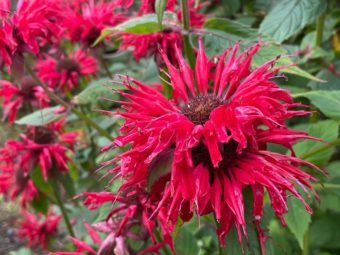
“Really red” variety of bee balm (monarda) in bloom at the Jensen-Olson Arboretum. (Photo courtesy of Sheli DeLaney/KTOO)

“We have two different kinds of bee balm growing here at the arboretum, a pink shade and a deep, deep fire-engine red shade,” Hudson said. “You want to plant them in the best sun possible to get the maximum amount of blooms.”

As the name suggests, bee balm attracts pollinators as well — primarily, bees.

Ginger Hudson, manager and horticulturalist at the Jensen-Olson Arboretum, inspects a patch of bee balm. (Photo by Sheli DeLaney/KTOO)

“We have a lot of bumblebees here even in Southeast Alaska and they love these, as well as lots of other little flies and late season butterflies,” Hudson said. “But mostly you’ll see bumblebees.”

Phlox and hostas are two other perennials that are still in bloom this time of year, and Hudson says she’s even seen hummingbirds visiting the hosta flowers. While attracting pollinators, the flowers and foliage are also entertaining through the autumn.

“And makes you think, well, summer’s not really over because look at this big head of flowers that just keeps on going,” Hudson said.

Garden Talk: What grows well in Juneau greenhouses

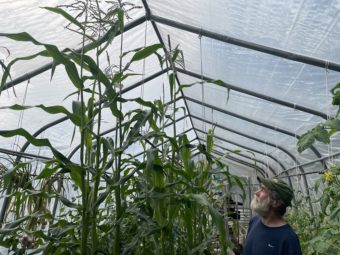
Master gardener Ed Buyarski grows corn inside a greenhouse. (Photo by Sheli DeLaney/KTOO)

Greenhouses expand the possibilities of what can be grown in cool, wet climates. Certain cucumber and tomato varieties do particularly well in Southeast Alaska.

Growing cucumber plants vertically can increase air circulation and reduce mold and mildew (photo by Sheli DeLaney/KTOO)

Master gardener Ed Buyarski uses some of his greenhouse space to experiment with dry-weather crops, such as corn. While his corn is tall, it’s not quite maturing.

“The corn has reached the ceiling, but it’s gonna be a while before we get any of that,” he said.

The rest of the space is dedicated to tomatoes and cucumbers. Buyarski selects varieties that are adapted to growing in a greenhouse, such as the Manny cucumber.

“Manny, I’ve grown for two or three years now,” Buyarski said. “They’re tasty. They’re smooth-skinned slicing cucumbers — they’re considered a European-style cucumber.”

Inside the greenhouse, Buyarski has staked the cucumber plants to grow vertically instead of flat on the ground.

“Cucumbers tend to get mold and mildew on them pretty easily, unfortunately,” he said. “I’ve got them strung up in the hopes of getting good air circulation in between the plants.”

A cluster of ripening, greenhouse-grown Siberian tomatoes (photos by Sheli DeLaney/KTOO)

Sungold, Siberian, and Glacier are examples of tomato varieties that consistently produce good harvests. The plants were started indoors from seed in April and transferred to the greenhouse in mid-May. The green tomatoes just started to show colors in early August.

And for gardeners without greenhouses, it’s still possible to grow tomatoes in the rainforest.

“Fourth of July is a short-growing tomato, determinate tomato, which could be grown in good-sized hanging baskets or in pots.” Buyarski said.

Garden Talk: Creative solutions for controlling weeds — like eating them

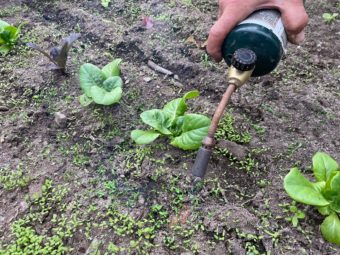
A propane torch burning unwanted chickweed sprouts in a lettuce bed. (Photo by Sheli DeLaney/KTOO)

Taking a propane torch to the rows between crops is a quick, easy solution to controlling weeds in the garden. But many weeds can be harvested and eaten.

White goosefoot (aka Lambsquarters) is an edible and nutritious garden weed closely related to spinach (Photo courtesy of Ed Buyarski/Ed’s Edibles)

Master gardener Ed Buyarski carefully burned away hundreds of tiny sprouts threatening his lettuce rows.

“Like we see between two lettuce, there’s about 50 chickweed plants, and it will steal the nutrients from them,” he said.

The torch eliminated hundreds of weedlings in a matter of minutes, along with any pests that may be in its path.

“Slugs should beware,” Buyarski said.

Other weeds can end up on the dinner table. Lambsquarters, for example, is a close relative to spinach that can be tossed into salad or lightly sautéed with olive oil and balsamic vinegar.

“You can even layer it in something like a casserole.” Buyarski said. “It’s very tender, very mild, and it’s terribly good for you. Not to mention, we’re eating the weeds, so you get extra points for that.”

Chickweed (Photo courtesy of Jennifer Nu)

Chickweed, if it escapes the torch, is also edible. It has a mild taste as well and is nutritious when eaten fresh.

“We can eat a lot of these weeds, and I try to,” Buyarksi said. And he introduces other people to them when he can. “Certainly, I subject friends to it, put in their salad.”

Garden Talk: Air-drying garlic and herbs

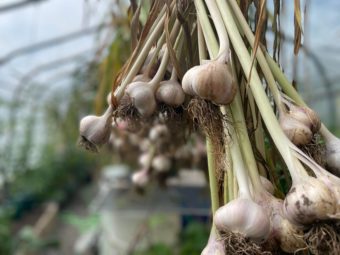
Hardneck garlic bulbs hanging up to cure inside a greenhouse (Photo by Sheli DeLaney/KTOO)

After garlic is harvested, it can be cured by hanging in a warm, dry place with good air circulation for a few weeks.

Master gardener Ed Buyarski says that he has garlic hanging in his greenhouses, his furnace room and his garage.

“In fact, last week I bought a dehumidifier to go in my garage underneath the garlic, and I’m emptying it twice a day.” Buyarksi says. “So I’m hoping that it will dry it better so it keeps better.”

Some of the garlic has been set aside to be eaten fresh rather than preserved. They show signs of the fungus disease botrytis. Buyarski recommends keeping them separate from unaffected garlic plants and giving them a quick rinse in a 10% bleach solution.

Garlic bulbs with the tell-tale pink streaks of botrytis should be eaten fresh rather than preserved (Photo by Sheli DeLaney/KTOO)

“We’ll eat them, friends will eat them. But we will not use that for the replanting later on in late September and October.”

A couple of days of air-drying is all that’s needed to preserve garden herbs, too, such as the oregano Buyarski grows in his greenhouse.

“Dry it just on cookie sheets in the open. I don’t bother to put it in a dehydrator.” he recommends. “Because if you heat it then you lose some of the volatile oils.”

Buyarski has even experimented with drying garlic leaves.

“That was quite a failure, that was in a dehydrator,” he says. “Made the house smell wonderful. But the next morning when we went to taste the dried crunchy garlic leaves, there was no flavor left.”

For other herbs that lose flavor when dried, like basil and chives, or are too tender for the drying process, Buyarski suggests freezing them in a baggie or even in ice cubes.

Garden Talk: A tour of Taay Hít, Tlingit and Haida’s new greenhouse

Master Gardener Lindsey Pierce is surrounded by sunflowers as she looks up at the top of the dome in Táayi Hít, the “Garden House” at Central Council of the Tlingit and Haida Indian Tribes of Alaska. (Photo by Sheli DeLaney/KTOO)

A year after completion, the greenhouse built by Central Council of the Tlingit and Haida Indian Tribes of Alaska has produced its share of successes and setbacks.

“The name is Taay Hít, which means ‘garden house’ in Lingít,” says Lindsey Pierce, master gardener and environmental specialist at Tlingit and Haida.

Also referred to as “the dome” because of its shape, the structure was assembled from a kit by local contractors last July. This year marks the second growing season for the greenhouse.

Cer Scott, also a master gardener and environmental specialist, said he was new to indoor gardening and overwhelmed at first. For him, one of the first challenges was deciding what to grow.

Cer Scott, Master Gardener and Environmental Specialist at Central Council of the Tlingit and Haida Indian Tribes of Alaska .(Photo by Sheli DeLaney/KTOO)

“We’re trying to decide, you know, should we grow things that are not as accessible at our stores?” Scott said. “Or should we grow things that people that are more, you know, wanted in the region, like cultural traditional foods. So we kind of did a mixture of both.”

One of the successes from this season included multiple crops of Swiss chard.

“We had several harvests and made a nice big lunch for the staff,” Scott said.

A lot of it also went to Smokehouse Catering, the tribe’s event company, who use produce from the dome in the meals they serve.

Tomatoes also did well, but basil was an especially big hit.

“It’s one of those things that it’s right next to the door, so when you walk in you get a waft of some fresh basil,” Scott said.

Ripe beefsteak tomato on the vine under the dome at Táayi Hít. (Photo by Sheli DeLaney/KTOO)

They had a few setbacks however, like pests and heat.

“We did have some cabbage here but we lost that unfortunately to some of the aphids,” Scott explains. “Aphids took over those so we just ended up pulling them to kind of help combat that.”

And a long stretch of hot weather earlier in the summer threw off the timing of their broccoli.

“While we were still trying to figure out the environment inside the greenhouse, as far as climate control, our broccoli ended up bolting. And flowering.” Scott explained. “It’s just their life cycle.”

“You can eat the flowers though,” Pierce added.

Lindsey Pierce, Master Gardener and Environmental Specialist at Central Council of the Tlingit and Haida Indian Tribes of Alaska, holds out edible broccoli flowers from a plant that bolted. (Photo by Sheli DeLaney/KTOO)

Scott and Pierce both completed the Alaska Master Gardener Program, and they agree that they have learned a lot in just two growing seasons under the dome.

“Last July is when it started. And it’s just been a ride ever since.” says Pierce.


Garden Talk

Correction: An earlier version of this story misspelled Taay Hít, the name of the greenhouse.

Site notifications
Update notification options
Subscribe to notifications