Tongass Voices

Tongass Voices: Frank Henry Kaash Katasse on navigating the irony of theater

Frank Henry Kaash Katasse tells a story of Raven bringing the sun, stars and moon to humanity during a ceremony celebrating the release of Rico Lanáat’ Worl’s new postage stamp “Raven Story,” on Friday, July 30, 2021 in Juneau, Alaska. (Photo by Rashah McChesney/KTOO)

This is Tongass Voices, a series from KTOO sharing weekly perspectives from the homelands of the Áak’w Kwáan and beyond.

Frank Henry Kaash Katasse is an Indigenous actor and playwright who incorporates Lingít language into plays performed on Juneau’s stages and airwaves. Now, he’s directing a play written by another Indigenous playwright, about white people putting on a Thanksgiving play. 

He says the play is full of humor and irony, but at its core, it gets at the question of who creates theater and who is in the audience watching. 

“The Thanksgiving Play” opens on Friday, with a pay-as-you-can preview on Wednesday. 

Listen:

Frank Henry Kaash Katasse: Kaash áyá ax̱ saayí. Dleit Ḵaa x̱’éináx̱ Frank Henry Kaash Katasse. Hi, I’m Frank Katasse. Frank Henry Kaash Katasse. I’m directing the play, “The Thanksgiving Play” at Perseverance Theater. 

It’s written by Larissa FastHorse. This play, this “Thanksgiving Play,” has been kind of like a darling across the country. It was, you know, it’s a very top produced play across the country, had a Broadway run within the last few years. 

And it’s funny. It’s a really, really funny play. The play is about, basically, it’s about four white people trying to put on a traditional Thanksgiving play without any Native people in it, and the struggles of trying not to offend anybody. And it’s all very farcical and it’s really, like, line-by-line, it’s a really, really funny play. 

There is a certain amount of irony within this play, especially that it’s, you know, it’s a written by a Native person about white people trying to do a Native play without any Native people. But, and that can be — that’s a tricky thing to navigate. And one great thing about Perseverance is that, you know, bringing in a supporting cast of Indigenous perspectives and BIPOC perspectives and so not just me, you know, helming as the director, but you know, we have cultural consultants that are going to come in.

And Perseverance Theater spends a great amount of resources and energy educating and discussing whose land that we’re on and how It’s important to tell these stories in Lingít Aaní, so this play, you know, it seems like to make fun and poke at some of those ideas, but Perseverance Theatre, I think, takes it very seriously. 

And I think it helps having, you know, a Native director like to understand some of the subtleties within the comedy. I’m like, “Did they understand this joke, like when they did this in Plano, Texas, or whatever, by a completely white cast and production team? Did they understand some of these jokes?”

These are really, really funny and, and we’ve got to try to highlight some of that Indigenous humor that’s built into the script. And there’s a certain amount of irony there. I think it is trying to hold up a mirror to society, and I think it’s my job to make sure it does that thing. 

I think Juneau will like it. I explain it to people just like I explained it here. It’s four white people trying to put on a Thanksgiving play, and they’re like, “that’s a funny premise.” And you’re like, “yeah, it is.” And they’re trying not to offend anybody. And of course, it’s always offensive. 

I think people are going to be surprised on how funny this play is.

Tongass Voices: Southeast Alaska shipwreck researchers on setting the record straight

Maritime Archeologist Jenya Anichtchenko presents her teamʼs research on the Star of Bengal at the Mendenhall Glacier Visitor Center on Feb. 7, 2025. (Photo by Jamie Diep/KTOO)

This is Tongass Voices, a series from KTOO sharing weekly perspectives from the homelands of the Áak’w Kwáan and beyond.

A team of researchers in Alaska have banded together to investigate a famous Alaska shipwreck. The Star of Bengal sank off the coast of Prince of Wales Island in 1908, taking more than 100 lives with it. The shipwreck highlighted stark racial inequality in Alaska at the time since most of those who died were Asian cannery workers. 

Members of a 2022 expedition to the site of the wreck are going back in May. In this episode of Tongass Voices, team members Gig Decker and Jenya Anichtchenko share what they hope to uncover.

Listen:

This transcript has been lightly edited for clarity.

Gig Decker: I’m Gig Decker, 50 year old — I mean, 50 year commercial fisherman from Wrangell, Alaska. And I was a commercial harvest diver for 38 years. And I became interested in shipwrecks 30 years ago, mainly because you run into a lot of that sort of thing when you’re commercial harvest diving. And I became interested in the Star of Bengal because I see it as a really important aspect of the fishing and processing industry. And I’ve always been really interested in seeing the story of the Bengal lifted to a point to where I think it deserves in the history of Alaska and coastal communities.

Jenya Anichtchenko : My name is Jenya Anichtchenko. I am a maritime archeologist. I came to Alaska in 2004 for the first time chasing a Russian shipwreck, and ever since I stayed in the state. I’ve done a lot of things professionally, but shipwrecks and maritime archeology remain my passion. I am originally from St Petersburg, Russia, and I am now proud to say I’m an Alaskan, for the last 20 years.

It’s kind of a mystery, maybe not so much, but in details it is. We know that out of 36 crew members of the Star of Bengal, about 17 died. And we know that of 106 cannery workers of Chinese, Filipino, Japanese origin, only 10 survived. It’s a huge racial disproportion of lives lost. And we’re hoping to be able to find out what really happened. 

Star of Bengal (Courtesy of the Wrangell Museum)

Gig Decker: A lot of people don’t realize the tremendous involvement that Asian people have had in the development of the fishing and processing industry in the Northwest, and particularly in Alaska. They were the predominant labor force, and there’s a fairly clear history of mistreatment of Asians, particularly of the Chinese — taking advantage of them, cheating them and not giving them the health care and that sort of a thing they need. 

So there’s been a long history of this, from Sacramento all the way up to the West Coast through to Alaska, not just in processing and fishing, but in timber and mining and road building.

And I’ve always felt that the Star of Bengal was a marker for this whole thing. I think that what happened that night reflects the way that the Chinese and Asians were treated in the industry, and I think it’s an important hallmark for the history of Alaska that should stand out a lot more.

Jenya Anichtchenko: I’ve been engaged in several archeological maritime shipwreck studies, and most of the time they originate from academia. This one, at least to me, came as a community wish, a community desire. It’s very important for me to know that this is a community project, and we’re trying to run it as such. 

Another thing I want to mention is it’s an immigrant story for me, and it definitely pulls on my immigrant heart. The immigrant population is vulnerable. Chinese and other Asian workers on the Star of Bengal, they were not welcome to this country at all. They had to work really hard, take jobs that nobody else would take, work for virtually nothing and risk their lives to eventually feel at home in this country. And it’s a really important aspect for me, and I think it’s an important thing for all of us to remember, especially today, what immigrant story in this country really is like. 

Gig Decker: It is really important because the record needs to be set straight about what happened that night. And anything that we can bring to light out there, I think it’s going to be really important.

Tongass Voices: Tamara Wilson on her museum installation and the slinkies that live there

Tamara Wilson sets up her exhibit “Slinkies and the Window Frame” at the Alaska State Museum on Feb. 3, 2025. (Photo by Yvonne Krumrey/KTOO).

This is Tongass Voices, a series from KTOO sharing weekly perspectives from the homelands of the Áak’w Kwáan and beyond.

Tamara Wilson recently unpacked a living room at the Alaska State Museum. She made it out of felt — among other materials — for her upcoming show, “Slinkies and the Window Frame.” 

For the exhibit, Wilson built accordion-like creatures covered in orange ceramic tiles. They will be unfurled throughout the gallery space with nameplate necklaces that say things like “George.” Those are the Slinkies.

The show opens Friday at 4:30 p.m. at the Alaska State Museum and runs through April 12.

Listen:

This transcript has been lightly edited for clarity.

Tamara Wilson: They’re totally useless, right? Like the only thing that they do is bring joy, which I think is kind of wonderful. It’s a little presumptuous of me to say that the work will bring joy, but if it does, that’s great. But it really has no other function outside of just being present for the viewer to enjoy.

I’m Tamara Wilson, and I’m an installation [designer] and painter from Fairbanks, Alaska.

A lot of my sort of formal background in arts was mostly painting. And then as it kind of developed over time, the paintings sort of started taking over the space, creating the space. So then I started thinking less about the paintings themselves, and more about people viewing the paintings, or people being inside the space.

And so then that kind of naturally turned into wanting to create, almost like a three dimensional painting for people to be in. So the installations came about because the paintings just weren’t enough.

So this is the back side of the slinky that will get put on this armature and then hung on the wall so you can see the accordions kind of. It’s like stretched out, and then when they’re shipped, they’re all condensed. So then that’s when they’re in, like resting slink. And then when they’re in the gallery, they’re pulled out, so that they’re in more of their organic, moving form.

One of Tamara Wilson’s slinkies named for “Slinkies and the Window Frame.” Courtesy of the Alaska State Museum.

So this piece that you’re seeing from the back side, it’s called U-turn. And the like name plates say “You turn round and round.” And so it’s the necklace of the slinky, clearly, because every slinky needs a necklace, apparently. And then coming out of the end of it is that expanding foam that’s against the wall with more chain. It’s kind of like its gut spilling out.

So yeah, I mean, read into it what you might, but the nameplates kind of allude to why its contents are being spilled onto the floor.

So this right here is a frame, like a kind of classic oak frame, and it’s going to go in this wall here. And so the people experiencing the installation that’s going to be on the other side of the wall will be framed in this when they’re inside it. So you will view them from the more traditional side of the gallery as if they were in the painting.

It’s very much a living space. The installation itself, that’s kind of adjacent to the more traditional gallery space, is set up like a living quarters. It has a bed, it has a television, a heat source — the radiator — a lot of house plants. And then on this side of the wall, on this side of the frame, are these like slinky pieces, and they are more like creatures, forms that might occupy that living room space.

There is something that’s kind of intriguing about looking into somebody else’s space. And I guess that initially the inspiration for doing this framed installation — that the viewer can actually walk through the frame — originally was just like who are in these colossal portraits that you see in museums? Often like royalty or I don’t know people that I don’t relate to or know or know much about.

And so the viewer being able to be in that frame themselves kind of elevates the viewer to be the portrait, in a way.

Tongass Voices: Marian Call and Lisa Puananimōhala’ikalani Denny on bringing together Juneau’s music-makers

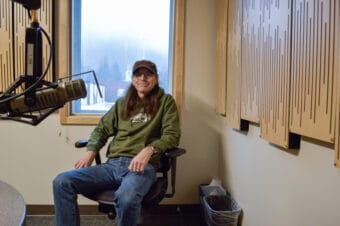
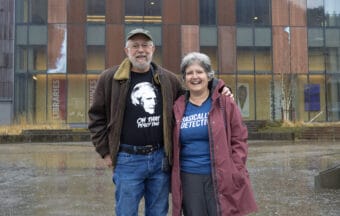
Marian Call and Lisa Puananimōhala’ikalani Denny are organizing the Juneau meeting of the Alaska Music Summit. Pictured in the KTOO studio on Jan. 24, 2025. (Photo by Yvonne Krumrey/KTOO)

This is Tongass Voices, a series from KTOO sharing weekly perspectives from the homelands of the Áak’w Kwáan and beyond.

Marian Call and Lisa Puananimōhala’ikalani Denny are organizing this week’s Alaska Music Summit in Juneau. It’s a chance for anyone who is a part of making music in the region to come together and swap ideas.

The Juneau summit is Saturday from 11 a.m. to 4 p.m. at Devil’s Club Brewing. Participants can register at alaskamusicsummit.com.

Listen:

This transcript has been lightly edited for clarity.

Marian Call: I’m Marian Call. I’m the Program Director of Music Alaska. 

Lisa Puananimōhala’ikalani Denny: I’m Lisa Puananimōhala’ikalani Denny. I am the project outreach coordinator for Music Alaska for the Juneau Music Summit. I also did a little volunteer coordination for our summit up in Anchorage.

The summit is a gathering of music-minded people across the state of Alaska. There are three of them: Fairbanks, Anchorage and Juneau. And it’s like a convention for people in every facet of the music industry to come together, to network, to share our perspectives and to connect with each other and level up together. 

Marian Call: The music summit was started about some years ago, but this is the seventh one, and we’re really excited to see every year, more and more people who are in different parts of music-making. Like people who do booking or people who are DJs, or people who make beats, or people who write new operas, or people who are teaching preschoolers, right? 

All these people serve different roles, but sometimes don’t have the chance to really talk to each other, even though all our fates are very connected. So the music summit makes space for this to happen, and it also gives us a chance to intentionally try to make our music ecosystem better, because it certainly nothing happens if we don’t try together to make it better. And when we do try to make it better, amazing things happen. 

We’ll also be talking about money, about what musicians earn, what they’re paid, how to make the money work. How to make it work well for the venue too. How to have a successful event when you’re trying to make sure that people are being compensated what they’re worth. 

Lisa Puananimōhala’ikalani Denny: We’ve reserved one small segment for to hear from the perspective of the bartenders, who are tend to be viewed as on the fringes of the scene, but they play such a crucial role in a lot of music events, especially like in downtown Juneau, where they’re helping run a lot of that show. 

Marian Call: I think that’ll be great. I think nobody ever asked the bartenders ‘Hey, which shows work?’, but I think they have specialized knowledge about that. 

Possibly the most important part is when we simply free the room up to everyone. Just talk to each other, right? Talk to someone you don’t know, talk to someone you haven’t talked to in a long time. So at lunch and afterwards and the next day at office hours, that’s really when it happens. 

We’re trying to kind of build bonds between the most distant corners of the music community, like if you’re as far apart as you can be in the music community, if you’re playing heavy metal

versus performing like 11th century chant. Or if you’re like teaching preschoolers versus performing with seniors in a community choir. 

No matter how far apart we are, all of our fates are tied together, and this is our opportunity, once a year, to try and make sure that people see that connection and value it. 

Lisa Puananimōhala’ikalani Denny: I am an independent musician in Alaska, and I wasn’t that before I came here. And Juneau is such a fun community to be an artist, a performer, a musician in, because we are so supportive. We’re so all about it. You want to try something? Do it. We’re going to support and applaud you. 

Tongass Voices: Rich Mattson on uncovering stories from the pages of Juneau’s history

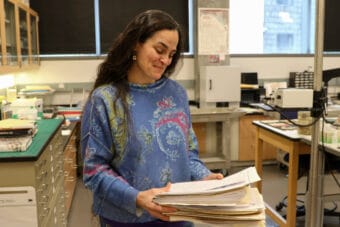
Rich Mattson, a researcher for Gastineau Channel Historical Society, looking through old newspapers at the Alaska State Archives on Jan. 21, 2025. (Photo by Yvonne Krumrey/KTOO).

This is Tongass Voices, a series from KTOO sharing weekly perspectives from the homelands of the Áak’w Kwáan and beyond.

Rich Mattson remembers playing in the ruins of Treadwell Mine as a kid in the 1950s, and he said that planted seeds of curiosity about Juneau’s past. 

Now, he researches history for Gastineau Channel Historical Society, and publishes daily “This Day in Juneau History” posts on juneauhistory.org. Mattson says he’s an amateur, but it has become almost like a part-time job in his retirement.

Listen:

This transcript has been lightly edited for clarity.

Rich Mattson: A popular bumper sticker in 1986 was “I survived the tsunami of 1986,” because there was a 7.7 magnitude earthquake in the Aleutian Islands on May 7, and it was feared that there would be a tsunami that would even reach into Juneau. 

So people went out to Auke Bay and lined the road to see the tsunami. Now, if there really would have been a tsunami, that would have been a pretty foolish thing to do. But as it turned out, it was only a two-inch wave, so bringing a rise to the bumper sticker, “I survived” that tsunami. 

I’m Rich Mattson. I just retired from DIPAC about 2018. And I’ve been following my passion for local history ever since. I grew up in Douglas. My dad came up as a fish biologist and with our family in 1957 and we ended up living down at the end of St. Anne’s Ave.

Well, growing up in that area, Treadwell was our playground, and Sandy Beach. There was an old timer here named Sim MacKinnon. He had made quite a collection of historic photographs, which, by the way, is in the State Library, fascinating to look at. 

And I just remember folks brought us down to a presentation he was giving. It was a Taku blustery night, and here’s all these pictures of old Treadwell. It just sort of set the scene. And that just hooked me as to be a lifelong student of Treadwell. So that really was what got me into local history.

I got a whole list of interesting stuff I found. And sometimes you find some goofy stuff. 

One of the first ones I came across, as a student of history, was, ‘Has anybody ever heard of  250-foot Johnson?’ Well, it turned out, Treadwell hired lots of Scandinavian workers, and there were lots of Johnsons. And so in the times there, most people had a handle of some kind that was assigned by their contemporaries. And this one, Charles Johnson, was working in the Treadwell Mine. 

Mr. Johnson was getting off his shift one afternoon, and he must have been sort of absent minded, and it doesn’t sound like they had a lot of safety railings around this thing, and he stepped off on the other side and promptly fell down the shaft. Well his friends were alarmed. They immediately went down on the hoist to recover his remains, and there they found him standing in the sump of water at the bottom in knee deep water, looking rather dazed. 

He had some bruises, no broken bones, and he’s a little bit in shock, understandably. Well, the newspaper reported that the next week, and they said he fell 250 foot down the Treadwell shaft. 

They said ‘ah, it was deeper than that.’ And they actually took a tape and measured that darn depth there. It wasn’t 250 feet, it was 256 feet! And from then on, Mr. Johnston was known thereafter as 256-Foot Johnson.

But for today, I actually went into my “This Day in History,” January 17. What was happening on that day? I think the one that was more interesting that I doubt very few people know, is the Goldstein ice skating rink. Well, the Goldstein building, as most people who are long timers around here know, is that big six story building at the corner of Second and Seward Street. 

Well, in 1939, that building got burned in a tremendous fire. It was probably the biggest fire in Juneau, certainly to that time, and even since then. The thing was just totally gutted.

But in those years when it was gutted, it was just a hollow shell. It was just the concrete walls, and because of the no roof, and it would rain and it would freeze, and presto! Juneau had an indoor, so to speak, ice skating rink. And so, Chief of Police [Ralston] was warning people that with the thawing weather that it was probably unsafe, so don’t go skating in the Goldstein ice skating rink until it freezes again. That was January 17 in 1940. So stuff like that.

Tongass Voices: Librarian Melinda Sandkam on engaging all ages with Douglas Library’s I Spy display

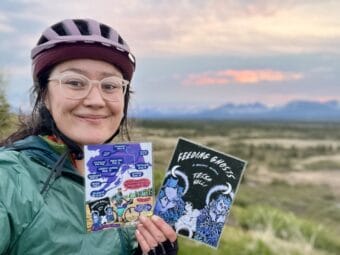
Librarian Melinda Sandkam in front of the I Spy display at Douglas Library on Dec. 13, 2024. (Photo by Yvonne Krumrey/KTOO).

This is Tongass Voices, a series from KTOO sharing weekly perspectives from the homelands of the Áak’w Kwáan and beyond.

You may have noticed the eye-catching display of bits and bobbins: stuffed animals, beads and soccer balls at the Douglas Library. And that’s what it’s for — to be looked at. There is a list at the bottom that says things like “find 10 ladybugs.”

Librarian Melinda Sandkam created the I Spy-inspired collection nearly two years ago, and has been adding to it ever since. 

Listen:

This transcript has been lightly edited for clarity.

Melinda Sandkam: People are surprised by it. They come upon it when they’re waiting for something. You know, we can’t have food in the library, but you can enjoy snacks in the lobby. So often, people will be munching on a little snack out here, and they engage with the I Spy display, people will be coming into our meeting room to use it, and so they they discover the I Spy display, or the Friends of the Library books that are available, or the free magazines to pick up.

And so it’s just kind of in passing through. But I really do find that people get interested in finding that either looking for something on the list or they just spy something that they recognize.

I’m Melinda Sandkam, and I’m the outreach librarian with Juneau public libraries. So I was inspired by seeing I Spy displays in libraries and other locations.

When I completed my degree and was exploring neighborhoods in the Pacific Northwest to move, I visited over 150 libraries in Washington and Oregon, and so I saw I Spy. Sometimes they were in a smaller setting, like an aquarium or big glass case. So it’s just a great engagement in the library.

The I Spy display at Douglas Library on Dec. 13, 2024. (Photo by Yvonne Krumrey/KTOO).

But I also saw the display at the Alaska State Museum, and they have a board where things are attached or glued to and so those were inspirations to filling this case with something to engage the community.

The very first thing I did was put out an ask to all our staff, because we have some really creative librarians. And just, “did they have any miscellaneous things sitting around?” That was where we got our Elvis in the purple sequin suit, from a staff member. And then we just collected things.

Then I started looking in yard sales. And here in Juneau, there’s all the piles of free stuff. And so I always keep an eye out there. I just picked up two pine cones last night in someone’s bucket of free stuff.

But I’m also looking for literary things. So I recently found a Clifford, the Big Red Dog. I found another panda, and I knew I had pandas, so I just keep an eye out for things that will have the literary theme or that will make it two or three or multiple items.

I came from an education background. I was a preschool director most recently, before becoming a librarian, and so you see at that early age how people engage in different ways. Some engage kinesthetically and some engage through literature and some engage with a math background. Some engage very physically, like building things — manipulatives.

So this is definitely an engagement with the mind of looking for small and big that can be with. Like we have a very big Eeyore and a very small Eeyore. Those are some of the most difficult ones to find. Or you’ll say, three Poohs, but the Poohs are all different shapes and sizes, and so that can engage very young ones. There’s a lot of color. There is a lot of characters that they might know.

So it is just that color, shapes, sizes, themes, animals. We have a crocodile, we have frogs, we have ladybugs, dinosaurs and so those are all things that may engage many different people.

Site notifications
Update notification options
Subscribe to notifications