This is Tongass Voices, a series from KTOO sharing weekly perspectives from the homelands of the Áak’w Kwáan and beyond.
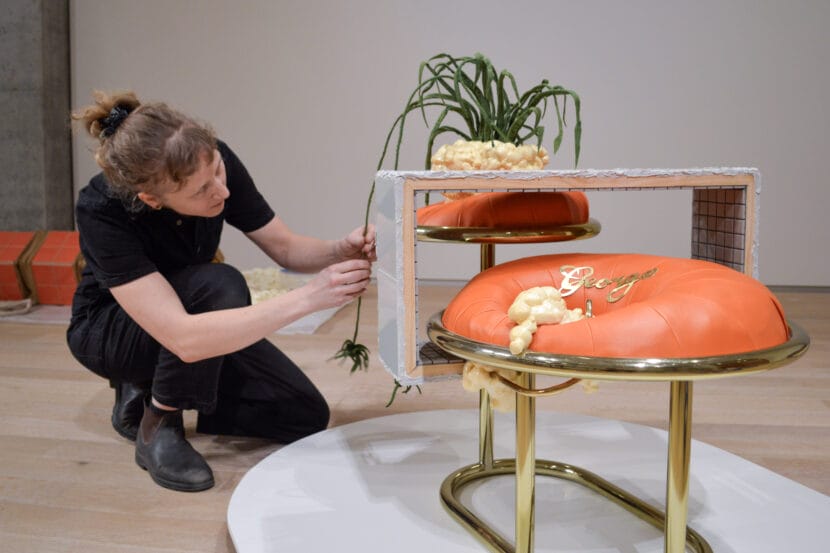
Tamara Wilson recently unpacked a living room at the Alaska State Museum. She made it out of felt — among other materials — for her upcoming show, “Slinkies and the Window Frame.”
For the exhibit, Wilson built accordion-like creatures covered in orange ceramic tiles. They will be unfurled throughout the gallery space with nameplate necklaces that say things like “George.” Those are the Slinkies.
The show opens Friday at 4:30 p.m. at the Alaska State Museum and runs through April 12.
Listen:
This transcript has been lightly edited for clarity.
Tamara Wilson: They’re totally useless, right? Like the only thing that they do is bring joy, which I think is kind of wonderful. It’s a little presumptuous of me to say that the work will bring joy, but if it does, that’s great. But it really has no other function outside of just being present for the viewer to enjoy.
I’m Tamara Wilson, and I’m an installation [designer] and painter from Fairbanks, Alaska.
A lot of my sort of formal background in arts was mostly painting. And then as it kind of developed over time, the paintings sort of started taking over the space, creating the space. So then I started thinking less about the paintings themselves, and more about people viewing the paintings, or people being inside the space.
And so then that kind of naturally turned into wanting to create, almost like a three dimensional painting for people to be in. So the installations came about because the paintings just weren’t enough.
So this is the back side of the slinky that will get put on this armature and then hung on the wall so you can see the accordions kind of. It’s like stretched out, and then when they’re shipped, they’re all condensed. So then that’s when they’re in, like resting slink. And then when they’re in the gallery, they’re pulled out, so that they’re in more of their organic, moving form.
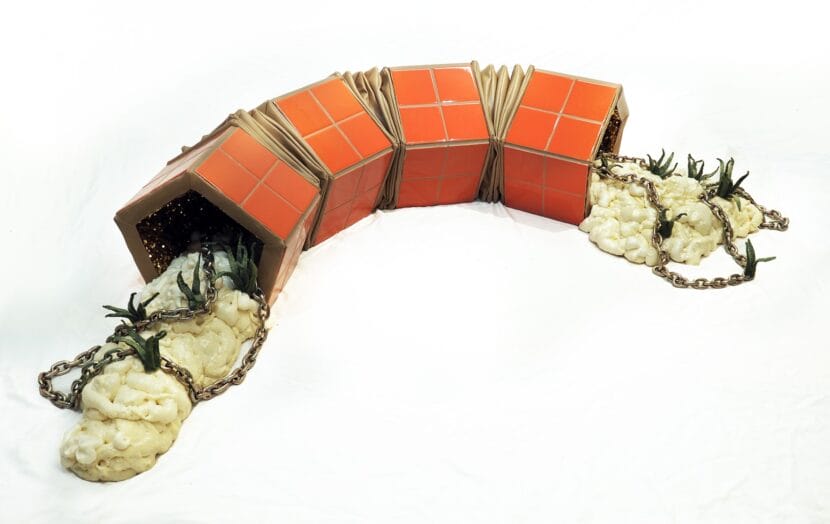
So this piece that you’re seeing from the back side, it’s called U-turn. And the like name plates say “You turn round and round.” And so it’s the necklace of the slinky, clearly, because every slinky needs a necklace, apparently. And then coming out of the end of it is that expanding foam that’s against the wall with more chain. It’s kind of like its gut spilling out.
So yeah, I mean, read into it what you might, but the nameplates kind of allude to why its contents are being spilled onto the floor.
So this right here is a frame, like a kind of classic oak frame, and it’s going to go in this wall here. And so the people experiencing the installation that’s going to be on the other side of the wall will be framed in this when they’re inside it. So you will view them from the more traditional side of the gallery as if they were in the painting.
It’s very much a living space. The installation itself, that’s kind of adjacent to the more traditional gallery space, is set up like a living quarters. It has a bed, it has a television, a heat source — the radiator — a lot of house plants. And then on this side of the wall, on this side of the frame, are these like slinky pieces, and they are more like creatures, forms that might occupy that living room space.
There is something that’s kind of intriguing about looking into somebody else’s space. And I guess that initially the inspiration for doing this framed installation — that the viewer can actually walk through the frame — originally was just like who are in these colossal portraits that you see in museums? Often like royalty or I don’t know people that I don’t relate to or know or know much about.
And so the viewer being able to be in that frame themselves kind of elevates the viewer to be the portrait, in a way.