Timber

In Kenai Peninsula wood-stacking contest, you’re supposed to bribe the judge

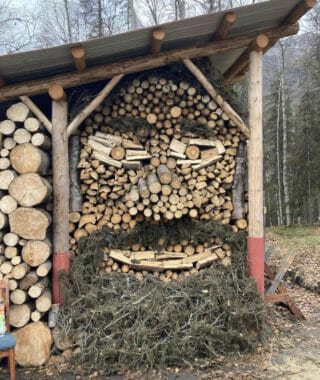
A woodpile arranged and decorated to look like a giant, bearded face
Gary Galbraith’s first-place winning wood pile. (Photo courtesy Of Sandra Holsten)

People who live in Cooper Landing and Moose Pass take a little extra care when they stockpile their firewood for the winter — because they know they’re going to be judged.

At this year’s fifth annual Cooper Landing Woodpile Contest, competitors in both Kenai Peninsula communities had a chance to show off their wood-stacking creativity in front of three judges, who traveled from home to home judging the piles in a number of categories.

Sandra Holsten was one of this year’s judges, along with Mary Story and Katie Feichtinger.

“The intention of the contest is to highlight people’s creativity with their cut firewood — which of course we have gobs of this year,” Holsten said.

That surplus of firewood is a result of the spruce bark beetle outbreak, which has been severe in the Cooper Landing area and has required residents to take down many of their damaged spruce trees.

“No matter how big or how little, anyone who has a woodpile is proud of it because they always take a lot of work,” Yvette Galbraith, the organizer of the competition, said. Galbraith said the winner receives a “Best Woodpile” plaque to display for the year, which was made by a woodworker known as Rabbit who passed away two years ago.

This year, there were 11 contestants who showed off their firewood finesse in categories including wood quantity, storage, accessibility and stacking creativity. The judges award points in each category to rank competitors.

Then there are the bribes. In this competition, bribing is not only allowed — it’s encouraged.

“Bribes can include anything from a beautiful jar of raspberry jelly, blueberry tarts, or alcohol,” Holsten said.

The judges can exercise a good deal of discretion when choosing a winner, and the bribes count for a lot. Holsten said she received a number of delicious treats and beverages from competitors.

Her favorite?

“Well, there was a wonderful blueberry Bailey’s coffee drink over in Moose Pass and that gentleman, incidentally, got second place,” she said.

When it came to first place, judges say it was woodpile supremacy that put one competitor over the top. Gary Galbraith of Cooper Landing — the husband of contest organizer Yvette Galbraith — arranged his woodpile into the shape of a giant face with ears and eyes, even using brush to create a wooden beard.

Jim Janssen of Moose Pass came in second with the tallest woodpile — and of course, his delicious bribe. The third place winners were a young Cooper Landing couple who are new to the area, Patrick McCartney and Sophie Koveleski, who Holsten said created a woodpile full of subtle touches.

“They came out and they were dressed like woodcutters, and of course they had a good bribe as well,” she said.

Galbraith, the first prize winner, won a brand new Stihl chainsaw for his pile prowess, donated by Craig Taylor Equipment of Soldotna. Taylor has been providing a chainsaw to the winner for three years now.

Holsten said one of the most touching moments of the contest was when Galbraith donated the chainsaw to the second place winner.

She said another standout of this year’s competition was the participation from a handful of residents of Moose Pass.

“In Cooper Landing, we think of Moose Pass as kin, if you would. Family,” she said. “There’s so much that goes back and forth that we were really, really happy to see them participating this year at that level, and hope we’ll get more.”

Of course, the judges are the real winners of the contest, since they’re on the receiving end of the bribes. Holsten said she and the other judges were supposed to take only two hours visiting the woodpiles, but ended up taking five because of how much fun they were having.

Editor’s note: Sandra Holsten is a board member of KDLL. 

Whale Pass residents seek last-minute halt to state timber sale near town

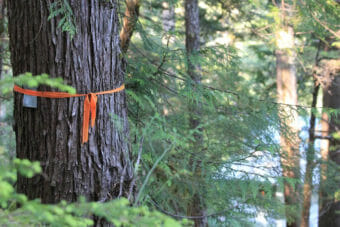
A tree trunk with orange flagging tape tied around it
A ribbon marks a tree in the Prince of Wales Island town of Whale Pass. (Photo courtesy of Maranda Hamme).

Community members in the small town of Whale Pass on northern Prince of Wales Island are fighting against the state’s plan to clear-cut nearly 300 acres of old-growth timber — including some within city limits. They’re concerned the clear cuts could hurt the town’s tourism industry and make landslides more likely, and time is running out to stop the timber sale.

Staff from the Alaska Division of Forestry received backlash from Whale Pass residents at a recent informational meeting in Whale Pass.

“I didn’t work 20 years out of my life to have everything I built destroyed,” one speaker said.

“I find it amazing that you put the economic future of the town, you know, at risk for 292 acres of crappy timber,” another attendee said.

Twenty of Whale Pass’ 100-some residents spoke at the Sept. 26 meeting, with all but two condemning the division’s plan to sell almost 300 acres of old-growth timber. The sale’s boundaries push up against homes and would leave the surrounding hillside clear-cut and barren.

Jimmy Greely lives on that hillside. He’s voiced his opposition to the sale before.

“We’re (Whale Pass residents) all basically against it,” Greeley said.

He looks out his kitchen window and sees orange ribbons marking the edge of the parcel slated to be clear-cut just 100 feet from his property line. He thinks it’s too close.

“Like, the, just the aspect that it’s in the town — literally in the Whale Pass boundaries,” Greely explained. “It’s not in the state forest land, but it’s still within the Whale Pass boundary.”

Greely said residents worry about what a bare hillside means for their safety.

“That concerns us with change of the water,” he said. “Water flow coming down the hill, the potential (of) landside, the wind coming from the north — the trees that are there now kind of give us adequate wind blockage.”

Others who attended the meeting worried about impacts to traffic flow on Whale Pass’ main roads, or damaging fish habitat. Some took issue with the idea of noise pollution so close to their backyards. There’s also murmurs of concern about what could happen to Whale Pass’ visitor industry without the scenic attraction of the trees.

Greely said that Whale Pass attracts visitors with a ‘do-it-yourself’ attitude drawn to staying in a cabin and taking themselves fishing.

“Basically, it would clear cut the whole hillside and kind of make Whale Pass not look very, very green anymore,” he said.

Greely is a member of the homeowners’ group Friends of Whale Pass. He helped draft a resolution passed by the Whale Pass City Council officially asking state forestry officials to push the boundaries of the sale back by about 400 feet.

Greely said the resolution asks the state to take a second look at potential environmental impacts. The Division of Forestry’s best interest finding showed there shouldn’t be substantial harm caused by the sale.

“So we’d like just to see them (do) a little bit more due diligence instead of just kind of pushing it through,” he said.

Whale Pass’s city clerk, Randy Toman, said he sent a copy of the resolution to the state’s Department of Natural Resources. He also said he’s been in touch with representatives from Gov. Mike Dunleavy’s office.

“We are throwing everything at this we can, realizing it is a Hail Mary, but our people here need to see we are doing everything possible,” Toman said.

An environmental policy analyst from the Southeast Alaska Conservation Council was one of the people who spoke out against the sale. Katie Rooks told KRBD she’s not even sure why the state wants this particular timber. She said the trees in the area are known to have a lot of imperfections.

“They’ve overlooked the fact that the economic damage to an entire community will reach far higher numbers than any potential benefit of the sale,” she said.

She told state forestry officials that they’re going about the sale wrong — taking too much at once and too close to homes.

“They’re going to kill a town,” she said.

State authorities downplay the risk of landslides following the clear-cut. State forestry officials say bedrock in areas above Whale Pass is relatively close to the surface, and that makes landslides unlikely.

And the state’s best interest finding says that helicopter logging — which could preserve some of the scenic views above Whale Pass — would be expensive and impractical.

Viking Lumber, Southeast Alaska’s last remaining mid-size sawmill, is expected to bid on the sale. The company and the Alaska Forest Association submitted comments supporting the Whale Pass sale this spring. They say it’ll be good for the island’s economy.

“Viking Lumber Co., Inc. supports the Whale Pass Timber Sale as it will continue to provide employment for residents of Prince of Wales Island and develop highly desirable lumber products for the North American market,” wrote Viking’s Steve Grandorff.

Southeast Alaska Area Forester Greg Staunton told KRBD that the value comes from the mix of wood — red cedar, yellow cedar, western hemlock and Sitka spruce are all part of the deal.

“It is a merchantable volume, and from our analysis it would be economical to harvest in our present climate, and part of that has to do with the species mix that was on the site,” Staunton said. “So the defect in the stand is notable, but it’s not abnormal for an old growth stand.”

Staunton said his department is aware of the strong opposition to the sale and welcomes more public input. He said there’s no bad blood between the state Division of Forestry and Whale Pass residents.

“You know, if people want to talk to us, we’re available and we make an effort to do so,” Staunton said.

The division is taking public comment on the plan through mid-October. Comments can be emailed to greg.staunton@alaska.gov or mailed to the Division of Forestry until Oct. 17.

Forest Service proposes young growth timber sale near Thorne Bay

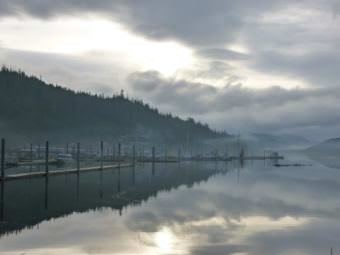
The harbor at Thorne Bay on Prince of Wales Island. (Photo courtesy Department of Commerce, Community and Economic Development; Division of Community and Regional Affairs’ Community Photo Library)

The U.S. Forest Service is proposing the harvest of up to nine square miles of young growth timber on Prince of Wales Island. It’s part of a years-long transition away from old growth logging in the Tongass National Forest — and some in the timber industry worry they’ll be left behind.

One of the project’s main goals is to provide local mills with three years’ worth of timber.

That would mean harvesting about 5,800 acres over 15 years. It’s a haul worth somewhere between $7 and $10 million.

The agency says the Thorne Bay Basin Integrated Management Project would be a much-needed boost to Prince of Wales Island’s timber sector.

“There is a need for young growth forest management now to produce future desired resource values, products, services, and forest health conditions that sustain the diversity and productivity of forested ecosystems,” the Forest Service’s plan read.

An area map of the Thorne Bay Basin Integrated Management Project. (Image courtesy of the U.S. Forest Service).

Grizz Nicholson owns Fair and Square Lumber in Coffman Cove. He said he’s a fan of the plan.

“I really support the transition to second growth as soon as possible,” Nicholson said.

He said the younger trees are easier on his equipment. And, he noted, they don’t have as many imperfections. That means he doesn’t waste as much turning the logs into lumber.

“When it comes to the amount of time it takes setting up to do the milling and, and the amount of waste that you get … for a small milling operation, that’s huge,” he said. “There’s enough wasted as it is, let alone defect waste.”

But Nicholson acknowledged that a transition towards younger trees will be a challenge for many in the timber industry.

“But it’s going to be hard on those mills whose business plan is sort of organized around cutting, especially red cedar,” he said.

The timber industry has long been geared towards old growth. And there’s plenty of demand — old growth Sitka spruce, for example, is prized by musical instrument manufacturers for its acoustic properties.

But in recent years, the federal government has pushed to transition Tongass logging towards young growth. The Obama administration revised a key planning document in 2016 to require the Forest Service to move away from old growth timber sales. And shortly after taking office, President Joe Biden’s administration announced a freeze on old growth sales in the Tongass. The Biden administration also is working to reimpose the Clinton-era Roadless Rule in the Tongass, which would protect roughly 168,000 acres of old growth.

Conservationists say moving towards young growth helps protect habitat for things like deer, salmon and wolves — and helps fight climate change.

But some in the region are skeptical that young growth can sustain Southeast Alaska’s dwindling timber sector. Jay Kohn owns JK Forest
Products in Thorne Bay, and said there’s just not enough young growth to keep mills like his in business.

“It would probably put half the mills on the island out of business, if not all the mills on the island out of business,” Kohn said.

Even now, Kohn said he can’t rely on a steady supply of it.

“It’s sporadic and very competitive,” he said.

He does agree that old growth has more imperfections, but explained those trees make a better finished product.

“Definitely the young growth tends to have less defects in the wood — however, the young growth itself is less mature wood and the visual cues are not the,” he said.. It’s not as visual(ly) pleasing. and (the) longevity of the wood isn’t there. It’s just not as pretty wood. It’s not the same. So it looks more like a piece of plywood.”

The state’s Department of Natural Resources recently proposed a controversial sale of some eight-million board feet of old growth timber on the northern side of the island.

Timber is only one part of the Thorne Bay Basin project. Other plans outlined in the proposal include planting native plants, restoration work on creek beds that are home to fish, and pre-commercial thinning to keep the environment healthy for wildlife.

“The purpose for thinning within wildlife corridors and terrestrial habitat areas is to increase the amount of light that reaches the forest floor to enhance the growth of forage plants to meet wildlife needs,” the draft plan explained.

The project also would add six miles of new temporary roads and one mile of permanent Forest Service System road, while cleaning up 42 miles of existing roads on eastern Prince of Wales Island. That work would be done with materials from existing quarries in the area.

“Seeking public input will help us ensure our ultimate decision factors in the needs and desires of the local community, as well as the visitors we receive,” said Mark Pentecost, a Craig and Thorne Bay District Ranger.

The public comment period for the Thorne Bay Basin project is open until Oct. 21.

Final projects selected in $25M program for sustainable development in Southeast Alaska

""
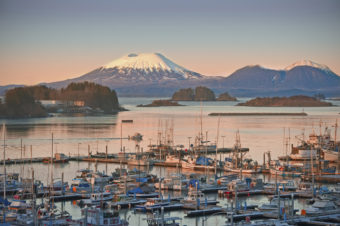
Sunrise over Thomsen Harbor in Alaska. Mt. Edgecumbe, Sitka Ranger District, Tongass National Forest, Alaska. (Forest Service photo by Jeffrey Wickett)

The U.S. Department of Agriculture has made its final funding decisions in a $25 million program to support local organizations in Southeast Alaska, officials said on Tuesday

The Southeast Alaska Sustainability Strategy, announced last year, has now made commitments to over 30 local and regional partners for 70 locally driven projects, Agriculture Secretary Tom Vilsack said in an online announcement event.

“These projects and investments, I think, reflect our common commitment to acknowledging, respecting and honoring Indigenous ownership and stewardship, the knowledge, the values, the priorities,” Vilsack said. “I think it also reflects our commitment to a community-driven investment strategy that reflects the input from local folks. It reflects the local knowledge and priorities and certainly puts a premium on collaborative relationships.”

The strategy is being undertaken by two agencies of the Department of Agriculture — the U.S. Forest Service’s Rural Development division and Natural Resources Conservation Services. It is intended to help the region transition from past reliance on large-scale timber harvests in the 16.7 million-acre Tongass National Forest, which encompasses most of Southeast Alaska.

Of the $25 million in project funding, about half will be managed by tribal and Indigenous organizations, for purposes that include arts and cultural support, enhancement of food security and support for cultural use of forest products.
The emphasis on Indigenous values and priorities was lauded by Richard Peterson, president of the Central Council of Tlingit and Haida Indian Tribes of Alaska.

“This is the first time in my 27 years as an elected person that I’ve actually seen this level of local decision-making,” Peterson said in the online event. “So often, we see decisions made at a national level that really don’t fit. We’ve got to shoehorn them in. And this is happening at the local level. It’s really refreshing.”

The other half of the funding is for projects aimed at boosting infrastructure, community economic development and natural resource management.

That includes workforce development projects to help young commercial fishermen and to enhance mariculture operations, said Robert Venables, executive director of the Southeast Conference, a regional economic development organization. Many of the opportunities “will help the next generation not just find a job but be the job-makers,” Venables said.

The Southeast Alaska strategy is a new way of doing federal government business that can be replicated in other regions of the nation, Vilsack said.

“It’s a model that creates a real powerful partnership where the resources of the federal government are directed in a way that local folks understand and can help to direct,” Vilsack said. “I’m excited about the potential for this model to be expanded, to continue to be expanded in other mission areas of the USDA.”

Related to the sustainability projects is the Forest Service’s decision, announced last year, to restore the federal protections to the Tongass under what is known as the Roadless Rule. The 2001 Roadless Rule largely bans timber harvesting in areas currently without roads, thus preserving old-growth stands. Under the Trump administration, Alaska was exempted from the Roadless Rule.

The decision to reinstate the protections in Alaska has attracted over 110,000 public comments, which must be fully reviewed before the Biden administration completes its final rulemaking, Vilsack said at the news conference.

The final rule is expected by the end of the year, he said.

“I recognize that this may not have happened as quickly as some would like. But I am committed to getting this done to conserve this important resource,” he said. “I hope folks understand that we do have to follow through the process. We have to be respectful of the people who took time and energy to provide comments so that the record is as complete and as strong as it possibly could be in order to defend the decision that we’ve made to restore the protections of the 2001 Roadless Rule.”

Stream restoration near Petersburg aims to improve fish habitat

An excavator working in a forest
Rock-N-Road excavators move logs into place on the east fork of Ohmer Creek Thursday, July 21, 2022. (Photo by Joe Viechnicki/KFSK)

Several streams south of Petersburg are getting some major restoration work this summer. The goal is to mimic natural processes to bring back topsoil and improve fish habitat.

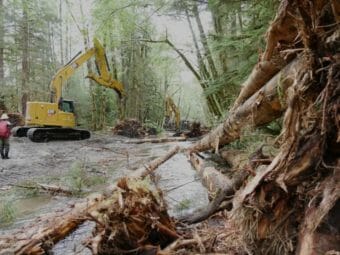
Two excavators were digging out part of the east fork of Ohmer Creek, a salmon stream that runs under Mitkof Highway about 21 miles south of Petersburg. They were moving huge logs, many with rootwads still attached, and placing them in the streambed.

Six decades ago, the trees along this stream were logged and many stumps removed.

“When you lose the wood out of the stream, you lose the fish habitat out of the stream,” said Heath Whitacre, a hydrologist with the U.S. Forest Service. “And the hard part to overcome is, you have a long time to wait until the trees that were logged in the flood plain come back to a size that will create more habitat in the future.”

This project aims to rebuild some of that fish habitat on an area of about 20 acres around east Ohmer Creek, along with the north and south fork of a tributary to that called Lumpy Creek.

The Forest Service has contracted with Petersburg company Rock-N-Road Construction to cut trees and truck them in from a different part of the island. In mid-July, they started using those logs to create deep pools for salmon and trout.

“We’re just basically creating a structure that will create that pool,” Whitacre said. “All that power that comes down in the water is going to basically flush out a nice deep pool.”

The repairs also stretch out into the forest, where the water flows when the streams top their banks. When it was logged, the area was also a source of gravel for crews extending the nearby Mitkof Highway. When they removed that gravel, they also took topsoil that would normally help new trees grow.

The Forest Service is partnering with the Southeast Alaska Watershed Coalition on this project. Kelsey Dean is a watershed scientist with the coalition.

“There’s a lot of areas where this happened in the 60s, and normally you would see trees be two times the size they are now, but they’re really stunted in growth because they lack that topsoil, that nutrients,” she said. “We’re also looking to restore the flood plains and recruit that soil back in by placing large wood there so that trees can grow bigger and not be this stunted.”

The watershed coalition purchased additional wood from a local company that will be dropped into the flood plain. The project also means re-engineering part of one of the creeks to divert flow into an area that’s been cut off.

The cost of the work is just over $400,000 dollars. The Forest Service is paying around $91,000 of that. The watershed coalition pays around $120,000 dollars from a compensatory mitigation fund it has. Another $155,000 comes from federal funding for projects on National Forest land, while the Alaska Sustainable Salmon Fund pays $40,000 of the project cost.

A man in a hardhat points at trees
Whitacre shows a corduroy road created to bring in logs to a portion of Lumpy Creek, along with the stunted spruce and hemlock growing in this part of the flood plain. (Photo by Joe Viechnicki/KFSK)

Sig Burrell owns the Petersburg contracting company Rock-N-Road. He said it’s not the first stream restoration they’ve done for the Forest Service, and they like doing the work.

“I think it will last,” Burrell said. “We did that one out on Kuiu (Island) and one on Prince of Wales (Island). Heath and these guys know what they’re doing, tell us where to dig them in and how to build these structures.”

The Forest Service did some prior restoration work at Ohmer Creek a couple decades ago, adding some rearing ponds for smaller fish. Those are showing signs of working.

The crews will be building around 15 structures in the creeks and the work should be done by early August. The Forest Service will monitor the progress one year, three years and five years after. Although the benefit for tree growth may not show up for much longer.

Forest Service seeks to restore logged area on Admiralty Island

A view of a hilly landscape with clearcut slopes
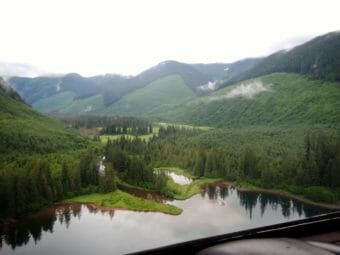
This aerial photo shows past logging upstream of Kathleen Lake in the Cube Cove area of Admiralty Island in Southeast Alaska. (USFS photo)

The U.S. Forest Service is proposing to restore land on an island in the Tongass National Forest that has been logged in past decades. The federal agency wants this 23,000 acres of developed land to match the wilderness area that surrounds it.

Cube Cove is on the northwest side of Admiralty Island. The area was heavily logged – mostly by clear cut – in the 1980s and 90s by Shee Atiká, Sitka’s Native Corporation. The U.S. Forest Service bought the land for just over $18 million, completing the deal in 2020. Shee Atiká had done some reclamation work after the logging, but the Forest Service wants to finish it up.

“Admiralty Island is a special and unique place, every inch of it anyways,” said Marci Johnson, a wildlife and fisheries biologist with the U.S. Forest Service. “Certainly some unique characteristics with the concentration of brown bears, eagle nests and a lot of intact, old growth forests throughout the island.”

Before the federal purchase, it was the largest privately owned land surrounded by a federal wilderness area. It’s now joined that protected area, known as Kootznoowoo Wilderness, which makes up most of Admiralty Island.

Shee Atiká did not immediately respond to a request for comment.

A map of Admiralty Island showing the project area
The Cube Cove region was logged in the 1980s and 90s by Shee Atiká, Sitka’s Native Corporation. On the map it appears as three fingers on Admiralty Island. The U.S. Forest Service is proposing to restore the land. (USFS)

Because of past logging, there are many remaining roads, bridges and culverts. The Forest Service proposes removing three large steel bridges and culverts that would affect fish passage. They also want to remove or modify some of the road beds that might affect water flow. Johnson says there is a coho salmon run and trout in the streams.

“So eventually this type of infrastructure does fail, and it could become a fish passage issue and water quality issue,” Johnson said.

The federal agency is also proposing to thin some of the new growth trees to allow space for larger ones to grow, especially around waterways.

“When you don’t have these large trees growing around these streams, you don’t have that temperature control and you also don’t have this large wood material that ends up in the creeks is good fish habitat,” Johnson said.

There are two federally managed recreational cabins on site that see visitors. Johnson says that the driving force behind the restoration project is preserving the wild character of the land now and in the future.

“Providing that wilderness experience in say a visitor in 300 years is still important too,” she said.

A few years ago, a pilot project removed a large culvert on a fish bearing stream near a lake in the area. It was run by the Southeast Alaska Watershed Coalition with help from an Angoon youth program.

An exposed culvert with logs lying across it
This culvert in the Cube Cove area of Admiralty Island was removed in a pilot project run by the Southeast Alaska Watershed Coalition with help from an Angoon youth program. (USFS photo)

The village of Angoon is south of Cube Cove on the western shore. Its residents have lived on Admiralty Island for as long as anyone knows and subsistence fish and hunt there.

“We put up fish to last us the winter,” said Tribal Administrator Charles James. “We can our fish; we smoke it,”

James doesn’t know if any residents go near the logged areas now but he says restoring the land makes sense.

“I think it would be nice to have those trees and stuff growing back and get all that stuff out of there,” he said.

The Forest Service plans to do more field work this summer to fine tune the details of the project, such as what tools and equipment will be needed. They are taking public comment on the proposal through July 22. They expect all the work to be completed within five years.

It’s unknown how much the restoration will cost and what partnerships might help fund it. But it’s been identified as a priority project by the Tongass National Forest.

Here is the U.S. Forest Service scoping proposal.

Site notifications
Update notification options
Subscribe to notifications