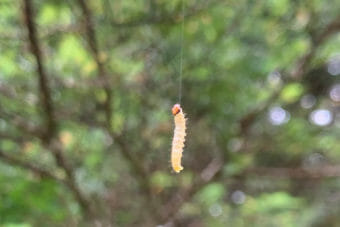
The western blackheaded budworm larva is familiar to many forest users as a caterpillar hanging from a tree branch. (Photo courtesy of USDA Forest Service Alaska Region)
An insect infestation that was first reported in 2020 will continue to cause damage to a variety of trees throughout the Tongass this summer.
Last summer’s unusually warm weather fueled an explosion in the western blackheaded budworm, leaving masses of browning trees in many areas of Southeast. The worm, which is the larval stage of the budworm moth, is known to feed on the new growth of trees, leaving them with a brownish-red appearance.
While budworms have been known to target hemlock trees, Dr. Elizabeth Graham, an entomologist for the USDA Forest Service Alaska Region, says they seem to be moving on to spruce this year.
“This is possibly the result of, you know, depleting the resource. There was so much defoliation on hemlock last year. And so the females may have chosen to lay their eggs on spruce instead, since there’s maybe more of a foliage resource available than with the Hemlock,” Graham said.
According to the Forest Service, this is the first large scale outbreak Southeast has seen since the mid 90s. While the damage may seem severe as worms continue to feed over the coming weeks, Graham says these infestations are a natural part of the changing forest.
“They’re basically a cool driver of change, that they’re creating new gaps in the canopy, adding some more light to the forest floor, adding some more fertilizers to the forest floor. And so there, there are many ways can be beneficial,” she said.
The infestations occur on a 30-to-40 year rotation. Graham says they usually persists over the course of several years before naturally crashing, but she’s hopeful that we’re in the peak stages.
“We’re kind of seeing that since they’re switching over to spruce now, and so they just can’t sustain at these levels. And so hopefully we’re reaching the peak, and that, you know, maybe this will be the last year,” Graham said. “They just can’t last that long.”
While most trees are expected to survive the outbreak, the Forest Service is encouraging visitors to document and share their observations of insects and tree damage through the iNaturalist app. Photos, videos or information related to the budworm or its subsequent damage that is uploaded to the app will automatically be included in the Alaska Forest Health Observations Project, a citizen science project in iNaturalist.
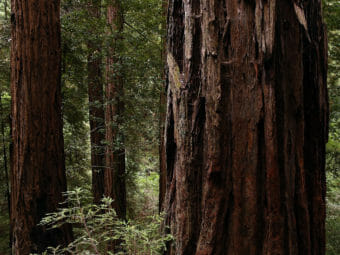
Coastal Redwood Trees (Photo by Justin Sullivan/Getty Images)
On the morning of March 27, 2018, rangers from Redwood National and State Parks put on their bulletproof vests and jumped into their cars. Their destination wasn’t far: a house in the small town of Orick, California, the same town as the park headquarters where the rangers are based. Pulling up to the house, they grabbed their AR-15s. Guns in hand, they pounded on the door, shouting they had a search warrant.
One of the residents opened the door, and the rangers began searching the premises. Two of them rounded the property and went into the backyard, where there was a shed. Holding their semi-automatic rifles up, ready to shoot, they entered the shed and found their suspect, Derek Hughes. “If you shoot me, you’re going to have all hell to pay,” Hughes reportedly said.
The park rangers handcuffed Hughes. Searching the premises, they found brass knuckles, a handgun, a camera they suspected was stolen from the park, a plastic bag with traces of methamphetamine, and four meth pipes. But the rangers weren’t there for any of that. They continued searching for what they were really looking for. And, scattered along a fence, under a tarp, and in a woodworking shop, they found it: chunks of illegally poached redwood.
When most people think of park rangers, they probably think friendly nature guides in fun hats. But at Redwood National and State Parks, the park rangers’ mission of protecting old-growth redwood trees has led them to become a kind of anti-poaching police squad. Some of their investigations have been so action-packed they could be episodes of a TV show. Think CSI: Redwood Forest.
A new book by writer and National Geographic Explorer Lyndsie Bourgon dives deep into this fascinating criminal world of tree theft and efforts to combat it. It’s called Tree Thieves: Crime and Survival in North America’s Woods, and much of it examines poaching conflicts in Orick, the southern gateway to Redwood National and State Parks.
Burl Poaching
In many ways, the struggling former logging town of Orick, California, resembles other rural towns and inner cities hit by the atomic bomb of deindustrialization. Blight mars man-made structures. Poverty and unemployment rates are high. And people have turned to drugs, alcohol, and crime to cope.
But the crime around Orick that Bourgon examines in her book has a distinctive local flavor. Over the last decade, Orick residents have been caught illegally harvesting a part of redwood trees known as “burls.”
Bourgon describes burls as “big, gnarly bumps” on trees that are covered in bark. “And they form after the tree has experienced a bit of distress,” Bourgon says. “Sometimes that means a fungal infection or a lightning strike or maybe they’ve survived a fire. And the burl is the tree kind of directing all of its resources into healing that area — and in doing so it creates a burl that holds a lot of genetic DNA. And often new trees will sprout from a burl because it contains a lot of genetic material.”
Redwood Burls (Wikimedia Commons)
Burls may be important to the health of trees, but they’re also financially valuable, sometimes fetching thousands of dollars for a slab. “They produce this really lovely piece of grained wood that’s very easy to carve because it’s smooth,” Bourgon says. “You don’t get a lot of blemishes or knots in it. People turn them into tables, sculptures, statues. They have been used in luxury goods made abroad, like in the consoles of cars.”
They say that money doesn’t grow on trees, but tell that to the region’s burl poachers. “It’s quick money,” says Stephen Troy, the chief ranger of Redwood National and State Parks. Through their investigations, Troy says, they’ve discovered that poachers can quickly offload their burl heists to local buyers. “We have found illegal burlwood in storefronts in Orick and as far as Eureka, to the south, as well as Crescent City, to the north,” Troy says.
The burl industry around Orick remains lucrative. Driving up Highway 101 — which in these parts is also known as Redwood Highway — you’ll see artisanal shops that sell sculptures, furniture, and trinkets made out of burlwood. It’s a cultural pastime and a way of making a living. The products show incredible craftsmanship and artistry. The problem, however, is some of this wood — and it’s pretty unclear how much — may be illegally harvested from old-growth redwood trees on national and state park land.
In an effort to get burlwood, poachers sneak into the woods in the dead of the night with chainsaws. Typically, Troy says, they’ll do it during stormy weather, when it’s less likely for people to catch them in the act. They saw off large chunks of trees, opening them up to infection and potentially threatening their ability to stand. “The burl is also a protectionary reproductive measure, so if you lose the burl, you’re not only losing that tree, but you might also be losing the ability of that tree to reproduce,” Bourgon says.
Articles about poaching at Redwood National and State Parks began proliferating around 15 years ago. Back then, however, the problem was theft of dead redwood logs, not live trees. “Although thieves haven’t started chopping down live trees, authorities worry that will become an issue as the number of easily poached logs diminishes,” the San Francisco Chronicle reported in 2006.
Poaching downed trees is still a serious problem for the ecological health of the forest, says Erin Gates, the Deputy Superintendent of Redwood National and State Parks. However, the problem has gotten even worse over the last decade. Since at least 2012, poachers have expanded their poaching to live trees in the parks, hacking off burls and even felling whole old-growth redwoods in their quest for burlwood. Park officials have uncovered dozens of poaching sites. And that, Ranger Troy suspects, is “just the tip of the iceberg.”
Gates sees illegal burl poaching as the latest chapter in a centuries-long story: the obliteration of the coastal redwood forest, which once covered two million acres along the West Coast. “For the most part, almost all of the old-growth redwoods on the planet have been cut down,” Gates says. “There are only 4 percent of them left.” Redwood National and State Parks protects about 40 percent of these remaining trees, and with supply dwindling on private land, the park has increasingly become a target. These trees can be upwards of 2,000 years old, so it’s not like they can be easily replaced.
To combat this scourge of forest crime, the park has invested in cameras, motion detectors, and various other technologies to catch poachers in the act. In the case of poacher Derek Hughes, this technology helped to catch the perpetrator. After a park ranger stumbled across a secretive poaching site in the park, he suspected the poacher would come back to the same area to harvest more burls. So he hid motion-activated cameras in the forest. A month later, the ranger analyzed the footage and identified a suspect who they believed was Derek Hughes (it’s a small town). The footage helped rangers get a search warrant for his residence, where they eventually found evidence of burl theft.
Hughes ultimately pleaded guilty to felony vandalism. The court sentenced him to two years of probation and required him to pay a $1,200 fine, as well as complete 400 hours of community service. Hughes is also banned from Redwood National and State Parks.
Rumble In The Woods
As we highlighted in the first part of this series, Orick residents have long had beef with the national park, seeing its creation, expansion, and subsequent management as the source of their immiseration. While in the past this tension was about the park’s prevention of logging, which was once the region’s livelihood, these days tensions are about the policies and day-to-day conduct of park officials.
In the early 2010s, Redwood National and State Parks declared burl poaching a “crisis,” and they began ramping up law enforcement efforts. A huge part of their mission, after all, is to protect this one-of-a-kind ancient redwood forest. However, as Bourgon documents, it also has exacerbated tensions between the parks and Orick.
Talking to some locals, the national park can sometimes sound like a foreign occupying force. Redwood National Park’s rangers, Bourgon says, pull people over if they suspect they are carrying illegally harvested wood, or are breaking the law in some other way. The park has also partnered with the Save The Redwoods League, an environmental group that has spent more than a century protecting redwoods, to offer a $5,000 reward to anyone who snitches on poachers.
“You can imagine — in an area that has been really affected by the work of the Save The Redwoods League and the park — how that might be perceived,” Bourgon says.
For Bourgon, tree poaching is the product of a desperation found in places without many options. Since the logging industry collapsed, Orick has been trapped in a downward spiral. When the park was opened and then expanded, officials told Orick that it would thrive as more and more tourists flocked to the area. How could it not? It’s right next to the parks. However, despite its prime real estate and the flow of tourist traffic through the area, Orick has, for the most part, failed to capitalize on its desirable geography.
“Orick finds itself ensnared in a vicious circle: its reputation for drugs and unsightly property deters anyone who might want to invest in making it a permanent home or a place where tourists might want to stay,” Bourgon writes. Local officials, like Gregg Foster, the executive director of the Redwood Region Economic Development Commission, sees a big part of the problem as a lack of public investment in infrastructure and upkeep and a morass of confusing regulations that discourages private investment.
Bourgon argues that Redwood National and State Parks should hire more locals, which might do double-duty of easing community tensions and providing greater opportunities in the area. Gates says park jobs are “open to everyone.” She added, “We encourage our local surrounding community members to apply for these positions, but we do not have any control over whether they do or do not apply.”
In recent years, economists have been paying much more attention to the intractable problems created by deindustrialization. It turns out that after places lose the main source of their livelihoods, residents don’t just move to other places for better opportunities, as classic economic theory suggested they would. Instead, many stay and suffer, even as their hometowns collapse. In desperation, some turn to criminal activity, like dealing drugs or stealing precious redwood burls. We’ve seen stories like this play out over and over again, in former coal-mining towns, in inner cities, and in places that lost manufacturing after Chinese-made goods flooded America.
Recognizing that people show a tendency to stay in place, economists and policymakers have been turning to “place-based policies,” or policies aimed at helping distressed places get out of their economic rut. If there were ever a place that smart policies could help turn around, Orick — which sits at the doorstep of incredible parks with the tallest trees in the world — has got to be a prime candidate. After all, if people there had good jobs and an incentive not to sneak into the parks at night, chainsaws in hand, it wouldn’t just be the community that would benefit: the redwoods would be more likely to flourish as well.
Copyright 2022 NPR. To see more, visit https://www.npr.org.
Arctic National Wildlife Refuge (U.S. Fish & Wildlife Service-Alaska)
Forty-eight candidates are running in the special election to fill the rest of Congressman Don Young’s term. It’s the most candidates ever in one election in Alaska. First up is the primary. Ballots are out now and must be returned by June 11.
Here’s how they responded, in their own words, to the following questions on natural resource development:
Do you want to see … (Please answer yes or no. If needed, add an explanation of no more than 10 words.)
Oil development on the Coastal Plain of the Arctic National Wildlife Refuge?
Development of the Pebble Mine?
A road built to serve the Ambler Mining District?
The Roadless Rule apply to the Tongass National Forest?
Jay Armstrong (R):
ANWR? “YES, Alaska needs ALL of our lands/ resources back from Feds.”
Pebble? “Yes, Only if done responsibly with no risk to fisheries/ environment.”
Ambler Road? “Yes, I support ALL roads to resources and towns where possible.”
Roadless Rule? “Alaskas Statehood Act wasn’t Constitutional, or resulting Federal tyrannical control.”
Nick Begich (R):
ANWR? “Yes”
Pebble? “A scientific, lawful, and comprehensive process must determine this outcome.”
Ambler Road? “Yes”
Roadless Rule? “No”
Gregg Brelsford (undeclared):
ANWR? “Yes. Properly balanced with subsistence, environmental protection, and climate change considerations.”
Pebble? “No. Don’t put ancient Bristol Bay reds at even microscopic risk.”
Ambler Road? “Yes. Properly balanced with subsistence, environmental protection, and climate change considerations.”
Roadless Rule? “No. Limited exception – properly balancing subsistence, environmental protection, climate change considerations.
Chris Bye (Libertarian):
ANWR? “Yes, it funds our universities and public schools.”
Pebble? “No, not in its current configuration with difficult international accountability.”
Ambler Road? “For a US mining company accountable to US judicial system and fines? With access by Alaskans? Yes.”
Roadless Rule? “No, what if natives or other AK residents want a road?”
Arlene Carle (nonpartisan):
ANWR? “Yes. The North Slope proved we can develop resources responsibly.”
Pebble? “Yes. Alaska’s resources belong to all Alaska people, not just a few.”
Ambler Road? “Yes. Resources are our competitive advantage. Let’s develop them responsibly.”
Roadless Rule? “I support exemption. Selective forestation preserves forest health. Nature’s way destroys.”
Santa Claus (undeclared):
ANWR? “NO. Protect the sacred. Defend the Arctic Refuge.”
Pebble? “NO. Protect Bristol Bay’s watershed and commercial salmon fishery.”
Ambler Road? “NO. A road threatens fish, game and subsistence way of life.”
Roadless Rule? “YES. And stop land exchanges in the world’s largest temperate rainforest.”
John Coghill (R):
ANWR? “Yes to oil development in the 1002 area”
Pebble? “Yes Develop the Pebble mine”
Ambler Road? “Yes, build the Ambler road”
Roadless Rule? “Repeal the roadless rule if possible, allow mineral extraction, and Hydro power in the Tongas National Forest.”
Chris Constant (D):
ANWR? “No, but would not oppose with local support/environmental protections.”
Pebble? “No. Our fisheries are a renewable resource we must protect.”
Ambler Road? “Yes, to facilitate long-term local infrastructure and economic development.”
Roadless Rule? “Yes, but with exceptions for tribal access for traditional uses.”
Al Gross (nonpartisan):
ANWR? “Yes. I support environmentally responsible development of the 1002.”
Pebble? “No. Wrong mine, wrong place. I support EPA 404c protections.”
Ambler Road? “Yes. I support responsible resource development that has local community support.”
Roadless Rule? “No.Tongass exemption will help build a sustainable economy in Southeast.”
Andrew Halcro (nonpartisan):
ANWR? “Yes. But it’s a distraction and is not happening in our lifetime.”
Pebble? “No. This is not the place for a mine.”
Ambler Road? “Only if the mining industry pays the cost.”
Roadless Rule? “No. The Tongass is big enough to allow for more logging.”
Ted Heintz (nonpartisan):
ANWR? “Yes, via directional drilling although there’s oil/gas elsewhere too.”
Pebble? “NO! I support ecologically sound development. Pebble isn’t ecologically sound!”
Ambler Road? “Yes, support domestic production, fight foreign exploitive producers like China.”
Roadless Rule? “YES! I support ecologically sound development. This isn’t ecologically sound!”
Don Knight (nonpartisan): (Blank email)
Jeff Lowenfels (nonpartisan):
ANWR? “Yes, if there is still interest.”
Pebble? “No, I am with Jay Hammond and Ted Stevens on this.”
Ambler Road? “Yes, it is mandated by ANILCA.”
Roadless Rule? “No, Southeast deserves an economy and that requires roads.”
Mike Milligan (D):
ANWR? “No to development in the 1002 lands of ANWR.”
Pebble? “No to Pebble Mine”
Ambler Road? “Yes with huge caveats on road use”
Roadless Rule? “Yes- NOLs got monetized, we’ll monetize carbon storage thru USDA.”
J.R. Myers (Libertarian):
ANWR? “Yes, for national security during international crisis.”
Pebble? “I oppose development of a Pebble Mine.”
Ambler Road? “I oppose a new road for the Ambler Mining District.
Roadless Rule? “Yes, we need to continue to apply the roadless rule to the Tongans National Forest.”
Sarah Palin (R):
ANWR? “YES.”
Pebble? “If the science proves it safe, build the mine.”
Ambler Road? “YES.”
Roadless Rule? “NO.”
Silvio Pellegrini (undeclared):
ANWR? “Yes. Must include all primary stakeholders in development.”
Pebble? “No. Work with the company to seek incentives to develop elsewhere for a Win-Win.”
Ambler Road? “Yes. Must include all primary stakeholders for the 20 miles of NPS development.”
Roadless Rule? “Yes and No. The Roadless Rule needs a revision to limit its geographic scope. Include all primary stakeholders.”
Mary Peltola (D):
ANWR? “I support exploration guaranteed by ANILCA pending rigorous regulatory assessments and ongoing local buy-in.”
Pebble? “No, I unequivocally oppose development of the Pebble Mine.”
Ambler Road? “Yes, pending local support, usage restrictions, and environmental standards are met.”
Roadless Rule? “No, impacted communities should determine how to use their land.”
Josh Revak (R):
ANWR? “Yes.”
Pebble? “The salmon fishery needs to be protected, and the regulatory permitting process should be adhered to.”
Ambler Road? “Yes.”
Roadless Rule? “No.”
Tara Sweeney (R):
ANWR? “YES.”
Pebble? “Support a transparent, science driven process and oppose preemptive decisions.”
Ambler Road? “YES.”
Roadless Rule? “Oppose executive decisions creating de facto wilderness that violate ANILCA’s “No-More” clause.”
David Thistle (undeclared):
ANWR? “NOT personally.”
Pebble? “NOT personally.”
Ambler Road? “Local Residents.”
Roadless Rule? “Yes, unpaved to “control cut” for Recreation & Emergencies.”
Ernest Thomas (D):
ANWR? “No.”
Pebble? “No Danger to the last remaining salmon runs on earth is too great a risk.”
Ambler Road? “l support the building of roads in Alaska under controlled conditions.” (Answer truncated to meet word limit)
Roadless Rule? “Forest management of this old growth forest shall be done via airal helicopter or balloon harvest.” (Answer truncated.)
Adam Wool (D):
ANWR? “ANWR leasing has already happened but it shouldn’t be expanded.”
Pebble? no. bad location for mine.”
Ambler Road? “yes. Ambler has potential to move us to renewables.”
Roadless Rule? “I support the roadless rule. It doesn’t pencil out for the Feds.”
Stephen Wright (R):
ANWR? “We are the best and we can safely extract it!”
Pebble? “Develop Rare minerals here in Alaska, we do it best”
Ambler Road? “We need corridors and ambler would be a good start!”
Roadless Rule? “We need roads to timber, access and safety, add roads!”
Editor’s note: We’ve left answers mostly unedited. If candidates exceeded the word count we did not include the last sentence(s).
The following candidates are on the ballot, but Alaska Public Media has not yet received a response to our emails: Dennis Aguayo, Brian Beal, Tim Beck, Robert Brown, John Callahan, Lady Donna Dutchess, Otto Florschutz, Laurel Foster, Karyn Griffin, William Hibler, John Wayne Howe, David Hughes, Robert Lyons, Anne McCabe, Mike Melander, Sherry Mettler, Emil Notti, Robert Ornelas, Maxwell Sumner, Richard Trotter, Bradley Welter, Jason Williams and Jo Woodward.
Members of the Gannett Glacier Fire Crew takes notes during a fire training scenario near Palmer on Thursday, April 29, 2018. (Photo by Casey Grove/Alaska Public Media)
Alaska’s wildland firefighters have been completing their annual training and, with help from a state grant, strategically cutting and removing trees, many of them killed by spruce beetles.
That hazardous fuels reduction comes as long-term forecasts signal a “normal” fire season ahead, with about a million acres expected to burn — somewhere between the sizes of Rhode Island and Delaware.
Norm McDonald, the state Division of Forestry’s Chief of Fire and Aviation, said the prep work cutting fire breaks is helpful and likely to save money in the long run. But McDonald said all it would take to go from an average fire season to a huge one is some hot, dry weather and a lightning strike — or the careless burning of some brush or a campfire.
Listen here:
The following transcript has been lightly edited for clarity.
Norm McDonald: If you look historically at our most devastating fires, they are in the urban interface, and they have been human caused. So these are all fires that in theory should be preventable. So I think just the awareness that any time you do an activity that includes either burning or open flame in the wildland setting, just use extreme caution, especially this time of year, May, as we have that dry grass and these windy conditions.
It does not take much of a start for a fire to get out of control, past where a homeowner can suppress it on their own. And those are our most expensive fires. Those take the most resources, the most firefighters and aircraft. So we really ask people to use extreme caution, whether that’s their typical Alaskan outdoor activities like camping and hunting. When you’re doing your land clearing, look at other options instead of burning in May and June when it’s dry and windy. Save that burning for fall when we get our wetter conditions or that first snow in October. That is something that we really try to encourage people to do.
Casey Grove: Gotcha, yeah. Nobody wants something getting away from them like that and causing damage to their neighborhood or anybody else.
Norm McDonald: No, and people are always surprised at how quickly — they have a burn barrel or a small fire or a barbecue in the grass — how quickly a fire starts to something that they can’t control with what they have on site. And then the fire department shows up and the helicopters show up. Every person that we go through with that always says the same thing, “I had no idea how quickly that fire could spread.” Just something to be aware of, for anybody doing that type of activity this summer.
Casey Grove: There’s a lot there that you can’t really control, like the weather or where lightning strikes and things like that. And you can get the word out about how residents should be behaving to be fire safe. But I guess there are a few things that you can do ahead of time to prepare. And one of those things is what you call hazardous fuels reduction, right? And I guess that’s a big push this year, it sounds like.
Norm McDonald: Yeah, and it’s nothing new to the division. We’ve been doing fuel breaks and the hazardous fuels reduction, you know, going back to the mid ’90s. And that really started with the first beetle epidemic we had going back to ’95, ’96, that timeframe. And so it’s something we’ve used and have had success with. What’s changed this year is we have, for the first time, last year we received state dollars. We’ve relied entirely on federal grants up until last year, for fuels reduction.
With this administration, public safety is a big part of their push, and we received a $10 million capital improvement project, just earmarked for fuels reduction. And so that gives us state funds to leverage more federal funds, which this year come to us through the infrastructure bill. So we are really in a good place when it comes to actually funding for this work.
And now building capacity to meet the requirements of that work is really where we’re at now. Yeah, it’s a really exciting time as far as opportunities to provide a better service and public safety and develop these fuel breaks around some of our critical infrastructure and communities.
Casey Grove: Well, what are fire crews doing right now, other than reducing fuels and cutting fire breaks? What are they doing to get ready for the coming fire season?
Norm McDonald: So our Division of Forestry crews, they come back starting about mid-April, and they do what we call our 80 hours or two weeks of training. And that’s their physical fitness, that’s their fire readiness. They’re getting their gear up and ready.
They’re ready to go May 1, so our crews are staffed. They’re ready to respond. We have them pre-positioned around the state, including Kenai and the Mat-Su Valley. The Fairbanks crew is down in Kenai, because snow still on the ground means fire season is a couple weeks behind. So we have them pre-positioned to where they’re available to do the most good and in a short order.
But while they’re not assigned to fires, they’re doing this fuels reduction work. So this is really good preseason work, and that kind of crossover training for a lot of the similar work they do when there’s a wildland fire. And that’s running chainsaws and clearing those fire breaks is very similar to what it looks like on the fire line, as it is when they’re building a fuel break ahead of the fire. So they’re engaged with that work and they’re ready and they’re pre-positioned and ready to go, should they be needed anyplace in the state.
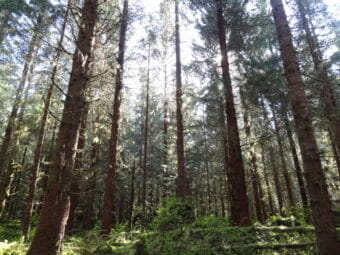
A stand of young growth timber that is for sale near Thomas Bay. The stand has regrown from logging in the 1950s and 60s. (Photo courtesy of the U.S. Forest Service)
The U.S. Forest Service is proposing a young growth timber sale near Thomas Bay in Southeast Alaska that’s seeing opposition from environmental groups. It’s one of the first sales to focus on second growth logging, following a federal plan to stop cutting down old growth trees.
The proposed sale at Thomas Bay could mean logging 22 million board feet of timber from about 840 acres of forest. It would focus on second growth trees that have regrown from logging back in the 1950s and 60s.
“So much has changed since the 1960s,” said Eric LaPrice, Acting District Ranger for the Petersburg Ranger District. He says the previous Thomas Bay logging came before laws restricted how it was done. “So, how areas were harvested in the 50s and 60s — how it’s done today would look nothing like that at all,” he said.
The proposed sale includes smaller plots within the original logged areas. LaPrice says there could be one sale for all of the 800 acres or several smaller sales over a number of years. Either way, it would likely involve clear cutting.
But LaPrice says the logging that’s allowed today does more to take into account wildlife habitat.
“We would have provisions to retain, for example, a buffer along a stream so it would keep the stream shaded,” LaPrice said.
These days, the Forest Service assesses the environmental impacts through workers that didn’t exist decades ago: silviculturists, hydrologists, archeologists and salmon biologists. In the past, areas were clear cut without thought about the regrowth. The forest would regrow pole-like trees too close together to establish limbs or spaces for wildlife. Left alone, it would take hundreds of years to become old growth again, requiring blow downs and other natural developments.
Now, the forest service monitors logged areas and can do restoration treatments like thinning if needed, says LaPrice.
“Right when things are beginning to re-grow, that’s the really critical time to monitor that things may be coming back the way we want them too,” he said.
This image shows the young growth timber that is up for sale near Thomas Bay. (Courtesy of the U.S. Forest Service)
Several environmental groups, like Center for Biological Diversity, Defenders of Wildlife, and the Southeast Alaska Conservation Council, are opposed to the Thomas Bay sale as planned. The sticking point for them is the size of the possible clear cutting, which they say is bad for habitat.
“Essentially, it will be clear cut,” said Katie Rooks, a policy analyst at SEACC. “The entire area will be harvested using clear cut.”
Rooks says that type of logging doesn’t follow the Southeast Alaska Sustainability Strategy, which the federal government announced last year. That plan looks to “support forest restoration, recreation and resilience.”
SEACC wants the Forest Service to stand behind its new plans. The environmental group is proposing some alternatives to the Thomas Bay timber sale that includes breaking it up and offering smaller sales to smaller operators. Rooks says that would be better for the environment and would likely keep the product in Alaska and the Pacific Northwest.
One reason for the timber sale is to restore the area from the old logging. Although most of the sale money would go to the U.S. Treasury, some would go to restoration work in the area, including improving old culverts.
“There were roads and trails that were left in from that, that altered drainage patterns, for example,” LaPrice said. “So, we would be looking at opportunities where if there was a drainage pattern that was altered we might want to restore it back to its original water course.”
SEACC is skeptical of restoration as an incentive for the timber sale. Rooks says other logging restoration projects in the region — like culvert work — have proven that it’s too expensive to get it all done just from timber sales.
“There’s always this backlog of things that need to happen,” said Rooks. “Creating more need for that to happen seems problematic.”
Final approval for the Thomas Bay project is at least a few years off. LaPrice says they hope to have the environmental analysis done in 2023.
It’s unknown how much money the timber sale will make for the government. LaPrice says he can’t speculate until the projects are appraised.
There is another smaller proposed timber sale on Mitkof Island that includes one million board feet on 40 acres located along Upper Falls Creek. It’s possible that logging could start there by the end of this year.
LaPrice says they’ve heard from some small Petersburg companies that are interested in both of the timber sales.
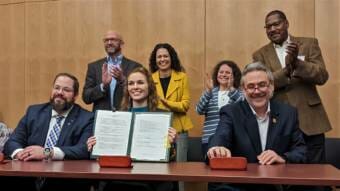
The Alaska heads of three different U.S. Department of Agriculture agencies pose for pictures with an interagency charter they had just signed that empowers a team to work on the Southeast Alaska Sustainability Strategy at the Andrew P. Kashevaroff Building in Juneau on March 31, 2022. Front row: Alan McBee with the Natural Resource Conservation Service, Julia Hnilicka with Rural Development, and David Schmid with the U.S. Forest Service. Back row: Deputy Under Secretary for Rural Development Justin Maxson, Under Secretary for Rural Development Xochitl Torres Small, Deputy Under Secretary for Natural Resources and Environment Meryl Harrell, and Under Secretary of Natural Resources and Environment Homer Wilkes. (Photo by Jeremy Hsieh/KTOO)
The grants are intended to be an early step in a long-term commitment to foster lots of sustainable economic activities driven by locals. There’s support for Indigenous cultural programs, seaweed and shellfish farming, timber management and more.
The Alaska heads of three different USDA agencies also signed an agreement that establishes a permanent team that will work on sustainability goals in Southeast Alaska.
Barbara Miranda, the U.S. Department of Agriculture’s new Southeast Alaska Sustainability Strategy coordinator speaks during an event at the Andrew P. Kashevaroff Building in Juneau on March 31, 2022. (Photo by Jeremy Hsieh/KTOO)
For now, SASS is a unique thing. The USDA doesn’t have other sustainability strategies for other parts of the country.
Miranda said in the past, tribes, local governments or other organizations in Southeast had to shoehorn their needs into existing federal programming. This new strategy has meant getting several different USDA agencies working together and listening to local needs.
“This is different,” she said. “We asked for input from our local organizations and received it. And now, federal agencies … we’re doing the work to struggle to fit those into our agency authorities. The shoe’s on the other foot with this.”
Miranda is based in Juneau. Until about a week and a half ago, she was the director of the Mendenhall Glacier Visitor Center, which the Forest Service runs. She’s also a former mayor of Gustavus, so she’s been on both sides of the table.
Alaska’s Congressional delegation opposes the Roadless Rule in the Tongass because they say it squelches economic activity and gets in the way of local stewardship.
Sen. Dan Sullivan said in a statement at the time that “$25 million doesn’t even come close to covering the economic damage that this administration’s policies will inflict on Southeast Alaska.”
On Friday, Sen. Lisa Murkowski’s said through a spokesperson that she is monitoring the strategy’s impact on Alaskans but still opposes a renewal of the Roadless Rule in the Tongass.
Xochitl Torres Small is the USDA’s undersecretary for Rural Development. She said the timber industry and the Roadless Rule are part of why Southeast Alaska is getting special attention.
U.S. Department of Agriculture Under Secretary Xochitl Torres Small speaks during an event at the Andrew P. Kashevaroff Building in Juneau on March 31, 2022. Also pictured: USDA’s Alaska conservationist Alan McBee with the Natural Resource Conservation Service, left, and Under Secretary of Natural Resources and Environment Homer Wilkes. (Photo by Jeremy Hsieh/KTOO)
“And so as you look at the changes in the timber industry — not strictly the Roadless Rule, but you look at court decisions, and you look at impact in terms of the challenges the timber industry faces now — combined with people who are responding to that by working more collaboratively together by coming up with new ideas for how to invest in the home that they love – that’s something that you want to invest in. That’s something that Rural Development, that’s something that USDA wants to be a part of,” Torres Small said.
Torres Small said the lessons the agencies learn in Southeast Alaska could be applied in other parts of the country.
“At this time, this is really a pilot. We’re forging new ground here,” she said.
USDA officials said they’re working on getting another $16 million in sustainability grants to Southeast Alaska in the next 6 months or so.
This story has been updated with comment from Sen. Lisa Murkowski’s office.
Correction: In an earlier version of this story, the names of USDA officials Julia Hnilicka and Justin Maxson were misspelled.
Close
Update notification options
Subscribe to notifications
Subscribe
Get notifications about news related to the topics you care about. You can unsubscribe anytime.