Timber

To pay oil tax credits, Alaska eyes selling carbon offsets on state forests

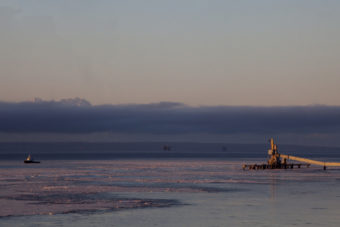
Cook Inlet oil platforms are visible from shore near Kenai, Alaska. The state of Alaska owes about $600 million in oil and gas tax credits to small producers and their creditors. (Rashah McChesney/Alaska’s Energy Desk)

The Dunleavy administration is eyeing a carbon credit program on state forestlands. It’s requested proposals from prospective consultants “to investigate the potential for a carbon offset credit program based on carbon sequestration on state lands,” according to a document that went up this month on a state website.

Alaska Native corporations have publicly vaunted windfalls worth tens of millions as some pivot from commercial logging to being paid to keep trees on their lands standing. Sealaska is one example: it and others went into partnership with oil giant BP in 2019. But state Revenue Commissioner Lucinda Mahoney told CoastAlaska in an interview that’s not where the idea came from.

“What we are looking for is to establish a program that enables the state of Alaska to communicate to the public that responsible development and management of our lands exists,” she said this week. “And we expect that we especially want to communicate this to many of the banks on Wall Street that prohibit investment in the Alaska Arctic oil and gas projects.”

She’s referring to pressure by major lenders that have effectively ruled out investments in new Arctic fossil fuel projects over concerns about impacts on the environment, Indigenous peoples and climate change.

Efforts to turn Alaska’s oil patch green

But where do carbon credits come in? Mahoney says corporations have carbon bills to pay. That is, they make pledges to offset their environmental impacts. And they do this by purchasing credits listed by the state of Alaska on one of the global carbon registries.

Mahoney says the state could use the profits to pay off some of the $600 million it owes in tax credits to Alaska’s small oil and gas producers and their creditors.

“For example, if we owe a bank $100 million in tax certificates, the bank could then say, instead of the cash, I would prefer that I receive a carbon offset value that is the equivalent — or maybe there’s a premium markup on it — of the tax certificate,” she said.

There is precedent for a state setting aside forestland for carbon credits, says Morgan Higman, a fellow with the Center for Strategic and International Studies in Washington, D.C. studying energy security and climate change. She pointed to Michigan’s state government, which recently made a deal with its largest energy utility, DTE Energy, that sets aside 100,000 acres of state forestland in exchange for $10 million in carbon credits.

“My initial reaction is it could work,” she said of Alaska’s framework.

But in general she says there are broader questions of whether carbon credits accomplish their stated goal of mitigating carbon emissions and slowing climate change.

“There’s a lot of concern about program integrity with these kind of things,” she said.

Two types of carbon offset markets

Those working on carbon offset credits in Alaska say there are basically two markets the state could tap into, voluntary markets and regulatory markets.

Nathan Lowejski, forestry manager for Chugachmiut, a Native nonprofit that serves communities on the Kenai Peninsula and Prince William Sound, says voluntary markers are the type consumers often see.

“I know there’s some websites where if you buy an airplane ticket, you can go buy some carbon offsets to offset your carbon footprint from your flight,” he said.

But there’s also the lucrative regulatory market like California’s cap-and-trade program, which requires polluters to purchase carbon offsets if they exceed a certain threshold of carbon production.

“The most simple way of looking at this is forest land owners can be paid by someone in California for an offset, and in return, they agree not to cut those trees for 100 years,” he said. “It’s not quite that simple. But that’s the simplest way of looking at it.”

From timber sales to long-term carbon offsets

Pivoting to carbon credits on Alaska’s state forests would be a departure from the government’s usual approach: timber sales. But the state’s holdings are small compared to the Tongass and Chugach national forests. There’s nearly 290,000 acres outside of Haines. There’s around 47,000 acres in Southeast and the largest would be the million-plus acres in the Tanana River Valley.

The Dunleavy administration is now shopping for a consultant to estimate the potential for carbon credits on state lands. The contract is worth up to $500,000 with the first report due by the end of the year.

Mahoney, the revenue commissioner, confirmed the state gets around that much from its proceeds from logging on state land. Carbon offsets could potentially offer more to state coffers than timber sales.

“It may be that we stopped doing that,” Mahoney said of commercial forestry. “We allow the trees to grow so that they can help continue to produce the carbon offset.”

What do Nestlé and NASCAR have in common?

It’s not clear what industry’s position would be on a policy that could restrict intensive logging on some state forestlands for a minimum of 30-40 years.

The Alaska Forest Association declined to comment. And nobody from the Resource Development Council offered any comments either. But conservationists, who have sometimes challenged state timber sales in court, welcomed the news.

“I see tremendous potential of carbon credits,” said forest ecologist John Schoen, a former habitat biologist with the Alaska Department of Fish and Game and now board chair with Audubon Alaska. He says Alaska’s old growth stands of trees are worth more in the long term, standing as carbon storage as the planet continues to heat up.

“This is one of the best natural opportunities to mitigate climate change that there is,” he added.

policy summary finalized this week and provided to CoastAlaska says the Dunleavy administration projects carbon credits could earn the state anywhere from $500,000 to $20 million in new revenue. It offered a “diverse, small list of entities and individuals who have purchased carbon offsets” including Amazon, Nestlé, NASCAR, Canadian Prime Minister Justin Trudeau, the country of Norway and the Dave Matthews Band.

It was the deadliest year ever for land and environmental activists

Climate activists in Quezon City, Philippines, light candles and hold LED-illuminated banners in December of last year to commemorates five years since the Paris Agreement and to call for an end to the killing of environmental defenders. (Aileen Dimatatac/Majority World/Universal Images via Getty)

The daughter of Fikile Ntshangase says that last October, three armed men entered her mother’s home and shot her dead.

Ntshangase had publicly questioned a local coal mine that she thought was — quite literally — undermining the small South African town where she lived, located about 360 miles east of Johannesburg.

“She saw the cracks in the walls of people’s homes and wondered if they were caused by the constant blasts from the mine,” her daughter, Malungelo Xhakaza, told Global Witness, an international human rights group. “She saw the coal dust gathering in living rooms and wondered if it was also gathering in people’s lungs. And she saw the tension the mine caused, the families it broke apart, the fear it spread.”

Ntshangase is one of 227 activists that the group says were killed last year in connection to their grassroots environmental efforts, according to a report released Monday.

Her killing was one of two in South Africa in 2020 attributed to environmental activism. However, the group says many more occurred elsewhere, with more than half occurring in just three countries: Colombia, Mexico and the Philippines.

“As the climate crisis deepens, forest fires rampage across swathes of the planet, drought destroys farmland, and floods leave thousands dead, the situation for frontline communities and defenders of the Earth is getting worse,” according to the report.

Indigenous communities, which make up only about 5% of the world’s population, bore the brunt of the anti-activist violence, accounting for more than a third of those killed, it said.

The figure for 2020 was up from 212 reported by Global Witness the previous year.

In Colombia, where 65 such activists were killed, a third of the attacks “targeted indigenous and afro-descendant people, and almost half were against small-scale farmers.” No attacks were recorded in North America or Europe, and only one – in Kiribati – took place in Oceania. On a per capita basis, Nicaragua, Honduras, Colombia, Guatemala and the Philippines were the most dangerous places to be a grassroots environmental activist, according to the report.

People place small posters depicting Honduran environmental activist Berta Caceres next to a fire as they wait outside the Palace of Justice for the verdict in the activist’s murder case. A little over five years after Caceres’ murder, an ex-chief of the energy company Desa has been found partly guilty. (Delmer Membreno/dpa/picture alliance via Getty Images)

While the highest number of killings – 23 – was linked to logging, others were linked to water and dams, mining, illegal crop substitution and agribusiness. In some places, protest has been either stigmatized or criminalized, the group has said previously.

Global Witness says its report documents the deliberate killing of “people who take a stand and carry out peaceful action against the unjust, discriminatory, corrupt or damaging exploitation of natural resources or the environment.”

The group says it collects data by reviewing publicly available online reports and datasets from international and national sources and counts only killings that have “clear, proximate and documented connections to an environmental or land issue.”

The number of such deaths last year was more than double the figure in 2013, but Global Witness says it believes its data represents an undercount because it relies on the level of transparency, press freedom and civil rights in the individual countries.

The group is calling for urgent action and recommends that companies and governments be “held to account for violence against land and environmental defenders, who are often standing on the frontline of the climate crisis.”

Copyright 2021 NPR. To see more, visit https://www.npr.org.

Warmer summers fuel western blackheaded budworm infestation of Southeast hemlocks

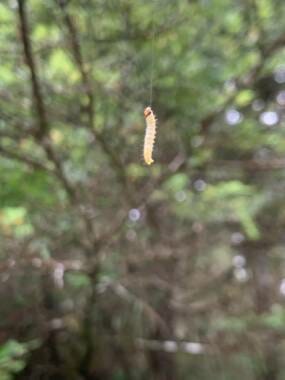
The western blackheaded budworm larva is familiar to many forest users as a caterpillar hanging from a tree branch. (Courtesy of USDA Forest Service Alaska Region)

After nearly 30 years in relative dormancy, the western blackheaded budworm population is exploding in Southeast Alaska, leaving swaths of browning hemlock in its path. U.S. Forest Service entomologist Elizabeth Graham and her team have been keeping tabs on the budworms and their effects on the local ecosystem. According to Graham, Southeast has historically been hit harder by western blackheaded budworm outbreaks.

“This is the first major outbreak we’ve had in Southeast since the mid 90s. And then prior to that there was one in the 1950s, they tend to happen on about a 30-40 year rotation. So the caterpillars are there all the time, but they’re not normally at this great a level,” Graham said.

The worm itself is the larva of the budworm moth and is known to feed on the new growth of hemlock buds, causing what’s known as “top kill.” As Graham explains, the warmer summers have spurred the population spike, which is expected to continue over the next several years before naturally crashing. While the damage can seem drastic to onlookers, Graham says the majority of trees will survive and possibly even thrive as a result.
Adult budworm moth. (Courtesy of USDA Forest Service Alaska Region)

“They’re actually a natural part of our forest,” Graham said. “And so change and disturbances is something that is supposed to happen in the forest in order to keep things dynamic and healthy. As you know, dramatic and worrisome as they are in appearance now, just to remember that our forest has been through this before, and hopefully the healthiest trees will survive, and we’ll maybe open up some more light and get some good berry years after this”

The Forest Service will continue to monitor the budworm infestation as they transition to moths in the coming weeks. Graham urges community members to contribute to their efforts by uploading photos of the moths or other forest pests to  the Forest Service’s crowdsourcing app, iNaturalist.

Craig man killed in commercial logging accident

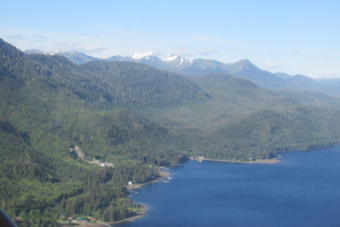
An aerial shot of Prince of Wales Island. (Photo courtesy KRBD)
An aerial shot of Prince of Wales Island. (KRBD photo)

State labor safety officials said Friday they are investigating the death of a Craig man killed at a commercial logging operation in the Ratz Bay area on Prince of Wales Island.
A statement from the Department of Public Safety said a log being loaded onto a trailer at a commercial logging operation fell off the truck at about 7 a.m. Thursday, killing 46-year-old Reginald Watt.

The statement said Alaska State Troopers, Village Public Safety Officers and U.S. Forest Service personnel responded to the scene. Watt’s body was sent to the state Medical Examiner’s Office in Anchorage. Next of kin have been notified, the agency said.

Alaska Labor Standards and Safety Division Director William Harlan says it’ll be some time before more information is released on the incident.

“Our investigation is ongoing at this time,” he wrote in an email.

Conservationists challenge old-growth timber sale in Haines State Forest for a second time

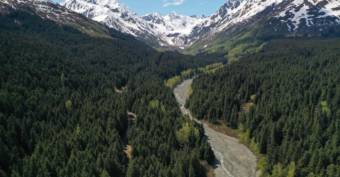
The Baby Brown and Glacier Side timber areas, left, are south of Glacier Creek, a main tributary to the Klehini River (Courtesy of Derek Poinsette)

Conservationists are challenging one of the state’s largest old growth timber sales in Haines State Forest in more than 20 years. It’s the second challenge to the Baby Brown project, which opponents say threatens biodiversity in upper Chilkat Valley.
Lynn Canal Conservation is leading a group of environmental organizations that allege the state failed to provide proper public notice before authorizing the logging of more than 1,000 acres of Haines State Forest. And they’re calling for the state to cancel the timber sale, says Executive Director Jessica Plachta.

“Our economy depends on an intact landscape, our fishing, our tourism,” she said. “90% of local people utilize subsistence resources, primarily salmon, and salmon is dependent on on intact forests. So the importance of this landscape really can’t be overemphasized, and Baby Brown is an integral part of this landscape.”

In 2017, the Baby Brown sale was canceled after Lynn Canal Conservation successfully argued that the state Division of Forestry didn’t create a land use plan for the entire harvest area.

This spring, the forestry division awarded Baby Brown to an Oregon-based timber company, Northwest Forest Products, for a bid of $423,455. The company has five years from the date of signing to harvest timber, roughly to early 2026.

This time they also included a second site, Glacier Side #2, of about 150 more acres of forest for logging. Lynn Canal Conservation says bundling the two parcels together under one formal plan without public input isn’t legal.

“They’re cutting corners on the public process to benefit the purchaser,” Plachta said. “And in this case, the purchaser is an out-of-state logging company that plans to raw-log export our forest, and it doesn’t benefit local people. It doesn’t even benefit the state. It costs the state more to offer these sales than it gets in timber receipts.”

She says public comment is a required safeguard for the management of state lands.

Deputy State Forester Tim Dabney says his office combined the two sites through an amendment for the convenience of the logging company. He says the tracts added later had already been previously authorized for logging, but that contractor defaulted.

“And without having done anything on the sale, and since Glacier Side #2 harvest units are adjacent to the Baby Brown harvest units, the decision was for us to combine both of those sales into one sale, which is totally fine,” Dabney said.

Baby Brown / Glacier Side timber sale (Alaska Department of Resources)

Dabney says his office has received the appeal and is considering their request to cancel the sale. He says the agency doesn’t know when it will rule on the challenge, but state attorneys and the Natural Resources commissioner’s office are reviewing whether the bundled timber sale was improper.

“We’re considering their request,” he said. “And I have really no information beyond that we’re in consideration of their request.”

Plachta says the entire Haines Forest region at the headwaters of the Chilkat Valley is critical habitat and should not be disturbed.

“I think it’s 13 miles of new roads, building a couple of new bridges, a whole bunch of new culverts. And, you know, that’s a lot of damage to what’s otherwise intact growth, transitional forest, which is really important,” she said. “Turns out the United States has less than 3% of its original old growth forest, and so it might feel abundant here, but it’s really not.”

The project proposes logging spruce and hemlock trees (Photo courtesy of Erik Stevens)

Plachta says there are telltale signs the old growth forest will not grow back as promised by state authorities, citing heavy logging in the Upper Chilkat Valley decades ago, which she says contributed to the decline of the king salmon runs.

“Where a lot of us are going to go blueberry picking this September, those are 50-year-old clear cuts,” Plachta said. “And those 50-year-old clear cuts are not regrowing, they’re not turning into the new old growth that the state forest predicts that we’ll be having. Those are blueberry fields with a lot of alder and the occasional coniferous tree.”

The bidder is listed as Northwest Forest Products of Baker City, Oregon. That’s a relatively new company in Alaska. But its principal has been through this before. The outfit is owned by Stan Runnels, a former Astoria Forest Products executive. The Astoria company had been the high bidder on the Baby Bear timber sale that was shelved in 2017 after environmentalists objected to the process.

Forest Service plans more small timber sales in the Tongass this summer

A forest road on Kupreanof Island near Petersburg (Joe Viechnicki/KFSK)

The U.S. Forest Service plans to offer more small and micro timber sales this summer in the Tongass National Forest in Southeast Alaska. The agency this week announced its plans to sell timber to small sawmills for the remainder of the federal fiscal year, which ends in September.

Dave Harris, the Forest Service’s outgoing director of forest management for Alaska, says the sales will create economic opportunity in the region.

“It’s just going to be a consistent continuation of support for local small niche markets and small operators in our scattered and diverse rural economy and in communities,” he said.

Harris estimates the program averages total sales of around three to five million board feet a year on the Tongass. The Forest Service says the small sale program aligns with the Biden administration’s sustainability strategy for Southeast Alaska. That includes a goal of halting large-scale logging of old growth on the largest national forest in the country.

Two small sales totaling around one million board feet will be put up for sale on Prince of Wales Island near Craig, Thorne Bay and Coffman Cove. There’s a micro sale for 10,000 board feet on the Wrangell Ranger District, and about 120,000 board feet to be offered near Petersburg and Kake. Further north, the agency plans to sell a mix of young growth and old growth wood near Hoonah and Sitka, totaling more than half a million board feet.

“There’s always a little bit more demand over on Prince of Wales than there is around Wrangell and Petersburg and there’s always a consistent, a relatively consistent demand up around Hoonah, Sitka,” Harris said. “And so we’re basically putting out a consistent program for those particular areas.”

The agency also plans to offer wood for Alaska Native cultural uses, like totem poles and canoes. That will be near Hydaburg on Prince of Wales Island.

Site notifications
Update notification options
Subscribe to notifications