Timber

Biden to freeze Tongass timber sales, invest in other Southeast Alaska sectors

The Tongass National Forest is the largest temperate rainforest in the country. (Erin McKinstry/KCAW)

The Biden administration announced Thursday it’s freezing any remaining old growth timber sales in Tongass National Forest and will pivot to investing in other sectors of Southeast Alaska’s economy.

statement from the U.S. Department of Agriculture said the federal government will invest $25 million and work with tribes, communities and Alaska Native corporations to provide technical assistance for projects and employment programs in the region.

“This approach will help us chart the path to long-term economic opportunities that are sustainable and reflect Southeast Alaska’s rich cultural heritage and magnificent natural resources,” Secretary of Agriculture Tom Vilsack said.

Thursday’s statement follows a recent announcement that the agency will start a lengthy process to reinstate the Roadless Rule in the Tongass, which restricts road building on federal forest lands.

That reverses the Trump administration’s decision to exempt the nation’s largest national forest from the Clinton-era rule that’s been fought by successive Alaska governors.

Dunleavy administration lambasts USDA

In a statement, Alaska Gov. Mike Dunleavy called out what he called President Biden’s “efforts to put Alaska workers permanently into unemployment lines and wipe out small businesses” with Thursday’s announcement.

“Narrow election results and political donations from environmental groups do not justify this federal agency’s policy flip-flop,” the governor said.

But the pivot away from forest products and toward other sectors was met with applause from the visitor industry.

“As we’ve been saying for a long time there’s so much else going on in Southeast Alaska that needs the Forest Service’s attention,” said Dan Kirkwood, a guide and general manager of Alaska Seaplane Adventures in Juneau. “We’re finally seeing some recognition that Southeast Alaska is really diverse in its economy and its cultures and the Forest Service’s trying to work on that. So that’s interesting.”

There have been few details released on the USDA’s $25 million “Southeast Alaska Sustainability Strategy,” but Southeast Conference’s executive director says meetings have been set up to discuss mariculture opportunities on and around Prince of Wales Island.

“The Tongass needs to be a multi-use forest. And unfortunately it’s still very much a political football that goes back and forth,” said Robert Venables. “So my hope is that we can work with the Forest Service’s stakeholders to really create more stability and at least many of the economic sectors and provide a longer term blueprint and map to go forward.”

Freeze on old growth logging announced

The practical effect of Thursday’s announcement would be to freeze any remaining old growth timber sales except for those used in small scale salvage projects for cultural use by Alaska Native tribes and others.

“The announcement that large scale, old growth logging is going to be ceased is very positive for that because those mass clear cuts are not going to occur here anymore,” said Marina Anderson, tribal administrator for the Organized Village of Kasaan on Prince of Wales Island.

“We hear commonly that we’re doing this for the next seven generations, or the seventh generation down the line,” she said. “However, we’ve been here for over 10,000 years, and we plan on being here for well over 10,000 years — we don’t have an expiration date on ourselves because we are part of this ecosystem.”

The largest timber sale in Tongass was already blocked by litigation. And only two old growth timber sales on Prince of Wales Island and near Ketchikan are in the works. A Tongass spokesperson says the local office is awaiting guidance following the announcement.

The announcement also didn’t mention amending the 2016 forest plan, which laid out a 15-year transition from old growth to second-growth logging. That would require a formal rulemaking process to ensure protections would last another political transition.

Proponents of ending old growth logging say they hope the shift in policy represents a long-term move away from Southeast Alaska’s federal forestland as primarily a supply for forest products.

“Any future administration is going to have the opportunity to pick its own policies and implement its own direction,” said Austin Williams, Trout Unlimited’s Anchorage-based legal director. “But I think what we’re seeing is that, as time goes on, the value of fish and wildlife, the cultural assets in the forest, the value of scenic beauty and climate resiliency — those values are becoming more and more important.”

The USDA notes that the Tongass has global significance as the largest intact temperate rainforest in the world. It also captures more carbon than any other national forest in the country.

Fate of lawsuits uncertain

There have been lawsuits filed on both sides of the Roadless Rule exemption issue. A coalition of tribes and conservationists has sued to overturn the Trump administration’s decision. And a separate lawsuit is defending the Roadless Rule exemption backed by local governments and industries.

Juneau attorney Jim Clark has been coordinating that effort to defend the Trump administration’s action. He says it’s not clear how the Biden administration plans to carry out its goals.

“We know where they’re headed and where they’re trying to go,” said Clark, who served as chief of staff for Republican Gov. Frank Murkowski. “And what we’re going to need to see is how they move to achieve those things.”

What the rise and fall of lumber prices tell us about the pandemic economy

DORAL, FLORIDA – MAY 27: Lumber for sale at a Home Depot store on May 27, 2021 in Doral, Florida. According to the National Association of Home Builders, lumber prices went up 300% last year. Factors driving the price increase are more demand and growing production, labor, and transportation costs. (Photo by Joe Raedle/Getty Images)

It’s been a roller-coaster ride for lumber prices over the last year — and it’s drawn outsize attention from the aisles of Home Depot to the Federal Reserve.

Lumber prices surged to record highs this year on the back of booming demand from homebuilders and do-it-yourselfers with plenty of time on their hands. The price surge was so big and sudden, it became a symbol of what some economists feared: rampant inflation.

But over the past two months, lumber prices have been dropping equally fast, giving weight to the central bank’s argument that pandemic price spikes for many products are likely to be temporary.

That’s not the end of the story, however. Lumber prices may have fallen, but they are still elevated, creating new headaches for the critical housing sector. And companies in the lumber industry are wrestling with a new pandemic problem: a shortage of workers.

Here are three things that the rise, fall and now volatility of lumber prices tell us about the pandemic economy.

Behind the great rise of lumber prices

The supply shock that sent lumber prices to record levels this year did not come from a shortage of trees: The price of raw timber has barely budged.

Instead, the lumber crunch was centered on sawmills, which cut round timber into square boards.

“You can think of us as the grain mill in the ecosystem of the timber industry,” says Ross Stock, a third-generation sawmill operator who runs Western Cascade Industries in Toledo, Oregon.

In the early months of the pandemic, many sawmills shut down, both for health reasons and because they assumed demand for lumber would plummet.

Instead, demand took off. Stuck at home, Americans in large numbers began adding decks, repairing fences and even building treehouses.

SPANISH FORK, UT – MAY 12: A worker assembles a truss for a home at Wasatch Truss on May 12, 2021 in Spanish Fork, Utah. Lumber prices have skyrocketed along with supply shortages the last several months have plagued the construction industry. (Photo by George Frey/Getty Images)

Professional homebuilders also got busy, as rock-bottom interest rates and a desire for more space pushed demand for housing into high gear.

According to the National Association of Home Builders, single-family home construction jumped 12% last year, and remodeling activity climbed 7%. Meanwhile, domestic sawmill output rose just 3.3%.

As a result, lumber prices soared — from $349 per thousand board feet in April 2020 to $1,514 this May, according to the trade journal Fastmarkets Random Lengths.

“It was absolutely an astonishing run,” Stock says.

That run in lumber prices sparked concerns about inflation as prices across a range of goods similarly jumped.

And then there was the great fall …

Since lumber prices peaked in May, however, demand has cooled sharply.

With vaccines rolling out and the impact from the pandemic easing, do-it-yourselfers have found other ways to spend their weekends.

“People are stuck at home less. They can go out and travel more. They can go out to restaurants and bars,” says Dustin Jalbert, a Fastmarket economist who follows the lumber industry. “In the home centers like Home Depot, Lowe’s, the wood volumes going through there have slowed substantially, especially for items like decking and fencing.”

Professional homebuilders are also tapping the brakes, in part because it’s taking longer to get appliances and doors and other building materials.

Florida homebuilder Chuck Fowke ordered windows for a house he was building in November. They finally arrived six months later.

“You have builders who have building permits that aren’t starting the houses,” says Fowke, who’s also the chairman of the National Association of Home Builders. “You have some that poured their slabs, and they haven’t gone any further.”

In the last two months, the composite price index compiled by Random Lengths has tumbled by 50% to $770 per thousand board feet.

Federal Reserve Chair Jerome Powell sees that drop as a good sign.

“Prices like that that have moved up really quickly because of shortages and the bottlenecks and the like, they should stop going up, and at some point in some cases, should actually go down,” Powell told reporters in June. “And we did see that in the case of lumber.”

WASHINGTON, DC – JUNE 22: Federal Reserve Board Chairman Jerome Powell testifies at a House Coronavirus Subcommittee hearing on the Federal Reserves response to the Coronavirus Pandemic on Capitol Hill June 22, 2021 in Washington, DC. Powell spoke about the nation’s recovery from the pandemic and that inflation has risen because of it. (Photo by Graeme Jennings-Pool/Getty Images)

But for lumber, that’s still not the end of the story

Despite the recent drop in prices, lumber still costs about 80% more now than it did before the pandemic — a premium that builders say is adding tens of thousands of dollars to the price of a new home.

And the supply of lumber is still not growing very fast.

Sawmill operator Stock says building a new mill would cost tens of millions of dollars. He’s trying to boost output at his current mill, but like other in-demand industries such as restaurants and hotels, he’s now struggling to find workers.

“It takes time to improve a mill. It takes time to develop people,” Stock says. “I’ve worked in sawmills since I was 8 years old. It’s hard work.”

Forecasters say lumber prices may have more room to fall. But price volatility creates its own headaches.

“The challenge right now for a builder is, if you’re asked to give someone a price for a home, it’s very difficult,” says Fowke, the Florida homebuilder. “We’re used to having prices change every six months or every 12 months. We’re getting price changes every two weeks.”

And even if two-by-fours are no longer propping up inflation, that doesn’t mean prices will return to their pre-pandemic wood floor. So lumber may continue to capture headlines as yet another example of a product upended by the unprecedented pandemic.

“It’s kind of like the price of gasoline,” says Jalbert, the economist. “Lumber has been the sort of poster child for these supply shocks that we’ve seen.”

Copyright 2021 NPR. To see more, visit https://www.npr.org.

Alaska recruits former California official as top forester

Alaska’s new state forester, Helge Eng, grew up in Oslo, Norway, at nearly the same latitude as Anchorage.

I’ve always considered Alaska kind of home in the sense that I was born and raised in a similar climate,” he told CoastAlaska in a recent interview from Anchorage.

Helge Eng joined the Department of Natural Resources on June 2 as director of the Division of Forestry and Alaska state forester, after a 21-year career at California’s forest management and wildlife firefighting agency. (Photo courtesy of Department of Natural Resources)

Eng just finished a 21-year career in California where, despite making his home in the foothills of the Sierra Nevada mountains, he said the dry heat spells were hard to escape.

“That wall of heat of 105 degrees is not something you really get used to,” Eng said. “So, coming up here, it’s a welcome change. And it’s like coming home for me.”

Eng spent more than 20 years working for the California Department of Forestry and Fire Protection — known as Cal Fire. He was in charge of resource management, which researched different timber practices on state lands.

As Alaska’s state forester, he oversees the roughly 260-strong Division of Forestry, which is in charge of fire protection and regulating logging on state and private lands. His division is attached to the Alaska Department of Natural Resources and is charged with preparing timber sales on state lands to supply local industry.

He’s preparing to meet with U.S. Forest Service officials next month to discuss the impacts from the Biden administration’s recent announcement that it plans to reinstate the Roadless Rule for Tongass National Forest, which could curtail old growth logging on federal lands.

We are continuing to work actively, as my predecessor did, to re-reinvigorate a timber industry in Southeast,” Eng said.

Clear-cut logging of old growth forests is controversial. And there’s been increasing scrutiny of projects on Prince of Wales Island and other parts of Southeast.

Eng says it’s his job to make sure all voices are heard before making critical land use decisions.

“There are several points of view on forest management and timber harvesting,” he said. “And I do think it’s important that all of those uses are represented and all the voices are heard. So, rest assured, there will be ample opportunity for public inputs into all of the state’s harvest decisions.”

As in California, which has been devastated by wildfires, his job here will also include wildland fire protection. That was a point underscored by his boss, DNR Commissioner Corri Feige, who released a statement earlier this month announcing his recruitment.

“State foresters in Alaska and California share similar challenges in fighting wildfire to protect lives and property, and similar opportunities in managing vast forest resources to benefit industry, wildlife and recreation,” Feige said in a June 2 statement. “We are fortunate to have Helge Eng bring his experience north to Alaska to lead our Division of Forestry in its continued success in achieving these goals on behalf of Alaskans.”

Eng replaces outgoing state forester Chris Maisch, who served for 21 years before retiring in February.
White House moves to reinstate Roadless Rule for Tongass

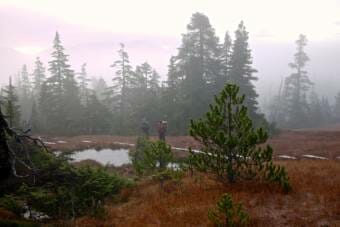
A pair of hikers in the Tongass National Forest in 2014. (Creative Commons photo by Joseph)

The Biden administration appears poised to reinstate a rule dating back to the Clinton White House that restricts new roads in the Tongass National Forest in Southeast Alaska.

The rule also restricts tree harvest in more than half of the Tongass — about 9.4 million acres. President Donald Trump ended the protections for the forest three months before leaving office.

The U.S. Department of Agriculture, parent agency of the U.S. Forest Service, has published a regulatory notice saying it plans to “repeal or replace” a Trump administration regulation from October that removed Roadless Rule restrictions in the Tongass.
The notice says USDA is proposing the change to be consistent with President Biden’s executive orders on climate.

Environmental organizations such as the Alaska Wilderness League have long argued that the Tongass — which is one of the world’s largest intact temperate rainforests — plays a critical role in combating climate change.

Research shows the rainforest stores about 40% of all of the carbon in the country’s national forests. 

“This is a globally significant resource,” said Trout Unlimited’s legal director Austin Williams, on Friday. “There’s absolutely no reason for us to continue to clear-cut log old-growth forest, it’s a critically important resource, and something that we need to be taking much better care of.”


“Taking an axe to Tongass old-growth protections was among the most reckless and irresponsible of the previous administration’s environmental rollbacks. Indigenous communities, hunters and anglers, the tourism and fishing industries, those who care about protecting our planet’s biodiversity and climate — all opposed removing roadless protections on the Tongass, wrote Andy Moderow, the organization’s Alaska director, in a prepared statement on Friday. “We applaud the Biden administration’s and the Forest Service’s commitment to addressing that rollback, but also want to make clear that a full reinstatement of roadless protections is a necessity and crucial to preserving America’s ‘Amazon’ and one of our most valuable assets in the climate fight.”

Joel Jackson, president of the Village of Kake, a federally recognized tribe on Kupreanof Island, welcomed the announcement. His tribe was among those that joined a lawsuit filed by conservationists and fishermen seeking to overturn the Trump administration’s Roadless Rule exemption in Southeast Alaska.

“As Native people, we are tied to the land,” he said Friday morning. “We go shopping in our forests and our waters to get our food, traditional food that we eat mostly. So it’s important that we have the old growth timber.”

Since its adoption in 2001, the Roadless Rule has been subjected to regular litigation and has pitted the State of Alaska against the federal government, with tribal, environmental, tourism, fishing and industrial organizations all weighing in.

Robert Venables, executive director of Southeast Conference, a regional civic and business organization, says the announcement injects further “uncertainty” over access to Southeast Alaska’s natural resources.

“It’s yet again another instance where the federal government — every single administration — is coming out there to change the rules,” he said Friday morning. “It’s very disappointing to see the continual back-and-forth every four years.”

Alaska’s politicians have long argued that the rule restricts Southeast Alaska’s ability to support itself — and the rest of the state — economically.

Gov. Mike Dunleavy expressed his disappointment in a statement on social media Friday, saying “North to the Future means North to Opportunity, and we will use every tool available to push back on the latest imposition.”

Correction: A previous version of this story misnamed the federal agency responsible for managing national forests – it is the U.S. Forest Service. 

As lumber prices climb, Alaskans increasingly mill their own

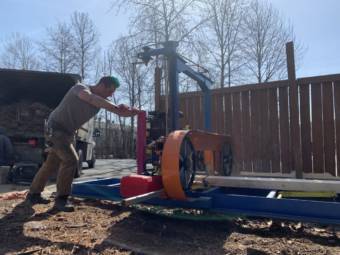
Hans Dow spends a Saturday afternoon milling more than 50 2x10s for garden boxes he’ll install in his South Anchorage backyard this summer. (Emily Schwing)

The price of lumber has more than doubled over the last year, and economists warn it may be a lasting trend. That’s why Alaskans like Hans Dow are getting crafty: buying or even building their own sawmills.

“I was like, well, I want a sawmill. I can make a lot of stuff with it. I also need to learn how to weld,” Dow said as he hefted a 9-foot log onto the deck of his hand-built sawmill, which sits in the corner of his South Anchorage backyard.

Dow spent the winter in his garage building the sawmill. It was his brother who really urged him to take on the project, Dow said.

“He was working on his house and we were kind of joking like, ‘Man, lumber is really expensive. We could probably build a sawmill or buy a sawmill and make our own siding and probably break even or come out ahead.’ And then I started to do the math. And I was like, ‘Oh yeah, it would be cheaper,’” he said.

The price of lumber is soaring for several reasons: When the coronavirus forced nationwide lockdowns, people stuck at home found projects to stay busy. Demand for lumber went up, but commercial sawmills were still locked down. Now, producers are scrambling to catch up. To top it off, record-low interest rates have driven lots of new home construction.

Dow spent about three weeks and $3,000 collecting the parts and pieces to assemble his mill. His aim was to build garden boxes for his wife this summer, and he estimated he’d need at least 42 2-by-10 inch boards to do it.

If he were to buy the lumber, it would cost him at least $2,000. But for Dow, spruce logs are free. He picks them up from Paul’s Tree Service, where he works as a crane operator. The company removes problem trees and beetle-infested spruce throughout the city.

Kate Sebring walks Willow homeowner Phil Hudson through the paperwork to purchase a portable sawmill. He ordered in February, and doesn’t expect it to arrive until July. (Emily Schwing)

Phil Hudson, 71, is a retired commercial radio host who’s worked with wood for decades. Hudson lives on 40 acres in Willow, and when he built his house 20 years ago, he said it cost him $3,500. He said he’s been planning on more floor space for years.

“I’m adding a 16-by-24 addition,” Hudson explained. “And then there’s a couple other little bump outs off that. I’m about tripling my floor area.”

If he purchased the lumber he needed to frame the addition walls last year, he might have paid more than $6 per board. This year, those same 2-by-6 inch boards cost at least $15. And depending on the type of wood and whether they’ve been pressure treated, the price can climb above $64.

“You can’t pay these kind of prices,” he said. “It’s like going to the grocery store and spending two hundred dollars and leaving with one bag of groceries.”

Hudson traveled to Anchorage to pick up his brand new portable sawmill sent from Portland. With shipping and an extra box of blades, the mill set Hudson back around $10,000.

But Hudson has a plan to recoup the costs. Hudson has acres of standing deadwood on his property, thanks to spruce beetles which have affected more than 1.1 million acres of forest in Southcentral since 2015. After he cuts down the wildfire hazards and finishes his own building projects, he said he wants to use the mill to make some extra money.

“As this goes on, I’ll make a few bucks in the future by building a kiln, and kiln-drying birch,” he said. “People like the birch and that live edge on the birch and that sort of thing.”

He can mill that, he said.

“What the hell — I don’t know how many years I have left, so I might as well do something that’s entertaining,” he said.

Hudson purchased his mill from Wood-Mizer, an Indiana-based company that manufactures tools for processing lumber, including small, portable sawmills. The company’s cheapest mill is just over $3,000, and prices rise to nearly $60,000. To say they’re selling fast is an understatement.

Kate Sebring quit her job at JBER last year to help her father, Parker Rittgers, handle the increase in demand for portable sawmills in Alaska. The two work together as sales representatives for Indiana-based Wood Mizer from a home office in Anchorage’s Hillside neighborhood. (Emily Schwing)

“The lead time is 44 to 59 weeks right now for a sawmill,” said Kate Sebring, an Alaska-based sales representative for Wood-Mizer. Other sawmill manufacturers are telling customers the same thing, she said.

Sebring quit her job at JBER last year to work with her father, Parker Rittgers, who originally became a sales rep for Wood-Mizer as a retirement hobby.

“I’ve been retired for ten years, so now I’m not working 40 hours a week,” Rittgers said. “I’m working 50 or 60 hours. I worked until about 10:30 p.m. last night. I was just bushed.”

A year and half ago, Rittgers said he was taking orders for one sawmill a week. Now, he and his daughter take deposits for three or four sawmills a day.

In Alaska, business doesn’t just come from the road system. Don Morgan was also at the Wood-Mizer office last month, shopping for a sawmill. He took the two hour flight from Aniak, a village of about 500 people in Southwest Alaska, to put his order in.

“I’m changing my shop into a house, so now I need a shop,” he said.

If he were to order the lumber he needs for his project, just shipping the boards to the village would cost at least $2,000. Nevertheless, he balked a little at the $10,000 price tag for the mill he came to consider.

“But I don’t know … We had a lot of trouble with building houses and getting material,” he said.

Aniak sits east of Bethel on the Kuskokwim River, where there are plenty of trees. Morgan can tow his mill with a snowmachine or a four-wheeler and find the wood he needs.

According to Kate Sebring, Wood-Mizer has shipped dozens of sawmills to villages across the state. Even with the shipping costs of the mill, many Alaskans are convinced milling their own lumber is more affordable than buying it.

Could rising timber prices aid the Tongass transition to second-growth logging?

A 70-year old stand of young-growth timber photographed in 2013. The tightly-packed trees are growing among the stumps of their much larger predecessors. (United States Department of Agriculture)

Soaring lumber prices could be a boon for Southeast Alaska’s struggling timber industry. The pandemic has fueled the demand for both renovations and the new home construction market, and supply has not kept up.

But industry experts are divided over how to best seize the opportunity in the region: By cutting what’s left of Tongass old-growth or by retooling to cut younger, second-growth trees.

In March, the National Association of Home Builders blamed rising materials prices for adding an average $24,000 to the cost of a new home.

Most of that cost is due to the skyrocketing price of lumber which is in high demand and “soaring to just absolutely record highs,” said resource economist Brett Watson with the Institute for Social and Economic Research at the University of Alaska Anchorage.

There are a number of explanations: low-interest rates have spurred home-buying, people doing more do-it-yourself projects and renovations, and also a bottleneck in the supply caused by the pandemic.

But could this be an opportunity for Southeast’s struggling timber sector?

“What I imagine that timber mills are looking at now during this recent run-up is thinking about whether or not these prices are here to stay,” Watson added.

Opponents of old-growth logging push second-growth solutions

Catherine Mater is an Oregon-based forestry consultant who’s worked both for timber outfits and for environmental groups opposed to old-growth logging. She’s been advocating for retooling Southeast’s timber economy to use second-growth trees instead of logging old-growth forests.

What we have in Southeast Alaska is literally a wall of wood that’s going to happen whether the industry is ready for it or not,” she told CoastAlaska during a visit to Juneau in September 2019.

And the real question is, can we do a good transition so that you’ve got an industry that could reinvent itself?”

Two years later, Mater says she still believes the focus on old-growth logging is a fight that no one can win.

Alaska really is the last state in the nation that harvests old-growth material — no one else is doing it,” she said in a recent telephone interview from Corvallis. “Everyone has transitioned to young growth harvesting. And the industry is not just surviving, but it’s thriving right now.”

Second- or young-growth trees cover a Tongass National Forest hillside in southern Southeast Alaska in 2012. (CoastAlaska)

The industry says Tongass second-growth is decades from viability

But Alaska’s timber industry remains focused on old-growth supply. That’s despite the Tongass National Forest’s 2016 plan to transition away from logging ancient forests.

The Forest Service prepped one of the largest timber sales in recent history on Prince of Wales Island. But environmentalists sued in 2019 — after objecting to clear-cutting old-growth forests — and a federal judge agreed that the agency’s review process was flawed.

It sent the Forest Service back to the drawing board to revive a portion of the old-growth logging plan. But in the meantime, it’s taken tens of thousands of acres of forest off the table — including second-growth lumber — and that means there’s little supply available on federal lands, says those who work in the industry.

There are no young growth sales scheduled in the Forest Service,” Eric Nichols of Alcan Lumber in Ketchikan told CoastAlaska. “So people can talk about all this stuff. But until you see these timber sales actually come up, you can’t count on them.”

He’s skeptical that second-growth trees are the answer. His company exports old-growth logs to Asia where he says there’s a strong market for their clear, knot-free timber. And he says it’s more economical to export overseas than transporting logs to mills in Alaska or down south.

By the time we build the roads and harvest the timber, truck them from a small island, put them in the water and transport them to a mill in Washington,” Nichols said, “our cost to do that is higher than what we can generate from the log.”

Others who make their living in this industry agree: Second-growth timber sales don’t pencil out. Especially as the costs of doing business rise.

Wes Tyler operates Icy Straits Lumber and Milling on Chichagof Island, west of Juneau. Most of his work is old-growth logs he agrees are prized for their clear, knot-free wood.

He doesn’t dismiss the potential for second-growth harvest but he says that is further south and out of range of his small mill near Hoonah.

The region’s industry now employs just a few hundred people at most, compared to the thousands when Alaska Pulp Corporation in Sitka and the Ketchikan Pulp Company operated their mills.

“It’s going to be difficult because the whole system of things — the whole infrastructure that used to be there in the old days — is gone,” Tyler said.

The last major sawmill in the region is Viking Lumber in Klawock. The company didn’t respond to calls for comment about the potential for second-growth trees. Nor did the Alaska Forest Association returns calls or emails.

Tyler says that it would take major investment to get Southeast’s timber manufacturing sector running again.

And so, somebody is going to have to spend a lot of money to set up for a volume-type infrastructure that’ll handle that,” he added.

The timber business is a long game. Tyler says in the northern reaches of the Tongass National Forest there could one day be potential for second-growth harvests in future decades.

“Most likely it would be another 30 to 40 years of growth before it is actually viable,” he added in a follow-up email.

Political winds shift the direction of Tongass management

Politics play a role as much as economics, leaving Eric Nichols of Alcan Timber deeply skeptical of his industry’s future. Chinese tariffs on timber exports imposed during the Trump administration’s trade war hurt the industry. Clinton-era Roadless Rule policies were supported under Obama but rolled back by Trump.

“Every four years, we keep changing the direction of the Tongass is going we’re going through that right now again,” Nichols said, “and you cannot make the investments needed either on the harvesting side, or on the manufacturing side, based upon an unsteady supply from the Forest Service.”

The political transition means the feds aren’t ready to show their cards of how management might change.

“We are evaluating the implications of the new administration changes and will provide updates as they become available,” Tongass spokesman Paul Robbins Jr. wrote in an emailed statement.

On top of it all,  Sealaska, the regional Alaska Native corporation, and largest private landowner exited the timber business — destabilizing the sector even further.

Yet Catherine Mater, the forestry consultant, says the pieces to revitalize the industry are in place — and have been for a long time. Working from the Forest Service’s own data and as well as her firm’s in-field surveys, she’s prepared a report that shows tens of millions of board feet of marketable stands of trees that are at least 60 years old.

Had Southeast been on track to transition to young-growth starting this year, you would have had competitive material flowing in not only to Alaska markets but in my opinion, in the Lower 48 markets,” she said. “The pricing has been so good.”

Of course, nobody can know for sure whether these higher prices are here to say. But both Mater and Nichols do agree on one point: second-growth timber isn’t being offered on the Tongass. That is hasn’t been the focus of the Forest Service.

The current timber sales in the works are about 1,850 acres of old-growth forest being prepped for sale on the north end of Prince of Wales Island. And a second project east of Ketchikan could offer about 6,040 acres of the national forest for logging.

Of that only about 1,000 acres of that timber sale would be second-growth forest as the emphasis continues to feed the demand for centuries-old trees, something conservationists have already raised their objections to.


Site notifications
Update notification options
Subscribe to notifications