Industry groups and the federal agency argued that the project was key to keeping Southeast’s last mills running over the next decade.
But a federal judge agreed with the plaintiffs who argued that the federal agency didn’t follow the law when it approved the timber sales. That’s because it hadn’t provided site-specific information on areas that could be logged.
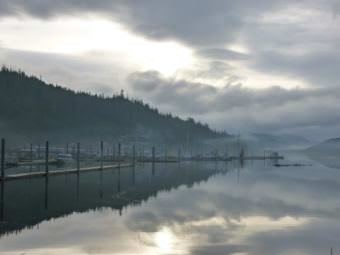
A portion of the Tongass National Forest along Peril Strait is seen from the ferry Chenega in Sept. 3, 2015. (Photo by Ed Schoenfeld/CoastAlaska)
Petersburg’s borough assembly on Monday was not interested in chipping in money to defend a Tongass National Forest exemption from the Clinton-era Roadless Rule. It didn’t even come up for debate or a vote for that matter.
The Trump administration last year granted a Tongass exemption to the nationwide rule that prohibits new logging and forest roads in parts of the national forest that do not have roads. It was something requested by multiple Alaska governors.
At a borough assembly meeting Monday, local resident Eric Lee testified in favor of keeping roadless prohibitions for the Tongass and against an exemption for the nearly 17 million acre forest.
“Language in the Roadless Rule is aimed specifically at preventing the construction of logging roads in areas that have not already been roaded,” Lee said. “It does not prevent the development of infrastructure projects in roadless areas. What it does do is make the permitting process for such projects more thorough, which is necessary to ensure the health of the forest. This is as it should be if we are to protect the forest that we’re all depending on.”
Alaska under Gov. Mike Dunleavy has intervened to defend the Tongass exemption and allow new logging and roadbuilding in undeveloped areas, calling those restrictions damaging. Others signing on to defend the exemption include the cities of Craig and Ketchikan, along with Southeast Conference, which is a coalition of panhandle municipalities and businesses. Some have agreed to contribute to that legal effort. Also on that side are former Gov. Frank Murkowski, shipping companies, chambers of commerce in Ketchikan and Juneau, and Juneau’s electrical provider.
Petersburg Mayor Mark Jensen asked for the assembly to consider contributing as well.
“Gov. Dunleavy welcomes support from Southeast communities and businesses in defense of the 2020 Tongass exemption rule drafted by the U.S. Department of Agriculture in October of 2020. Like it says here, I requested this to see if the assembly … the Petersburg Borough would like to support the Tongass exemption,” Jensen said.
Borough assembly member Bob Lynn moved to support the Tongass exemption but his motion received no second, meaning it doesn’t come up for a vote or any debate.
In recent years, the assembly has been pretty split over the topic, even voting down multiple resolutions for or against a Tongass exemption. In 2019, assembly members agreed to take no position on roadless.
But contributing to a legal effort wouldn’t have been a first for the Petersburg assembly. They voted last June to donate to the defense of commercial salmon trolling offshore of Southeast Alaska.
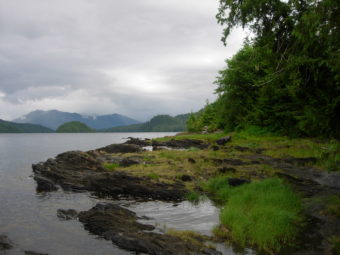
Tongass National Forest near Ketchikan, Alaska. (Creative Commons photo by Mark Brennan)
New research reaffirms the global importance of Southeast Alaska’s temperate rainforest for combating the effects of climate change. That’s according to data released Tuesday by a coalition of environmentalists and tribes opposed to old growth logging in Tongass National Forest.
Oregon-based researcher Dominick DellaSala says protecting forests is key to maintaining their function as a carbon sink.
“There’s no magic wand,” DellaSala said. “We only have a big vacuum cleaner that we can [use to] just suck CO2 out of the atmosphere and store it safely. Forests are doing that for us.”
He and his colleagues at the Woodwell Climate Research Center analyzed carbon data and found that the Tongass National Forest holds 44% of all the carbon stored by the United States’ national forests.
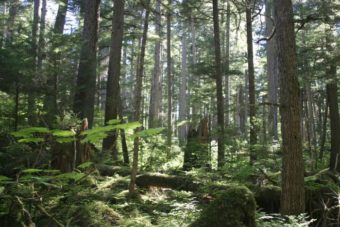
“Basically, when you go through an old growth forest, you’re walking through a stick of carbon that has been built up into the forest for many, many decades. Centuries,” DellaSala said. “And the largest trees in those forests store about 50% of the above ground carbon, so they are enormously important from a carbon standpoint.”
Trees store carbon by using photosynthesis to transform carbon dioxide from the air into food, which then fuels tree growth.
DellaSala introduced the findings Wednesday at a press conference organized by the Southeast Alaska Conservation Council, a Juneau-based conservation group opposed to clear cuts.
Exempting Tongass from the Clinton-era Roadless Rule was widely supported by state leaders and Alaska’s congressional delegation, who say it hindered resource development on federal forestlands. The state of Alaska recently joined a federal lawsuit seeking to oppose efforts to overturn the Trump administration’s exemption for the Tongass.
But tribal president Joel Jackson of the Organized Village of Kake added that the erosion control that healthy forests provide is key to sources of subsistence food from fish to wild game.
“My focus has always been the protection of the Tongass old growth — the remaining timber — for providing shade and pristine water for our salmon to return to the streams,” Jackson said. “That’s the most important thing to me because our life is salmon. We rely on being able to put away enough salmon for the winter — for a whole year until the salmon return. That’s our people’s main staple.”
Salmon returns to Southeast Alaska have plummeted in recent years. Last year’s commercial harvest was one of the lowest on record.
DellaSala was one of 111 scientists to sign a letter earlier this month urging the Biden administration to protect old growth and roadless areas of Tongass National Forest as part of its climate plan expected to be presented at the United Nations 2021 Climate Change Conference in November.
The state of Alaska and a former governor along with a host of municipalities, trade groups and businesses have filed to defend the Tongass National Forest’s exemption from a Clinton-era rule that limits development on federal land.
The Trump administration decided to get rid of the Roadless Rule for the Tongass last year. Shortly afterwards, a group of tribes, conservation groups, fishermen and tourism companies sued the federal government, seeking to overturn the decision. They say the decision to lift the rule on more than 9 million acres of the Tongass is based on a flawed environmental analysis and ignores the input of Alaska Native tribes and the public.
But the state and the rest of the coalition looking to defend the exemption for the Tongass say the rulemaking process was proper and that an exemption is critical to the state’s economy.
“The Tongass holds great economic opportunity for not only Southeast Alaska, but the State as a whole,” Gov. Mike Dunleavy said in a news release. “From resuming our timber industry to attracting tourism, this region has the potential to create good-paying jobs and it is my administration’s intent to defend our state’s rights and improve access to public lands.”
Robert Venables is executive director of Southeast Conference, an economic development group. He said projects in the Tongass are already held to high standards under state and federal laws and regulations.
“What really is the issue, in my mind, is having a conversation of, how does Alaska really access and control and have more of a conversation about how the forest is managed? Because this is very unique, where you have almost 96% of the region in direct federal control,” Venables told Alaska’s Energy Desk in a phone interview.
He said the Roadless Rule places unnecessary hurdles in front of development, pointing specifically to renewable energy projects. While developers can apply for exemptions to the Roadless Rule — and most are granted — he said the rule adds to the cost and time required to complete projects.
“This is not about extraction of resources. This is about every single economic sector meeting having unique needs for the forest, and we need a management plan that can reflect that,” Venables said.
Roadless Rule supporters disagree. They see increased resource extraction and development as an inevitable consequence of the rule going away in Alaska.
President Joel Jackson from the Organized Village of Kake said he’s concerned development could hurt the region’s other economic drivers.
“Our region, before COVID, was heavily reliant on tourism, and sport fishing, and commercial fishing and subsistence fishing. And it still is. And those areas provide way more jobs and more economic value to Southeast Alaska,” Jackson said in a phone interview.
Jackson said it’s also a threat to Alaska Native tribes’ way of life, since they harvest food and medicine from the forest and nearby waters.
Ketchikan’s city and borough have joined the state in defending the exemption. City Mayor Bob Sivertsen said development doesn’t have to harm the environment.
“Well, there are mitigations for everything we do,” Sivertsen said via phone. “We have the technology these days to do construction and other things that would lessen the impact on environmental issues, whether we’ve got to put in fish culverts, silt fences, the design and placement of the roads, all those types of things.”
Roadless Rule advocates say that logging and other development could accelerate climate change because the Tongass stores vast amounts of carbon.
Other parties defending the exemption include the city of Craig, statewide and Southeast chambers of commerce, electric utilities, shipping companies and resource development advocacy groups.
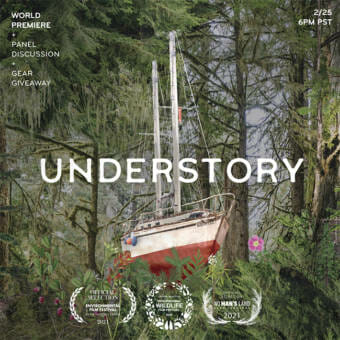
The documentary film, “Understory,” looks at the impacts of logging on Prince of Wales Island in Southeast Alaska. (Image courtesy of Last Stands)
A documentary film about the impacts of logging on Southeast Alaska’s Prince of Wales Island called “Understory” is starting to make its way through film festivals. The film features a resident of the small Prince of Wales community of Point Baker.
Elsa Sebastian is the narrator and co-producer of “Understory.” In the film, she sails her boat with a few friends around Prince of Wales and backpacks into the forest. Sebastian says she isn’t anti-logging, but she doesn’t like industrial clear cutting. This winter, she’s been apprenticing in Sitka learning how to repurpose salvaged, old growth timber into furniture.
“As a local person, the way I see it, is that we’re not just stripping the land of biological abundance when we clear cut it, we’re also removing our reserve of really valuable timber, really valuable trees that could be used carefully and locally forever,” she said.
Sebastian grew up on Prince of Wales in a home without running water or electricity. She commercial fished with her parents. The forest was part of her identity. As an adult she started to investigate logging happening in her backyard. Industrial-scale logging began on the island in the 1950s and expanded in the second half of the last century. Now the island supports the region’s only remaining mid-sized sawmill where some of the trees cut are still processed.
Sebastian shifted from power trolling in Southeast to gillnetting in Bristol Bay to spend more time on what she calls “ground truthing” or studying the land by personal observation.
“It’s basically going to the land to see for yourself if what you’ve been told is true,” she said.
Point Baker resident, Elsa Sebastian, is co-producer and narrator of the documentary film, “Understory,” which looks at the impacts of logging on Prince of Wales Island in Southeast Alaska. (Photo courtesy of Last Stands)
Natalie Dawson is a wildlife biologist who has studied mammals in the Tongass for 20 years. She spent “months backpacking on Prince of Wales, and Kuiu, and Admiralty,” trapping them, she said.
Dawson was interested in seeing Prince of Wales from the water — from the outside looking in.
“I’m used to being literally nose down in the lichen and moss and the downed trees and that kind of allowed me the perspective of pulling back and seeing the island as a whole place,” Dawson said.
Also joining them was Mara Menahan, a wildlife artist who specializes in painting plants.
The trio had traveled together a few years earlier, spending a month bushwhacking through areas of Prince of Wales. Sebastian says, at times, if felt like they were just animals navigating through very difficult terrain.
“When you’re carrying a heavy backpack and you come up to an edge of an old clear cut and you realize you’re going to have to crawl through it, it’s really challenging and it shifts your opinion about what that clear cut means,” said Sebastian.
This trip by sail boat included two people filming. It was Sebastian’s first time venturing into advocating for the Tongass in a professional way, but she thought the message was important. She says a lot of people think you can cut the big trees down and little ones will replace them.
“That logic makes sense in a way, but it’s not true,” she said. “I mean, we’ve tried to move through a 70-year-old clear cut and felt like we were going to break our legs the entire time. It’s pretty scary to walk through old clear cuts, whether you’re a human or a black bear or a deer.”
From her observations, Dawson believes logging impacts mammals on the Tongass. But she says funding for scientific research is so limited, it’s hard to quantify it.
Dr. Natalie Dawson, featured in the film, “Understory,” has her PhD in endemic mammals of the Tongass National Forest. (Photo courtesy of Last Stands)
For Sebastian, she says she didn’t really get what industrial logging was until she spent a few months walking in the woods.
“I’ve been fishing off of Prince of Wales my entire life. I grew up on a fishing boat and we used to fish down by Craig,” Sebastian said. “And when you look at the land, I mean, there’s different shades of green but it all looks green. You know, an old clear cut that’s grown back for 50 years, it looks green from the water. But when you get into that forest, it doesn’t feel alive.”
The film “Understory” also touches on other themes: the federal subsidies to keep logging going and the carbon sink the forest provides to combat climate change. It also features Marina Anderson, with the Organized Village of Kasaan talking about her tribe’s history of logging on the island.
Funders for the film included Patagonia, The Wilderness Society, Audubon Alaska, Peak Design, and Sitka Salmon Shares.
The coronavirus pandemic has complicated local screenings of the film. Sebastian says they will come up with a plan even if it’s an outdoor showing. In the meantime it’s getting shown at film festivals throughout the country.
Dead spruce behind Kenai Peninsula College. (courtesy of Mitch Michaud)
Soldotna is waiting on a federal grant to remove beetle kill trees that could fall and pose a fire risk. But the beetles themselves aren’t so patient.
“Needless to say, the wheels of government don’t work as fast as the beetles do,” said local forester Mitch Michaud, who’s helping Soldotna forge a path forward among a persisting spruce bark beetle problem.
When spruce bark beetles eat away at trees, they make them weaker and more prone to toppling over.
What concerns Soldotna is that the brush from dead trees could become a fire hazard. The city successfully applied for a grant last year from FEMA to mitigate that risk, totalling around $300,000.
But between hurricanes, wildfires and the pandemic, FEMA’s been busy. The agency also has to do an environmental assessment before sending funds over.
Michaud’s helping the city scout trees that need attention now. He identified some at Aspen Park that the city should remove using its own funds while it waits for FEMA.
In the meantime, the Parks and Recreation Department will keep tabs on other trees in other parks that could be high risk.
“We’re generally waiting,” said John Czarnezki, Soldotna’s director of economic development and planning. “Unless we get these situations, like at Aspen Park, where we’ve got some higher-risk trees that could damage neighboring properties, could damage our city infrastructure.”
“And we’ve got a wellhouse there, we’ve got fences, we’ve got a building, we’ve got a significant investment in that park that we’re trying to protect,” he added.
Spruce bark beetles are tiny and lay eggs in host trees between May and July. Beetle outbreaks are cyclical and typically track with the life cycles of spruce trees.
But outbreaks become more likely when trees are unhealthy. And lately, both drought and fire have ramped up in Southcentral Alaska.
“And that was something that we had to show the folks at FEMA in our grant,” Michaud said. “Was that we’re looking at beetle intervals occurring every 10 years.”
Beetles typically stick to forests, since city trees are well tended. But Michaud said drought has made it so even the hearty trees in city parks are vulnerable.
“The ones at my home, I lost five,” he said. “And I had survived every beetle attack.”
Michaud’s looking at Aspen Park because of how quickly trees have been dying there.
Not all the trees at the park are at risk of falling. The area is relatively sheltered from the wind.
But those with advanced decay are making him nervous. They could topple tomorrow.
“I have to guard any answer I give, saying any of these trees could fall down at any time,” Michaud said. “So there is no insurance of that. Likewise, in a natural forest, you’ll have beetle kill trees that will stay up for, like, almost 10 years.
Tree removal is one part of the project FEMA will fund. The city is also looking at trimming trees to reduce risk of fire spread.
Soldotna’s plan will probably change before the grant is finalized.
“FEMA’s aware that our trees are continuing to die and that there will need to be some adjustments to our plan,” Michaud said.
The plan also doesn’t account for private property. Czarnezki said they’ve been looking for separate funding for that.
“And that has been much harder to come by,” he said.
Soldotna heard from FEMA last week that grant funds could take 12 to 18 months to arrive. Once the project is underway, the city will look for ways to revegetate parks that have been affected.
Close
Update notification options
Subscribe to notifications
Subscribe
Get notifications about news related to the topics you care about. You can unsubscribe anytime.