Timber

US Forest Service mismanaged Tongass timber sales, report says

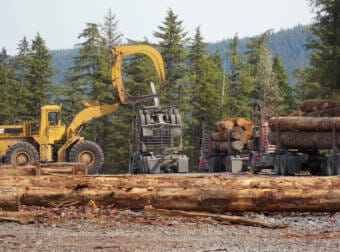
Logs are transported from the road system to water on Kupreanof Island near Petersburg in 2013. (Joe Viechnicki/KFSK)

An internal audit by the U.S. Forest Service says the federal agency mismanaged two timber sales. The report blames pressure to meet timber harvest targets. Mistakes meant $2 million less for habitat restoration work on the Tongass National Forest. Auditors also found the sales failed to outline planned restoration work and potentially violated conflict of interest rules among other findings.

The August 2020 internal agency audit found problems with oversight and administration of two large timber sales on the Tongass National Forest in Southeast Alaska. It only saw the light of day after Public Employees for Environmental Responsibility sued for it.

Jeff Ruch, Pacific director of the Maryland-based watchdog group said the report only tells part of the story.

“The report concludes that the problems were motivated by pressure to meet timber sale quotas but doesn’t explain pressure by whom, what about that pressure, how was it manifested, which officials were responsible,” Ruch said. “And that sort of cryptic, unspecific kind of finding makes it difficult for the Forest Service to use it as a basis for reform.”

The report was done by an oversight branch of the Forest Service’s Washington office. It reviewed the Big Thorne Stewardship Contract, awarded in 2014 to Viking Lumber on Prince of Wales Island. It found the agency underestimated the volume by more than 10%.

By law, the Forest Service isn’t allowed to put out timber sales that don’t pencil out for companies. If the cost of getting the wood out of the forest and to market is more than its worth, then it’s a no go. But the report says the agency was incorrect in its valuation of the timber, “making it possible for a positive value and ultimately helped the Tongas and the Region obtain its annual timber sale goal.” In the end, it effectively reduced the overall contract amount to around $2 million to Viking, to avoid a lawsuit from the company.

The report did not find that low-value hemlock is being left uncut in the woods, as prior agency analysis had found. It states that “the contractor is cutting every decent hemlock in the forest.” The report does not include any mention of the Tonka timber sale near Petersburg that was flagged in prior internal reviews for sale oversight problems.

The agency also reviewed the state of Alaska’s Good Neighbor Authority Agreement from 2017. That agreement allows the state’s Division of Forestry to do the preparation, administration and oversight for logging on federal lands. Under that pact, nearly 30 million board feet on Kosciusko Island in the southern Southeast was awarded to Alcan Timber of Ketchikan. But the auditors were concerned over potential conflict of interest in the deal. That’s because the same unnamed person doing the appraisal for the state later contracted with the purchaser to do preparation work for logging. The report says that could give a person with privileged details of the sale the ability to gain financially.

Alcan’s Eric Nichols said a state employee with 40 years experience in Southeast Alaska did the appraisal and retired from the state after it was awarded to Alcan. That employee got an ethics clearance from the state and started a forestry consulting company doing timber sale layouts, Nichols writes in an email. And he says that people with this experience are “very hard to find with the downward spiral of the timber industry.”

The Forest Service’s report also notes problems with the state’s software for estimating timber, valuation of those trees and the agreement’s omission of habitat restoration work that is supposed to accompany the logging.

Environmentalists seized upon the critical audit to question the Forest Service’s timber management practices on the Tongass. Sally Schlichting is with the Southeast Alaska Conservation Council in Juneau. She said the 20-page audit’s findings are concerning.

“They really call into question whether the other timber sales that the Forest Service has planned are being properly developed and whether there are other issues out there with other timber sales that are not being properly managed,” Schlichting said.

Forest Service officials declined an interview. In a statement, the agency says it’s updating its policies to clearly define roles and responsibilities, strengthen internal controls over timber sales, improve oversight of the program, and provide additional training for employees. The full statement read:

“The USDA Forest Service takes seriously its obligation to ensure the accountability, integrity, and effectiveness of the work we perform. During routine reports on timber sales, the agency discovered some inconsistencies, which were addressed by Alaska Region 10 and validated through an internal audit. To ensure future work is completed in a consistent manner, Alaska Region 10 has already or will soon update its policies to clearly define roles and responsibilities, strengthen internal controls over timber sales, improve oversight of the program, and provide additional training for employees. We are confident we have sufficiently developed a plan to achieve more efficient and effective oversight of timber sales to help meet agency goals. The final report was released internally on August 18, 2020, and is now publicly available on the Forest Service website.”

State forester Chris Maisch was not available for an interview Monday. An agency spokesperson referred questions to the Forest Service. The timber industry group Alaska Forest Association also declined to comment.

Correction: An earlier version of this story misstated the impact of the lost value from the timber contract. The $2 million reduction is not paid by taxpayers but impacts the habitat and restoration work that could happen on the Tongass National Forest.

Ketchikan borough assembly to consider opposing Roadless Rule lawsuit

Ketchikan Assembly (Photo courtesy KRBD)
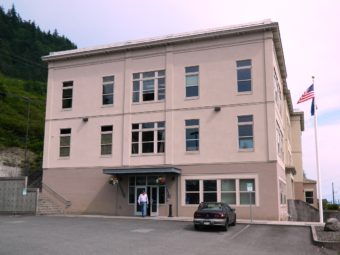
The Ketchikan Gateway Borough Assembly meets in the White Cliff building at 1900 First Ave. (KRBD photo)

The Ketchikan Gateway Borough Assembly will consider opposing a lawsuit seeking to reinstate the Roadless Rule in the Tongass National Forest.

The Trump administration’s Tongass exemption opened up approximately 9.4 million acres of federal forest land to potential road building and other development. A legal challenge seeking to overturn the exemption was filed by Southeast Alaska tribes and conservation groups late last year.
The Ketchikan City Council recently voted 6-1 to spend up to $5,000 to intervene on the federal government’s behalf. Elected officials in Wrangell recently considered a similar request but decided not to intervene.

In other business, the Ketchikan borough assembly will consider taking over operation of the entire Rainbird Trail located above the Third Avenue Bypass. The University of Alaska Southeast requested transfer of maintenance responsibilities for the portions located on UAS lands to the borough. The borough’s portion of the trail has been closed since a landslide last fall. The trail is popular with residents and cruise ship passengers.

If approved, trail maintenance and repair would be included in the 5-Year Capital Improvement Program. Work would occur in phases with a proposed budget of $100,000 in the first year, and $150,000 annually for two more years after that. Most of the funding could come from grants and head tax paid by cruise passengers.

The Ketchikan borough assembly is also slated to hear two reports. Rep. Dan Ortiz is scheduled to provide a legislative update. The borough auditor will deliver an annual report on the local government’s finances for the fiscal year ending June 2020.

The meeting begins at 5:30 p.m. Monday in the Ketchikan Borough Assembly Chambers at the White Cliff Building. It is also live streamed on the borough website and available on local cable channels. Public comment will be heard at the beginning of the meeting.

Ketchikan’s City Council votes to defend Roadless Rule rollback in court

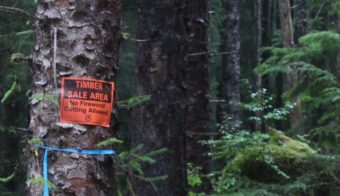
A timber sale sign is posted in the Tongass National Forest on Prince of Wales island. (KRBD file photo)
A timber sale sign in the Tongass National Forest on Prince of Wales island in 2015. (KRBD file photo)

An overwhelming majority on Ketchikan’s City Council wants to defend the Trump administration’s decision to exempt the Tongass National Forest from the Roadless Rule.
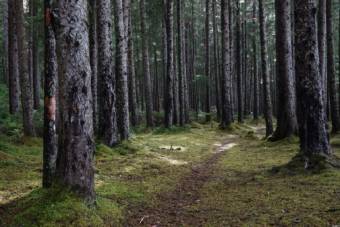
A legal challenge by Southeast Alaska tribes and conservation groups seeks to overturn the rollback, which could ease road building and other development on some 9.4 million acres of federal forest land.

Ketchikan City Council member Riley Gass said the collapse of the cruise season in 2020 in the face of the pandemic shows that the region needs to tap its natural resources.

“I think this is important because as we all know, and we’re all seeing, there’s not a whole lot of industry going on in our region, there’s not a lot of — there’s just not a lot of industry. And if we can try to help out to bring back some amount of timber industry in the region, I think it’s prudent,” he said.

The Ketchikan City Council voted 6-1 Thursday to spend $5,000 on legal work to intervene in federal court.

Roadless Rule critics say there’s little chance the region will again see large-scale logging, as it did in the mid-to-late 20th century. But they say the rule is an obstacle to mining, energy and other development in the Tongass.

The lone vote against came from Janalee Gage.

“I won’t be supporting this because, one, they were working with Native tribes on this issue, and they had come to several different points where they all agreed, and then they decided to ignore everybody’s input. And that is why they’re in this position,” she said.

The Biden administration can’t easily overturn the rulemaking process that exempted the Tongass National Forest from the Clinton-era rule. But Congress could — Democrats from Washington, Arizona and Colorado have filed a bill to restore the rule.

The exemption was championed by Alaska’s congressional delegation.

Sitka fish and game committee speaks out about climate change

Members of the Sitka Advisory Committee expressed concern that climate change is impacting habitat for fish and game resources that commercial, sport and subsistence users rely on. (Photo by Erin McKinstry/KCAW)

Sitka’s local fish and game advisory committee is speaking out again about climate change and its impacts on commercial, sport and subsistence activities.

When the group met on Wednesday, they signed off on a letter to other advisory committees around Alaska urging them to take action. Last November, the group unanimously passed a climate emergency resolution, and in February, they were part of an effort that unsuccessfully petitioned the city assembly to do the same.

The city has since formed a task force to address climate change locally.

Member Stacey Wayne who holds the shellfish seat, said at the meeting that part of the Sitka advisory committee’s job is to advise others on wildlife conservation and use, including matters related to habitat.

“We’re fighting as user groups to have fish to fish, and our seasons are collapsing and our stocks are collapsing, and all of these are related to climate change,” Wayne said. “And so our job is to preserve opportunities to fish and hunt for the community.”

Support for the letter was almost unanimous, but member Luke Bastian, who holds the guide seat, did have some concerns.

“I think there’s unforeseen consequences there, and I don’t know if it actually gains us anything,” he said.

Wayne and others disagreed, saying that calling on other advisory committees to take action could have a tangible impact.

“Maybe with many voices pressuring local governments to become louder in support of stopping climate change and taking actions at the local level, there can be an impact to help preserve and protect the habitat for the species that we’re supposed to be protecting,” she said.

The committee also signed off on a letter opposing the decision to reverse the Roadless Rule in the Tongass National Forest and filled or renewed positions on the trapping, processing, alternate and sport fishing seats.

Democrats renew push to restore Roadless Rule in Tongass National Forest

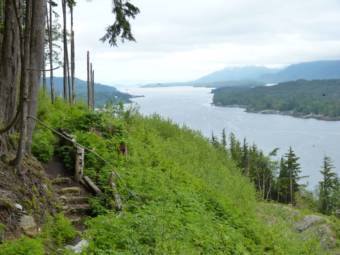
Portions of the Tongass National Forest can be seen from Ketchikan’s Rainbird Trail.
Portions of the Tongass National Forest can be seen from Ketchikan’s Rainbird Trail. (KRBD file photo)

Democratic lawmakers in Congress have begun trying to reinstate the Roadless Rule for Alaska’s Tongass National Forest

They’ve filed a bill that would reverse the Trump administration’s decision to exempt the nation’s largest national forest from the 2001 rule that restricts road-building and other development. 
And with the U.S. Senate slated to change hands, the bills filed in both chambers on Tuesday have better prospects than previous efforts. 

The Roadless Area Conservation Act of 2021 mirrors past bills. It was introduced by U.S. Sen. Maria Cantwell (D-Washington) and Reps. Diana DeGette (D-Colorado) and Ruben Gallego (D-Arizona).

“The looming climate crisis has only increased the need to protect America’s last remaining wild forestlands, which reduce wildland fire risk and store huge amounts of carbon,” Sen. Cantwell said in a statement.

Alaska’s Congressional delegation and many state leaders hailed the Tongass exemption, finalized last October.

It could open up 185,000 acres of old growth forest in Southeast Alaska to logging.

But it’s proven controversial. Forest Service hearings in recent years showed the Clinton-era rule had strong support both in Alaska and Outside. 

A coalition of 10 conservation groups including Alaska Wilderness League, Alaska Audubon and Southeast Alaska Conservation Council released a statement on Tuesday supporting the bills.

“This legislation preserves roadless areas for hunting and fishing, activities that support a subsistence lifestyle and define a way of life for many people living in rural forested areas,” the groups wrote.

A coalition of conservationists and Southeast Alaska tribes filed a lawsuit last month to compel the U.S. Department of Agriculture to reinstate the Roadless Rule. 

Absent legislative action or a court ruling that reinstates the Roadless Rule, an incoming presidential administration couldn’t easily reverse the exemption. 

Sealaska Corporation says it’s quitting logging

The northwest coast of Prince of Wales Island. (Photo by Joe Viechnicki/KFSK)

Sealaska Corporation announced on Monday that it is getting out of the logging business after more than 40 years.

The move by one of the region’s economic powerhouses is the latest sign of Southeast Alaska’s economic transition away from logging.

“Logging created value for our Alaska Native shareholders for decades, and it brought us to where we are today. We’re grateful for the commitment and professionalism that led to our success,” Sealaska CEO Anthony Mallott said in a statement. “But we’ve now built an organization that can thrive well into the future, and that means engaging in activities with more enduring benefits for our communities.”

The corporation declined further comment.

The news was welcomed by environmentalists opposed to logging old growth forests.

“We are overjoyed for Sealaska at this incredible decision making by Anthony Mallott and by their board chair Joe Nelson,” Meredith Trainor, executive director of the Southeast Alaska Conservation Council, told CoastAlaska on Monday. “And just this visionary leadership of moving Sealaska away from logging and towards other ways of creating benefit for their people.”

The Juneau-based Native corporation says the transition isn’t expected to affect future profits or dividends. A joint statement says the decision is part of a long-term plan to generate “sustainable value” for shareholders.

Until now, Sealaska was a major player in the region’s timber economy with more than 360,000 acres in its portfolio.

In 2015, it began logging lands it received through a transfer by Congress of more than 70,000 acres of Tongass National Forest, largely around Prince of Wales Island.

The Alaska Forest Association, the state’s timber industry group, declined to comment on the news.

Sealaska Corporation was created by the landmark Alaska Native Claims Settlement Act. It has about 22,000 shareholders, most of whom live in or have historic ties to Southeast Alaska.

Site notifications
Update notification options
Subscribe to notifications