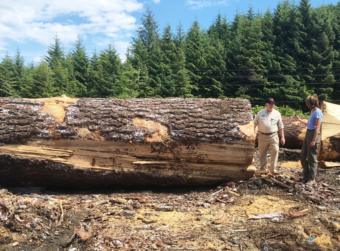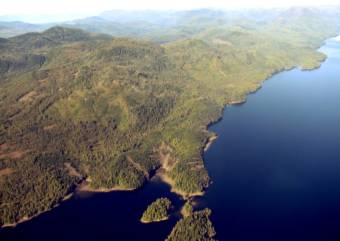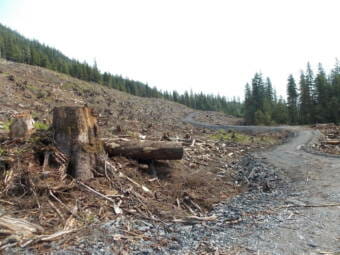
A logged area on Kupreanof Island near Petersburg in 2013 (Joe Viechnicki/KFSK)
A watchdog group hopes a lawsuit will shake loose more evidence of lost revenue from timber sales on the Tongass National Forest in Southeast Alaska. The borough government in Petersburg has also sought answers about what’s been done to fix problems, with little response.
Public Employees for Environmental Responsibility is a Maryland-based national watchdog group for current and former public sector workers. In the past, it has published internal documents from the U.S. Forest Service that pointed to problems with oversight, transparency and accounting for timber contracts on Prince of Wales Island and near Petersburg.
In August, the group asked the Forest Service to release its audit of Tongass timber sales under the Freedom of Information Act. That request has yet to be fulfilled, and the group is asking the courts to enforce the law.
The group’s Pacific director, Jeff Ruch, expects the audit will confirm those earlier findings.
“We think it’s timely in that as you know there’s an effort to dramatically expand logging on the Tongass by repealing the Roadless Rule, and that if past is prologue and they’ve lost money on these earlier sales, you may be looking at a new gusher of red ink from new sales,” Ruch said.
Ruch thinks the financials from the audit also should have been included in the recent environmental analysis used to grant a full exemption of the Tongass from the Clinton administration’s Roadless Rule. A decision on opening up more areas of the Tongass to logging and roadbuilding is expected in the coming weeks.
Elected officials and residents in Petersburg have also asked about the extent of lost revenues from past timber sales and what’s been done to correct oversight with sale administration. Alaska regional forester Dave Schmid said last November in a public meeting that the audit was nearly complete. Nearly a year before that, he said the agency was responding to timber sale issues.
KFSK and others submitted Freedom of Information requests for that audit in 2019, but the agency has not produced it.
The Petersburg borough has also sent letters seeking answers, dating back to 2018. Forest Service chief Vicki Christiansen responded in May 2019 that the agency would share more information.
“We look forward to sharing with you those actions aimed to address any findings identified by the audit,” Christiansen wrote.
Appeals to the Department of Agriculture’s Inspector General for a separate external review have so far been fruitless.
In 2016, staff with the Washington office of the Forest Service found, among other things, that timber companies are leaving behind lower value hemlock and cutting more of the high value cedar and spruce, which changes the economics of timber sales and how those are appraised and awarded.
George Woodbury of Wrangell is a board member for the Alaska Forest Association, an industry group.
“The reason it’s not being taken is because we got the long-term sales taken away and the pulp mills, so we don’t have the secondary manufacturing facilities,” Woodbury said. “We are no longer able to use everything that we were before. It’s the result of the environmental challenges and the fact that they shrunk the timber supply so much you can’t have an industry big enough to utilize all the wood.”
The Forest Service says it won’t comment on litigation. It referred inquiries to the Department of Justice, which did not immediately respond to questions this month.
U.S. Secretary of Agriculture Sonny Perdue and Sen. Lisa Murkowski look at some old-growth logs in the yard at Viking Lumber in Klawock. The two toured Prince of Wales Island on July 5, 2018. (Photo by Leila Kheiry/KRBD)
The Trump administration announced last week that it’s planning a full rollback of the Clinton-era “Roadless Rule” for the Tongass National Forest. The administration described the goal of the rollback as “maximum additional timber harvest.”
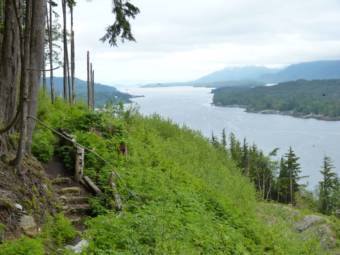
The Roadless Rule, simply stated, forbids road building and industrial activity — with some exceptions — in areas that don’t already have them. It covers nearly 9.4 million acres, or just over half, of Southeast Alaska’s Tongass National Forest.
Addressing civic and business leaders at Southeast Conference on Friday, Sen. Lisa Murkowski praised the federal government’s decision.
“The Roadless Rule is not just about timber,” Murkowski said via videoconference link. “It is about reasonable access for a wide variety of users, whether it is for renewable energy that we work so hard to build, whether for recreation, whether for mineral — it is for all pieces of the Southeast economy.”
Alaska’s congressional delegation has long opposed the 2001 rule. So has the state of Alaska, which sued and settled with the feds to win an exemption that lasted about seven years.
So those applauding the decision say don’t expect boom times right away. Especially not with logging
“I don’t think it’s going to be any more intensive than it was when we had total exemption in the period from 2004 to 2011,”Jim Clark, former chief of staff to Gov. Frank Murkowski told CoastAlaska.
The Juneau attorney has been helping fight the Roadless Rule from the beginning. He predicts it’ll help the mining and energy sectors — especially hydropower — by making it cheaper and easier to build roads on federal forest lands. But it won’t happen overnight.
“It would be a mistake to oversell either the problems that are going to occur for the environmental community as a consequence of this, or to oversell how much economic development is going to occur,” Clark said.
Industry groups signal support
The Alaska Forest Association — a timber industry group — applauded the federal government’s decision.
“Application of the Roadless Rule to the Tongass was never appropriate and has stifled the timber industry, and the larger Southeast economy,” AFA Board President Bert Burkhart said in a statement.
The Roadless Rule has been popular in Alaska. The Forest Service says it received about 411,000 comments, most of those in favor of keeping the status quo.
And during two years of public hearings, Southeast Alaskans came out in person to defend it. The reasons varied: concern about deer and salmon habitat, preserving wild places for guides to bring tourists.
Tribes were particularly vocal about keeping the national forest intact.
“We want to keep what’s here because we know the effects of logging in our area,” Joel Jackson, tribal president of the Organized Village of Kake said by telephone on Friday. “Old growth timber areas provide for us … berries and our medicines and also to hunt the deer and moose in our area.”
The federal government is required by law to consult with federally recognized tribes that live around the Tongass. Jackson says he feels like the agency was just going through the motions.
“I felt like they didn’t really listen,” he said. “And it turned out they didn’t.”
A November 4, 2019 U.S. Forest Service listening session was well-attended by Roadless Rule supporters. (Photo by Rashah McChesney/Alaska’s Energy Desk)
D.C. timber lobbyist linked Gov. Dunleavy with U.S. Ag Secretary Perdue
Agency emails obtained in a records request by Southeast Alaska Conservation Council show a D.C. lobbyist working for the Alaska Forest Association set up a telephone call between U.S. Secretary of Agriculture Sonny Perdue and Gov. Mike Dunleavy last year.
The governor’s office confirmed the May 7, 2019 call took place but would say nothing about what was discussed. The AFA, whose members were in Washington and in the room during the call, also declined comment.
The revelation of the joint timber industry/Alaska governor telephone call with Perdue has angered tribal leaders. Tribes had offered to travel to D.C. to meet with Secretary Perdue but were reportedly told only an undersecretary would be available to receive them.
Joel Jackson says it’s unfair that Trump administration cabinet officials will meet with industry but not tribal governments.
“They’re just the timber association and the tribes are sovereign nations,” Jackson said. “So that really upset me that we were brushed aside.”
Arguments against exemption range economic to ecological
Taxpayers have lost money on virtually every Tongass timber sale since the 1980s, says a D.C. budget watchdog group.
“We are concerned that opening up areas where they’re not currently roads to timber sales would increase taxpayer losses,” said Autumn Hanna, vice president of Taxpayers for Common Sense, a nonpartisan D.C. group.
“We’ve seen plenty of evidence already the taxpayers would lose significantly more by logging in these old growth areas that are harder to access and have been protected by the Roadless Rule,” Hanna said earlier this month.
The losses happen because the Forest Service actually pays for building new roads used by the timber industry to log public lands. In relatively remote areas with old growth stands of trees, she says, the costs to the public are even higher.
“So, taxpayers are upside down and underwater on the timber sales,” she added.
The Forest Service’s final environmental impact statement runs to nearly 700 pages. And critics have already seized upon one passage that downplays any impact to climate change. It says more logging would have only “a temporary influence on atmospheric carbon concentrations” that would get better as the forest grew back.
“Yeah, I don’t buy it,” said Dominick DellaSalla, an Oregon-based researcher with Wild Heritage, an advocacy group. “And I think they’re kicking the can down the road, there’s a lot more impacts that are going to happen.”
“We’ve got to recognize that every action has a reaction in terms of the atmosphere,” DellaSalla told CoastAlaska. “And to deny that, the Forest Service is really denying climate change.”
Under the federal government’s rule-making process, the Secretary of Agriculture has to wait 30 days from releasing its formal “record of decision.” That’s what makes the rule binding. A future presidential administration could work to change that, but it would have to go through this multi-year rule-making process from scratch.
Agency’s 2016 Tongass forest plan limits old growth logging
But there’s another piece to the Tongass logging debate. The amount of old growth timber that can be cut is restricted by the Tongass forest plan that sets out a transition to young growth over 15 years.
Gov. Bill Walker’s administration petitioned for the Roadless Rule to be rolled back in 2018. But the state didn’t stop there: it also called on the federal government to revise the 2016 forest plan that limits old growth timber harvests.
“There was a request for revision of the 2016 plan,” said Clark, the natural resources attorney in Juneau. “There’s been absolutely no movement on that by the Forest Service or anybody else”
That would be an entirely different fight.
“Rulemaking takes a long time,” Clark said. “And this one would be, I think, more difficult than what we did on the Roadless exemption.”
In other words, the fight over old growth logging in Tongass National Forest is a conflict that moves about as swiftly as the trees grow.
Portions of the Tongass National Forest can be seen from Ketchikan’s Rainbird Trail. (KRBD file photo)
On Thursday, the U.S. Department of Agriculture announced that it is forging ahead with a proposal to make the Tongass National Forest fully exempt from a Clinton-era rule designed to limit road development on federal lands.
It’s known as the Roadless Rule, and successive Alaska governors and the state’s congressional delegation have pushed to make it not apply in the Tongass.
Proponents say exempting the Tongass would allow for more mining, communications and renewable energy projects on federal land. It could also open up more areas for logging, though advocates and opponents seem to agree that the impact on the timber industry would likely be minimal.
But many Alaska Natives worry that rolling back the rule would damage areas tribal members use for hunting, fishing and foraging. Nearly 200 people testified at 18 hearings last year specifically geared towards people who rely on the forest for their way of life — and large majorities supported keeping the rule in place, according to the U.S. Forest Service.
An internal Forest Service report notes that 96% of public comments received on the issue last fall supported leaving the rule in place. Approximately 1% supported a full exemption.
The final environmental impact statement was released late on Thursday. That starts a 30-day waiting period before the USDA can issue a final decision on the Roadless Rule for the Tongass National Forest.
The western shores of Carroll Inlet in 2015. This region about 10 miles northeast of Ketchikan is part of the South Revilla project area, where the U.S. Forest Service proposes to offer more than 5,000 acres of old growth Tongass National Forest to commercial loggers. (Photo by Larry Edwards/Alaska Rainforest Defenders)
The federal government proposes to offer more than 5,000 acres of old growth forest in Tongass National Forest for commercial logging. While conservationists are sounding the alarm over the project near Ketchikan, the timber industry has raised questions over whether it would be viable.

The U.S. Forest Service says the South Revilla project is intended to support around 300 jobs regionally. The timber sales would be over the next 15 years and would be a mix of cutting old and young stands of trees.
The sales would be largely in the Carroll Inlet area, a patchwork of federal and state lands mixed with swaths already clear-cut by the Alaska Mental Health Trust Authority.
“We can’t do much about what’s happening with the mental health trust,” said Larry Edwards of Alaska Rainforest Defenders in Sitka. “But on the public lands that either the state or the federal government own, we shouldn’t be doing any more logging in this area at all.”
The Forest Service’s draft environmental review says removing old-growth habitat may further fragment the forest, eliminating connectivity important to deer, wolf, mountain goat, marten and bear in an area used by subsistence hunters. According to the review, the timber sales would decrease deer habitat, the primary prey for Alexander archipelago wolves, for 150 years or longer. A petition was recently filed to have Southeast Alaska’s wolves listed under the Endangered Species Act.
But the Forest Service justifies the work, saying a steady supply of economic timber is needed to support Southeast Alaska’s forest products industry.
“The Forest Service is going back in, and they’re just picking out isolated areas of old growth that are left over,” Edwards said.
Law prevents the agency from offering timber sales that appraise negative — that is, they would cost more to prep for sale than the agency would get in return.
The agency says it’s already spent about $5.1 million in planning and preparation for this project. Offering a timber sale would cost another $8 million or so. But using its own numbers, all of the proposed timber sales would put the agency in the red — which it can’t do by law.
It’s also unclear whether there would be any takers under current market conditions.
The Alaska Forest Association commented last year that the South Revilla project overlaps with a previous 2,200-acre Saddle Lakes project that was aborted over lack of interest.
Eric Nichols of Alcan Forest Products is skeptical the South Revilla project will find a buyer.
“You can’t buy it just to lose money on it,” he said.
Nichols’ company exports raw logs to Asia. The U.S. trade war with China has led to a lot of uncertainty, as tariffs are scheduled to be reimposed next year for his Ketchikan-based firm.
So timber operators may not be willing to incur the risk right now.
“That’s going to make the decision to buy anything very difficult,” Nichols said, “trying to understand what’s going to happen between the U.S. and China.”
Notice of a draft environmental impact statement was published in the federal register on Friday, Sept. 4. That triggers a 45-day comment period to weigh in on the project.
Marina Anderson on the Landback Issue of Vogue Tongass. Tristan Douville helped put the covers together. (Photo by Bethany Goodrich)
The Roadless Rule debate for the Tongass National Forest has been going on since before social media websites even existed. But today, it’s not uncommon to scroll past conversations about the sweeping policy changes on Facebook or Instagram. In a push to get the word out before the Trump Administration makes a final decision, young, Indigenous leaders in Alaska and elsewhere are making that content extremely sharable.
Even if you’re not aware of the contentious, ongoing Roadless Rule debate, you’ve probably heard of Vogue, the high-end fashion magazine. Now, imagine combining the two: a Vogue cover with dense federal policy.
Marina Anderson is the Tribal Administrator at the Organized Village of Kasaan, and she’s on that reimagined cover of Vogue, which includes headlines about real ordeals tribal governments have faced. It’s posted to her Instagram page.
“Right Across the top in capital letters it says, ‘Vogue,’” she said. “And we have Vogue Tongass, and it’s called the Landback Issue.”
Anderson isn’t the first person to use a mockup of a Vogue cover to make a point. A black, Oslo-based student started the #VogueChallenge over the summer to promote more diversity on the magazine’s covers, which have been photographed mostly by white males. Anderson says she’s been meaning to write a thank you note for the inspiration.
She thought this approach could also be used to educate people about problems at home.
“So immediately it’s able to draw somebody in because it’s something we’re familiar with, which is Vogue,” Anderson said.
Depending on how closely you keep up with the news, you might be aware of the major management changes underway in the Tongass National Forest.
In 2018, the State of Alaska petitioned the United States Department of Agriculture for an exemption to the Roadless Rule. That would mean the rule that prohibits road building elsewhere on national forest land wouldn’t apply to the Tongass. Proponents say the exemption could open up access to logging and other activities.
But lots of people, from commercial fishermen to tribal governments, have voiced strong opposition. There are concerns about what this could mean for deer and salmon habit and climate change mitigation. Recently, nine tribal governments requested another federal process to establish a Traditional Homelands Conservation Rule. The idea is to protect important areas for Tlingit, Haida and Tsimshian peoples.
All of this is complicated, and that’s where the Vogue cover fits in.
“I’ve been hearing that because it was catchy and easy to follow along with the Vogue covers on social media, they were finally ready to learn about it,” Anderson said.
Several Indigenous leaders and social media influencers have joined the cause, sharing their own Vogue Tongass covers. The posts are linked to a website that helps people generate letters to their local elected officials and the Secretary of the USDA.
“A priority of the campaign was to be able to reach young people to keep the momentum up,” Anderson said. “A lot of us have a big large web, and we have the know-how to click fast on these little phones and make things happen.”
(Photo courtesy of Richard Peterson)
Richard Peterson, the President of the Tlingit and Haida Indian Tribes of Alaska, has been following the proposed changes to the Roadless Rule closely for a long time, but he only recently learned about a Tongass edition of Vogue.
“I had many people reach out and say, ‘hey, where’s your Vogue cover?’ And I was like what?”
Peterson now has his own Vogue Tongass cover, which he posted on Instagram. He says he was delighted to see this innovative way of getting the message across.
“I think a lot of people really don’t understand what the tribes’ concerns are right now,” Peterson said. “I think that’s how we can start the conversation.”
Marina Anderson thinks that’s a conversation young people should be prepared to have. The Roadless Rule has been an ongoing topic in Alaska for decades, and the debate doesn’t seem to be going away.
“If we’re going to have to fight this fight in another 10 years, we’re going to need these people ready,” she said.
So far, she says 500 people have submitted letters supporting tribal governments.
A clear-cut in the Tongass National Forest on Kupreanof Island in 2014. (Photo by Ed Schoenfeld/CoastAlaska)
Gov. Mike Dunleavy recently praised President Donald Trump’s decision to make changes to bedrock environmental policy. Proponents say the changes streamline a burdensome regulatory process that hampers development on federal lands. In the Tongass National Forest, they come at a time when sweeping management changes were already underway.
Natalie Dawson, the executive director at Audubon Alaska, compares the changes to the National Environmental Policy Act to a late-night text.
“It used to be like the morning text message where it was thoughtful and you had a night to sleep on it. And you thought about your actions and what you may or may not want to say. And now, we can kind of go with heat of the moment decision making.”
Changes include removing the requirement to analyze cumulative impacts, like climate change, for new projects to take place on federal lands.
Dawson thinks another impact of the late-night text version of NEPA will be less public engagement. She says public input was a founding principle of the NEPA framework. Now, that’s being degraded.
This is all happening when the Tongass — the nation’s largest national forest — was already going through some controversial management changes. It’s slated to be totally exempted from the federal Roadless Rule, which could open up more access to logging. Under old NEPA, that public process was already fraught, with critics claiming the U.S. Forest Service didn’t listen to the public or tribal governments’ feedback to keep those protections in place.
Under new NEPA, Dawson says getting a word in on future projects will be a lot harder. One change is that only substantive comments will be accepted. This means that expressing general concerns about logging near deer or salmon habitat isn’t going to cut it.
“There was this phrase called, ‘to the fullest extent possible encourage and facilitate public involvement,’” Dawson said. “So ‘to the fullest extent possible.’ That language is now gone.”
“You may not have the time to sit down with all the maps and documents and provide a site-specific analysis of the federal agency action, and yet you are an incredibly important stakeholder in this process,” she said.
In the last few years, public meetings held throughout Southeast Alaska to discuss changes to the Roadless Rule were well attended. Dawson says that in the future, it’s not clear if public meetings with federal agencies will even take place. Before, meetings were held when there was substantial interest or controversy. Now, public meetings will only occur “when appropriate.” She says it’s also unclear who among the various federal agencies will make that determination. The same goes for decisions about whether a project is significant enough to trigger a full environmental review.
Dawson thinks the region recently saw a preview of what these changes could mean. The largest proposed timber sale in the Tongass in decades wasn’t allowed to move forward because it violated NEPA. Dawson says that project might not have the same barriers in another go-round.
Tessa Axelson, executive director of the Alaska Forest Association, says the ruling on that sale was a setback for the timber industry, and she thinks streamlining NEPA will be a good thing.
“I don’t see anything necessarily that is going to result in the loss of public input into the process,” Axelson said.
The timber industry group has long pushed for changes to NEPA. Axelson says under the old version, projects could be held up for many years — making it difficult for struggling operators to bid on federal timber sales and plan for a predictable supply.
“What we want is a process that is responsive to the law and also ensures that the professionals, that agencies are held to a standard for producing things timely and in such a way that is not so burdensome to small business operators,” Axelson said.
Still, Axelson doesn’t think an exemption to the Roadless Rule in the Tongass and revisions to NEPA will do enough to ensure a better outlook for Alaska’s timber industry. It’ll be up to federal agencies to plan enough timber sales that actually come together.
In the meantime, all of this could change in November. President Trump’s NEPA revisions can be undone by a new presidential administration.
Close
Update notification options
Subscribe to notifications
Subscribe
Get notifications about news related to the topics you care about. You can unsubscribe anytime.