The federal Office of the Inspector General is opening an investigation into how the U.S. Forest Service granted millions of dollars to the State of Alaska to work on a Roadless Rule decision in the Tongass National Forest.
In November, two Democractic members of Congress requested the investigation after Alaska’s Energy Desk obtained documents showing the state used some of the money to pay a timber industry group for additional industry perspective.
Sen. Debbie Stabenow of Michigan and Rep. Raúl Grijalva of Arizona questioned if the funds were misused. The money came from a modified federal grant typically used to prevent wildfires.
The state spent the money in a variety of ways, but it drew criticism from tribal governments and environmental groups for offering some of the funds to the Alaska Forest Association — at a time when a major decision is being made that could impact logging in the nation’s largest national forest.
Governor Mike Dunleavy has sharply denied any misuse of funds.
Corri Feige, Alaska Department of Resources Commissioner, reiterated that in a statement, which also says the state hasn’t received notification of the investigation yet, but will work cooperatively with the inspector, trusting that the inquiry is fair.
The Office of Inspector General will determine if the Forest Service had the proper authority to award the $2 million grant to the state and confirm whether other stakeholders knew about it or not.
The United States Courthouse and Federal Building in downtown Anchorage. (Photo by KDLG)
An organization that promotes the oil, gas, mining and timber industries in Alaska’s schools is suing its former executive director, alleging she embezzled at least $187,000.
Alaska Resource Education filed suit against Michelle Brunner, who worked for the organization for a decade ending in 2017, on Wednesday in federal civil court.
The group, with a roughly $300,000 annual budget, helps teach students about Alaska’s natural resources, distributing curriculum to K-12 schools. Modules include “Trees, a Renewable Resource,” and “Fossil Fuel Hunt.”
The group’s board of directors includes employees of some of Alaska’s biggest players in the natural resource industry, including ConocoPhillips, Usibelli Coal Mine and Hilcorp, along with Alaska Airlines and the Alaska Railroad.
In a 29-page complaint, Alaska Resource Education alleges Brunner stole money through unauthorized payroll transactions and bonuses, credit card charges for personal expenses and direct bank transfers, and hid some of the actions by describing them as payments to legitimate vendors.
It says Brunner falsified emails from the organization’s employees and consultants to qualify for a mortgage for, and then buy, an Arizona home. She also shredded documents and ultimately deleted her email account after leaving her job, though Alaska Resource Education hired a consultant that partially restored it, the suit says.
“We want to reassure our donors, our educational partners and the public that we have done everything possible to ensure the organization’s financial integrity and fiduciary responsibility going forward,” the group’s new director, Ella Ede, said in a prepared statement.
Brunner did not respond to a message sent to her Facebook account Thursday.
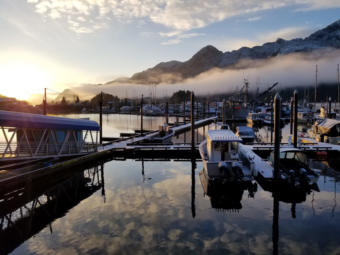
Pelican harbor, pictured here in late 2019. Pelican was left off the draft summer ferry schedule, leaving the town’s seafood processor worried about how they’ll get product to market. (Photo courtesy of Heather Bauscher)
The breakdown of the Alaska Marine Highway System has left many towns struggling to bring in building supplies, groceries and other goods. But for some businesses, the challenge of getting freight out of town is just as urgent — and without ferries, they’re taking a hit.
Even under normal circumstances, shipping logs out of Tenakee Springs is not exactly a walk in the park.
“We crane lumber off our barge and stack it near the entrance to the ferry,” said Gordon Chew, owner of Tenakee Logging Co. His company usually relies on the ferry to get their product to market. They load lumber onto unattended trailers or pickup trucks, then put them on the ferry for buyers in Juneau to receive.
But these are not normal circumstances. Tenakee hasn’t seen a ferry in months, and with the town’s dock slated to be rebuilt starting in July, it may not get another sailing until December.
That leaves Chew without many good options for shipping lumber. And, he said, it’s especially frustrating after spending years tailoring his company’s system to work with the ferries.
“We’re desperately trying to figure out ways to do freight,” he said. “And it’s taken us eight years really to get the logistics all worked out with renting trailers, having them staged on the ferry unattended.”
Now, though, it’s right back to the drawing board. Without any obvious fallback options, and uncertain of when they might see another ferry, Chew is getting creative.
“We’re looking at possibly buying a motorized landing craft,” he said.
He said the vessel is a similar style to the World War II D-Day boats you’d see in “Saving Private Ryan” — except this time, it would be transporting lumber, not tanks. Chew said it’s far from an ideal option. The boat itself is down in Washington state, so just getting it up to Tenakee Springs will set them back a lot in fuel costs. Then there’s all the maintenance — Chew said the boat isn’t in great shape.
Still, he said, there aren’t a lot of other options.
“It’s not the smartest idea that we’ve come up with, in terms of getting our own boat,” he said. “But we don’t know what else to do.”
Tenakee Logging Co. isn’t the only family business in Southeast looking for alternative ways of moving freight.
“We’re doing well over 100,000 pounds of product out of Pelican in four months,” said Seth Stewart, owner of Yakobi Fisheries in Pelican. Those four months are during the summer.
The product? Frozen fish. A lot of it.
Like Tenakee Logging Co., Yakobi Fisheries has worked out a ferry-based supply chain. Fish totes, freezer bags, building supplies and more come in by ferry — fish goes out.
Also like Tenakee, Pelican hasn’t had a sailing since the fall, and residents were shocked to find their town was entirely left off the ferry system’s draft summer schedule when it was released in late January.
Stewart admits it’s not ideal.
“Am I worried? Yeah,” he said. “I mean, I would like to not have to worry about how we’re getting product in and out of Pelican, considering that the ferry system was set up, you know, exactly for these sorts of reasons, so people could build their businesses or build their homes or live their lives with the support, knowing that there’s a highway going to Pelican.”
Stewart is feeling more optimistic than Gordon Chew — at least, he’s not in the market for a landing craft yet. Yakobi Fisheries won’t start shipping out processed fish until the summer, and Stewart thinks the town might be able to work out some kind of compromise with the state Department of Transportation and Public Facilities before then. Like contracting with a private freight company for the summer, perhaps.
Amid this uncertainty, Stewart said just figuring out a way to get through this summer would buy them time to work out a more durable solution.
“It’s not gonna turn out well,” he said. “It’s gonna cost us more money this summer than I think is profitable in the long run. But if we can just make it through this season, then it gives us time to plan out something that is viable for long term.”
Either way, Stewart and Chew should have more information soon — the state plans to release a final ferry schedule later this month.
A dead stand of yellow cedar on West Chichagof-Yakobi Wilderness in Southeast Alaska. (Photo courtesy of Lauren Oakes)
Yellow cedar is a commercially valuable tree species for the timber industry. It grows from California all the way to Southeast Alaska, but there are fewer living trees growing across the range because of climate change.
A recent study explores the business potential of salvage logging, or harvesting trees that are already dead. It sounds eco-conscious, like something that would be cataloged beside reclaimed wood. But Brian Buma, an ecologist with the University of Colorado, thinks that’s a stretch.
“I have to say, I really hate that term because dead trees are just as important to the ecosystem as live trees,” Buma said.
Buma is not totally opposed to logging, but he is concerned about the number of ways humans are contributing to yellow cedar’s decline. For example, through climate change.
Normally, snow helps insulate the trees’ roots, but rain combined with cold snaps can freeze yellow cedar roots, causing them to die. In total, about 7 percent of the species has died across its range.
“On one hand you don’t want people cutting down live yellow cedar because it’s dying,” Buma said. “So, we want to conserve it where it’s still alive. But on the other hand, you don’t want to take away a valuable resource in the community.”
Like Buma, the U.S. Forest Service also wondered about this new inventory of climate change killed trees. Southeast Alaska’s timber industry is struggling, and there’s been a long debate about whether or not the federal agency is doing enough to help it survive.
Past studies indicate yellow cedar that’s been dead for decades can be just as good for making stuff as living trees. (The species is famous for being resistant to rot.) So together, ecologists and foresters set up a task for five sawmills on Prince of Wales and Kupreanof Island. They wanted to know if lumber from dead trees worked as well in practice as it seemed to on paper.
On of the five sawmills used in the experiment was Kupreanof Lumber & Design, run by Kevin Merry. The Forest Service handled the fees for harvesting the dead yellow cedar, and Merry cut the trees along the road in Kake himself. He says the trees were spread out so harvesting them was labor and time intensive, and some of the yellow cedar was too degraded to mill, but he was still able to find markets.
“At that time, I sent a little bit of it down to the guy in Florida making turkey calls,” Merry said. “Some more of it was used by some wood carvers. Some of it ended up being firewood.”
In the end, Merry’s costs were higher than his gross revenue. But of the five mills in the experiment, three of them actually did OK.
Brian Buma says the results were kind of a mixed bag. Still, it proved you can make money on a species of dying trees.
“It’s not like this is suddenly going to support a bunch of new jobs,” Buma said. “This is just sort of a way to protect the species while doing some damage — but not a ton of damage — to the ecosystem.”
And Buma thinks that might be the marketing key to creating a high value product. For instance, beetle-killed pine, found in Western parts of the United States, has gained in popularity. Why not climate change killed wood? If that’s the story of our time, some people might want to own a piece of that.
“I think it’s interesting. I got laughed at when I told some of the folks in Southeast,” Buma said. “They thought that was silly.”
Still, Buma says he would be a potential customer.
There is at least one small sawmill in the region that makes guitar tops from salvage trees. They’ve even used dead yellow cedar for that. But they currently don’t have plans to expand that part of their business.
Logged lands near Lake Kathleen, on Admiralty Island, are among those Shee Atiká has agreed to sell to the Forest Service. (Photo courtesy U.S. Forest Service)
The federal government is finalizing the buyback of heavily logged forest lands on Admiralty Island from Shee Atiká, Sitka’s urban Native corporation.
U.S. Forest Service Alaska Region’s Deputy Director for Recreation, Land & Minerals Dawn Collinsworth says the deal was completed over four years.
“They were lands that had been conveyed under the Alaska Native Claims Settlement Act to the Shee Atiká Corporation,” she said. “And they were logged at one time but they are returning to a more natural character and will be allowed to do so.”
The corporation will receive $18,312,200 — slightly less than $800 an acre.
The nearly 23,000 acres around Cube Cove were intensively logged from the 1980s up until the early 2000s. They’ll be added to Kootznoowoo Wilderness, a protected part of the Tongass National Forest about 30 miles south of Juneau. It will be off-limits to future logging.
The land deal involves the lion’s share of Shee Atiká’s real estate holdings.
“The completion of the Cube Cove land transfer was truly a monumental team effort,” Shee Atiká Board Chairwoman Pamela Steffes said in a statement.
The Ketchikan headquarters of the Alaska Forest Association. (Photo by Elizabeth Jenkins/Alaska’s Energy Desk)
The Alaska Forest Association has named a new executive director.
(Photo courtesy of the Alaska Forest Association)
Tessa Axelson will help lead the Ketchikan-based timber industry group, which has long-advocated for logging jobs and less federal red tape preventing timber sales in the Tongass National Forest.
Axelson will be taking over the role from Owen Graham, who led the organization for close to 20 years. Graham will still be involved in some of the nonprofit’s initiatives.
Bert Burkhart, the group’s board president, said Axelson is a good fit because of her history communicating with the public. She previously worked at the Denali Commission, an independent federal agency that assists with infrastructure projects in rural Alaska.
Axelson begins work at the Alaska Forest Association in February.