Timber

With a Roadless Rule decision pending, tribal governments petition for new process

Tongass National Forest
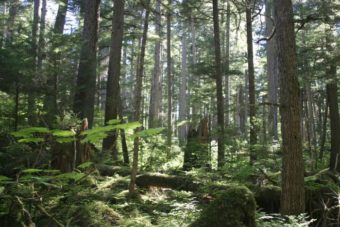
Part of the Tongass National Forest on Douglas Island pictured in 2004. (Creative Commons photo by Henry Hartley)

Nine tribal governments in Southeast Alaska submitted a petition to the United States Department of Agriculture on Tuesday, asking for another rule making process for the Tongass National Forest. 

The federal agency is close to announcing what’s likely to be a full exemption of the Roadless Rule in the Tongass, which the state has long requested. 

But there’s been discord between the Department of Agriculture and tribal governments, who’ve repeatedly stated Roadless Rule protections should stay in place. In an unreleased federal report, 96% of the public said they disagreed with changes to the Roadless Rule, too. An exemption would make it easier for new roads to be built in the forest — opening up access to logging. 

Joel Jackson, the President of the Organized Village of Kake, was one of the leaders who signed the petition. He’s concerned about damage to fishing and hunting areas, and he said Kake’s concerns have felt ignored by the federal agency. 

“They seem to minimize our way of life,” Jackson said.

The petition outlines the creation of a Traditional Homelands Conservation Rule to protect important areas for Tlingit, Haida and Tsimshian peoples. 

In 2018, the State of Alaska petitioned the U.S. government for the Roadless Rule exemption in the Tongass. Tribal governments were supposed to be playing an integral role in that process, but have been critical of how the federal agency has handled things — saying that deadlines were rushed and that a meeting was scheduled during the chaos of the coronavirus pandemic, making it difficult to attend. 

The petition asks the Department of Agriculture to create a new, more robust consultation process. Marina Anderson, the Tribal Vice President of Kasaan, says that would bring in more science to help guide the process. 

“That best available science includes Traditional Ecological Knowledge,” Anderson said.

It’s unclear how long the Department of Agriculture has to respond to the tribal governments’ petition. The agency accepted former Gov. Bill Walker’s petition to reexamine the Roadless Rule after four months

U.S. House advances bill that would hobble development in ANWR and Tongass

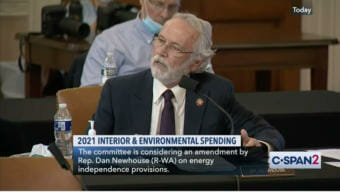
Video still showing Rep. Dan Newhouse at a House Appropriations Committee hearing
Still from video of House Appropriations hearing July 10, 2020. The committee approved a bill that would erect barriers to oil development in the Arctic National Wildlife Refuge and logging in the Tongass National Forest.(C-SPAN)

The U.S. House Appropriations Committee approved a bill Friday that would erect barriers to oil development in the Arctic National Wildlife Refuge (ANWR) and logging in the Tongass National Forest.

The provisions are tucked into the Democrats’ appropriations bill for the Interior Department and the Forest Service. The Republican-led Senate is sure to block them, so the measures serve primarily as a statement of Democratic values and to draw attention to what environmentalists view as endangered land in Alaska.
One provision says the government can only auction off drilling rights on the Coastal Plain of the Arctic Refuge with a minimum bid of half a billion dollars.

The Interior Department is expected to announce an ANWR lease sale soon. Alaska’s delegation in Congress wants to see the area developed. But Alaska’s sole House member isn’t on the appropriations committee, so it fell to Rep. Dan Newhouse to try to remove the ANWR provision.

“In addition to creating new jobs in Alaska and across the nation, opening this minuscule area to oil exploration, empowers the United States to reduce our dependence on foreign sources of oil and expand our domestic energy supply,” Rep. Newhouse, R-Wash., said during the House Appropriations Committee’s session on the bill.

Newhouse’s amendment also aimed to remove a sentence in the bill to block new logging roads in the Tongass.

Rep. Mike Quigley, D-Ill., was among those who argued against the amendment.

“One of the provisions in the bill that this amendment seeks to strip would end millions of dollars of taxpayer subsidies to the timber industry in Alaska and stop the irreparable damage to the Tongass National Forest, a treasured part of our unique national heritage,” he said.

The Newhouse amendment failed, leaving the anti-development measures for the Tongass and the Arctic Refuge in the bill. The legislation next goes to the full House, where it will likely pass.

The Senate is working on its own bill. As Newhouse acknowledged during the debate, the Alaska provisions don’t stand much chance in the conference committee where the two bills will be reconciled.

Court deals potentially fatal blow to logging plan for tens of thousands of acres of Tongass National Forest

An aerial shot of Prince of Wales Island. (Photo by KRBD)

A federal judge has dealt a potentially fatal blow to what would’ve been the largest timber sales in Tongass National Forest in decades.

The court challenge ends the U.S. Forest Service’s plan to open up 24,000 acres of old growth forest on Prince of Wales Island to commercial logging. It also halts road building for the 15-year project.

Conservationists had successfully blocked the federal government’s attempt at pre-clearing large amounts of timber for sale without identifying the specific areas where the logging would actually occur.

But after the Forest Service argued throwing out the entire project would harm what’s left of Southeast Alaska’s timber industry, Judge Sharon L. Gleason gave both sides a final chance to make a case for and against allowing the agency to correct deficiencies in its review and move forward.

Her final ruling came down squarely against the Forest Service’s plan. In a 14-page order signed on Wednesday, Judge Gleason ruled the “the economic harm” of invalidating the timber sales “does not outweigh the seriousness of the errors” in the agency’s handling of the project.

“It’s exactly what we asked for and we couldn’t be more pleased,” said Meredith Trainor, executive director of the Southeast Alaska Conservation Council which brought the lawsuit.

The ruling, she says, effectively sends the feds back to square one, triggering a fresh environmental review under the landmark National Environmental Policy Act — “which includes requesting public input on the specific areas that they want to log, which is what was a big sticking point in the basis of this case,” Trainor said.

Alaska’s timber industry reacted with disappointment to the ruling.

“The Southeast timber industry is primarily reliant on timber sales from the (Tongass National Forest),” Tessa Axelson, executive director of the Alaska Forest Association wrote in a statement. “This decision further threatens the viability of Southeast Alaska’s timber industry.”

The Prince of Wales Landscape Level Analysis was the first time the agency used this approach for environmental review on an Alaska timber sale. The ruling affects these projects including the Central Tongass Project near Petersburg and Wrangell as well.

But the judge’s decision does not affect other aspects of the Prince of Wales project. That includes habitat and stream restoration and investment in recreational trails and cabins that had been supported by a resident advisory group. It’s unclear what progress will be made in those areas as most non-timber sale related projects remain unfunded by the Forest Service.

The federal agency can appeal the decision. It did not return calls for comment.

Editor’s note: A previous headline for this story said “Court deals potentially fatal blow to logging plan for 24,000 acres of Tongass National Forest.” 24,000 acres is the area in the plan for harvesting old-growth trees. The authorization also includes nearly 20,000 additional acres of young-growth trees. The reference to the specific number of acres has been removed. 

Social distancing at a logging camp? An Alaska operator wants more resources.

The Ketchikan headquarters of Alcan Forest Products and Alaska Forest Association. (Photo by Elizabeth Jenkins/Alaska's Energy Desk)
The Ketchikan headquarters of Alcan Forest Products and Alaska Forest Association. (Photo by Elizabeth Jenkins/Alaska’s Energy Desk)

The timber industry and the fishing industry have something in common. They’re both trying to figure out how to safely transport seasonal workers to Alaska during the pandemic.  

Eric Nichols, the head of Alcan Forest Products, has a lot of errands to run to stock a pantry for a remote logging camp in Edna Bay. On the top of his grocery shopping list: potato chips.

Nichols says he wasn’t sure he’d be able run the logging camp this year. President’s Donald Trump’s ongoing trade war with China has been a big setback for his business.

But he decided to give this season a go. Now, the coronavirus is compounding an already challenging endeavor. Nichols needs to transport at least three skilled workers up from the Lower 48. 

“Ideally, I would like to be able to go to the local hospital,” Nichols said. “I would like to to be able to have them test somebody and tell me ‘yes’ or ‘no’ fairly quickly.”

Ketchikan doesn’t have drive-through COVID-19 testing, like other parts of the state, and the hospital and a clinic are only testing people who are symptomatic. 

So, for workers arriving to Ketchikan from Washington or Idaho, Alcan Forest Products has limited options. The company can take workers’ temperatures before putting them on a chartered plane to camp. But once they arrive, there’s no such thing as social distancing. The crew sleeps on boats close to the shore. They eat communal meals from a galley-style kitchen. 

Nichols says he knows other industries — like fishing and oil — are looking for more clarity on this issue, too. 

“I’m not sure how people [are] going to do it,” Nichols said. “I’m reaching out trying to understand if there are guidelines for this? What do we need to do? How do we need to ensure that we don’t infect some of our own people? I don’t want to end up like Conoco where they shut the whole thing down.”

Earlier this month, ConocoPhillips shut down its oil rigs on the North Slope in order to protect its employees.

Tessa Axelson is also trying to figure out how to keep timber workers safe. The executive director of the Alaska Forest Association says the timber industry has a lot of questions right now about how to best operate during the pandemic. 

She’s reached out to various agencies to see about a better COVID-19 testing strategy.

“This is all new to everyone. It needs to be implemented yesterday,” Axelson said. “And it needs to happen on top of additional safety procedures and requirements for ensuring the safety of workforce.”

She’s also fielding questions from the timber industry about how to apply for federal funding from the CARES Act. The industry employs about 300 people in the region. Axelson calls it a network of “small businesses.”

“What does the potential economic fallout from COVID mean for those businesses? And how do we provide resources and information about their eligibility in the process of applying,” Axelson said.

Eric Nichols, at Alcan Forest Products, doesn’t plan on applying for federal relief. He thinks it could be too complicated for his specific operation. 

He says he’s taking the double whammy of financial and health concerns one step at a time.

“It’s very dicey out there,” Nichols said. “I don’t know what’s going to happen here after this year. I don’t know what’s going to happen after July or August here. Like I said, we see a little bit of a window right now, and that’s what we’re trying to produce for.”

Alaska’s struggling timber industry can now hit pause on federal contracts

The Ketchikan headquarters of Alcan Forest Products and Alaska Forest Association. (Photo by Elizabeth Jenkins/Alaska's Energy Desk)
The Ketchikan headquarters of Alcan Forest Products and Alaska Forest Association. (Photo by Elizabeth Jenkins/Alaska’s Energy Desk)

In reaction to the pandemic’s disruption of the global timber market, the U.S. Forest Service is allowing extensions on existing timber sale contracts with sawmills and timber operators.

Typically, Forest Service contracts expire after three to five years. But this change gives businesses a way to request up to a two-year extension on certain contracts so they can navigate the difficult times.

Alaska businesses are getting an extra year on top of that because of another setback: The ongoing trade war with China.

Much of Southeast Alaska’s timber is exported to China, and operators had expressed concern about the future of their business under the steep retaliation tariffs.

In a press release, U.S. Sen. Lisa Murkowski, R-Alaska, said that the pandemic is threatening timber jobs and could “potentially bankrupt mills.” She added that the state’s timber operators have suffered under the “draconian 20-percent Chinese” tariffs.

Challenge to Tongass timber sale on Prince of Wales Island upheld in court

An aerial shot of Prince of Wales Island. (Photo by KRBD)

A federal judge has ruled in favor of green groups challenging the largest Tongass timber sale in decades.

U.S. District Judge Sharon L. Gleason’s Wednesday decision keeps in place her injunction blocking the first phase of a 15-year plan to open up 23,269 acres on Prince of Wales Island to old-growth logging.

“The Forest Service has not yet taken the requisite hard look at the environmental impact of site-specific timber sales on Prince of Wales over the next 15 years,” Gleason wrote in her 50-page decision.

Oral arguments last month pitted the U.S. Justice Department verses Juneau-based Earthjustice attorneys. Government lawyers argued the project is needed to sustain the local timber industry.

But the environmentalists’ lawsuit alleged the Forest Service didn’t offer site-specific information on where logging would occur. The judge agreed. She ruled that the federal agency’s reliance of a “landscape level analysis” violated multiple federal laws and was inconsistent with the agency’s 2016 Tongass Forest Plan because it didn’t offer specific information on what would be logged.

“It’s the biggest timber sale the Forest Service has approved in any national forest in the last 30 years,” Earthjustice attorney Tom Waldo told CoastAlaska. “They tried to shortcut the whole process by not saying where the trees would actually be cut, and the court held that that violated multiple laws.”

But the judge stopped short of completely throwing out the project, allowing the Forest Service to file an additional brief. That’s because the federal agency argued cutting off the timber supply would harm business in the region.

Messages left Wednesday seeking comment from the U.S. Forest Service and Alaska Forest Association weren’t immediately returned.

Site notifications
Update notification options
Subscribe to notifications