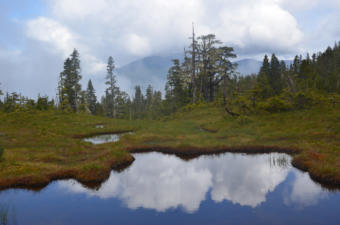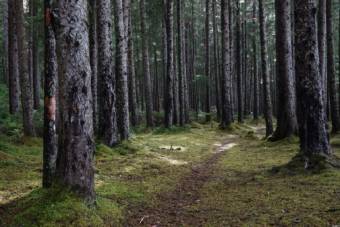
The Tongass National Forest is the largest temperate rainforest in the country. With exceptions, the Clinton-era Roadless Rule restricted road building and industrial activity in around 55% of the national forest. Advocates for its repeal said it posed unnecessary hurdles to development projects, like logging, mining, and renewable energy (Photo by Erin McKinstry/KCAW)
A federal watchdog agency says the U.S. Forest Service acted illegally when it awarded a $2 million firefighting grant to the state of Alaska in 2018. The state had asked for the grant to gather input on a proposal to exempt the Tongass National Forest from the Clinton-era Roadless Rule.
The U.S. Department of Agriculture’s Office of Inspector General issued its report Wednesday. The report says the Forest Service illegally awarded the $2 million to the state through a grant program intended to support fire suppression in state-owned forests.
A Washington, D.C.-based spokesperson for the Forest Service, Larry Moore, said that the money had been set aside for the state. But he says none of it actually ever changed hands. The agency says it’s working with its in-house lawyers to determine how to reallocate the money.
That means the state is on the hook for any expenses the grant was meant to reimburse. The $2 million grant was to be matched by state funds. It’s not clear how much the state spent gathering input from industry groups and local stakeholders. The governor’s office did not immediately respond to questions for this story.
The USDA watchdog does not directly accuse state officials of wrongdoing — in fact, documents obtained by Alaska’s Energy Desk show that the state told the Forest Service exactly what it was requesting the money for. But investigators say that money never should have been awarded as part of the firefighting grant.
Investigators say it’s above-board for the Forest Service to provide funding to gather input on rule changes. But they say awarding that money to the state without informing other interested parties that money was available for that purpose violated federal law and regulations.
The investigation was prompted by a story last year from former Alaska’s Energy Desk reporter Elizabeth Jenkins. She uncovered documents showing the state had paid the Alaska Forest Association more than $200,000 to influence the rulemaking process. At least one Southeast Alaska tribe was also reimbursed for travel expenses estimated at a few thousand dollars.
Units of plywood stacked at a Haines hardware store. (Claire Stremple/KHNS)
There are a few jobs that have stayed steady through the pandemic, and contracting is one of them. But pandemic slowdowns in the supply chain mean the cost of doing business has gone up.
COVID-19 had a serious impact on the wood products industry down south. Mills and manufacturers closed for a while — or at least that’s what hardware store managers are hearing from suppliers.
“Demand started outstripping supply and causing the price of the product to go up,” said Robert Adams. He manages a Haines hardware store. He said prices started climbing as early as this spring, in April and May.
“Lumber started ticking up. Doug fir and hemlock, plywood started to follow and it’s been going up substantially,” said Adams.
It’s not just Haines. Lumber yards and hardware stores around the state say they’re having the same issue. Some have it worse than Adams — at least he can get lumber. Others aren’t always able to get certain items, like treated lumber.
Adams said the price of plywood has nearly doubled.
“Back in early April, February, April, it was about $19.99 a sheet. Right now we’re selling them for $35.50 a sheet,” he said, gesturing at a stack of exterior grade, half-inch plywood.
But Adams said people still buy it.
People like Haines contractor Carlos Jimenez.
“It happened slow. And then there was a really steep change a few months ago. Eyes didn’t pop out of my head. It just is what it is. I think the whole nation’s facing some tough times, and you just have to kind of roll with it,” he said.
Jimenez, who spoke to KHNS at the job site for a 2,000 square foot home overlooking the Chilkat River, said the prices have not slowed demand at all. Luckily, he bought the lumber for that job before prices ticked up. He said the difference could have been in the tens of thousands of dollars if he hadn’t.
“The customers ultimately have to, you know, bear the brunt of that cost,” he said. “Building is really strong right now, whether it’s people doing home projects, or looking for contractors.”
Jimenez said that even when the cost for new projects comes in higher, people are generally still up for it — even if the price jumps by a couple of thousand dollars.
Unemployment numbers are about double the state average in the Upper Lynn Canal, but some people still have work and still have money to spend.
“People are still working, they’re just working from home and they’re forced to spend a lot of time at home and now they wants some space,” Jimenez said.
“They want decks, lots of decks, additions, done a couple of those. And I think I think that’s really what’s driving it because people are spending more time at home than ever,” he said.
Prices have started to level off from their steady climb a few months ago, and the local demand will start to slacken as we head into winter.
But it’s not just lumber and plywood. COVID-19 shutdowns impacted many branches of manufacturing. Appliances have been hard to come by, and local automotive parts retailers report that suppliers can only fulfill about half of what they order.
The Tongass National Forest is the largest temperate rainforest in the country. With exceptions, the Clinton-era Roadless Rule restricted road building and industrial activity in around 55% of the national forest. Advocates for its repeal said it posed unnecessary hurdles to development projects, like logging, mining and renewable energy (Photo by Erin McKinstry/KCAW)
On a rare sunny afternoon in the Tongass, Chuck Miller showed me a spot near the water where his grandmother would often take him. He pointed out where they’d collect salmonberries, blueberries and huckleberries, giving Tlingit names for each.
“And then my grandmother would show me some of the plants we could use for medicinal purposes,” Miller said.
He eats many of the same foods as his ancestors. He hunts seal, collects seaweed, and fishes for salmon.
“I like to use the word Tlingit soul food,” Miller said. “It makes you feel good on the inside.”
He said he’s not political, and he doesn’t know all the ins and outs of what a full exemption of the Roadless Rule means for the Tongass National Forest, which is bigger in land area than the entire state of West Virginia. But anything that could threaten his subsistence way of life makes him nervous.
“If they allowed roads into certain areas where it affects our harvesting, I’m not a big fan of that,” he said. “You’re gonna get more population, more pollution and then some things might get overharvested.”
Chuck Miller poses for a photo near where he and his grandmother used to collect berries and medicinal plants. “Our Tlingit people have been eating food off the land since time immemorial. It’s a very important part of our culture,” Miller said. (Photo by Erin McKinstry/KCAW)
Miller isn’t alone. At a U.S. Forest Service hearing in Sitka last fall, commenters advocated unanimously to keep protections for the Tongass in place. Subsistence users and environmentalists worry that opening more than nine million acres of the Tongass to potential development for logging or mining could disrupt vital habitat for the species many depend on like Sitka black-tailed deer and salmon.
Eric Jordan is a Sitka-based commercial fisherman, but he feeds his family salmon too. He recalls what clear-cut logging did to salmon streams and wildlife habitat in the last century.
“Around Southeast, the people who live here understand how damaging that was to our ecology, and they do not want it reintroduced,” Jordan said.
The immediate return of industrial-scale timber operations to Southeast isn’t likely, mostly for economic reasons. But that doesn’t ease Don Hernandez’s worries. He lives in Point Baker on Prince of Wales Island, and like many of his neighbors, a significant portion of what he eats is hunted, fished or gathered.
“Ten years down the line, depending on what pressures may come from industry, once the long-term protections are eliminated, we could see a push to have more large-scale clear-cutting on the Tongass again,” he said.
He chairs the Southeast Alaska Regional Subsistence Advisory Council, which advises the federal board on important hunting and trapping decisions on federal lands.
The Forest Service’s final environmental impact statement states that the full exemption of the Roadless Rule in the Tongass will have “minimal adverse and beneficial effects” on subsistence users. It posits that increasing road access could open up hunting and fishing areas to those who don’t have boats and spread subsistence use over a larger area, rather than concentrating it in more accessible places.
But Hernandez said he thinks the costs far outweigh the benefits.
“When you spend the amount of money that it takes to build a road in Southeast Alaska, you have to extract a lot of timber to justify building those roads. So it’s not just a small impact,” he said. “And yes it does provide access for subsistence users and people use the roads. But, over time, all the negative impacts from the road building and clear-cutting, it takes a toll.”
Proponents of the changes say they’ll allow for more economic development opportunities like mining, communications and renewable energy projects. But for many people who live in and around the nation’s largest temperate rainforest, it’s all about the long view.
Take Allysia Witherspoon. She, her husband and their two children live in Sitka and rely on hunting and fishing for a good portion of their household needs. She says they’re nervous about what the decision to roll back protections for the Tongass will mean long term for subsistence resources — especially after the lion’s share of Alaskans implored the federal government to keep the Roadless Rule in place.
“It’s kind of alarming that no matter what research has been provided and all the comments of all the people who live here that they would try to do the exact opposite,” Witherspoon said.
Wednesday’s decision to overturn Clinton-era protections for 55% of the Tongass could be challenged in court. Congress could also get involved or a future administration could start the years-long process of reinstating the Roadless Rule in Southeast Alaska.
Editor’s note: This story was produced as part of a collaboration between KCAW and Alaska’s Energy Desk.Erin McKinstry is a Report for America Corps member.
Alaska’s congressional delegation and governor are welcoming the Trump administration’s decision to fully exempt the Tongass National Forest from the Clinton-era Roadless Rule. That’s a federal regulation that generally restricts road-building and industrial activity on national forest lands that don’t already have them.
Industry figures are also applauding the decision.
“The forest products industry … has been imperiled for some time,” said Tessa Axelson of the Alaska Forest Association, a Ketchikan-based timber industry group. “There’s a handful of small operators that are working on the Tongass, harvesting timber. In order to continue to survive, those businesses are dependent on a predictable supply of timber.”
And lifting the rule, she says, provides that predictable supply. She says the industry supports hundreds of jobs, including businesses that aren’t directly related to logging. But she says she doesn’t think lifting the rule will mean large-scale timber operations will come roaring back.
“We have no belief that that level of operation in the Tongass will occur again,” she said.
The U.S. Forest Service says lifting the Roadless Rule would open up about 168,000 old-growth acres to potential logging. That’s about 2% of the area protected by the rule, or 1% of the total Tongass.
But it’s not just about timber. Frank Bergstrom is a mining consultant in Juneau with some 40 years of experience. He says it could make mineral exploration more attractive to investors.
“There’s no roadmap to these things,” he said. “It’s just, maybe it’ll lead to a little more optimism.”
But he says development projects still require other forms of federal review.
“This is one obstacle that has at least been diminished. But there’s a long road to hoe,” he said.
Roadless Rule supporters dispute that it held up economic development in the region. The U.S. Forest Service routinely approved waivers for energy, mining and infrastructure projects in designated roadless areas, says Austin Williams of Trout Unlimited in Anchorage.
“The only reason for a full repeal of the roadless rule on the Tongass is to open up areas for logging,” he said. “Every single other alternative would have allowed non logging projects to move forward as they have in the past.”
The public comments received inside and outside Alaska were overwhelmingly in support of keeping the rule. An information request from the Southeast Alaska Conservation Council found that 96% of public comments from within and outside Alaska favored keeping the rule in place.
Executive Director Meredith Trainor says it was pretty overwhelming.
“Just 1% of the total responses out of 15,000 that they looked at that they analyzed — just 1% wanted to see a total exemption from the Tongass,” she said.
Tribal leaders say people forage, hunt and fish in protected lands.
“Of course our reliance on the Tongass for our way of life. That is what we’re trying to protect as Natives in Southeast Alaska is our way of life,” said Joel Jackson, president of the Organized Village of Kake on Kupreanof Island.
“They just completely ignored our, our input and input to the other five tribes. So I felt very disrespected,” he said.
Ken Rait is project director at the Pew Charitable Trusts, and he helped push for the original 2001 Roadless Rule. He says the federal government has downplayed the temperate rainforest’s value as a carbon sink as the effects of climate change worsen. And he says that because federal timber sales are a loss for federal taxpayers, economic arguments don’t add up.
“This decision has no basis in science. It has no basis in rational kind of fiscal policy. And it has no basis in so far as public support,” he said.
The Trump administration’s decision could be reversed through a court challenge or an act of Congress. Alternatively, another presidential administration could revisit the rule — but that would require public comment, meetings and another multi-year process.
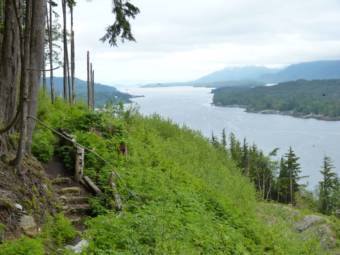
Until then, some 9.4 million acres in the Tongass are no longer bound by the restrictions under the Clinton era Roadless Rule.
Portions of the Tongass National Forest can be seen from Ketchikan’s Rainbird Trail. (KRBD file photo)
President Donald Trump’s administration announced Wednesday that it is finalizing its plans to reverse roadless protections for more than 9 million acres of the Tongass National Forest in Southeast Alaska, or a little less than 15,000 square miles.
The roadless rule was originally established in the final days of the Democratic Clinton administration, and it barred logging and road construction on some 58 million acres of national forest lands, including big swaths of the Tongass.
Since then, it’s been the subject of lawsuits, as well as requests for an exemption from Alaska elected leaders, who claim the rule has harmed the state’s timber industry and made it harder to develop mining and energy projects in Southeast Alaska.
Wednesday’s decision stems from a 2018 petition to U.S. Secretary of Agriculture Sonny Perdue from former independent Alaska Gov. Bill Walker’s administration.
Advocates argue that reversing the roadless rule would harm Alaska Native subsistence traditions and Southeast Alaska’s burgeoning tourism industry. They also note that the reversal is unlikely to revive the region’s dwindling logging business, and say that it threatens the Tongass’ ability to absorb greenhouse gas emissions.
Environmental groups immediately called on Congress to reject the Trump administration’s decision, and the exemption could also be challenged in court.
This is a breaking news story and will be updated when more information is available.
Portions of the Tongass National Forest, seen from Ketchikan’s Rainbird Trail. (KRBD file photo)
Changing a federal rule isn’t simple, but the Trump administration is on the verge of doing it. Last month it started a 30-day clock to completely exempt Tongass National Forest from the 2001 Roadless Rule.
The rule restricts — but does not prohibit — road building and resource development on some national forestlands. Critics say it locks up natural resources. To change it, the federal government is required to consult with tribal governments. And it did — nine Southeast Alaska tribes in all, whose traditional homelands are now part of the country’s largest national forest.
Bob Starbard is administrator of Hoonah Indian Association. When the federal government started its consultation, the tribe was the first to sign on as a cooperating agency. And he says at first it seemed like U.S. Forest Service officials were listening.
“The Tongass, which we sit in the middle of, is part and parcel of being Tlingit. We are people of the land,” Starbard said. “It became clear at the very end, however, that the game had already been fixed.”
By that he means the meetings, hearings and public comment periods — which were dominated by Alaskans who favor of keeping the rule intact — didn’t move the Forest Service. It recommended lifting the rule completely and is expected to make it official before the end of October.
“It’s just another broken promise to tribes as far as we’re concerned,” Starbard said.
The nine tribes said as much in an Oct. 13 letter to Agriculture Secretary Sonny Perdue and Forest Service chief Vicki Christiansen.
The three-page letter is unequivocal, with one sentence in boldface: “We refuse to endow legitimacy upon a process that has disregarded our input at every turn.”
The letter demands an updated environmental impact statement reflecting that the tribes have withdrawn their cooperation.
Marina Anderson, administrator of the Organized Village of Kasaan on Prince of Wales Island, says is was clear that for the federal government, tribal consultation was not taken seriously.
“It was apparent that our participation — requested by the federal government in the throes of this rulemaking process — was a form of box checking, a form of the government saying that they had consulted with us properly and they met with the Indigenous people properly,” Anderson said. “And all of the information that was really relayed to the Forest Service from the tribes, in my perspective, that information was disregarded completely. And really, it distracted us from a lot of other things that we needed to focus on with our time as well.”
In a statement, USDA spokesman Larry Moore wrote that the tribes’ input “was integral to the agency’s analysis during the rulemaking process.”
Alaska’s congressional delegation has long chafed against the Clinton administration-era Roadless Rule.
Republican Sen. Lisa Murkowski has been one of its most vocal critics. She addressed the Alaska Federation of Natives but didn’t mention this milestone during her 18 minutes of remarks.
Republican Rep. Don Young applauded the rule change at a recent forum hosted by the Resources Development Council.
“I’m happy to say for those in the area, you know my position I’ve been there I’ve worked there. We’ve got it done. So let’s open up Southeast to the communities for their economic well being,” Young said.
It’s not just Alaska’s congressional delegation that wants to see the Roadless Rule repealed. Elected officials from across the spectrum have spoken out against it.
Gov. Mike Dunleavy has applauded the Trump administration’s rollback. But it was his predecessor and political opponent — Gov. Bill Walker — who got the ball rolling.
But Anderson says elected officials in Alaska have not listened to the majority of residents who oppose the rollback of the Roadless Rule.
“Alaska’s delegation, this entire time, has had industry’s best interest, and they’ve been in full support of the exemption,” she said.
Close
Update notification options
Subscribe to notifications
Subscribe
Get notifications about news related to the topics you care about. You can unsubscribe anytime.