Timber

Lingít activist recalls history of Indigenous women protecting the Tongass: ‘The momentum has only grown’

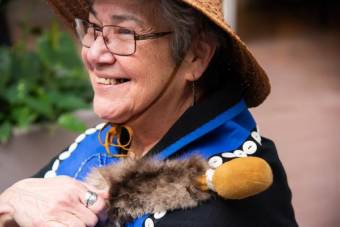
Lingít activist Wanda Culp. (Photo by Melissa Lyttle, courtesy of Southeast Alaska Conservation Council)

It has been 21 years since the 2001 Roadless Rule for the Tongass National Forest was first established. 

For the people involved in the battles between industry and subsistence, the tug-of-war over land use in the Tongass National Forest has been going on even longer. 

KTOO’s Lyndsey Brollini sat down with Lingít activist Kashudoha Wanda Culp to talk about the impact of such a long history and the role that Indigenous women have played in this conflict.  

Listen:

This interview has been edited for length and clarity.

Lyndsey Brollini: Do you think you could kind of go a little bit into the background on the issue? How it came up?

Wanda Culp: My involvement came about in the early 1980s when I moved from Juneau and into Hoonah and needed to know firsthand how to hunt, fish and gather. And through that process, I was literally taken under the wings of my Lingít grandmothers, who taught me a lot about the history of our people and where we come from.

When the clear cut started in Hoonah, it happened right in one of our hunting areas. We always, you know, would drive around when we had vehicles just for something to do. And I was up on Hoonah mountain, ran into one of my grandmas. Her and her husband were driving around, and she looked at the fresh clear cuts. And she was crying. And she said, “See what they’re doing to us. Do you see what they’re doing to us?” It broke my heart, and I did not realize because we’re so isolated in Hoonah — those days with no, you know, no access to internet technology like today — so I had no idea that others in Southeast were also voicing their objections to the clear cut business happening all around us. So it was our combined voices that I believe helped create the 2001 Roadless Rule. It was so politically controversial back then, after the 1990s when the boom basically busted. I became a recluse. It was pretty harsh. 

Maybe six years ago, Osprey Orielle Lake in WECAN International — Women’s Earth in Action Climate Network — called me up, got my name somewhere, and literally pulled me out of moth balls as she made me aware of what was occurring politically with the Roadless Rule again. We’ve been to Congress through WECAN and partnering with Earth Justice. They helped us, four of us from Hoonah, in early 2019 to meet with 14 Congress people in D.C. face-to-face. We wore our regalia and spoke to them through our regalia representing who we are as Indigenous women. 

So once it was a change of hands through our last administration, it beefed up the temperature, you know, in the realization that we can no longer allow the Roadless Rule to be a political puppet at their whim. We need to put it into law now. 

When we really began rolling and boiling here, and it was early 2019 Lisa Murkowski tried slipping the weakening of the Roadless Rule in a budget rider. That’s how easy it is to manipulate that rule. And had we not been alerted to that, that would have happened a long time ago. 

There’s been plenty of silence to what we have brought forward and publicized. One of my elders told me when it comes to us, when I was worried about why isn’t anybody saying anything, she’s like, “It’s called tacit approval.” Silent approval. And we have that. The need for grassroots solutions, we just need a way to process it and get it out from the ground up all the way to D.C. this way, not from the top down.

Lyndsey Brollini: Do you think that the momentum is already there, that grassroots momentum?

Wanda Culp: It is. It was already there in the 80s and 90s. That momentum created the 2001 Roadless Rule. And that rule never stopped being challenged. This is old hat, what we’re doing, always defending the Roadless Rule. The momentum has only grown. 

And at one meeting, there was ex-loggers, teachers, and, you know, they were so relieved to hear when I said, “You folks have a right to say your objections to what’s happening on this clear cut logging.” 

They were being quiet because they thought — they didn’t want to step on our toes— and they thought that we initiated the clear cut logging to destroy our own land. 

So once that conversation was opened, I began to realize how many people love the Tongass and realize that it’s not so controversial within our own region.

What’s controversial is the misuse of it. 

Lyndsey Brollini: It was really good to hear from you.

Wanda Culp: Yeah, it’s good to talk about this. Thank you for the opportunity. 

Public comment period opens as Biden moves to restore Roadless Rule protections to Tongass

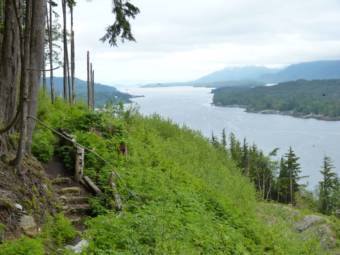
Portions of the Tongass National Forest can be seen from Ketchikan’s Rainbird Trail.
Parts of the Tongass National Forest seen from Ketchikan’s Rainbird Trail. (KRBD file photo)

The Biden administration on Tuesday formally began the process of restoring ‘Roadless Rule’ protections to millions of acres of Southeast Alaska’s federal forestlands.

It opens a 60-day comment period to undo action taken by the Trump administration that critics say could lead to more old growth logging in Tongass National Forest.

notice in the federal register published Tuesday says that Southeast’s timber industry is shrinking.

Tongass National Forest-related logging and sawmilling fell from just shy of 200 jobs in the early 2000s to around 60 workers in 2018.

The U.S. Department of Agriculture argues that restoring the 2001 Roadless Rule reflects the Biden administration’s priorities to build on the region’s tourism and fishing sectors.

The U.S. Forest Service has already frozen old growth timber sales under the current administration.

“…. a policy change for the Tongass can be made without significant adverse impacts to the timber and mining industries, while providing benefits to the recreation, tourism and fishing industries,” the notice reads.

Trout Unlimited’s Austin Williams in Anchorage says Alaska Gov. Bill Walker’s 2018 petition to exempt the Tongass National Forest from Roadless Rule protections put too much emphasis on commercial logging.

“It’s really time that we just move past that,” Williams said Tuesday. “And we recognize that there’s more value on the forest, keeping it and conserving it so that we can have, you know, fish and wildlife so that we can have tourism so that we can have cultural and traditional uses and to help fight climate change.”

The Roadless Rule would apply to about 9 million acres of the Tongass. But in practical terms, it could protect at most about 168,000 acres of old growth forest from clear cut.

Alaska elected leaders decry ‘federal overreach’

Gov. Mike Dunleavy and Alaska’s congressional delegation strongly supported the Trump administration’s exemption of Roadless Rule and has called the Biden administration’s move “federal overreach.”

“We think that discretion for the forest to be managed should continue to be at the local level,” the governor’s chief of staff Randy Ruaro, who grew up in Ketchikan when it was a lumber town, told CoastAlaska. “We don’t need Washington, D.C. with a one-size-fits-all rule for every forest in the nation.”

A lawsuit by the state to block the Biden administration’s initiative to bring back Roadless on the Tongass was dismissed last week by a federal appeals court.

A separate lawsuit by a coalition of tribes and ecological groups in favor of roadless protections remains pending but could be rendered moot by the new change in direction.

Tuesday’s action opens up a two-month comment period required before the agency can move forward.

If the Roadless Rule is applied to the Tongass, it could be reversed again by a future administration. More permanent protections would take an act of Congress.

Biden administration begins Roadless Rule do-over for Tongass

A portion of the Tongass National Forest along Peril Strait is seen from the ferry Chenega in Sept. 3, 2015. (Photo by Ed Schoenfeld/CoastAlaska News)
A portion of the Tongass National Forest along Peril Strait seen from the ferry Chenega in Sept. 3, 2015. (Photo by Ed Schoenfeld/CoastAlaska)

The Biden administration announced Friday the start date of its formal process to reinstate the Roadless Rule, which protects about 9 million acres of Tongass National Forest.

“Restoring the Tongass’ roadless protections supports the advancement of economic, ecologic and cultural sustainability in Southeast Alaska in a manner that is guided by local voices,” U.S. Agriculture Secretary Tom Vilsack said in a statement.

Successive Alaska governors have opposed the Roadless Rule since the Clinton administration put it in place in 2001. It’s been an on-again, off-again situation since then, with legal battles and politics coming into play.

The most recent whip-saw came last year, when the Trump administration exempted the Tongass from the rule.

Vilsack, who oversees the Forest Service, is again calling a do-over. He says a two-month comment period will be its first step to reinstate the Roadless Rule. And it’s a similar announcement to one made earlier this year that the Trump-era rule would be reversed.

“I don’t know how many times Vilsack can announce the same thing and have it sound like news,” said Juneau attorney Jim Clark, who has been coordinating a legal effort with some local governments and resource industries to preserve the Tongass exemption from the Roadless Rule.

He says the rhetoric around the rule’s protections of ancient forests is overblown.

“All this new exemption would do is open up 168,000 acres to timber harvest that wasn’t previously previously open,” he said Friday. “You wouldn’t know that from listening to the news — you’d think that all of the Tongass is going to be subject to clear cutting.”

And it’s true that while the rule change could affect more than 9 million acres, less than 170,000 acres of that would be old growth timber that could be logged under the current exemption.

Alaska state lawsuit rejected by federal Court of Appeals

Gov. Mike Dunleavy directed the state to join a lawsuit filed by resource industries, but the Court of Appeals dismissed the lawsuit earlier this week saying last year’s Roadless exemption is still in force, and the case was moot. But the governor’s office says the fight isn’t over.

“I would anticipate a very big vigorous response to the the efforts to control Alaska out of Washington, D.C.,” said the governor’s chief of staff Randy Ruaro, who hails from the former logging boomtown of Ketchikan. He told CoastAlaska on Friday that the Biden administration’s freeze on old growth timber sales ignores laws on the books that direct the Forest Service to make timber available to industry.

“We dispute the discretion of the Secretary to arbitrarily decide from Washington, D.C., to not follow those federal statutes and impose the Roadless Rule on the Tongass,” Ruaro added.

But opinion polls and the public record from hearings show healthy support for the Roadless Rule both in Alaska and Outside.

In Southeast, it has defenders from growing non-extractive industries like commercial fishing and tourism. Tribes whose traditional homelands are in what’s now Tongass National Forest also railed against the Trump administration’s rollback, both at hearings and in court filings.

Commercial logging of Tongass impacts subsistence

That’s because the legacy of clear-cutting and other development conflicted with rural residents’ hunting and fishing traditions.

Don Hernandez chairs the Regional Advisory Council on federal subsistence. It spent hours taking testimony over the Roadless Rule.

“It had just become pretty obvious over a long period of time that the areas of the Tongass that were most significantly impacted by past logging were all suffering harms to subsistence uses,” he said from his home on Point Baker on the northern edge of Prince of Wales Island, which is almost completely blanketed by federal forestland.

Hernandez is a commercial fisherman. He says the council heard loud and clear that people were worried about more old growth logging.

“And to expand that into other areas of the Tongass that people have come to rely on to meet their subsistence needs was just not going to be acceptable,” Hernandez said.

Tongass National Forest’s value as a carbon sink

To federal policymakers, the Tongass is seen less from a lens of conserving hunting and fishing grounds and more as a bulwark against climate change.

The Pew Charitable Trusts’ Ken Rait, who worked on developing the Roadless Rule under the Clinton administration in the 1990s, says there’s a recognition by the Biden administration that forests need to be kept intact to sequester carbon.

“And you know, there’s nowhere in the U.S. where this is more important than the Tongass National Forest,” Rait said from Portland, Oregon. “And so the decision is the right one for the Tongass, but it’s also the right one for the nation as a whole.”

The resource extraction industry and many of Alaska’s elected leaders complain that red tape will further lock up federal lands to energy and mining.

But Rait says there are safeguards in the rule. The Forest Service can — and does — issue waivers for projects in the public interest. More than two dozen to date have been granted, he says.

“The view that this is a blanket rule that will stop any development whatsoever from occurring on the Tongass just has not been borne out by the history of this issue,” Rait said.

How exactly the Biden administration plans to reverse the Trump administration policy still isn’t clear, says Clark, who served as chief of staff to former Governor Frank Murkowski, another strident Roadless Rule critic.

“It’s just a situation where we have to wait and see what the administration is actually doing,” he said.

Nov. 23 is when the Biden administration rolls out its plan for bringing back the Roadless Rule. If the last go-around is any indication, it’ll be a drawn out affair. It took more than two years to exempt the Tongass from the rule.

The federal government says more than 95% of people nationwide supported keeping the Roadless Rule in place during those hearings.

The Trump administration overturned it anyway.

A 60-day comment period will begin on Nov. 23, 2021 with the publication of a proposal to repeal the 2020 Alaska Roadless Rule. Comments can be submitted electronically using the Federal eRulemaking Portal; mailed to: Alaska Roadless Rule, USDA Forest Service, P.O. Box 21628, Juneau, Alaska 99802–1628; hand-delivered to Alaska Roadless Rule, USDA Forest Service, 709 W. 9th Street, Juneau, Alaska 99802 or emailed: sm.fs.akrdlessrule@usda.gov

Forest Service proposes restoring young-growth stands in central Southeast Alaska

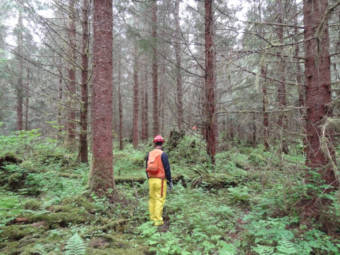
This forest in Southeast Alaska has been thinned after logging to help strengthen individual trees and develop an understory. (Photo courtesy of USFS)

The U.S. Forest Service is proposing a project to help restore some young-growth forests in central Southeast. It’s seeking funding and approval to treat areas that have been logged in the Petersburg and Wrangell Ranger Districts. If funded, field work could start next year.

If you live in Southeast Alaska, you’ve likely seen young-growth forests. They crop up after clear cut logging.  The trees are all the same age — pole-like, with minimal low branches.

“Trees come in really thickly, and they can fully occupy a site,” said Sheila Spores, a silviculturist with the U.S. Forest Service. “Oftentimes there’s nothing in the understory. You know, it will be sparse and dark, no shrubs, no forbs and no other little trees.”

This young-growth forest in Southeast Alaska shows trees that are all the same age, competing with each other. The lack of understory is also evident. (Photo courtesy of USFS)

Besides logging, young-growth forests can occur naturally if there is a disturbance like a major blow down. Eventually, the forests evolve into old growth with a healthy ecosystem that is better for wildlife. But it takes a very, very long time.
“A few hundred years,” Spores said.

The U.S. Forest Service is proposing to help speed that process up by manually thinning stands on about 110,000 acres.

The process also allows them to encourage the growth of certain species of trees.

“You know, yellow cedar is a slow growing species that is being impacted by yellow cedar decline,” Spores said.
“So, we can go in and if we have two trees that are really good, solid trees but you have to pick one, we’ll pick the yellow cedar over the other one, for example.”

For the most part, the cut trees would be left on the forest floor to create a natural understory.

Spores says they hope to get funding to continue the work for a decade. The cost will depend on how much is approved and for how long. Most money will come through a restoration trust fund, which gets funding from tariffs on imported timber and other wood products.

The forest service started this type of young-growth restoration in the 1970s.

Encouraging old growth is not only better for wildlife habitat and water sheds but also for future logging.  The thinning is actually referred to by the forest service as “pre-commercial thinning” because eventually it could be logged again.

And that’s a sticking point for some conservation groups, especially when some of the young growth is in roadless areas where development has been prohibited in the past. Alaska currently has a roadless exemption from the Trump administration but the Biden administration has said it would seek to reinstate it.

“Our main concern at SEAC is inclusion of the inventoried road less areas,” said Meredith Trainor, Executive Director of the Southeast Alaska Conservation Council.

She says SEACC will be keeping an eye on how the project develops.

“In general, I think this is a good thing that they’re doing this thinning work, and they’re doing sort of what is effectively restoration work in areas that have been previously logged,” Spores said. “We’d just like to see the roadless areas treated separately since they have different management requirements and are a different category of forest.”

It’s not certain who will do the work, which usually includes people walking through the forest with chainsaws. Spores says they sometimes partner with conservation groups or tribes. But mostly, they contract out to companies that specialize in it.

“I have to say that this work is really extremely physical and it’s hard, and we don’t often have large, local workforce that want to do this kind of work,” Spores said.

The Forest Service is taking input this November and hopes to make a decision by the end of the year. If funded, the field work could start next spring or summer.

Yakutat village corporation delays board elections after criticism of its logging operations

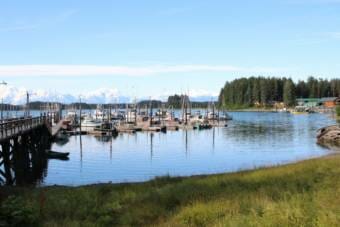
Yakutat’s Harbor in August 2017. (Emily Kwong/KCAW)

Yakutat ’s village corporation has postponed its annual board election while it confers with its attorneys over what it says are “false accusations” over its logging operations.

Yak-Tat Kwaan, Inc. has been criticized by some tribal and city leaders who believe that the corporation’s clear cuts threaten salmon streams and cultural sites. Yak-Tat Kwaan denies this.

The village corporation was created in the 1970s by the landmark Alaska Native Claims Settlement Act and granted more than 20,000 acres to benefit shareholders with ties to the traditional Yakutat village. Its annual meeting was planned for this Saturday.

But in an unsigned November 12 letter to the corporation’s shareholders, management says the election could be tainted by what it called “unfair attacks being leveled against” the corporation.

“The false accusations being leveled against the corporation have reached beyond the shareholders of the corporation, the community, and even the State of Alaska by way of social media,” the letter reads. “All shareholders deserve to have a free and fair election, which is not tainted by patently false claims about the decisions of the Board of Directors and the financial health of the company.”

Critical posts on social media were being reviewed by the village corporation’s attorneys, the letter added. In Alaska, ANCSA shareholder speech is regulated by state financial examiners, which critics say can effectively chill free speech.

The CEO of Yak Timber, the logging subsidiary of the corporation, declined to comment.

The shareholder meeting has been pushed back until Jan. 8, 2022. Its last annual meeting was January 30, 2021.

State law requires an ANCSA corporation to hold a shareholder meeting and re-elect its board of directors at least once a year.

Rifts widen over Yakutat village corporation’s expanded logging

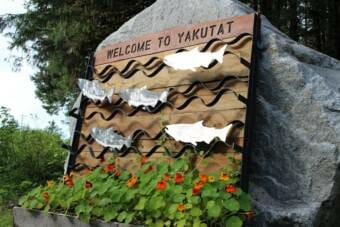
A wooden sign with metal fish on it that says Welcome to Yakutat
Yakutat is a community of about 600 people on the Gulf of Alaska coast in uppper the crook of the Southeast Alaska panhandle. Emily Kwong/KCAW)

Yakutat is a remote Gulf of Alaska village about halfway between Juneau and Cordova. Its economy has long been tied to fishing, tourism and for the first time since the 1980s, commercial logging. That’s thanks to its Indigenous-owned Native corporation getting back into the timber game, cutting and exporting to foreign shores.

But recently that’s concerned elected officials in both the city and tribal governments, who have called for a halt to cuts in areas they say are ecologically sensitive and culturally sacred to Yakutat’s inhabitants.

Yakutat Mayor Cindy Bremner used to be president and CEO of Yak-Tat Kwaan, Inc. and serve on its board of directors of the village corporation. Since 2015, she’s only been active as a shareholder.

But a couple years back she said she had a hunch and decided to look up local timber plans on a state website. It was there that she first learned of the village corporation’s ambitious logging plans in Yakutat.

“And then the very next day, they had their barge of equipment coming in,” she said. “I just had a bad gut feeling one day, and I was pretty sad to see that they had applied for that.”

Yak Timber, Inc.

Yak-Tat Kwaan’s last public filings with state financial regulators date from 2017. Back then it said it had no plans to log any of its 23,040 acres, or 36 square miles, granted in the 1970s under the Alaska Native Claims Settlement Act.

But the following year the corporation created a new subsidiary: Yak Timber, which got to work quickly. A note to shareholders last summer said that in two years it made $1.8 million in logging and selling cabins and tiny homes.

“It is understandable that some do not like logging,” Yak-Tat Kwaan CEO Shari Jensen wrote in a June 25 letter to shareholders that was partly in response to timber critics.

“Instead of using energy to sabotage Yak Timber, it would be nice to see it being used to help make Yak-Tat Kwaan a viable and a long-term sustainable company for years to come,” she wrote.

Earlier that month, the corporation released an unaudited report that says the corporation earned some $3.8 million from timber in 2019, with a net profit across the board just shy of $800,000 that year.

But that economic boost has been contentious, Bremner said.

“The shareholders, I feel, are kind of torn about the logging going on here,” she said.

Yak Timber needed financing to get heavy equipment for its crews. Since 2019, it’s borrowed at least $7 million, according to documents and statements to shareholders who were told the debt’s necessary to carry the corporation until more timber is sold. The village corporation’s fish plant and timber rights on some of its land have been used as collateral.

The mayor says she’s concerned that Yakutat’s forestland is being sold too quickly to finance the corporation’s ventures.

“They’ve leveraged the resources on our land to be able to do this,” Bremner said. “And I don’t think that is something that they should be able to do.”

ANCSA directs Indigenous enterprises to drive profits for shareholders

Talk to another Bremner and there’s a very different view.

“You’ve got to hear the rest of the story,” said village corporation executive Don Bremner, who is related to the mayor.

“Yes, we’re related — everyone in Yakutat’s related,” he says.

The community has fewer than 600 people and has lost people in the last census.

Don Bremner is president of both the village corporation and its timber subsidiary. The long-term health of the company is good and the debt isn’t a concern, he said.

“We’re a valid business, making real serious business decisions, not based on perception, opinion, without research,” he said. He declined to get into specifics, saying that’s an internal matter for Yak-Tat Kwaan’s shareholders. And because the village corporation has less than 500 of them, it’s not required to file its annual reports with state financial regulators.

But Bremner still dismisses concerns about logging Yakutat’s lands too quickly.

“It’s not a large volume, but the people that have concerns are the folks that will always have those concerns,” he said.

His other message is that Congress created for-profit corporations to enrich Native shareholders. And that’s exactly what Yak-Tat Kwaan is doing, he said.

“We’re a profit-making business and ANCSA directed that we keep making money off of our assets, become self determined,” he said. “If they want to go try change ANCSA, have at it. It’s just not going to happen. Because you’ve got 12 very rich regional corporations making a lot of money off ANCSA. So that’s what we’re doing, is running corporations, profitably.”

Tribes, state historic office raises concerns over Humpback Bay clear cuts

An anonymous “Defend Yakutat” website has emerged criticizing Yak-Tat Kwaan’s timber practices in the community. (Screenshot by Jacob Resneck/CoastAlaska)

Yakutat’s city government opposed this year’s logging around Ophir Creek, which includes pink salmon habitat.

But that hasn’t caused the board of directors to shift course. A state fisheries biologist reported that some of the logging was too close to streams, and follow-up visits are planned for November.

But the real fight brewing is over logging planned on a 426-acre tract around Humpback Creek, about 10 miles to the northeast of the village.

As the name suggests, it’s also known for its pink salmon. And its Indigenous name comes from both the Eyak and Lingít languages, which residents say speaks to Yakutat’s history as a crossroads of Native cultures.

“Humpy Creek itself you know, has a lot of significance in our oral history,” said Judith Dax̱ootsú Ramos, who is originally from Yakutat and now teaches immersive languages at University of Alaska Southeast in Juneau. “People were kind of taken aback when they saw the plans for the harvesting in that area and nobody knew that they were going to be harvesting in that area.”

Ramos said the corporation is making its commercial timber plans without consulting elders or anyone with traditional knowledge.

The debate over logging for cash versus conserving cultural resources is a common friction that arises from ANCSA’s legacy over the past half-century.

Tribal governments urge village corporation to rethink logging plans

A resolution passed September 28 by Southeast Alaska’s regional tribal government in solidarity with the Yakutat Tlingit Tribe.

State agencies work with for-profit Native corporations to realize the commercial value of natural resources. That’s despite sustained opposition from tribal governments.

Both Yakutat’s tribal council and the regional Central Central Council of Tlingit & Haida Indian Tribes of Alaska have passed resolutions in opposition to the Humpback Creek timber harvests around Humpback Creek.

The state’s Office of History & Archaeology also recently wrote a letter to the village corporation warning that its clear cuts could threaten historic sites. It said there are irreplaceable heritage resources in and near the project area.

But good-paying jobs in Yakutat are scarce in the community, which is losing population. So the promise of timber jobs and cash dividends does resonate, said Cindy Bremner, the mayor.

“Has it been good for the local economy and putting people to work and contributing to payroll taxes?” she asked. “Yes. Do I like that? Yes, I do. I don’t like the way they’re doing it.”

She added: “They could have come up with a 20-year sustainable plan that wouldn’t have required clear cutting. And more people could have gotten on board with something like that.”

Yak-Tat Kwaan to face shareholders in November meeting

There appears to be a reckoning coming in Yaktuat. Successive shareholder meetings have been canceled this year. The corporation said that’s due to COVID-19 precautions and other scheduling problems.

“It’s not some kind of world secret that there’s a pandemic going on,” Don Bremner said.

But others suspect the corporation is delaying because of rising anger over the clear cuts near town, and an anti-logging website has sprung up calling itself “Defend Yakutat.”

Cindy Bremner said shareholders plan to try and hold the village corporation accountable when board directors are up for reelection. She said there’s a clear disconnect between Yakutat residents, village corporation shareholders and those calling the shots.

“Most of those board of directors don’t even live here anymore, and don’t have to see the devastation of clear cut logging every day like we do,” she said.

The Nov. 20 meeting could be a referendum on Yakutat’s satisfaction with the last few years of commercial logging. But it will only be open to its few hundred shareholders, many of whom make their homes elsewhere.

Site notifications
Update notification options
Subscribe to notifications