Timber

State cuts 13-mile firebreak west of Delta Junction

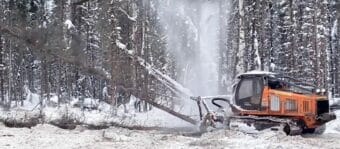
A heavy masticator like this was among the pieces of heavy equipment used by state Forestry and a contractor to clear vegetation from the fuel break the agency cut in an area west of the Delta River and the City of Delta Junction. The masticator knocks down trees and then grinds them up into chips. (Alaska Division of Forestry)

The state Division of Forestry has cleared a wide swath of trees and vegetation from a fire-prone area west of Delta Junction. It’s one of several fuel breaks that Forestry has cleared over the past year to protect other communities around the state from wildfire.

Forestry Division crews used earthmovers and other equipment last winter, while the ground was frozen, to clear a 300-foot-wide, 13-mile-long swath of forest west of the Delta River. That’s where several big wildfires have burned in recent years, like the Oregon Lakes Fire that blackened 35-thousand acres in 2019.

“That area has a got a frequent-fire history,” says Norm McDonald, who heads up Forestry’s Fairbanks-based fire and aviation operations. “The combination of fire starts and the wind — that’s just an area of concern for us.”

McDonald says agency officials have long considered cutting a fuel break in the area, to eliminate vegetation that feeds a fire and to create safe areas for staging crews to fight wildfires. And the Oregon Lakes Fire, along with increased state and federal funding for wildfire prevention, motivated them to get the job done.

“It gives us a toe-hold,” he said, “a place where we can safely put firefighters to protect whatever values that we identified.”

That toe-hold is the 349-acre fuel break, west of the Delta River and the city of Delta Junction on state land near military training areas that are littered with unexploded bombs and other munitions.

“We know it was used actively by the military for training, and we know there’s unexploded ordnance out there,” he said, “So we have not and will not put firefighters in there.”

North of that area, there are several cabins scattered about and structures that are part of the faith-based Whitestone community, where about 60 people live. The area is vulnerable to wildfires sometimes sparked by military training that can spread quickly through dry, dense vegetation, often driven by high winds.

“Having a pre-identified or pre-established fuels break in that area just makes a lot of sense,” McDonald said in an interview Wednesday.

He said Forestry hopes to begin work on the bigger phase 2 of the Delta River-West project late next year. He says it’s part of Forestry’s “proactive approach to fire management” that’s being applied statewide.

“We’ve got projects going in Fairbanks and Kenai and Anchorage and Mat-Su Valley. So, across the state, people will notice more fuel-reduction activity than we’ve ever had.”

The Sunset Fuel Break in the Mat-Su, for example, which was completed last month, will help protect the communities of Houston, Meadow Lakes and Wasilla.

McDonald says state and federal fire officials believe fuel-reduction projects are more important now that climate change has made wildfire seasons start earlier and last longer, with larger and more destructive fires.

He says fuel breaks also offer another benefit, in the form of firewood

“We found people are excited to have a fuel break that protects their community,” he said, “but they’re also really excited to have a place to get firewood.”

McDonald says area residents can contact their local Forestry office to find out how to apply for a permit to pick up firewood left over from the projects, once they’re completed.

Forest Service seeks Alaska workers amid national labor shortage

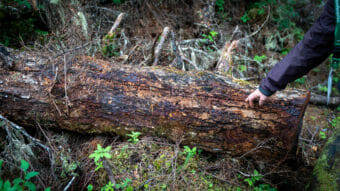
A U.S. Forest Service timber crew on Kosciusko Island (Photo courtesy U.S. Forest Service)

The U. S. Forest Service is seeking new recruits nationwide, with extra focus on filling positions in Alaska. But recruiters say economic conditions are making it hard for them to recruit and retain employees who come from out of state. Now, the agency is turning its attention to the local workforce.
America is in the grip of a widespread labor shortage. According to the latest data from the U.S. Chamber of Commerce, there are over 10 million job openings in the U.S. — but only 5.7 million unemployed workers. The U.S. Forest Service has not been spared from the shortage. And recruiters say it’s especially hard to bring people to Alaska.

Toby Bakos is a wildlife biologist for the Petersburg Forest Service District. He helped set up for a local hiring event on March 2. He said it’s part of the biggest hiring frenzy he’s seen in his decades-long career with the Forest Service.

“This is super rare,” said Bakos. “I don’t remember a single other time when we’ve hired so many permanent positions at one moment in time.”

The Petersburg District is advertising twenty temporary positions as well as six permanent positions. Fifteen of those will open within the next two weeks.

Petersburg District Ranger Ray Born said he hopes the new hiring initiative will help his team make up for years of attrition. His district saw a wave of retirements during the pandemic. Born said the Petersburg Forest Service District is also flush with funding for new projects in the Tongass National Forest. However, those projects require more staff.

“A bunch of different laws got passed and over the last couple of years, and we got increased funding for projects,” said Born. “So we need more people.”

Tiffany Christiansen is an administrative support assistant for the Forest Service. She said the agency isn’t just looking for anybody — they’re specifically seeking out workers with strong ties to the area. Christiansen said hands-on experience living and working in the Tongass National Forest is valuable to the agency — even more valuable than certain academic credentials.

“Someone who has local knowledge has a leg up on someone who’s never been to Alaska,” said Christiansen. “In other words — maybe they haven’t gone and studied these particular sciences in a college down south, but they’ve lived in and grown up in it or lived in it.”

Jason Steele is a Forest Service recruitment specialist. He’s not originally from Alaska, but he recognizes the importance of hiring people who know the area best.

“I could not have gone into Alaska and hit the ground running in these positions, because I don’t know about these things,” said Steele. “In the local community, people do know all about bear habitat and how you would safely work in bear-populated areas in Southeast Alaska.”

But there are also practical reasons for why the Forest Service is trying to source people locally. Born said locals are also better equipped to stay — especially in the current climate of economic hardship.

“We bring people in and they’re like, ‘You mean I can’t drive to my next town?’” said Born. “Some people that’s just not ready for that Alaska adventure.”

Born said Alaska’s remoteness deters potential hires from taking the leap. Especially in the Southeast, where people have to take planes and boats to access the outside world.

However, Born said one of the worst obstacles to hiring people from Outside is Petersburg’s housing market.  Petersburg has struggled with a housing shortage for decades. That lack of housing is already making it difficult for local government offices like the Petersburg School District to bring in workers from out of town.

Born said the Petersburg Ranger District expects up to 40 new workers this year — but they only have 36 beds in their bunkhouse. Compounding that, there’s no space in the bunkhouse for the families they might bring with them. He’s working with local realtors to try and ease the pressure — but that’s why, he said, it makes sense to hire people who are already settled in the area.

Alaska Legislature gets first look at carbon plan proposed by Gov. Mike Dunleavy

Evidence of a red breasted sapsucker on a down tree along Juneau’s Rainforest Trail in the Tongass National Forest on July 15, 2022. (Photo by Paige Sparks/KTOO)

Gov. Mike Dunleavy on Friday officially unveiled a pair of bills intended to market Alaska as a destination for companies interested in reducing the effect of their greenhouse gas emissions.

The result could generate millions of dollars for the state while helping reduce the effect of global climate change.

One bill would create laws and a leasing structure for companies interested in capturing carbon dioxide and injecting it deep below ground, where it cannot contribute to climate change.

The other piece of legislation would allow companies to pay to preserve forested state land from logging and development, offsetting any greenhouse gas pollution they make. Payments would be made through the global market for carbon credits.

“There’s a burgeoning market for carbon credits, particularly in the voluntary market, and Alaska seems to be really well-positioned to take advantage of these opportunities,” said John Boyle, commissioner of the Alaska Department of Natural Resources.

The Alaska Center, which advocates for environmental protections in the state, noted on its website that the governor’s proposal requires a delicate tap dance in order to “convince skeptical members (of the Legislature) the benefit of leaving certain forests un-clearcut, certain wetlands un-mined, etc.”

Rep. Tom McKay, R-Anchorage and a former oil and gas worker, chairs the House Resources Committee, which will hear the proposals first in the House.

“The key words are ‘due diligence,’” he said. “We need to do what’s best for all Alaskans, as per the constitution … that’ll be, I think, our overriding mission.”

In the Senate Resources Committee, co-chair Sen. Cathy Giessel, R-Anchorage, said she expects to begin two weeks of hearings Feb. 20.

Alaska Gov. Mike Dunleavy speaks at a news conference on Thursday, Dec. 15, 2022, at the Alaska State Capitol in Juneau. (Photo by James Brooks/Alaska Beacon)

While those meetings haven’t been formally scheduled, Giessel said the forestry component of the carbon plan will receive the most immediate attention, with underground carbon sequestration taking second billing.

Carbon credits like the one proposed under the Dunleavy plan aren’t a new idea, and the principle is relatively straightforward. To compensate for carbon dioxide emitted by their business, a company pays to preserve a section of forest — even a kelp forest underwater. As plants grow, they absorb carbon dioxide from the air, locking it in wood or seaweed.

If a tree isn’t cut down or burned, that’s a net benefit to the atmosphere.

Third parties, both in the United States and internationally, operate a market in surveying forests and selling credits based on those forests’ ability to absorb carbon from the atmosphere.

For the most part, the market in carbon credits is voluntary, driven by the desire to not contribute to the growing problems caused by climate change.

That’s one piece of the Dunleavy plan. In the other piece of legislation, the governor’s administration is setting out rules for capturing and injecting carbon dioxide deep underground. Most of the state’s oil producers already inject natural gas, seawater and other material underground to boost oil production, and the same principle could be used to sequester carbon dioxide pulled from the atmosphere.

This effort, known as “carbon capture and underground sequestration,” is used on a limited basis internationally, as heavily polluting industries capture carbon dioxide directly from its source before it’s released into the atmosphere.

Some companies are also experimenting with pulling carbon dioxide from the open air, but that technology is energy intensive and hasn’t been reproduced on a commercial level.

Complicated legislation typically takes at least two years to pass the Legislature, and Giessel said it’s reasonable to think that it will be “a couple years” for carbon legislation to leave Juneau.

To develop both bills, the governor’s office hired the Legislature’s normal consultant on oil and gas issues, Gaffney Cline.

To avoid a conflict of interest, they’ll have to hire new outside experts, extending the time it takes to analyze the bills.

Even if the bills become law by the end of the 33rd Legislature in 2024, it’s likely to take several years before the state realizes any income.
The forest-related bill is likely to move quickest, but when Michigan launched a similar program, it took 18 months for a third-party broker to physically examine state forests, then begin selling carbon credits, Giessel said.

That was unusually fast, she said, and involved forests accessible by road. Most of Alaska’s forests don’t have roads, and the process of surveying them could take years. That makes both the timing and potential revenue uncertain.

The state’s own fiscal notes say that “revenues are not specifically estimated because of the market and timeline uncertainty for carbon offset projects.”

An August 2022 study performed for the Department of Natural Resources estimated that three pilot projects — one near Haines, another near Fairbanks, and a third in the Matanuska-Susitna Borough — could earn $82 million over 10 years.

Operating expenses for the forest-linked program are projected to be about $1.3 million per year once it’s fully established, and to be higher in the near term as the project gets started, according to fiscal notes submitted by the Department of Natural Resources.

“You’ll probably hear us very much threading a needle,” Giessel said of the upcoming legislative hearings. “We’re not wanting to discount or in any way vilify the (proposal). Of course, we’ll look at it. It’s just more complicated than it seems.”

This story originally appeared in the Alaska Beacon and is republished here with permission.

Biden administration restores Roadless Rule protections to Tongass National Forest

""
The Stikine River Flats area in the Tongass National Forest, viewed from a helicopter on July 19, 2021. (Photo by Alicia Stearns/U.S. Forest Service)

The largest national forest in the United States is once again protected from development under the Roadless Rule. The United States Department of Agriculture announced Wednesday it had restored roadless protections to 9.37 million acres of the Tongass National Forest, which spans most of Southeast Alaska. 

In a press release, Agriculture Secretary Tom Vilsack said the Tongass is key to conserving biodiversity and addressing the climate crisis, adding that the decision listened to the requests of Alaska Native tribes and people of Southeast while also recognizing the importance of fishing and tourism to the region’s economy. 

The agency said in a press release it got around 112,000 public comments in the two-month period after it began the process to get the Roadless Rule back in place. The majority were in favor. 

The Roadless Rule was put in place at the end of the Clinton administration in 2001. It prevented road construction, reconstruction and timber harvest in most areas of the Tongass and many other national forests. 

But under the Trump administration, more than half of the national forest had been removed from Roadless Rule protections. Tribes and environmental groups in Southeast Alaska quickly sued, saying the decision disregarded overwhelming opposition.

Throughout the last two decades, multiple Alaska governors and members of the state’s congressional delegation have pushed back against the rule, saying it hampers resource development and economic growth in the state

Correction: An earlier version of this story understated the number of acres that regained Roadless Rule protections.

Tribal groups call for halt to logging at ‘sacred and culturally historic’ site near Yakutat

An aerial photo of a snowy, clear-cut area close to the coast.
Clear-cut logging site at Humpback Creek near Yakutat. (Courtesy of Defend Yakutat)

Controversy over a logging project near Yakutat in Southeast Alaska has intensified. The local tribe, an archaeologist and others say a site that’s being logged is home to centuries-old ruins that could provide clues into the history of Southeast Alaska’s Indigenous people.

Yakutat elder Victoria Demmert says her ancestors — for hundreds of years — harvested the abundant salmon that returned to Humpback Creek every summer.

“I don’t know how you could live here, grow up here and not know,” said Demmert, a council member for the Yakutat Tlingit Tribe.

Just this past August, the tribe passed a resolution calling the site sacred and culturally historic. Elders like Demmert and anthropologists say the tribe purchased the site from previous inhabitants hundreds of years ago. Tom Thornton with the University of Alaska Southeast visited the site in August and found “there is evidence of house remains and culturally modified trees and other landscape features.”

So Demmert says she was taken aback when she learned that the local Native village corporation, Yak-tat Kwaan Inc., had begun clear-cutting the forests around Humpback Creek. She says the company never publicly announced that its subsidiary, Yak Timber, planned to log the area.

“We had to find out by seeing what was going on,” Demmert said. “And then seeing some drone footage of it in addition to pictures that were being taken.”

An aerial photo of the clear-cut area annotated to show the locations of boulders and rock walls.
This is an aerial view of the logging near Humpback Creek. The yellow circles indicated boulders found at the site. The black lines represent rock walls. (Courtesy of Defend Yakutat)

In a Dec. 8 letter to Yak-tat Kwaan, the tribe called on the company to stop logging the area. The tribe wants time to investigate the site.

“We know we had a village there,” Demmert said. “And we know there are historical sites there, and we want Yak-Tat Kwaan to stop and let archaeologists get in there before everything’s destroyed.”

Now there’s physical evidence of the history, says Sealaska Heritage Institute. That’s the regional Native nonprofit organization dedicated to preserving the history and culture of Indigenous people in Southeast.

A Yak Timber equipment operator found what could be several house pits and a series of parallel stone walls at the site being logged. That was at the beginning of December.

The institute announced the findings in a joint news release with the Yakutat Tlingit Tribe and Sealaska Corp. on Dec. 15. The groups called on Yak Timber to stop logging the area until it can be investigated.

“There are cultural and spiritual dimensions of it, that’s really important to us,” said Rosita Worl, the institute’s president and a Ph.D. anthropologist. “The rock wall…I’m just so curious about what, what is that? What kind of fishing occurred with that rock wall?”

A close-up photo of the tread from a piece of heavy machinery next to an old, overgrown rock wall.
Stone wall found near Humpback Creek. (Photo courtesy of Defend Yakutat)

Sealaska Heritage is working with archaeologist Aron Crowell with the Smithsonian Institute’s Arctic Studies Center. Crowell believes the Yakutat site could date back 700 years.

In the joint news release, he says “A remarkable set of cultural features related to salmon harvesting appears to be preserved. . . cultural layers at the site could provide a unique record of traditional lifeways and subsistence practices extending back 700 years. Although part of the site has been clearcut, the cultural features do not appear to have been substantially damaged, and their future preservation should be a high priority.”

Even before Humpback Creek, logging was controversial among Yak-tat Kwaan’s shareholders — so much so that Yak Timber announced on Oct. 4 that it would dissolve and sell off its assets.

But later in the fall, Yak Timber reversed course and started logging near Humpback Creek.

“Yak Timber is harvesting. We’ve been harvesting,” said Marvin Adams, CEO of Yak Timber, on December 13, two days before Sealaska Heritage announced their findings. He says the site has never been documented as historic and was approved by the Alaska Division of Forestry after they inspected it in 1975. A 2007 letter (page 12) from Sealaska Corp. discussing historic sites did not identify the area either.

After the findings were announced, Adams said he had yet to be formally notified of Humpback Creek’s cultural significance. He said the company would follow all relevant laws and regulations, but declined to say whether Yak Timber would continue logging the area.

“Obviously, we’re not going to go over some historical site to destroy it,” Adams said. “I think we all respect that. But right now, I have not been able to get any documentation from the tribe or anybody else.”

He points to the work of anthropologist Frederica de Laguna. She researched and wrote extensively about the Yakutat Tlingit Tribe from notes she gathered in the 40s and 50s.

Adams says she never mentioned Humpback Creek as a sacred site.

“If there was actually a historical site and a settlement there, I can assure you that that would have been listed and the specific house and the clan house that was supposed to be there would have been listed,” he said. “But it never was.”

But Demmert sees it differently. Though de Laguna’s work doesn’t go into detail, she says the anthropologist’s notes do mention Humpback Creek as an important salmon-harvesting site. It’s where her people Kwaashk’iḵwáan got their name, which means “people of the Humpback Creek.”

“It’s part of our history, it’s part of who we are,” Demmert said. “And to see it desecrated. . . it just hurts spiritually and physically. It just breaks our heart and brings tears.”

Worl, the Sealaska Heritage president, says the tribal groups are working with Crowell and the state to see how they can investigate the site further.

Naturalists reveal history of centuries-old spruce that fell on Gastineau Avenue

A man stands smiling next to a cross-section from a spruce tree. Standing on edge, it comes up to his waist.
Naturalist Steve Merli stands next to the cookie from the spruce that fell on Gastineau Avenue on Sept. 27, 2022. The asymmetry of the rings shows that the tree was leaning out from a steep slope. (Photo by Claire Stremple/KTOO)

After it fell, the old tree above Gastineau Avenue slid about 650 feet down the shoulder of Mt. Roberts before crashing through a few houses and taking out a power line.

The tree knocked one home off its foundation, flipped a pickup and triggered an evacuation alert for the neighborhood. It took the city fifteen truckloads to haul away the debris.

The slide was over in a few seconds, but when Juneau naturalist Steve Merli looked at a slice of the tree — called a cookie — he saw a much longer story.

“That’s a calendar,” he said.

Merli and naturalist Richard Carstensen founded Discovery Southeast in Juneau to teach youth about the outdoors. They’re used to using ecological evidence to answer human questions.

Fingers point to a black scar in the rings of a tree
Naturalist Richard Carstensen points to a scar that a rock left long ago on the tree that crashed into Gastineau Avenue. (Photo by Claire Stremple/KTOO)

Carstensen said the rings tell us the tree was likely older than the United States. It sprouted and took root on the steep mountainside during the Little Ice Age, sometime in the 1700s. That’s back when Áakʼw Tʼáak Sít, the Mendenhall Glacier, extended about five miles further than it does today, and the Gastineau Channel was choked with icebergs. Typical August weather during the time included sleet.

But the rings show a lot more than the tree’s age.

“The first thing we noticed was that the rings are way bigger here,” Carstensen said, pointing out a contrast between the two sides of the tree. One side has wider rings. “A conifer tree that’s based on a steep hill is almost always leaning out, like in this case toward the channel. When they lean over time, they get thicker rings on the lower side.”

Carstensen said old trees like this one can actually thrive on Juneau’s steep slopes.

Goats, old trees and steep places

A pandemic-born obsession with mountain goats led Carstensen to new insights about incline and tree longevity. He spent a lot of time watching goats on avalanche paths, and he noticed some really old trees where he didn’t expect them.

“You cannot study goats and not become intrigued with their relationship to avalanches,” Carstensen said. “Because that’s the main way they die. But it’s also creating the best goat winter habitat in the world.”

A man leans against a large spruce tree
Naturalist Richard Carstensen stands in front of an old spruce in the Behrends slide path in downtown Juneau. (Photo by Claire Stremple/KTOO)

Out on the Behrends hillside, he pointed out a grazing goat. It was munching on nettles at about 1,000 feet up and easy to see because there was only low foliage around him. This is a known avalanche path, and the little trees are a giveaway — mostly alders and low brush. But Carstensen pointed out a huge spruce.

“I call this the brave outlier because it sits out right in the firing line. And I’m guessing it’s at least 300 years old,” he said.

The spruce is extremely thick — Carstensen calls it “refuge diameter.” In other words, there’s safety in its girth. There aren’t many other trees around it because anything too much smaller gets toppled or buried.

“Every year, there’s an avalanche. And more often than not, it piles up to the base of this tree to 10 feet or more,” he said. “And you’ll walk over it and you go, ‘how did this thing survive?’”

He said there are even more trees like this up high. He’s seen them while installing cameras to check out the goats.

It turns out big trees do well on steep hillsides, and not just because they aren’t likely to get logged. “Colluvium” is the term for rocky soil on slopes like these around Juneau. It’s coarser than soil in a valley, for instance, and will have rocks and even boulders in it. Those give roots something to hold onto. Carstensen said the deep water table on a very steep hillside also helps because trees will send their roots down further.

He pointed out a hemlock that would have been inconspicuous if there wasn’t a huge bald eagle nest in its crown. It’s about five feet thick at the base. Carstensen said it’s easily 1,000 years old.

“If we were to core that hemlock, I can guarantee you that the outer foot alone would have 300 rings,” he said.

The life of a tree

The cookie from the Gastineau Avenue tree tells us the tree lived on a steep slope, but it also tells us a little about its life there. The rings are so dense at the core that they nearly blend together. Carstensen said that’s rare for the species.

“Normally, a spruce gets started in a canopy gap, and the center rings are pretty big. But this tree was suppressed by an overhead canopy, so it was growing very slowly, like a hemlock grows in a forested, shady situation,” he said.

Carstensen pointed out a dark spot in the trunk where a rock likely bashed the tree. According to the rings, it took almost three decades to fully heal. It wasn’t the only evidence of abuse, either — the rings knit around other dark spots, all on the uphill side of the tree.

Debris left from the Sept. 27, 2022 landslide and treefall on Gastineau Avenue, after the city cleared the street. (Photo by Claire Stremple/KTOO)

There’s no definitive answer to what took the tree down. It could have been high winds, or saturated soil that gave way. The base of the trunk was rotten, according to Juneau city officials.

Most of the tree went to the dump — what’s left still rests between the damaged houses on Gastineau Avenue.

Correction: An earlier version of this story misstated the name of Discovery Southeast.

Site notifications
Update notification options
Subscribe to notifications