Timber

Trump administration announces plans to rescind Roadless Rule once again

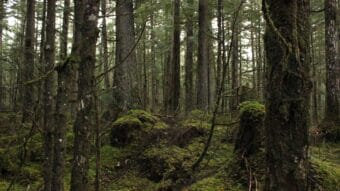
The Tongass National Forest is the largest temperate rainforest in the country. With exceptions, the Clinton-era Roadless Rule restricted road building and industrial activity in around 55% of the national forest. Advocates for its repeal said it posed unnecessary hurdles to development projects, like logging, mining, and renewable energy. (Erin McKinstry/KCAW)

The U.S. Department of Agriculture announced plans to rescind the Roadless Rule yesterday, aligning with President Donald Trump’s executive order earlier this year to end a ban on constructing roads in undeveloped areas of the Tongass National Forest in order to stimulate more logging in the region.

The Roadless Rule has flip-flopped multiple times since it was established to protect undeveloped lands in 2001. It was rolled back during Trump’s first term before being reinstated by former President Joe Biden. 

Mike Jones is the Tribal President for the Organized Village of Kasaan on Prince of Wales Island, an area of the Tongass that has been logged heavily. 

“It’s the largest temperate rainforest in the world … it’s the northern lung of the planet,” Jones said of the Tongass.

He said new roads and additional logging would degrade the landscape and harm salmon streams that people rely on. 

Rolling back the Roadless Rule in Alaska hasn’t been popular in the past. When the U.S. Forest Service considered exempting the state from the federal Roadless Rule back in 2019, more than 144,000 people submitted public comments and most were opposed to opening up the Tongass to new roads. 

U.S. Senators Lisa Murkowski and Dan Sullivan both welcomed the rollback. 

“Repeal will not lead to environmental harm, but it will help open needed opportunities for renewable energy, forestry, mining, tourism, and more in areas that are almost completely under federal control,” Murkowski said in a statement today.

Kate Glover is an attorney at Earthjustice, an environmental law firm that has challenged past rescissions of the Roadless Rule on behalf of tribes, conservation nonprofits and tourism and fishing groups. 

“It’s disappointing to see the administration doing something that’s so clearly contrary to what the public is asking for and is contrary to the public interest,” Glover said. 

More than 9.2 million acres of the Tongass are inventoried as roadless areas under the rule. Nearly 330,000 acres of the 16.7 million-acre forest are considered suitable for logging, according to the U.S. Forest Service’s latest 2016 management plan. That plan is currently going through a revision

The USDA did not respond to a request for comment. Viking Lumber and Alcan Timber, the largest logging companies operating in the Tongass, also did not respond.

Feds ask court to dismiss timber industry lawsuit that aims to increase Tongass old-growth logging

The Tongass National Forest covers more than 80% of the land in Southeast Alaska. (Photo by Katie Anastas/KTOO)

Listen to this story:

The largest timber companies operating in Southeast Alaska want the Tongass National Forest to sell them more old-growth timber, and they’re suing the federal government to get it. The Department of Justice asked the court to throw the case out in May.

The Alaska Forest Association along with two of their members, Viking Lumber and Alcan Timber, filed the lawsuit in March, alleging that the U.S. Department of Agriculture failed to fulfill a promise to supply the companies with enough timber to meet market demand. But the government filed a motion to dismiss the case, writing that it didn’t make such a promise.

The case comes after President Trump issued two executive orders aimed at expanding logging in the Tongass this March, and follows decades of legal disputes over Tongass timber. 

Frank Garrison is an attorney with Pacific Legal Foundation representing the timber industry. He said the industry has faced a 30-year decline, and that Viking and Alcan are struggling. 

“They’re on the brink of collapse,” he said. 

He said the companies rely almost completely on old-growth timber offered by the Tongass National Forest.

The government argues in the motion that it is only required to “seek to” provide enough timber to meet market demand while balancing other forest uses and ensuring their sustainability — as written in the 1990 Tongass Timber Reform Act. The law eliminated an old requirement for the Tongass to supply 4.5 billion board feet of timber per decade. The DOJ argues that the agency is not legally required to provide a specific amount of timber to companies.

The DOJ also writes in the motion that the timber sale objectives in the 2016 Tongass National Forest Management Plan are aspirational goals, not binding commitments that can be challenged in court. Furthermore, the government asserts that plaintiffs don’t point to a specific agency action or rule that has been violated. 

But Garrison said that the management plan gave timber companies an expectation that they would have roughly 15 years to transition their businesses from old-growth to new growth trees, and provided estimated amounts of old-growth timber that they could expect to buy. 

“The timber industry, including our clients, relied on the management plan when they were figuring out how they were going to run their business for the next decade,” Garrison said.

When the Forest Service announced the Southeast Alaska Sustainability Strategy in 2021, which proposed to end old-growth logging, Garrison said the agency abandoned its commitment to a slow transition.

The Forest Service has not met its annual target for timber sales in Alaska since 2014, according to a U.S. Government Accountability Office report published last year. Demand for forest products from the Tongass between 2015 and 2030 is estimated to range from roughly 41 to 76 million board feet per year, according to a Forest Service study published in 2016, the most recent market analysis. Between 2020 and 2023, the Forest Service offered sales for a total of 14 million board feet.

Garrison said he hopes that two recent Supreme Court decisions will tip the lawsuit in the industry’s favor. The first is DHS v. Regents, a 2019 case that set a precedent that federal agencies must consider whether those benefiting from a policy rely significantly on its continuation before upending it.

The second case is Loper Bright Enterprises v. Raimondo, which overruled a legal doctrine called Chevron deference last year. The doctrine directed courts to defer to federal agency interpretations of ambiguous laws. Now, the courts must use their independent judgment to interpret laws that agencies administer. It’s unclear whether these new precedents on agency discretion will factor into this case.

Nonprofit environmental law firm Earthjustice is representing a group that seeks to intervene in the case. It includes the Organized Village of Kasaan, the Organized Village of Kake, a boat tour company called The Boat Company, Alaska Longline Fishermen’s Association, Natural Resources Defense Council, Southeast Alaska Conservation Council, and The Wilderness Society.

Earthjustice Attorney Kate Glover agrees with the DOJ that the case should be thrown out because the industry hasn’t challenged a specific agency action. She said that timber companies are looking for a wholesale policy change.

“The timber industry plaintiffs are asking the court essentially to order the region to take a step backwards — to go back to a long-gone era of large timber sales, large clear cuts, where we make that the priority for the use of old-growth forests,” Glover said.

Joel Jackson is president of the Organized Village of Kake, a tribe based on Kupreanof Island. He said the forest’s health is vital to support an abundance of salmon, deer and moose. Since heavy logging moved out, he said the tribe’s food security has improved. Jackson does not want to see old-growth logging scale back up. Instead, he wants the old-growth to be preserved for future generations to experience it as he has. 

“It’s like walking into one of the most beautiful cathedrals you could ever walk into anywhere in the world,” Jackson said of the forest.

The tourism industry brings significantly more money into Southeast Alaska than the timber industry. Jackson said the two are at odds because visitors come to see one of the last protected temperate rainforests in the world, not clear-cut logging in the mountains. 

Maggie Rabb is the Executive Director of the Southeast Alaska Conservation Council, one of the environmental groups trying to intervene in the case. She said that the timber industry’s demands are out of line with what most Southeast Alaskans want for the Tongass.

“They want nuanced, science-based, responsive management. And that does not look like one logging company telling the Forest Service how much they need, and letting that drive decisions about how we manage our forests,” Rabb said.

The Tongass National Forest is undergoing a revision to its management plan, which will update timber sale objectives. The new plan is expected to be completed in 2028. 

The USDA, DOJ and Forest Service declined to comment. The timber industry must file a response to the DOJ’s motion to dismiss the case by June 24. 

Clarification: This story has been updated to include the name of the boat tour company seeking to intervene in the case. 

‘We all fish right there’: Local concerns pause timber company’s plans for Haines

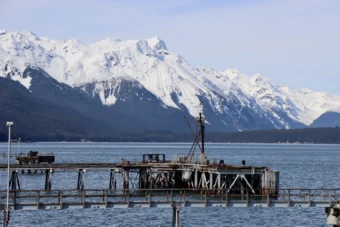
The log transfer facility and storage site would be a little over four miles outside of town, in Haines’ Lutak Inlet, pictured above on March 27, 2025. (Avery Ellfeldt/KHNS)

Four years ago, an Oregon-based timber company won a contract to harvest some 23 million board feet of spruce and hemlock outside Haines. Now, the company’s plan to get that timber out of Alaska – and into buyers’ hands – is sparking pushback.

That’s because the company’s local operator is seeking permits to build a log transfer facility and storage site in Haines’ Lutak Inlet, a popular spot for commercial and subsistence fishing.
“We all fish right there,” said Erik Lembke, a commercial fisherman in Haines.

The concern pushed the State Department of Natural Resources to make an about-face late Wednesday afternoon by temporarily closing the permit application’s public comment period. The period was originally set to end on Friday.

Tony Keith, a natural resource manager with the department, said the feedback the agency had received so far made it clear the public needs more information. In response, the agency will require the company to provide the public with more details, including a dive survey of the ocean floor.

“Then, once you’re finishing the log transfer facility, or if you’re trying to bring it back under review or anything, you’re able to do another dive survey and go out there and check bark accumulation and stuff like that,” Keith said.

The Chilkat Valley’s first major timber sale in decades

The so-called Baby Brown timber sale lies in the Haines State Forest, just over 35 miles northwest of town between Porcupine and Jarvis Creeks. The state first awarded the sale to a contractor in 2016 but later canceled it after conservation groups appealed the land use plan. Later, in 2021, the sale was awarded again, this time to an Oregon-based company named NWFP Inc.

State Forester Greg Palmieri said the company has been developing what he called a “responsible plan” for the project over the last several years. As he sees it, Baby Brown presents a “huge opportunity” for Southeast and the Chilkat Valley specifically, which used to be home to a booming timber industry – but hasn’t seen a major sale in decades.

Palmieri said 8 million board feet of timber were harvested in the area in 1995, and there were a few other, smaller sales until about 2000. But he added that the last time there was a sale around the size of Baby Brown, “it was probably around the mid-70’s.”

“If there’s no industry working in the area, there’s no potential for growth. So this sale was designed to encourage the development of the industry,” Palmieri said. “Conceptually, does it crack that egg? We’ll have to see. It has the potential to do that.”

The contractor’s local operator – NSEA Timber Inc. – submitted the permit application on March 11, according to Keith of the Department of Natural Resources. The company also needs permits from the borough and U.S. Army Corps of Engineers.

The application proposes a log transfer facility and storage area on a 12-acre site about four miles out of town, off Lutak Road. The property is in a borough-designated waterfront industrial zone near the Alaska Marine Lines dock.

The facility would include a slide to transfer log bundles into the water. A boat would then place each bundle into a floating log raft and tow the raft to a storage site close to shore. Later, they would be loaded onto ships, which would transport them to buyers.

“This is a fundamental step in that process to get the product to market,” said Palmieri.

This type of facility has been around for decades, said Charles Nash, who used to be employed by the contractor but is no longer associated with the sale. Nash has worked in Alaska’s timber industry for years.

“There used to be log transfer facilities all over Southeast, and they come in many types. Some are slides, some are cranes,” he said. “But that’s how, generally, how logs got in the water.”

Palmieri, the forester, said the facility is a conservative option that aims to reduce traffic and limit impacts on the inlet – and the fisherman who use it. He estimated the storage site would be about 1,700-feet long, roughly one-third of a mile.

Fishing concerns

But some worry about the log rafts affecting water quality and access to the inlet.

“The way that you fish Lutak Inlet, you know, you fish out from the shoreline,” said Rafe McGuire, a commercial fisherman in Haines.

He added that a log area close to shore would mean fishermen would lose access to that area and more because they would need to make sure their nets wouldn’t get swept closer by the tide.

“You can’t fish very close to it. So you’d lose most of that distance,” McGuire said.

Lembke, the other fisherman, said there could be up to 20 boats fishing the area during the sockeye run.

“I think if there was a lot of logs and a big ship, it would pretty much make it impossible to do that,” he said

Polly Johannsen – who signed the permit application for the local operating company, NSEA Timber Inc. – did not respond to multiple requests for comment. Nicole Zeiser, area management biologist with the state Department of Fish and Game, did not respond to an emailed request for comment.

Earlier this month, a separate lumber company confirmed it was temporarily shutting down a work site near Kodiak. The company attributed the decision to China’s pause on imports of U.S. logs in response to ongoing trade disputes.

Palmieri says he’s received no indication that the trade war has affected the sale. The permit application, for its part, says logging could begin as soon as this spring and run through 2028. The agency did not say when the dive survey will take place or what the permitting delay will mean for logging operations.

U.S. Forest Service cuts back Southeast Alaska timber sale after public comments

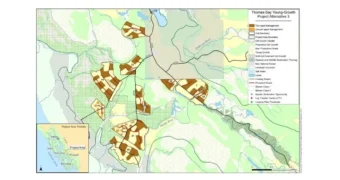
This map depicts the plan the U.S. Forest Service approved for the Thomas Bay timber sale. The yellow represents the available young growth stands. The brown areas are sections that will be harvested at different times. (Map courtesy of USFS)

Timber sales in Southeast Alaska’s Tongass National Forest often spark conflict between environmental groups, the timber industry, and the U.S. Forest Service. Timber companies want more opportunities to harvest, and environmental groups want to protect the forests. But a new sale near Petersburg focusing on second-growth trees has all those groups on board.

The sale design is the result of the Forest Service changing its public process over the years.

Brett Martin has owned a small sawmill for 35 years. He lives part-time in Petersburg and part-time in Sitka and loves making lumber out of Southeast trees.

“Two by fours, two by sixes, fenceposts, fencing…,” Martin said. “Anybody who’s ever sawn logs into lumber, you know, it gets into your blood, and it’s something you really enjoy.”

Martin considers himself one of several small cottage industry mills in the region. He’s also been a logging engineer for three decades, contracting with the Forest Service and private companies to inventory forests for possible harvests.

He has seen timber sales dramatically decline in the last few decades, devastating the region’s industry. Employment went from the thousands – when logging old growth was common practice – to less than 300 workers a few years ago.

There is only one remaining larger-sized timber company in the region – Viking Lumber Co. on Prince of Whales Island. They have the necessary infrastructure to harvest trees in very remote places. And Viking has sustained its company by shipping logs out of Alaska in the round to be processed somewhere else. Martin says that means Alaskans must import their lumber.

“Most of the lumber that’s used for oh, construction purposes in Alaska, a lot of it shipped up from the Lower 48, if not most of it,” he said.

But Martin sees an opportunity to keep more lumber in Alaska with the Forest Service’s shift from old-growth to young-growth timber sales. The Tongass has 17 million acres of forest and Martin says up to 450,000 acres is young growth or second growth, meaning it’s been previously logged. It’s those young trees that the Forest Service wants companies to harvest while preserving the old-growth stands.

Ray Born, Forest Service district ranger based in Petersburg, is helping to manage the new timber sale in Thomas Bay.

“There’s certain old growth areas, we’ll just leave alone,” Born said. “We’re gonna leave them, you know, for wildlife or for old-growth characteristics or things like that we want to maintain over time.”

The initial Thomas Bay timber sale proposal was for about 22 million board feet, mostly clear-cut. After a few years of public process, they shrunk the harvest to 12.6 million board feet to be harvested through a patchwork of areas over several years.
A stand of young growth timber that is for sale near Thomas Bay. The stand has regrown from logging in the 1950s and 60s. (Courtesy of the U.S. Forest Service)

Thomas Bay has been logged to varying degrees from the 1930s through the 80s. The Forest Service still considers it a productive area, with the ability to regenerate harvestable trees in 60 to 80 years. Born says there could be continuous harvests if it’s done piecemeal.

“So the intent is we’ll do some now, and 20 years down the road, we’ll do some more, 20 years down the road, we’ll do some more and in about 80 years, come back to where we started at,” Born said.

Harvesting smaller areas over time could be better for wildlife and it could allow small sawmills more opportunities. Those are comments the Forest Service has heard during the public process leading up to the sale. Born has been working with the Forest Service for three decades and says a lot has changed in how they approach timber sales.

“It’s more listening. We’ve listened more carefully to all the people who have an interest in it now and it’s more holistic,” Born said. “And that’s kind of one of the unique things about the Forest Service, you know, we focus on serving the people and caring for the land – it’s that balance there that makes it really interesting, and we spend more time listening to the people now.”

And they did listen to people, according to Katie Rooks with the Southeast Alaska Conservation Council.

“I actually have lots of good things to say about the Forest Service in relationship to this particular timber sale,” she said.

The Southeast Alaska Conservation Council often opposes timber sales but they see the Thomas Bay one differently.

“This feels like a different timber sale,” said Rooks. “Instead of going for the obviously most profitable alternative, they do create a pretty decent balance between providing some timber and wildlife habitat.”

Rook’s group isn’t anti-timber but they are against clear-cutting old growth – they believe it’s bad for the trees and the wildlife. The Thomas Bay sale’s environmental assessment considered the impacts to deer, moose, wolves, marine mammals, salmon, and birds. Rooks also supports the federal effort to break up the acreage over time, catering to smaller sawmills.

“To be able to somewhat create a market for this timber and to process it here locally as much as possible into a higher value-added product,” Rooks said.

That’s exactly what small sawmill owners like Brett Martin are interested in. He has a vision to expand his company and provide building materials for Southeast residents and businesses. He also wants to sell cabin kits from the local wood.

“I can hire 14 to 16 guys full-time, and that’s just in my sawmilling side of it,” Martin said. “I truly want to start a construction side of it, which would then allow us to, you know, start building cabins because people will come, they’ll want to buy a kit, and then the very next question out of their mouth is going to be, ‘Do you know of anybody who builds them?’ I could potentially hire, 20 to 25 people full-time.”

To accomplish his business goals, Martin would like to buy two million board feet of timber a year for the foreseeable future. But first he has to win the bid for the Thomas Bay sale, which the Forest Service plans to open in early fall.

The Forest Service plans to start marking the area in April.

While big equipment is at the Thomas Bay site for logging, the Forest Service plans to restore habitat that’s been damaged from past timber sales. Back in the 50s and 60s logging in Southeast was often short-sighted. Projects left behind infrastructure that affected fish migration, such as culverts that later became blocked. Or they logged up to the water’s edge, damaging fish rearing habitat. The Forest Service also plans to treat invasive plant species while they’re at the site.

Whale Pass wants carbon credits instead of state timber sale: ‘A clear-cut right in the town’

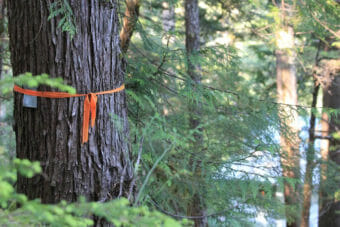
A tree trunk with orange flagging tape tied around it
A ribbon marks a tree in the Prince of Wales Island town of Whale Pass. (Photo courtesy of Maranda Hamme).

The Southeast island community of Whale Pass is asking the state to pursue carbon credits instead of a nearby timber sale. But the state says it’s going ahead with the logging project.

Whale Pass has long opposed a nearby timber sale on state land. The state approved the project this spring to clear-cut nearly 300 acres of old growth on a steep slope behind the town. Residents say it’s just too close.

“A clear-cut right in the town. You know, directly in the backyard, ” said resident, James Greeley.

Greeley says the project site is just 100 feet away from his property line. He is also a city assembly member and says residents are concerned about many things: more exposure to wind, messing with the watershed used for homes, affecting salmon streams, and the community’s growing tourist industry – the logging traffic and “visual eyesore” on the landscape.

“No one’s really anti-logging out of this whole group,” said Greeley. “We’re just kind of saying, you know, maybe not this timber sale.”

This DNR map depicts the state’s land near Whale Pass in dark green, the timber sale in yellow, and roads for the project in red dashes.

Residents have asked the state to adjust the boundaries but were rejected. Now, the community is asking the state to reconsider the project – and seek carbon-offset credits instead.

This follows a new state law that allows the Department of Natural Resources to develop a system to use the state’s forested land to sell carbon-offset credits. Companies would basically pay the state to keep its trees intact.

Governor Mike Dunleavy, who introduced the bill said it “will generate new revenue for the state.”

Whale Pass’s city assembly approved a resolution supporting carbon-credits. And Greeley sent a letter to the commissioner of the Department of Natural Resources  explaining their stance – that carbon credits would be much more profitable than the timber sale.

“The difference is like, insane, really,” Greeley said.

He says the city worked with the Nature Conservancy of Alaska to come up with the profit estimates. It shows carbon credits, over time, could bring in anywhere from about one to nearly seven million dollars, according to various market prices.

The state’s DNR says they do not have an estimate yet on how much the timber sale at Whale Pass will make. The project went out to auction on, Oct. 14.

Nature Conservancy spokesperson, Amy Miller, says carbon credit projects are a win-win.

“They create the opportunity for a community to preserve a resource that’s important to them, and also earn some money in the process,” she said.

Pink harvest boundary tape hangs from a tree near Whale Pass. (Photo by James Greeley)

The Whale Pass harvest requires four miles of new logging roads to be built, which is expensive. Greeley says the state can make more money without all of that required development.

“They’re telling me that they can’t give me a bigger buffer on my property, because they won’t be able to cover the cost of building the road, to even have the timber sale,” Greeley. “Versus if they don’t even have to do anything, they’re gonna make 10 times as much.”

Despite the ongoing opposition, the state is moving forward with the project. No one from the DNR office would agree to an interview for this story. But in a written statement, Commissioner John Boyle repeated what the department has said before – that the state’s constitution mandates that the department uses natural resources on public lands.

Boyle wrote that while carbon offsets present new opportunities, “Regular timber harvests in our Southeast State Forest ensures DNR meets that mandate.”

The two main logging companies in Southeast — ALCAN in Ketchikan and Viking Lumber on Prince of Wales Island — have been asking the state for timber sales. The state’s DNR blames the federal government for not supplying logging opportunities on federal land because of the Roadless Rule.

In February, Greg Staunton, the state’s area forester, told CoastAlaska that they have to provide old-growth logging near communities in some cases.

“A lot of the land base that we’ve been charged with managing here is in proximity to where communities are,” Staunton said.

But Katie Rooks says seeking a timber sale instead of carbon credits doesn’t make sense. She’s with the Southeast Alaska Conservation Council. She’s seen the numbers and says it doesn’t add up.

“What Whale Pass sent the state definitively proves that this timber is worth more economically to the state itself if left on the stump,” Rooks said.

Rooks says there is also the value of leaving the landscape for the town, which is a subsistence community. Something that Whale Pass residents were asking the state to consider.

“The state’s response to this proposal – it reads angrily,” said Rooks. “It reads as if the state is penalizing its own town, the town of Whale Pass, for the federal government’s lack of supply of timber. And that’s unfortunate.”

Other communities and tribal governments on Prince of Wales island have also voiced opposition to the project. The state says logging could start early next year, depending on the harvester’s needs.

In new challenges to Tongass ‘Roadless Rule,’ pro-logging arguments have disappeared

Sun shines through the canopy in the Tongass National Forest. (Photo by Brian Logan/U.S. Forest Service)

The state of Alaska, a coalition of business groups and a pair of electric-power organizations have opened a new round in the generation-long fight over environmental protections in Southeast Alaska’s Tongass National Forest.

On Sept. 8, the state and two other groups of plaintiffs filed three separate federal lawsuits to challenge a Biden administration rule restricting new roads in parts of the forest, which is home to some of America’s last stands of old-growth trees.

Each lawsuit asks U.S. District Court Judge Sharon Gleason to overturn the new rule and prior versions.

The Roadless Rule, as it is known, was enacted (and sued over) as early as 2001 by logging proponents, but the latest lawsuits bring a new wrinkle: In more than 100 pages of court documents, the word “logging” appears only once.

Instead, plaintiffs are arguing that the federal government’s rules make clean-energy projects and other economic development unaffordable.

The legal complaints cite prospective geothermal and hydroelectric power plants, as well as hypothetical metal mines whose products could be used for green technologies.

“You’ve got true roadblocks for very desirable projects. These are projects that are going to provide cost savings and environmental benefit,” said Luke Wake, an attorney with the Pacific Legal Foundation, which is representing the Inside Passage Electric Cooperative and the Alaska Power Association in one of the lawsuits.

The state of Alaska, which is leading a second lawsuit, has opposed the Tongass Roadless Rule through Democratic, Republican and independent administrations alike.

In a written statement, Gov. Mike Dunleavy said that “Alaskans deserve access to the resources that the Tongass provides — jobs, renewable energy resources, and tourism, not a government plan that treats human beings within a working forest like an invasive species.”

The third lawsuit, which includes the Alaska Chamber of Commerce and Resource Development Council of Alaska among its plaintiffs, is being led by former Gov. and former U.S. Sen. Frank Murkowski, the father of current U.S. Sen. Lisa Murkowski, R-Alaska.

Jim Clark, Frank Murkowski’s former chief of staff and an attorney working on the case, said he remembers when he represented the Alaska Forest Association in a prior lawsuit on the issue.

“This case is old enough to drink in any bar in Alaska,” he said.

In the years since he first worked on the issue, Southeast Alaska’s logging industry has almost entirely vanished. A pulp mill in Ketchikan is now a cruise ship terminal; another in Sitka is a sanctuary for bears.

Overturning the Roadless Rule isn’t about clear-cutting anymore, he said. Instead, it’s about improving access for projects that now need special approval.

“It’s not like we don’t have access under the Biden law, notwithstanding the Roadless Rule, but it is a barrier,” he said.

In legal filings, the Inside Passage Electric Cooperative offered an example: It hopes to build a power line between Kake and Petersburg, allowing those communities to share low-cost power.

The project was expected to cost $17.5 million, but because of the Roadless Rule, it would have to be maintained by helicopter, causing the projected cost to balloon to $65 million.

“As a result of these heightened costs, the Kake-Petersburg Intertie Project remains stalled. But IPEC would resume efforts to further this project if it could obtain road access,” said Jodi Mitchell, IPEC’s CEO, in legal testimony.

Clark said that logging companies aren’t part of these new lawsuits because logging is restricted under a new forest plan, something separate from the Roadless Rule, and the prospects of changing the forest plan are limited.

“There’s no way we’ll be able to change the forest plan to make a difference here,” Clark said.

Kate Glover is an attorney with the environmental law firm Earthjustice, which has participated in prior Roadless Rule lawsuits.

Glover said the attempt to switch to another focus in the Roadless Rule “is certainly noteworthy,” but that the issue “really is about logging,” which was the primary focus of the original rule.

The three lawsuits — which are expected to be combined into one by U.S. District Court Judge Sharon Gleason — will continue a 22-year-old dispute over the extent to which the U.S. Forest Service has the authority under existing law to restrict road building in the forest.

In 2001, the federal government wrote a nationwide rule restricting road building in designated areas. Roads are needed for intensive logging.

The state of Alaska challenged the rule in court, and the federal government agreed to exempt much of Alaska from it.

That changed in 2011, after a federal judge ruled in favor of environmental groups who had filed a lawsuit arguing that the Alaska exemption was unlawful.

The state appealed the verdict and saw it overturned by a three-judge panel of the Ninth Circuit Court of Appeals, but a subsequent appeal to the full Circuit Court saw the Alaska exemption again overturned.

The state challenged the legality of the 2001 rule overall in a separate lawsuit filed in Washington, D.C., but lost that case.

After the election of President Donald Trump, the state supported a new roadless rule that allows Tongass development. The Trump administration passed the new rule, but lawsuits stymied its implementation, and the Biden administration’s new rule, enacted in January, overwrites the Trump rule.

Though the state and allied plaintiffs have repeatedly lost in court on the issue, attorneys say the legal groundwork has changed over the past few years.

The U.S. Supreme Court’s 2022 ruling in West Virginia v. EPA has the potential to significantly reduce the power of federal agencies to write regulations that aren’t specifically authorized by Congress, and in summer 2024, the Supreme Court is expected to reinterpret a standard known as the “Chevron doctrine” and again restrict the authority of federal agencies.

“All of which makes you think the Supreme Court is more favorable,” Clark said.

This story originally appeared in the Alaska Beacon and is republished here with permission.

Site notifications
Update notification options
Subscribe to notifications