KRBD - Ketchikan

KRBD is our partner station in Ketchikan. KTOO collaborates with partners across the state to cover important news and to share stories with our audiences.
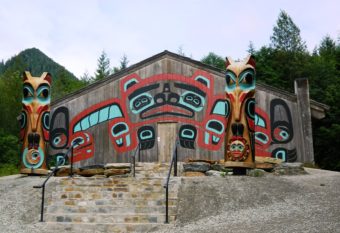
Saxman and Kasaan awarded USDA Rural Development grants

The city-owned clan house in Saxman, July 22, 2013.
The city-owned clan house in Saxman in 2013.

U.S. Department of Agriculture Rural Development awarded a $60,000 grant to the City of Saxman last week. The announcement was made by Alaska State Director Jim Norlund.

The grant is provided through a program with a goal of offering affordable loans and grants for facility projects in rural areas. Grants are available to rural communities with a population of 5,000 or fewer.

Saxman’s grant will be used to replace the roof of the city-owned clan house. A press release issued by the USDA states that replacing the roof will prevent damage to the expensive, custom-made red cedar ceiling purlins. Purlins are the horizontal beams along the length of the roof.

The tribal house was completed in 1990 and is used for Native cultural activities. It is also a venue for many community events.

USDA also awarded a $26,250 grant to the City of Kasaan. The money will be used to prepare environmental assessments for water and wastewater projects.

USDA Rural Development has invested more than $2 billion in 226 rural Alaskan communities since 2009.

Forest Service moves forward with Tongass second-growth transition

A Tongass National Forest clearcut is shown in this 2014 aerial view. A new court decision limits logging on roadless areas of the forest. (Photo by Ed Schoenfeld/CoastAlaska News)

The U.S. Forest Service moved forward Thursday with plans to transition to second-growth harvest on the Tongass National Forest within 16 years. The draft record of decision represents a compromise that won’t leave anyone completely happy.
Tongass Forest Supervisor Earl Stewart has chosen Alternative 5 for the proposed Tongass Land Management Plan amendment.

What does that mean? Well, there’s a lot of detail in the draft Record of Decision, but the main point is that during the transition, the U.S. Forest Service will offer an average of 46 million board feet of timber on the Tongass National Forest per year.

For the first decade, that will include more old-growth logging than second growth – almost three times as much. But then from years 11-15, the ratio will flip, allowing more young growth harvest and limiting old growth.

By year 16, timber stands offered for logging will be almost 100-percent young growth, with a few microsales of old growth for specialty products.

Concurrent with Stewart’s announcement was a flurry of news releases from various groups. Trout Unlimited Alaska likes the decision because it protects more salmon streams; but various conservation groups are unhappy, and say that the transition should be faster.

On the timber industry side, Owen Graham of the Alaska Forest Association said the transition needs to slow down.

“We’ve always agreed that there needs to be a transition, but we wanted the trees to reach maturity, which is 30 years in the future,” Graham said. “If they cut the trees now, over the next 10-15 years, then they’ll be too small to be properly sawn in the sawmills, and they’ll just end up being exported to China.”

Graham said that the old-growth harvest planned during the transition isn’t adequate to maintain the few remaining sawmills. He added that a full inventory of young growth trees is needed before formalizing the amendment.

“To do this transition right now is purely politics and all the rubbish that people are making up that it’ll work; it’s all rubbish,” Graham said. “They know perfectly well that it won’t work and they don’t care.”

Dominick DellaSala, though, said it has worked in his state. He’s a scientist with the Geos Institute in Ashland, Oregon, and also is unhappy with the draft Record of Decision. But his complaint is that the proposed transition is too slow, and will not do enough to combat climate change.

“I think the Forest Service is missing an opportunity here because they’re basing (their decision) on old-school forestry and antiquated log processing techniques,” DellaSala said.

DellaSala, who advocates for a transition within five years, said there are new technologies that will allow mills to operate profitably with young-growth trees. He said Good Faith Lumber on Prince of Wales Island tested that equipment, and it worked, which shows mills that are willing to adapt can survive a transition.

The Tongass plan amendment has been in the works for a few years, ever since Secretary of Agriculture Tom Vilsack directed the Forest Service to transition to young growth. Part of that process was the formation of the Tongass Advisory Committee, or TAC: a group of 15 representatives of Southeast conservation, tribal and timber industry groups.

Andrew Thoms of the Sitka Conservation Society was one of the TAC members, representing environmental interests.

“As a conservationist, I’d love to see the Forest Service get out of old growth right now, but our involvement in the advisory committee really followed this ethic of trying to come up with a collaborative solution and make Tongass management work for all the stakeholder groups,” Thoms said.

Thoms said Alternative 5 protects high-value habitat and provides a road-map for a full transition to young growth. He added that dissatisfaction on the part of some timber industry representatives and some conservation groups indicates that the decision is a true compromise.

There has been some concern by Alaska’s congressional delegation that the amendment is moving forward before a complete inventory of young growth is complete, and there is pending legislation to delay the transition. But Tongass Forest Supervisor Stewart said that isn’t an impediment.

He said the Forest Service considered hundreds of thousands of comments on the issue, along with the TAC recommendations and input from scientists.

“We believe we have enough information at this time to go forward with the forest plan amendment, yet concurrently we will continue with the inventory for more on-the-ground decisions,” Stewart said.

And if that inventory shows there isn’t adequate young growth to support the industry, Stewart said there is flexibility within the Tongass Land Management Plan to evolve.

You can read the draft Final Environmental Impact Statement and Record of Decision here. The link also provides information on how to comment.

A final Record of Decision is expected by the end of the year.

Ketchikan celebrates new, clean biomass boiler at airport

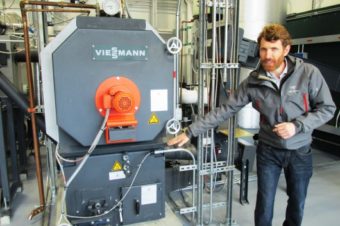
Andrew Haden of Wisewood Inc Ketchikan-Airport biomass boiler
Andrew Haden of Portland-based design firm Wisewood, Inc., explains how the Ketchikan Airport’s biomass boiler works. (Photo by Leila Kheiry/KRBD)

Pretty much everyone attending Ketchikan International Airport’s boiler-room ribbon-cutting on Friday remarked on how clean the space is. The new biomass wood pellet system also is whisper quiet, environmentally friendly and, officials said, will save the Ketchikan Gateway Borough money in the long term.

“We’re really excited about this airport biomass heating project, which is why you’re all here. I hope. If not, your plane just left, joked Ketchikan Gateway Borough Mayor David Landis.

But then he quickly focused on the bottom line:

“This new biomass boiler system replaces a unit that was oil-fired and was 43 years old and very costly to maintain,” he said. “These heating costs for this unit will be reduced by about 40 percent, we expect.”

The project was almost entirely grant funded. With the help of state and federal grants, Landis said the borough’s cost for the nearly $1 million project was about $50,000.

The airport’s new boiler room is also really, really clean.

“You could do surgery in here,” joked one attendee.

Well, maybe it’s not quite that clean, but the former fish-storage building next to the airport terminal is bright, freshly painted and toasty warm.

Unlike other boiler rooms, this one needs to remain visually appealing because it’s going to be an ambassador, of sorts. A large window at the front of the building will allow anyone coming through Ketchikan’s airport to see the biomass system, and an informational sign will let the visiting public know what it is, and why it’s important.

So, why is it important?

“We’re just so proud of this project because it’s an example of how you can create a regional economy,” said Devany Plentovich is program manager for biomass and heat recovery with the Alaska Energy Authority, which was the primary funder of the airport’s new boiler.

Ketchikan airport biomass boiler silo
The Ketchikan Airport’s new biomass boiler’s wood pellet silo is outside the boiler building and feeds pellets directly to the boiler as needed. (Photo by Leila Kheiry/KRBD)

“We have local pellets that are supplying a very high-profile project, with the airport,” she said. “People will be able to see this as they’re traveling through the city. Maybe we can expand biomass even more in the state.”

Bob Deering is the region’s renewable energy coordinator for the U.S. Forest Service, which also helped get the airport project going. He said Ketchikan is a leader statewide in biomass.

“You guys are pretty much the only ones that have your own fuel refinery – a pellet mill – in the state. You’ve got a forest products mindset for utilizing forest products in Alaska,” he said. “You have more biomass boilers than any other community in the state, I believe. You’ve got the federal building, you’ve got the library, you’ve got this flagship project here.”

Deering also notes that wood fuel is considered environmentally clean. The pellets, provided by Ketchikan-based Tongass Forest Enterprises, are made from wood waste. Deering said wood is a plentiful, carbon-neutral heat source, and the ash created from burning pellets could be used in a garden. And, he said, spilling this fuel isn’t a big deal.

“I’ve spent a lot of my career cleaning up fuel spills. It’s expensive,” he said. “If you guys have a fuel spill here, you’re going to use a dustpan to clean up your fuel spill.”

Ketchikan Biomass Ribbon cutting
Penny Pedersen of Sen. Lisa Murkowsi’s office, borough Mayor David Landis and Devany Plentovich of Alaska Energy Authority cut the ribbon on the Ketchikan International Airport’s new biomass wood pellet boiler. (Photo by Leila Kheiry)

The airport project is the first of two biomass conversions that the Ketchikan Gateway Borough started working on a few years ago. The other one will be at Ketchikan High School.

Plentovich said that project has been recommended for Alaska Energy Authority grant funding, but – considering the state budget crunch – the money isn’t there right now.

“But it is a very, very solid project and we need to figure out how we can get it to move forward,” she said.

And when it does happen, you can be sure there will be a ribbon to cut.


Site notifications
Update notification options
Subscribe to notifications