
KRBD - Ketchikan

KRBD is our partner station in Ketchikan. KTOO collaborates with partners across the state to cover important news and to share stories with our audiences.
Ketchikan assembly postpones vote on retail marijuana tax, sales tax cap measures

Ketchikan Gateway Borough Assembly voted to postpone measures on a retail marijuana tax and a sales-tax cap increase during session Monday.
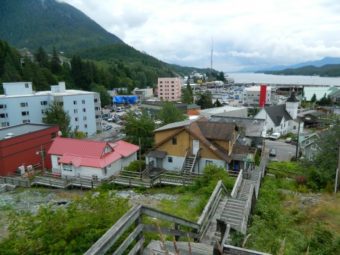
A view of Ketchikan from the top of the Edmonds Street stairs. Ketchikan Gateway Borough Assembly voted to postpone measures on a retail marijuana tax and a sales-tax cap increase during session Monday.

After lengthy discussion Monday, two tax items on the Ketchikan Gateway Borough Assembly agenda each were postponed: an increase to the sales tax cap and a tax on retail marijuana.

The retail pot tax discussion is an item that carried over from the second meeting in July.

During that meeting, an ordinance that called for a marijuana sales tax of up to 10 percent was sent back to borough management with direction to link the additional tax to the potency of marijuana products, such as concentrates and edibles.

When it returned to the Assembly, though, there was lengthy discussion about how complicated the borough’s excise tax should be.

Assembly Member John Harrington suggested indefinitely postponing the measure and asking borough management to come back with another, simpler ordinance calling for a 5 percent excise tax on retail marijuana.

That motion passed 4-3, with Mike Painter, Alan Bailey and Stephen Bradford voting no.

Glen Thompson, though, added that he’d like some options with the new ordinance, including an additional excise tax related to potency.

“I think there’s some validity to an additional excise tax on potent products that can be a danger to children, and we’ve seen this in places in Colorado where toddlers pick up something they think is a candy bar and wound up in the hospital,” Thompson said. “An additional excise tax on those types of products to dissuade their use is probably warranted.”

The assembly also discussed and ultimately postponed a proposed increase to the sales-tax cap on single-item purchases, which has remained at $1,000 for about three decades.

The original proposal tripled the tax cap, but during the second meeting in July, the motion’s co-sponsor Bill Rotecki asked that it be lowered to $1,500, and adjusted to inflation every five years.

The tax increase still wasn’t a popular proposal. Local business representatives spoke during public comment against raising the tax cap, stating that they compete against big-box online stores that offer free shipping, so taking away this small advantage could affect their sales.

Hannah Ramiskey of Schmlock Mechanical said it’s in the community’s interest to help local businesses, and not provide more incentive to shop online.

“They don’t provide any services here. They don’t give money to your children,” Ramiskey said. “They don’t provide employment for your workers here. As retail gets smaller and smaller and smaller in Ketchikan, those are jobs that are gone. That is money donated through all of those stores – to donations to this community — and it’s harder and harder.”

Rotecki questioned whether someone would choose to buy online rather than locally over about $30 – which is the extra sales tax they would pay if the tax cap jumped to $1,500.

Rotecki’s argument in favor of raising the tax cap is that leaving it as is means a greater percentage of taxes comes from smaller-item sales, putting more of a burden on lower-income residents.

But, with an apparent majority on the Assembly opposed to raising the sales-tax cap, he suggested not raising it, but still adjusting it to inflation every five years.

“The inflation thing is a very minimal increase,” Rotecki said. “I don’t know that this (assembly) body would have the nerve to do anything and I think that doing nothing is really wrong, so I propose that we do something, which is inflation-proofing.”

That amendment passed, with Painter, Thompson and Bailey voting no.

But then, Thompson proposed postponing the whole thing indefinitely. He argued that the conversation was premature, and the Assembly needs to have a wider discussion about taxes in general.

That motion to postpone passed 6-1 with only Rotecki voting no.


Troopers investigate death of Prince of Wales woman

A Hydaburg woman died Sunday in a wooded area near Klawock on Prince of Wales Island.

According to the online Alaska State Troopers dispatch, Troopers learned of the woman’s death a little after 5 p.m. Sunday. The woman’s identity has been tentatively released as Jodylee Guthrie, 27, and next of kin were notified.

The body has been sent to the State Medical Examiner’s Office in Anchorage for an autopsy and to confirm the identification.

The death is under investigation.

Ketchikan assembly will consider sales tax cap, marijuana tax

Ketchikan Gateway Borough Assembly will consider two tax proposals on Monday.

One proposal would raise the sales tax cap on single-purchase items from $1,000 to $1,500; the second would establish a boroughwide marijuana excise tax.

Raising the sales tax cap was proposed during the Assembly’s last meeting, but the original idea was to raise it to $3,000. That would have meant single-purchase items of large value, such as vehicles and appliances, would be taxed up to $3,000, but not beyond that price. The tax cap has been $1,000 for many years.

The majority of the borough felt that tripling the tax cap was too much all at once, and voted to change the amount to $1,500 for now, but to also allow the tax cap to adjust with inflation. The measure is returning to the Assembly on Monday for a public hearing and second vote.

Another part of the original proposal was to exempt the first $500 of residential rent from sales tax. That portion will come back to the Assembly on Aug. 15th.

A vote on the marijuana tax was postponed from the Assembly’s last meeting after a suggestion that the borough tax pot based on potency.

Marijuana products such as edibles and leafy pot still would be taxed based on price, according to the revised ordinance.

Products would be taxed an additional amount based on potency.

If the measure is approved as written, all retail marijuana would be taxed between 5 percent and 10 percent of the retail price, in addition to the regular sales taxes. On top of that, marijuana concentrates and edibles would be taxed between 5 and 10 cents per milligram of THC, which is the active ingredient in pot.

If approved by the Assembly, the tax would still need to be ratified by voters.

Monday’s Assembly meeting starts at 5:30 p.m. in Borough Assembly chambers at the White Cliff building. Public comment will be heard at the start of the meeting.

Murkowski on primary campaign tour of Alaska

Sen. Lisa Murkowski (KRBD file photo)
Sen. Lisa Murkowski is making a campaign trip around Alaska during the Senate recess. (KRBD file photo)

Alaska’s Sen. Lisa Murkowski is on a campaign trip around the state during a month-long Senate recess.

During a brief layover Wednesday in Ketchikan on her way to Sitka, she talked about the state’s Republican primary campaign, and about the presidential election.

Alaska’s primary election is less than a month away.

On Aug. 16, registered voters will go to the polls and choose which candidates they want to see on the November ballot.

Sen. Lisa Murkowski will be on the Republican primary ballot, along with her competitors, Paul Kendall and Thomas Lamb of Anchorage, and Bob Lochner of Wasilla.

Murkowski vividly recalls her last re-election six years ago, when she lost the primary and then launched a successful write-in campaign. While that worked, she doesn’t really want to do it again.

“I had, I think, what we would all recall as a rather tumultuous election back in 2010, and some people have said, ‘Well, we haven’t heard from your other opponents; things must just be fine.’ We certainly are working to make sure that things are fine, but certainly not taking anything for granted,” she said

Murkowski said she’s focused on reminding constituents of the Alaska issues that she’s worked on, such as access to land, developing energy resources, healthcare, substance abuse, and financial support during a state budget crisis.

“It’s a tough time in the state right now — I think we all recognize that,” she said. “So part of what I view my role and responsibility back in the Senate is to do everything that I can to provide some stability, and clarity and predictability at the federal level.”

Murkowski said that Alaska’s capital budget this year is more than 85 percent federally funded projects. She wants to keep those funding sources stable.

“So, whether it’s a six-year highway bill, so that we know what that flow of money is going to look like; whether it’s the PILT monies, secure rural schools, of course, very, very important down here in Ketchikan,” she said.

Secure Rural Schools and federal Payments in Lieu of Taxes, or PILT, are meant to help communities make up, at least in part, the loss of property taxes from the vast amount of federal land within their borders that can’t be taxed. This year, the Ketchikan Gateway Borough received about $1.1 million through the PILT program.

Murkowski said she skipped the recent Republican National Convention because she wanted to focus instead on touching base with her constituents, and she has only 30 days to reach as many as possible.

“In the past 10 days or so, I’ve been up on the Yukon, up on the Kuskokwim, up in Fairbanks, down on the Kenai Peninsula, I was in Petersburg yesterday, Wrangell this morning, I’m gonna be in Sitka this evening, going up to Anchorage and Fairbanks and the Mat-Su Valley over the weekend, and then Kotzebue and Nome. So, I’m everywhere,” she said.

While she didn’t attend the GOP convention, Murkowski said she has been paying attention, and there’s plenty to consider from both the Republican and Democratic conventions.

“I do think that it is interesting that we’re moving forward, as Republicans and Democrats, with two nominees who, if I understand correctly, are probably the least-liked nominees in recent political history,” she said.

Murkowski said she’s already familiar with Hillary Clinton, the Democratic nominee, who is a former U.S. senator and secretary of state.

“And, as an Alaskan coming from a resource-production state, she has made clear that the policies that she holds on energy and I think resource production generally would make it very difficult for our state,” Murkowski said.

Murkowski said she’s less familiar with Republican nominee Donald Trump.

“You got three, four months here to figure it out, but I’m worried that the choices that we have in front of us as a nation are ones that lack the enthusiasm that I would like to have in our national candidates,” she said.

So, since her own Senate write-in campaign was successful six years ago, would Murkowski consider a write-in campaign for U.S. president?

“No way! No, no, no,” she said, laughing. “I am happy to be able to represent the people of Alaska in the United States Senate. That, in and of itself, is a big enough job. We’ll leave that to others to take on the White House.”

In addition to her two Republican primary opponents, other candidates are seeking Murkowski’s seat on the Senate.

Democrats running in the primary are Edgar Blatchford and Ray Metcalf, both of Anchorage, and Cean Stevens, an Anchorage Libertarian, according to the state Division of Elections’ website.

At one point, Murkowski also faced Anchorage Mayor Dan Sullivan on the Republican ballot, but he has since withdrawn.

U.S. Senate candidates who will not be on the primary ballot, but will be on the general ballot in November are Breck Craig of Anchorage, Ted Gianoutsos of Anchorage, Sidney Hill of Palmer, Margaret Stock of Anchorage, Bruce Walden of Wasilla and Jed Whittaker of Anchorage.

Wellness center hires Ketchikan teens to help promote drug-free lifestyle

A Ketchikan assemblyman is proposing the borough issue vouchers to allow students to choose private or public school. (Photo from KRBD)
Ketchikan Wellness Coalition will hire high school students to promote drug-free activities and serve as peer counselors. (Photo from KRBD)

A new substance-abuse program will be implemented at Ketchikan High School this year.

The Ketchikan Wellness Coalition, or KWC, received funding through the federal Drug-Free Communities grant program to hire high school students as peer counselors and leaders. The students work with staff to develop programs and activities promoting a drug-free life and supportive relationships.

Incoming senior Rachel Winburn said promoting a drug-free life will always be included in program activities, but an upcoming session will focus on identifying adult mentors.

“This upcoming one is more along the lines of helping these kids move forward successfully in their lives by having different ties with different people that they can rely back on, not just their parents,” she said. “Family members, coaches, teachers, other people that they can rely on.”

KWC executive director Kevin Gadsey said studies show having a web of support of at least five adults is important for keeping students drug-free, and teen mentors are key in developing effective communication.

“In the office, I think we’re all 40 or older. We don’t know the ways,” he said. “Rachel has already educated us on Snapchat and some of the other snap-related marketing abilities.”

Specifics for the program still are under development, according to Gadsey. He hopes much of the messaging will be created by the student workers, with KWC staff providing support and direction.

A part of the grant requires putting together an activity group of teen leaders. Gadsey said the vision is a counsel of councils.

Vince Tenebo, a junior and another student hired for the program, stays active in sports. He hopes to attract sports groups, and others, into the program to join the council.

“It’s going to create ties and that’s going to lead to connection where we really can control each other,” Tenebo said. “Get away from drugs and really move forward in high school without using drugs or alcohol while having fun.”

Gadsey says this the second year of a 10-year grant, and KWC hopes to continue the in-school program in future years.

Ketchikan School Board OKs abuse/assault program policy

A Ketchikan assemblyman is proposing the borough issue vouchers to allow students to choose private or public school. (Photo from KRBD)
Ketchikan High School (Photo from KRBD)

The Ketchikan School Board quickly approved a new policy Wednesday establishing programs to help reduce child abuse and sexual assault.

There was no discussion before the unanimous roll-call vote in favor of the policy, which calls for age-appropriate information for students in all grade levels to teach about appropriate conduct, and resources available for students.

The program also will provide information for dating-age students about healthy and respectful relationships, and the warning signs of abusive behavior. Teachers will receive training to not only present the information, but to identify students who may be victims of abuse.

The policy includes an opt-out measure for parents who don’t want their children to participate.

Also Wednesday, the Board heard from Revilla High School principal Kurt Lindemann about the school’s summer program. He said 42 students showed up to recover missed credits from the previous year.

“We had 15 who were Kayhi (Ketchikan High School) students who recovered 32 half-credits,” he said. “We had six kids from Schoenbar who worked on seven different classes. We had three kids from Fast Track who completed four credits, and we had 18 kids from Revilla who completed 27 credits.”

Lindemann said this sort of credit-recovery program helps students catch up, and stay in school.

The board spent a long time discussing a brief sentence in Superintendent Robert Boyle’s report. In his suggested strategic plan, he mentioned a policy that would allow students to skip one year of high school.

Boyle expanded on that idea during the meeting, explaining that the students would have to earn the proper credit through a high school equivalency test.

The district already does offer early graduation through several avenues. This program, though, would allow students to fulfill their graduation requirements and then stay in school to enhance their post-secondary education.

“If you’re really cooking, then you may want to take all AP classes,” Boyle said. “They could graduate earning $15,000-$20,000 a year while they’re in high school. Meaning that you can skip so many credits, even potentially your entire freshman year of college. It’s worth a lot of money for you to have dual credit and all those types of things that are possible through the AP classes.”

AP classes are Advanced Placement, and often can count for college credit.

The Board directed Boyle to bring back additional information for the next meeting.

Also Wednesday, the School Board approved a contract with Tatsuda’s IGA to provide milk for the district lunch program. That grocery store was the only bidder for the contract.

The next Ketchikan School Board meeting is Aug. 10.

Site notifications
Update notification options
Subscribe to notifications