KRBD - Ketchikan

KRBD is our partner station in Ketchikan. KTOO collaborates with partners across the state to cover important news and to share stories with our audiences.
A cannery in Southeast Alaska is at the forefront of America’s tinned fish renaissance

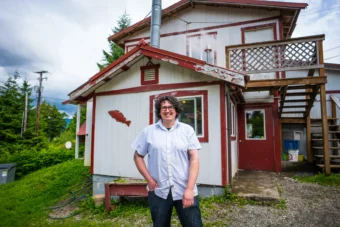
Owner Mathew Scaletta stands in front of Wildfish Cannery in the village of Klawock on Prince of Wales Island. (Bethany Sonsini Goodrich)

Wildfish Cannery was founded in Klawock, Alaska in the late 1980s by a school teacher named Phyllis Mueller. Her grandson Mathew Scaletta is at the helm these days.

Scaletta is passionate about food. He spent summers cutting fish at the cannery as a kid and then cut his teeth in the culinary world in Chicago and Portland. While working everywhere from bars to fine dining restaurants, he noticed something.

“Places were importing Spanish and Portuguese canned fish. It was kind of quietly becoming a thing,” Scaletta said. At the time, he said, canned salmon stateside was cheap – probably better for stocking a fallout shelter than a charcuterie board.

Then, Scaletta said he saw something that changed everything: an episode of Anthony Bourdain’s show “No Reservations.”

In the episode, Bourdain visits Espinaler Taverna, a tavern in the Spanish seaside town of Vilassar de Mar. The bartop is lined with dozens of bowls of oily little fish, smoked oysters, and cured seafoods.

Bourdain samples a can of razor clams that his guide tells him costs more than $150 USD.

‘Rest assured this stuff bears no resemblance to the can of smoked oysters you ate stoned and desperate back in college,’ Bourdain narrates over the din of the packed tapas bar. ‘This is the world’s best seafood and here’s what’s so mind blowing: it only gets better in the can.’

“It kind of blew my mind to see that, right? And it stuck with me,” said Scaletta.

In 2015, Scaletta’s grandmother Phyllis was diagnosed with cancer. He came home to Alaska and took over the cannery.

Scaletta said he saw a hole in the market.

“So I set out to be the first U.S.-based highend craft cannery. And we’re still there,” he said. “I’m still working on that.”

Wildfish’s garlic sumac rockfish or smoked coho go for about $10-$14 a can. The most expensive offering is a $40 can of fried king salmon cheeks. Since Scaletta started smoking salmon for the slightly spendier masses, tinned fish is officially on the map in the U.S. But he doesn’t take credit for that.

“There were other companies who came in after us, who, frankly, just had a lot more money,” he laughed.

According to Scaletta, the business – and tinned fish in general – really took off in the United States in 2020. The Wall Street Journal reported that in 2022, U.S. sales of canned seafood rose by nearly $3 billion and are still growing annually. Scaletta said he hopes to soon expand to a second cannery in Klawock. He said it’s hard to keep his more popular products in stock, nowadays, maybe partly due to some significant national attention on his company.

Marguerite Preston edits the kitchen section of Wirecutter, a product review outlet from the New York Times. As the editor, Preston doesn’t normally do the actual reviewing, but she said she really wanted to write a guide to tinned fish.

“Obviously, tinned fish has been around in all kinds of forms for centuries. In many cultures, it’s never gone out of style. But in America, it’s becoming trendy,” she said, adding that she’d been seeing sleek new brands of canned seafood everywhere. “I would say in the past maybe three years, maybe a little bit longer, we’ve just seen this growing interest, these trendy new brands, this beautiful packaging.”

Preston and her team collected over 100 different tins, jars, and cans of fish from Europe, Asia and the U.S. and laid them all out on the counter of their office in Brooklyn. They grouped the fish into categories and split up the tasting over three days.

“And then we just kind of went at it and felt really pretty ill at the end of each day to be honest,” she laughed.

Preston published her findings on Wirecutter’s website in December. The guide is like an Olympics for tinned fish, with each category crowning a world champion. Preston said when it came to sampling salmon, the unanimous favorite was Wildfish Cannery.

“I think the thing that stood out the most was the texture, it just had the most buttery, meaty, succulent texture. And then the flavor was really good too – the level of smoke. You can tell just by looking at them. They have this beautiful, kind of burnished look on top,” Preston said of Wildfish’s smoked king and sockeye salmon.

Scaletta said it was thrilling to see his small cannery getting national press. The art of canned fish isn’t a “new trend” to an Alaskan though. The state’s culture of home canning was a major inspiration for Wildfish.

“One of the most precious things an Alaskan has in your pantry is your home-pack – like your smoked and jarred salmon, right?” Scaletta said. “This is about taking what we already had, which was this culture of home-pack, and the idea of a jar of smoked salmon being elevated, and kind of bringing that to the masses.”

As tinned fish solidifies itself as a high class snack, Wildfish is going to continue to do what Alaska canneries have always done according to Scaletta – buying high-quality fish from local fishermen and canning it for the masses.

Delta pulls out of Ketchikan and Sitka, leaving Alaska Airlines as the only major carrier

Delta's first flight of the summer season touched down in Juneau at 8:49 p.m. May 30 with 120 passengers from Seattle. (Photo by Heather Bryant/KTOO)
A Delta Air Lines flight touches down in Juneau. (Photo by Heather Bryant/KTOO)

Delta Air Lines has pulled its bookings for summer flights to both Ketchikan and Sitka, a seasonal service it had offered for nearly a decade. That leaves Alaska Airlines as the only major carrier in the two communities.

Scott Habberstad oversees community relations for the Alaska market of Alaska Airlines. During a Ketchikan Chamber of Commerce luncheon days after Delta’s Jan. 11 pull-out, Habberstad gave a presentation and took questions from the audience.

Habberstad said he was disappointed to see his competitor go.

“I love the fact that Delta was here, because competition makes you better, right? Really does,” he said.

But Habberstad was adamant that losing Delta would not affect the cost of flights in and out of Ketchikan.

“The fares will be the same as they were last year, as they were this year, and they’ll be the same next year,” Habberstad said. “We’re not here to gouge, we’re here to stay.”

Since 2015, Delta had been offering once-daily flights connecting both Ketchikan and Sitka to Seattle during the busy summer months. As the carrier has expanded its hub in Seattle, it has increasingly challenged Alaska Airlines’ dominance in its namesake state. That competition has meant lower prices for customers.

Scott McMurren, the long-time publisher of the Alaska Travelgram newsletter and travel columnist for the Anchorage Daily News, tracks the price of Alaska flights for a living. He said each time Delta has entered a city previously dominated by Alaska Airlines, prices have dropped.

And since Delta pulled its seasonal flights in Ketchikan, McMurren said Alaska Airlines’ prices already look to be substantially higher for the upcoming summer than they were last year.

“It’s important to just understand that when there is a monopoly in the market, prices drift up,” he said. “And this is not exclusive with Alaska Airlines, Delta does the same thing. All airlines do the same thing.”

But Habberstad insists Alaska Airlines does not intend to raise prices. In a phone call with KRBD, Habberstad said that the apparent increase could be due to sale pricing.

“It’s possible that there was a sale fare in the market, a special sale fare, for some reason when you were looking at it, and there may not be a sale fare today,” he said.

As for Delta, the Sitka and Ketchikan flights apparently just weren’t getting enough passengers to pencil out. In a statement sent to KRBD, a Delta representative said to better meet demand, those aircraft are being reallocated to Bozeman, Montana, “a market with strong year-round demand from Seattle.”

But the airline is continuing to expand in the state’s biggest cities. Delta has recently added a new route from Fairbanks to Salt Lake City and from Anchorage to Los Angeles.

‘World’s largest undeveloped gold mine’ faces legal challenges from Canada and Alaska tribal nations

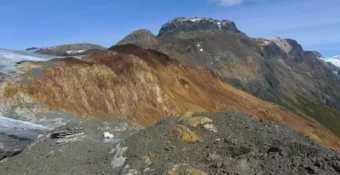
Oxidized rock colors a ridge above where one of Seabridge Gold’s KSM project’s open pit mines is being dug, from the KSM Project’s Prefeasibility Technical Report. (Seabridge Gold)

A major Canadian mining prospect upstream from Southeast Alaska is drawing legal challenges from both sides of the border, as tribal groups fear the project could pollute their ancestral waterways.

At the river’s mouth

The Southeast Alaska Indigenous Transboundary Commission, or SEITC, is worried about the region’s rivers. The commission represents 15 Tlingit, Haida, and Tsimshian nations that came together because they believe mining in British Columbia poses a threat to their spawning salmon and hooligan habitats, like the Unuk and Stikine Rivers.

The transboundary commission’s attention is currently on the Kerr-Sulphurets-Mitchell project, a proposed gold and copper mine at the foot of a glacier just across the Canadian border.

“KSM is on a whole other scale of mining, one of the world’s largest open pit mines, if it’s ever built,” said Guy Archibald, SEITC’s director. “Our tribes and communities are directly downstream. We rely on fish and the food security opportunities that the Unuk provides.”

The KSM Project is being developed by Seabridge Gold. According to the Canadian exploration company, the mine could generate nearly 1,500 jobs and over $30 billion in Canadian dollars for British Columbia and $60 billion Canadian for the nation over its projected lifespan of about 60 years.

Archibald weighs the stakes differently.

“Billions of tons of acid-generating waste rock just piled into valleys,” he said. “Valley fills in direct tributaries to the Unuk River. And so it’s almost inevitable that bad things are gonna happen.”

Mine tailings are the materials left over from the mining process, like acidic rock waste, undesirable metals, and the chemicals and discharge from processing the ore. All of this waste is stored in tailings facilities or dammed ponds until it can organically break down. According to the U.S. Environmental Protection Agency, many decommissioned mine tailing facilities are designated as Superfund sites.

Archibald cited the Mount Polley disaster, a 2014 failure at another mine in British Columbia that is widely referred to as one of the worst mining disasters in Canadian history. Canadian news outlet The Narwhal reported that KSM’s tailing ponds would be around 28 times the size of the one that failed at Mount Polley. SEITC estimated that KSM’s tailings ponds would require ongoing maintenance for at least 250 years, long after the mine shutters.

Tazia Wagner holds a pair of hooligan. (Jack Darrell/KRBD)

A voice in the process

In July, the British Columbia government issued a finding in the permitting process for the project known as a “Substantially Started Determination.” Under British Columbia’s law, environmental permits for development projects like mines come with an expiration date. According to the British Columbia Environmental Assessment Office, that’s partially because the environmental assessment process is constantly evolving – i.e. new science, new information, new regulations. Once a mine reaches a certain stage in development, though, the province can declare that it is far enough along and has met the environmental permitting requirements to move forward without its environmental “stamp of approval” lapsing.

Part of that environmental assessment process involves public comment and “a legal obligation to consult with Indigenous nations whose interests could be affected by the outcome of a substantially started determination.”

“And yet, the Alaska tribes are not really afforded any kind of voice in how this process works out. So we are trying every way possible to try to be sure that our communities are protected,” said Archibald, alleging that tribes in the transboundary commission weren’t afforded a meaningful seat at the table in that process.

In late November, the transboundary commission and SkeenaWild Conservation Trust filed a legal challenge against the British Columbia government. They’re represented by the Canadian law firm EcoJustice and are arguing that the mine was “rubber stamped” – challenging the premise of the province’s decision that the mine is “substantially started.”

The KSM mine received its environmental assessment a decade ago. EcoJustice attorney Rachel Gutman said that the process has changed since then and the province has a “deeper understanding of a rapidly changing climate” and “threats to salmon populations.”

“There are good reasons why the law has expiration dates for environmental assessments, including ensuring that mega projects like the KSM mine do not proceed based on outdated information,” Gutman said in a press release. “This is particularly important in this case due to the rapidly changing climate in Northern BC.”

The challenge also alleged that the province specifically considered whether the “substantially started determination” would help the mine in its timeline to secure outside funding when it issued the determination.

“We believe it is inappropriate for the (British Columbia Environmental Assessment Office), the agency tasked with assessing the environmental impacts of a project, to consider how their decision might support a company with project funding,” said Greg Knox, the executive director of SkeenaWild.

R. Brent Murphy is Seabridge’s Vice President of Environmental Affairs. In an email to KRBD, he wrote that Seabridge’s legal counsel are preparing to defend the validity of British Columbia’s determination. In his view, the Southeast Alaska tribal commission’s “ultimate goal is to halt all mining and exploration activities in the transboundary region.”

Murphy claimed that mining projects like the KSM aren’t responsible for declines in salmon and hooligan habitats. He chalked them up instead to “changes in ocean conditions, declines in quantity and quality of spawning habitat, and overfishing.”

Seabridge Gold’s Brent Murphy points to a valley to be dammed to hold tailings from the KSM mine during a July tour. The project has won federal environmental approval. (Ed Schoenfeld/ CoastAlaska)

“There is also a misconception that Alaskans were not engaged during the (environmental assessment) process of the KSM Project,” Murphy said about the transboundary commission’s challenge that tribes weren’t properly consulted in the process. “On the contrary, the BC Environmental Assessment Office actively receives input and feedback from Alaskan regulators, tribal groups, and the Alaskan public for any mining project undergoing the EA process within the transboundary region.”

For Archibald and the transboundary commission, though, those requests for feedback amounted to an empty promise. He called British Columbia’s consultation process for Alaskans “everything short of being meaningful or consent-based at all.”

SEITCs challenge, as well as its recent petition to an international human rights commission, hinges on its demand to be afforded the same sway in the consultation process as Canada-based First Nations, a request that has been categorically denied by both British Columbia and the larger Canadian ministry.

There is Canadian legal precedent for U.S.-based tribes to be afforded the same rights to consultation as First Nations protected under the Canadian constitution. That precedent is R. v. Desautel, a 2021 Canadian Supreme Court finding. An indigenous American citizen was tried in Canada’s courts for killing an elk in British Columbia without a hunting license. The defendant lived on a reservation in Washington and argued that he was exercising his Aboriginal right to hunt in the traditional territory of his ancestors.

As Archibald put it, the case forced the Canadian Supreme Court to ask a central question: “Do indigenous, non-resident people of Canada – people who live outside of Canada but have ties to traditional lands within Canada – have any rights to those lands? And the Supreme Court said yes.”

“Given the complex nature of an ecosystem, a productive ecosystem, like the Unuk watershed, and the complex nature of one of the world’s largest mines, what the outcome of that is going to be if it moves forward, is really anybody’s guess,” said Archibald.

In a September opinion piece in the Anchorage Daily News, Murphy struck back at the legal challenge and its supporters categorizing Canada’s decision as a “rubber stamp,” saying that Seabridge had already sunk roughly $1 billion in Canadian dollars into the project which constitutes substantial progress. He also challenged what he called “widespread misinformation” surrounding the mining industry.

Murphy said that the KSM project met British Columbia’s three main criteria for a “substantial start determination” – work had begun on the mine, the company had spent significant money on construction, and it had received “the support of our First Nations partners.”

The headwaters

The Tsetsaut Skii km Lax Ha Nation is an Indigenous First Nation in British Columbia that borders the KSM site.

In November, it filed its own legal challenge against British Columbia. Ryan Beaton, who provides legal counsel for the nation, said that the KSM project’s proposed tailings facility is on the nation’s land and the province didn’t properly consult with them either before “essentially greenlighting” the project.

“If we’re going to go ahead with this permitting, and this is going forward, where’s the consultation? Where are the funds to deal with the environmental damage from this?” Beaton asked.

Beaton described Tsetsaut Skii km Lax Ha as a small tribal nation “surrounded by larger, more powerful or more connected First Nations neighbors.”

Those larger First Nations surrounding the Tsetsaut Skii km Lax Ha’s traditional territory are the Tahltan and the Nisg̱a’a. And both nations publicly support the mine.

If the KSM project is built, Seabridge envisions three open-pit mines that will feed a processing facility and a tailings facility to store mine waste. Seabridge anticipates those mines could produce at least 47 million ounces of gold and 7 billion pounds of copper over their lifespan.

“The concern is a huge amount of toxic waste flowing out onto the territory, into the waterways, destroying the fishing for the nation, affecting wildlife,” he said, explaining the nation’s concerns if one of the dams at the tailing facility failed.

The KSM project’s mine site layout during the operation phase, from its environmental assessment certificate application. (Seabridge Gold)

For Beaton and the Tsetsaut Skii km Lax Ha, even if all goes according to Seabridge’s plan, some of the damage has already been done.

“Just the construction of the project on its own terms, if everything goes well, has had a huge impact on their hunting territories, their traditional ways of life, huge swaths of forest cut down, so there’s already been major impact,” Beaton said.

The KSM project has also caused particular friction between the Tsetsaut Skii km Lax Ha and their First Nations neighbors. That’s because Beaton said if the project moves ahead, gold and copper aren’t the only things that will be flowing out of it – so will huge sums of money to the Tahltan and the Nisg̱a’a.

The Tahltan and the Nisg̱a’a both signed agreements with Seabridge over the last decade. Publicly, Nisg̱a’a Nation President Eva Clayton has said that projects like Seabridge’s KSM stand to attract investors to First Nations territories in the Golden Triangle and “improve the quality of life of our Nisg̱a’a and Tahltan people.”

Recently, the two nations announced a partnership to “maximize joint opportunities on the Seabridge KSM Project.”

“On behalf of both the Nisg̱a’a Nation and the Tahltan Nation, I would like to acknowledge Seabridge for their support and encouragement,” Tahltan Nation Development Corporation Chair Carol Danielson wrote in a statement at the time, “and their willingness to actively engage and work with our Partnership on their KSM project, the world’s largest undeveloped gold project.”

Neither Tahltan nor Nisg̱a’a leadership responded to requests for comment.

Beaton compared the tailings facility dispute to hearing there was a big construction project happening in your neighborhood and then finding out “all the toilets for the project were going to be built in your backyard while the money flowed elsewhere.”

“When the (KSM project) is over, the Nisg̱a’a and Tahltan get to go home and the Skii km Lax Ha, this small First Nation, is stuck with a huge waste facility on its territory, and that is not the way Indigenous consultation should go,” said Beaton.

The Tsetsaut Skii km Lax Ha aren’t strangers to mining, though. The tribe has worked with other mining projects in the past and recently signed an agreement with a different company for a neighboring mine.

“Our nation is certainly not anti-industry,” said Beaton, adding that the nation does see the benefits mining could have on the province and their communities. “But it’s got to be done responsibly and in a way that respects both the nation’s rights but also the environmental concerns that they have.”

“'(It’s) the ‘Asserted’ territory of the Tsetsaut Skii km Lax Ha,” said Seabridges’ R. Brent Murphy about the First Nation’s claim that it owns the land for the tailing facility. “While they have sought recognition of their ‘exclusive’ rights to this area, it is currently not recognized by the government.”

The federal government of Canada marks the site of the proposed tailings facility as traditional Tahltan territory.

In its legal challenge, the Tsetsaut Skii km Lax Ha allege that this comes from a complex history of misinterpreted treaties and shaky ethnographic accounts that essentially, as Beaton puts it, “writes the Skii km Lax Ha out of their own history on their own territory.”

This assertion is backed by a 2021 report from British Columbia’s Attorney General, as well as a 2017 environmental assessment of a different mine, that supports the Tsetsaut Skii km Lax Ha’s exclusive rights to the area where the tailings facility will be located.

“We’re not asking them to take our word for it,” Beaton said. “We’re asking the province to act on their own assessment.”

Similar to the legal challenge EcoJustice filed on behalf of Alaska tribes across the border, the Tsetsaut Skii km Lax Ha’s legal complaint is lobbied against the provincial government. According to Beaton, that’s because the small First Nation is alleging that the province officially recognized their territory but because of their size and their lack of support for the KSM project, their constitutional right to consultation was minimized.

“The province is really picking and choosing who gets rights, and that is not appropriate. It’s really colonialism in action,” said Karen McCluskey, Beaton’s co-counsel representing the Tsetsaut Skii km Lax Ha.

For Seabridge, the could-be world’s largest gold mine passed its comprehensive seven-year environmental review process and according to Murphy, the company plans to invest millions of dollars annually into ongoing water quality reviews. For him, the province’s determination just reflects that Seabridge has done its part in making sure the project is safe and sustainable. He also continuously pointed to the support of their Indigenous partners – the Tahltan and Nisg̱a’a – and how they’ve allowed the project to move forward on their ancestral lands.

“The benefits are flowing to neighboring First Nations, to the government, and to industry. You know, the Tsetsaut Skii km Lax Ha nation has said they would like to have no dump on their land. That’s their position,” Beaton said.

The ball is currently in British Columbia’s court to determine how long officials will need to respond to these legal challenges on both sides of the border. Beaton estimated the whole process could take about a year.

For the KSM mine, Seabridge is hoping to solicit a partner for the venture, another mining company big enough to build and operate a mine this scale. After that, the company anticipates construction on the mine would take about five years.

With Trump’s new pro-timber order, Alaska conservationists poised to rehash Tongass Roadless Rule

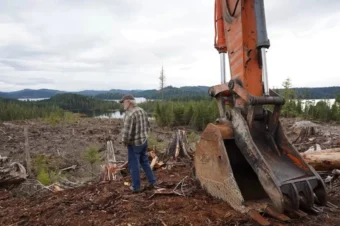
A Naukati Bay resident looks out over a clear cut northwest of his home on Prince of Wales Island in Alaska in September 2021. (Eric Stone/KRBD)

In the first two days of his new term, President Donald Trump signed more than 200 executive ordersOne was aimed at accessing more natural resources in Alaska. It attempts to roll back protections on over 9 million acres of Tongass National Forest, potentially opening them up for logging.

Trump’s executive order is titled “Unleashing Alaska’s Extraordinary Resource Potential.” The order alleges that restrictions on mining, logging, oil drilling and other resource extraction on Alaska’s federally protected lands is “an assault on Alaska’s sovereignty and its ability to responsibly develop these resources for the benefit of the Nation.”

The Tongass is the world’s largest remaining temperate rainforest. The Trump administration is seeking to rescind the Roadless Rule, which prohibits road construction and timber harvest on over 58 million acres of national forests across the country.

The Jan. 20 executive order won’t have any immediate effect on the ground. Normally, an executive order like this would kick off a lengthy public process with the U.S. Forest Service and its parent agency, the U.S. Department of Agriculture.

The Juneau-based Southeast Alaska Conservation Council has been fighting to keep most of the Tongass roadless for decades. Council Director Maggie Rabb said it’s hard to predict what this administration will do next.

“This president has proven to be unusual sometimes, and so we’re not sure,” she said. “It is possible they could just try to remove it and skip the public process.”

The Tongass covers most of Southeast Alaska and is the largest national forest in the country. The conservation council was formed in 1970 specifically to combat wide-scale, industrial old growth logging in the forest.

During his first term, Trump took action to exempt Alaska from the Roadless Rule, only to be reinstated by the Biden administration. Rabb said the rule has been rolled back and rolled forward by various presidents pretty much since its inception – but not without a fight.

“If they do remove the Roadless Rule, it would start – it could start new litigation that we would join to put the Roadless Rule back in place, and then we would be suing against the Forest Service,” she said.

The conservation council has been involved in litigation around the Roadless Rule off and on, but as the presidential administrations change, so do their legal allies.

“The parties on our side change whether we’re with or against the federal government,” said Rabb.

During the Biden administration, the conservation council was suing the State of Alaska on behalf of the federal government to support its protections of the Tongass. That case is now on hold.

It’s possible the current administration could completely remove the Roadless Rule in short order and begin fielding proposals for new logging roads through the forest.
“How quickly that happens is very much a question, because logging has not proven to be that profitable for quite some time,” said Rabb. “Why would you push to further grow a logging industry that’s costing the taxpayers money and supports less than 1% of our regional economy?”

Rabb referenced a 2020 report from nonpartisan federal watchdog group Taxpayers for Common Sense that found that the federal government was actually losing money on timber sales in the Tongass.

“These sales have consistently generated less revenue than the USFS spends to administer them, resulting in large net losses for U.S. taxpayers,” the report said, adding that taxpayers were subsidizing the region’s logging industry to the tune of $1.7 billion over the last 40 years.

Rabb said that the conservation council is not anti-logging. There is still active logging in the Tongass. For Rabb, the Roadless Rule has been an effective tool to protect old growth without actually ending logging.

“The push to roll back the Roadless Rule has very little to do with on-the-ground realities in Southeast Alaska or market demand, and it’s very much about external agendas that are disconnected from our region,” she said.

According to Rabb, the removal of the Roadless Rule has been a conservative talking point for years and was outlined in Project 2025, an infamous conservative policy roadmap for the Trump administration aimed at reshaping the federal government. Trump has at various times embraced the document and its architects and distanced himself from its ideological extremes.

“If you actually look at the language there, one of the reasons they articulate for getting rid of the Roadless Rule is that it ‘forces residents to rely heavily on a subsidized ferry system,’” Rabb said, referencing the Alaska Marine Highway System. “But I would love to have someone explain to us how removing the Roadless Rule would allow you to drive from Ketchikan to Sitka. It’s just preposterous. It has very little to do with our realities.”

President Donald Trump signs an executive order at the White House supporting natural resource development in Alaska on Monday, Jan. 21, 2025 in Washington. (C-Span screenshot)

Keith Landers has operated a small sawmill on Prince of Wales Island for the last 30 years. If you flown to Alaska in the last few years, you’ve probably passed beneath a wooden, mushroom-like sculpture in the N Concourse of Seattle-Tacoma Airport. Landers brags that his mill supplied the wood for that sculpture, as well as the cedar-planked ceiling above passengers’ heads.

He doesn’t think more logging in the Tongass is a bad thing.

“We need to be truthful about our forest,” Landers said. “This is a big forest. It grows over a billion board feet a year. No one’s going to clearcut the whole thing.”

Landers said he hasn’t had a winning bid for Tongass timber in two years because larger competitors outbid small mills for the limited inventory. Most of that wood, he said, doesn’t stay in Alaska.

“I’m really looking for an honest program, something that supports stuff besides outside influence,” Landers said. “Over the 30 years I’ve been here, nothing has been done. I have never felt like I have been supported by anybody.”

Landers said he’s glad for anything that would open more timber for his mill, but only if it prioritizes Alaskan operations and supplies locals first. As opposed to “more large corporations buying up the Tongass and shipping the lumber overseas.”

“I’ll be honest with you, under the first Trump administration, he rolled back the Roadless (Rule) and never did a darn thing,” Landers said. “We have to have a serious conversation about what we want to do with our forest and to create some jobs here because their word is worthless. It’s worthless. It’s not for local people.”

Landers hopes the new Trump administration can guarantee reasonably priced, sustainable Tongass lumber, without environmental groups like the Southeast Alaska Conservation Council taking them to court over each timber sale. But he’s not optimistic. For Landers, the rules changing every four years makes it hard to run his small business.

“We just can’t continue to have timber for four years and then under the next administration, have no timber at all. It just doesn’t work real well,” Landers said, adding that what the Tongass needs is a balanced timber program that both political parties can get on board with.

“That’s what I would tell Mr. Trump. I would say, ‘We got to have a forest plan that works and that’s guaranteed for people to invest,’” Landers said. He added that it’s a waste to spend millions of dollars on timber sales and logging infrastructure, “and then turn around and tear it down in four years. Don’t bother us.”

Landers recalled that when he first got into the logging business, there were “probably around 30 small mills” in Thorne Bay. Now, his mill is one of three. He said his children will inherit the mill when he retires but something has to change.

“This will continue to go on,” he said about the mill. “But I’m not putting my family through what I went through over the years. It’s been nothing but a dogfight with the environmental groups.”

Joel Jackson is the president of the Organized Village of Kake, an Alaska Native tribe located on Kupreanof Island in the heart of the Tongass. He’s been supporting the Roadless Rule since it was enacted, because he says the old growth trees it protects are essential for preserving their way of life.

“It took thousands of years to become what it is today,” he said. “The canopy of the old growth trees are spaced in such a way that it allows growth underneath the trees, and that’s where we collect our medicines and our berries and everything else that’s there.”

Jackson respects anyone trying to make a living – he worked in industrial logging himself during its heyday decades ago. But he’s also seen huge swaths of clearcut forest change the landscape.

“I’m not against anybody working, but, gosh, we got to be able to manage our resources better than what we’ve done in the past,” Jackson said.

“There is broad, sweeping support of keeping the Roadless Rule on the Tongass. And so I think our job is to bring those voices together again and show that we can have a healthy Southeast Alaska with the Roadless Rule here in place, and that it is an important tool that we don’t want to throw out,” said Rabb.

Trump hasn’t made his picks for who will lead the USDA or the Forest Service so he hasn’t formally staffed the agencies or roles that he’s giving direction to.

USDA spokesman Wade Muehlhof said in an email that they are in the process of reviewing Trump’s executive orders. Afterwards, he wrote, they’ll tell agencies how to implement them as soon as possible.

Washington state man dies while exploring abandoned mine on Prince of Wales

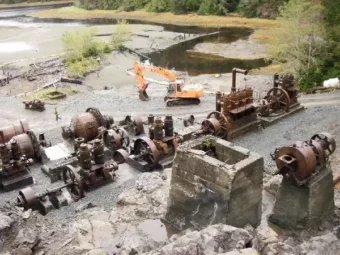
The U.S. Forest Service removed building debris and contaminated material from the Salt Chuck Mine site in 2011. The historical mining equipment was grouped in one area, seen in this October 2011 photo. (U.S. Forest Service)

A Washington state man died while exploring an abandoned mine on Prince of Wales Island last week, leading to an extended recovery effort.

Fifty-year-old Devin Albert was visiting his cousin in Klawock for the New Year’s holiday, and ventured out with a few other locals on Thursday, Jan. 2 to go rock hunting in the Salt Chuck Mine near Thorne Bay. The mine historically produced gold, silver, copper, and palladium from 1905 to 1941 and has since been designated as an EPA Superfund site.

While deep within one of the mine shafts, Albert suffered a medical emergency, which those with him believed was a heart attack. Alaska State Trooper Sergeant Rob Jensen said the man was having difficulty breathing, so the others in the group tried to assist him out of the mine.

“One particular area was a very steep climb,” Jensen said. “They were on their way out. The individual wasn’t really communicating verbally. They were assisting him along and shortly thereafter, he collapsed.”

Jensen said the group then attempted CPR on Albert for more than 30 minutes, but were unable to resuscitate him. He was presumed dead at that point, as he did not have a pulse and was not breathing. The rest of the group climbed out of the mine, but they weren’t able to carry Albert’s body with them.

By the time Troopers and Village Public Safety Officers arrived on the scene, it was dark and beginning to snow. Jensen said the entry point to the mine site looks like a 400-foot volcano, with a rope leading down from the rim to the mine shafts below.

“In order to go down in there and out, you need both arms, both legs to be working great,” Jensen said. “And be able to kind of hand-over-fist this rope coming out. It’s extremely sketchy, getting in and out of during daylight. Doing it at night time was a suicide mission.”

Troopers decided not to attempt a recovery that night but remained on scene and activated the Ketchikan Volunteer Search and Rescue Squad. Throughout Friday and Saturday teams descended into the mine using a helicopter, ropes and other equipment, but were unable to locate the body. On Sunday, Jan. 5, rescuers tried an alternate shaft entrance near the beach that extended nearly a mile into the depths of the mine, and they were able to locate and recover Albert’s body.

Jensen said there’s no foul play suspected, and that officials anticipate an underlying health issue to be at fault. But he said navigating the mine site is extremely stressful.

“I must emphasize that going in and out of there without the proper gear, training, you know, if somebody does get injured, you are looking at a very protracted time in order to get out of there,” Jensen said.

The body has been sent to the state medical examiner’s office in Anchorage to determine the official cause of death.

Students and teachers report a sharp decline in support for non-native English speakers in Ketchikan schools

Ketchikan High School is seen on the first day of school, Sept. 3, 2024. (Michael Fanelli/KRBD)

Rose Ann Bruce came to Alaska from the Philippines about a year and a half ago. Now she’s a junior at Ketchikan High School — and she is working on her English.

“As you can tell, my grammar is, like, not very good. But I’m trying because that’s not my first language,” she said.

Her first language is Tagalog. She speaks English carefully. Sometimes, when she’s saying something important, she’ll write it out in her phone’s Notes app and then read it.

Bruce said her grades are good, but assignments can be harder when you don’t know all of the words in the instructions. Plus, she feels like her peers and teachers have certain expectations.

“Like, ‘Oh, you’re in the U.S. You should know how to write an essay. You should know how to answer this,’” Bruce said. “But what if you can’t? What if you’re just learning?”

Bruce is not alone. The school district supports at least 84 students through its federally mandated English Language Learners’ program. But students and staff say that program has shrunk over the last several years, and that it no longer meets the needs of students trying to learn and navigate high school in a new language.

A Decline in Services

Six years ago, Ketchikan High School’s ELL program included five class periods taught by about half a dozen certified staff. Now, students who struggle with English are told to seek help from a teacher during study hall. But the need hasn’t changed — the number of high schoolers in the program is roughly the same.

Bruce’s friend Czarina Cabillo, also a junior, has lived through those changes. She came over from the Philippines when she was younger and has attended elementary, middle and high school in Ketchikan.

Cabillo said she had teachers and resources to help her with the language in elementary school, but not anymore.

“It didn’t exist in middle school for me,” Cabillo said.

Cabillo said she started to fall behind until, by her freshman year of high school, she felt completely lost. Like the other kids, she was assigned essays on Shakespeare.

“That’s when I started struggling more in English,” she said. “We lost our classroom, we lost our teacher, and then, technically, right now, it’s not even a class anymore,” she said.

Sarah Campbell has watched those changes, too. She’s been a teacher in the district for 20 years.

“You can say you have this program, but no, you’re not fooling me,” she said. “I saw what it was 10 years ago, and I see what it is now. I don’t even recognize it.”

Campbell said the program used to include a range of specialized classes: ELL levels 1-3, Language Arts, Social Studies, and Conversational English — all for students like Bruce and Cabillo.

“Why change a successful model? It doesn’t make any sense to me,” Campbell said.

She said she watched her English language learners begin falling behind.

“I see students not making as many gains in their conversational and academic English, both in their verbal and written discourse. I see and have seen, over the past couple of years, some students actually stop attending school,” she said.

‘A really very good program’

Michael Robbins, a tall, upbeat man with glasses, is the Ketchikan School District Superintendent. He stepped into the role in 2022 and said he can’t speak to what happened during former superintendent Beth Lougee’s tenure — Lougee did not respond to an interview request from KRBD. But across the board, Robbins said, Ketchikan schools are facing unprecedented limitations in programming.

According to the superintendent, it all comes down to the state’s per-student funding formula — the base student allocation — and the fact that it hasn’t been substantially raised in a decade.

“Anytime you don’t increase the base student allocation, it’s going to impact student achievement and learning,” said Robbins. “This is a state of Alaska funding problem.”

Still, he says Ketchikan’s ELL program is working.

According to Robbins, ELL students in the district have a very high graduation rate. He said 97% graduate on time, and the hard work of the current ELL program staff is partially to thank for that.

Robbins said that the program now consists of a coordinator, who serves the whole district, and two paraprofessionals, one of whom is ELL-certified.

“I would say that we have a really very good program in place,” said Robbins. “Are there places that we can improve? Sure, absolutely.”

A formal complaint

ELL is a federally mandated program, and there are regulations about the level of programming the district has to provide. The Department of Education provides grant funding for ELL programs, but according to Robbins, Ketchikan’s school district is just under the number of ELL students needed to qualify for those funds.

In 2022, a teacher in the district, Valerie Brooks, filed a formal complaint with the district alleging that the English Language Learners program was not meeting federal directives set forth in Title VI of the Civil Rights Act or requirements laid out in the School District’s nondiscrimination policy. Brooks, who has since retired, wrote in her complaint that this “could be construed as a violation of [students’] civil rights.”

Sedor, Wendlandt, Evans & Filippi, LLC, an Anchorage-based law firm that represents the school district, investigated the complaint and found that there had been a significant diminishment of ELL services — but that the district was still in compliance with state and federal law.

Campbell disagrees with these findings, though. She said the fact that several schools in the district don’t have ELL-certified teachers or paraprofessionals is a violation of state law and that no data has been shared with district or ELL program staff about how the program is helping students meet academic goals or the process for monitoring the success of those students after they leave the program — all of which Campbell says the district is required to evaluate annually and share the results with teachers under state and federal requirements.

“That’s just one lawyer’s opinion, and it’s the lawyer that the district hired,” Campbell said about the findings. “It doesn’t necessarily put the pressure on those who are making those decisions to have to account for the decisions they’ve made.”

A Task Force

Penny Leighton used to be one of the district’s certified ELL teachers. Like Campbell, she disagrees with Robbins’ view of the program — she says it has become a shadow of what it once was.

According to Leighton, the English Language Learners’ department was “stacked” back in 2017. But over a few years, it got whittled down — fewer class periods, less staff — and then it took a nosedive when Covid hit.

Leighton said that as other programs got back on their feet after the pandemic, the ELL program didn’t. By then, she was the only certified ELL teacher left in the program, driving between all of the district’s schools.

“I have all this documented by the way, I have every email, tons of text messages that I screenshotted from all of this, because I kept track,” said Leighton. “You know, because the administration kept saying, ‘we’re doing a great job, you know, we’re there for our students.’ We’re not.”

She felt like she was fighting a losing battle.

“And then I retired. It wasn’t happy, it wasn’t joyous,” she said, tearing up.
I wasn’t celebrating my retirement. I wasn’t ready to go.”

She didn’t fully step away though. Leighton chairs the Ketchikan Gateway Borough School Board’s ELL Task Force. The School Board created the task force after Campbell and students spoke out about the decline in services at one of their meetings earlier this year.

The task force has met twice and developed a half-dozen recommendations to the school district on how to revitalize the ELL program. But the meetings largely revolved around the nature and objective of the group itself.

For Leighton and Campbell, the task force’s purpose is to bring the ELL program back to what it used to be. But the school board representative on the task force took issue with that, saying the group’s only objective and authority is to “open up discussion about how we could move forward.”

Meanwhile, Rose Ann Bruce is focused on finishing her work before winter break.

“We need some ELL class so they can still teach you how to say even basic words, because if you just got here, you’re not gonna know everything,” she said. “It’s unfair towards the people who can’t, like, have their voice out, when it’s also hard for them to translate what they want to say.”

This story is part of CoastAlaska’s “Evolving Education” series. You can find the series online at kcaw.org.

Site notifications
Update notification options
Subscribe to notifications