Food

Another Domino’s is coming to Juneau

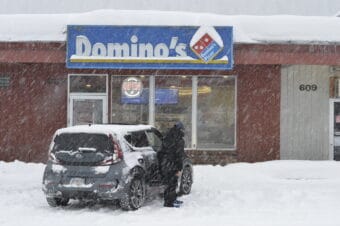
A person steps out of their car parked in front of the Domino’s pizza in downtown Juneau on Tuesday, Jan. 23, 2024. (Anna Canny/KTOO)

Another Domino’s Pizza restaurant is coming to the Juneau area soon, despite opposition from some residents. 

The city’s planning commission unanimously granted a permit to build the restaurant — which will be on Clinton Drive near Safeway in the Mendenhall Valley — during an online meeting Tuesday night. 

Some neighbors wrote letters of opposition, and the board of the nearby Vintage Park Condominium Association asked the commission to deny the permit, citing concerns about traffic. 

Hilliard Lewis, who lives across from the proposed Domino’s, said at the meeting that he’s worried about noise and light pollution.

“Most of that area is shut down by 6 p.m. or 7 p.m., and a Domino’s Pizza is going to be open to 9 p.m. at the earliest and probably midnight,” he said. “I don’t think that we’re going to have any sort of peace with traffic going through all of that time.”

He said the restaurant would be out of character for the neighborhood and urged the commission to vote against the permit. He also asked if there was a way to block headlights from shining toward the condos.

Rob Worden, the applicant with R&S Construction LLC, said the site’s lot doesn’t allow them to change the drive-through. But he said he isn’t concerned about light pollution because of the condominium’s layout.

Planning Commissioner Travis Arndt agreed and said the application fits the area’s zoning. 

“The intention of our zoning district is commercial applications. So to say this is not a proper use for the area is incorrect — this is exactly what the area is zoned for,” he said. 

This will be Juneau’s third Domino’s — there’s already one near Foodland IGA, and another in the Valley near Pipeline Skatepark. 

The developer did not share a timeline for the new restaurant’s construction and did not respond to requests for more details.

State launches new online application for food assistance as work to address backlog continues

IGA Foodland Grocery Store Juneau Alaska, December 20, 2022 (Photo By Paige Sparks/KTOO)

Alaskans can now apply for food stamp benefits online, after the state Division of Public Assistance announced the launch of an online form Friday.

It’s part of the state’s effort to revamp the food assistance system to speed up application processing, as some Alaskans have waited months for their benefits.

A backlog of thousands of applications has plagued the division for more than a year. Chronic understaffing, a cyberattackoutdated software, office closures and a spike in demand resulted in the state falling months behind.

Now, officials hope the online application will get Alaskans the food assistance they need in a more timely fashion.

Ketchikan resident Vanessa Budge is among those caught in the state’s food stamp backlog. As of Friday, she hadn’t received benefits in over three months.

“I’ve called and I’ve called, and they keep saying, ‘Oh, we’re working on it. Oh, we’re just getting through some of the applications,’” Budge said by phone.

On top of her job as a caretaker with an in-home assistance provider, she’s a mom of two young children and also takes care of her own aging parents. Budge has relied on the Supplemental Nutrition Assistance Program, commonly known as SNAP or food stamps, for years.

She says everything seemed to be working smoothly until the pandemic.

In 2021, more than 80,000 Alaskans used the program.

Food stamp recipients have to reapply periodically. Currently, that’s once a year.

Budge reapplied for benefits in August, she said. She was able to get emergency benefits for a month back in September to ensure her kids didn’t go hungry, but since then, she’s been left to wait.

“I’m down to nothing but canned goods and soups and stuff that, you know, lasts for a good while. But with the kids growing and stuff, I don’t think it’s gonna last more than a week,” Budge said.

And Budge is just one of thousands of people with similar stories playing out across Alaska.

Ron Meehan, with the Food Bank of Alaska, said he’s seeing the effect of that backlog firsthand.

“We know that when SNAP doesn’t work, people that are in need are showing up at our network of food banks and food pantries across the state, and we’ve continued to see just exceptionally high levels of need across our network,” he said.

With office closures and software upgrades, state officials with the Division of Public Assistance said their backlog swelled to 12,000 in December.

Division Director Deb Etheridge said after a variety of changes, including the suspension of a requirement that applicants be interviewed, the waiting list is now down significantly. The backlog now stands at 8,311, with 86 of those dating back to last July, said Department of Health spokesperson Shirley Sakaye.

“We’ve made significant progress in that backlog in our SNAP applications, but we’re also working really hard to stay current with those cases that are coming in,” Etheridge said.

new online form launched in late December might ease the strain, Etheridge said. It allows food stamp recipients to apply for benefits without the hassle of a 28-page paper application.

The system is connected with MyAlaska, the sign-on service Alaska residents use to access things like hunting and fishing licenses and Permanent Fund Dividend applications.

The online food assistance application form saves time, Etheridge said. For one, it’s simply easier: the first 260 online applicants to fill it out were able to complete the form in about 20 minutes, compared with roughly an hour for the paper application, Etheridge said.

It should also help reduce the time it takes to process an application, Etheridge said. An application with all of the required information typically takes an hour or less to process, but with a 28-page form, it’s easy for applicants to make mistakes that can stall an application for days at a time, she said.

The online form flags those potential errors in advance, Etheridge said.

“For example, if they say that they have a job, and they do not upload any income verification, and they go to the next screen, they can continue to move through the application, but they’ll get an alert that says ‘Did you mean to do that?’” Etheridge said.

Meehan, from the Food Bank of Alaska, said it’s a welcome step.

“I think it’s incredibly exciting,” he said. “It provides another platform for individuals seeking food assistance to be able to access that application. Prior to that, we were one of only two states that did not have an online application.”

Meehan said his group has its eyes on another big change that they’re hoping for, something called “broad-based categorical eligibility.” That would essentially eliminate a requirement that, in most cases, says food stamp recipients can have no more than $2,750 in assets.

“We know that assets, in particular, are incredibly difficult and time-consuming to verify, and by allowing people to save, it can help families get out of poverty and ultimately get off the program,” he said.

Etheridge, the Public Assistance director, said the state is working on ways to implement that change, though she said antiquated computer systems make it a complicated proposition. Etheridge said she’s working with the federal agency overseeing SNAP to determine whether the broad-based eligibility standard can be implemented while the state works to modernize its information system.

A pair of bills in the state House and Senate introduced near the end of last year’s legislative session would mandate that change and increase income limits to twice the federal poverty level. That’s $75,000 for a family of four.

But as officials’ efforts to address the backlog continue, Vanessa Budge, the caretaker in Ketchikan, is still waiting.

“I just want to know when I’ll be able to get my food stamps so I go food shopping, because my kids need food,” she said.

The state hopes to clear the backlog by mid-March, according to Sakaye. Etheridge’s division is in the process of hiring nearly two dozen entry-level eligibility technicians to process applications, and senior department leaders have been tasked with processing emergency applications, she said.

Meanwhile, Etheridge encouraged people who need emergency assistance to stop by a local Division of Public Assistance office or call 1-800-478-7778. Anyone in need can also find a local food pantry at the Food Bank of Alaska’s website by clicking the button labeled “Find Food.”

With bison herds and ancestral seeds, Indigenous communities embrace food sovereignty

Sophia Moreno (Apsáalooke/Laguna Pueblo/Ojibwe-Cree) plants crops in the Indigenous gardens outside American Indian Hall on the Montana State University campus in Bozeman, Montana. (Adrian Sanchez-Gonzalez/Montana State University)

BOZEMAN, Mont. — Behind American Indian Hall on the Montana State University campus, ancient life is growing.

Six-foot-tall corn plants tower over large green squash and black-and-yellow sunflowers. Around the perimeter, stalks of sweetgrass grow. The seeds for some of these plants grew for millennia in Native Americans’ gardens along the upper Missouri River.

It’s one of several Native American ancestral gardens growing in the Bozeman area, totaling about an acre. Though small, the garden is part of a larger, multifaceted effort around the country to promote “food sovereignty” for reservations and tribal members off reservation, and to reclaim aspects of Native American food and culture that flourished in North America for thousands of years before the arrival of European settlers.

Restoring bison to reservations, developing community food gardens with ancestral seeds, understanding and collecting wild fruits and vegetables, and learning how to cook tasty meals with traditional ingredients are all part of the movement.

“We are learning to care for plant knowledge, growing Indigenous gardens, cultivating ancestral seeds, really old seeds from our relatives the Mandan, Hidatsa, and Arikara: corn, beans, squash, and sunflowers,” said Jill Falcon Ramaker, an assistant professor of community nutrition and sustainable food systems at Montana State. She is a member of the Turtle Mountain Band of Anishinaabe.

“A lot of what we are doing here at the university is cultural knowledge regeneration,” she said.

But it also has a very practical application: to provide healthier, cheaper, and more reliable food supplies for reservations, which are often a long way from supermarkets, and where processed foods have helped produce an epidemic of diabetes and heart disease.

Many reservations are food deserts where prices are high and processed food is often easier to come by than fresh food. The Montana Food Distribution Study, a 2020 paper funded by the U.S. Department of Agriculture, found that the median cost in the state of a collection of items typically purchased at a grocery store is 23% higher on a reservation than off.

“With food sovereignty we are looking at the ability to put that healthy food and ancestral foods which we used to survive for thousands of years, putting those foods back on the table,” Ramaker said. What that means exactly can vary by region, depending on the traditional food sources, from wild rice in the Midwest to salmon on the Pacific coast.

Central to the effort, especially in Montana, are bison, also referred to as buffalo. In 2014, 13 Native nations from eight reservations in the U.S. and Canada came together to sign the Buffalo Treaty, an agreement to return bison to 6.3 million acres that sought “to welcome BUFFALO to once again live among us as CREATOR intended by doing everything within our means so WE and BUFFALO will once again live together to nurture each other culturally and spiritually.”

Nearly a decade later, dozens of tribes have buffalo herds, including all seven reservations in Montana.

The buffalo-centered food system was a success for thousands of years, according to Ramaker. It wasn’t a hand-to-mouth existence, she wrote in an article for Montana State, but a “knowledge of a vast landscape, including an intimate understanding of animals, plants, season, and climate, passed down for millennia and retained as a matter of life and death.”

Ramaker directs both the Montana Indigenous Food Sovereignty Initiative and a regional program, the Buffalo Nations Food Systems Initiative, or BNFSI — a collaboration with the Native American Studies Department and College of Education, Health and Human Development at Montana State.

With bison meat at the center of the efforts, the BNFSI is working to bring other foods from the northern Plains Native American diet in line with modern palates.

The BNFSI has received a $5 million grant from the U.S. Department of Agriculture to carry out that work, in partnership with Nueta Hidatsa Sahnish College in New Town, N.D.

Life on reservations is partly to blame for many Native people eating processed foods, Ramaker said. Food aid from the federal government, known as the Commodity Supplemental Food Program, has long been shipped to reservations in the form of boxes full of packaged foods.

“We were forced onto the reservations, where there was replacement food sent by the government — white flour, white sugar, canned meat, salt, and baking powder,” she said.

From left to right, James Vallie (Apsáalooke/Anishinaabe), Angela Bear Claw (Apsáalooke), and Jill Falcon Ramaker (Anishinaabe) plant Native seeds in the Indigenous gardens at Montana State University on June 4, 2021. (Adrian Sanchez-Gonzalez/Montana State University)

Processed foods contribute to chronic inflammation, which in turn leads to heart disease, cancer, and diabetes, which occurs at three times the rate in Native Americans as it does in white people.

Studies show that people’s mental and physical health declines when they consume a processed food diet. “In the last decade there’s a growing amount of research on the impact of good nutrition on suicide ideation, attempts, and completion,” said KayAnn Miller, co-executive director of the Montana Partnership to End Childhood Hunger in Bozeman, who is also involved with the BNFSI.

All Native American reservations in Montana now have community gardens, and there are at least eight different gardens on the Flathead Reservation north of Missoula, home to the Confederated Salish and Kootenai Tribes. The tribe is teaching members to raise vegetables, some of it made into soup that is delivered to tribal elders. This year members grew 5 tons of produce to be given away.

Ancestral seeds are part of the effort. Each year the BNFSI sends out 200 packets of seeds for ancestral crops to Indigenous people in Montana.

Creating foods that appeal to contemporary tastes is critical to the project. The BNFSI is working with Sean Sherman, the “Sioux Chef,” to turn corn, meat, and other Native foods into appealing dishes.

Sherman founded the award-winning Owamni restaurant in Minneapolis and in 2020 opened the Indigenous Food Lab, through his nonprofit, North American Traditional Indigenous Food Systems. The lab, in downtown Minneapolis, is also a restaurant and an education and training center that creates dishes using only Indigenous foods from across the country — no dairy, cane sugar, wheat flour, beef, chicken, or other ingredients from what he calls the colonizers.

“We’re not cooking like it’s 1491,” Sherman said last year on “Fresh Air,” referring to the period before European colonization. “We’re not a museum piece or something like that. We’re trying to evolve the food into the future, using as much of the knowledge from our ancestors that we can understand and just applying it to the modern world.”

Among his signature dishes are bison pot roast with hominy and roast turkey with a berry-mint sauce and black walnuts.

In consultation with Sherman, Montana State University is building the country’s second Indigenous food lab, which will be housed in a new $29 million building with a state-of-the-art kitchen, Ramaker said. It will open next year and expand the ongoing work creating recipes, holding cooking workshops, feeding MSU’s more than 800 Native students, and preparing cooking videos.

Angelina Toineeta, who is Crow, is studying the BNFSI at Montana State as part of her major in agriculture. “Growing these gardens really stuck out to me,” she said. “Native American agriculture is something we’ve lost over the years, and I want to help bring that back.”

KFF Health News, formerly known as Kaiser Health News (KHN), is a national newsroom that produces in-depth journalism about health issues and is one of the core operating programs at KFF — the independent source for health policy research, polling, and journalism.

Copyright 2023 KFF Health News. To see more, visit KFF Health News.

Alaskans again wait months for food stamps; workers union blames policy choices

Food in Food Bank of Alaska’s Anchorage warehouse on April 21, 2023. (Photo by Claire Stremple/Alaska Beacon)

Nikita Chase doesn’t have a Christmas tree yet this year. She said she is more worried about staving off an electricity shutoff notice than getting into the holiday spirit. Her food stamps, known as Supplemental Nutrition Assistance Program benefits, were nearly two months late.

“I am pretty much tapped out going into Christmas. That’s not a great place to be,” she said.

She ran up debt on her credit card to pay for heat and electricity after she spent all her cash to feed her family. She paid significantly higher prices for piecemeal groceries in her remote home of Tenakee Springs instead of taking the ferry to Juneau to do a big shopping trip while she waited for the state check.

So Chase found herself in the same situation as she was in this time last year — waiting on hold with Alaska’s Division of Public Assistance to get her overdue benefits. By the time she got them, nearly two months later, she was roughly $2,500 in debt.

“I was on the phone in tears, saying, ‘I have to go into town to do my shopping,’” she said.

The state is again in a food stamp backlog of crisis proportions, leaving thousands of Alaskans hungry or indebted as they scramble to pay for food and keep up with bills. State employees say they cannot keep up with the work and the director of these workers’ union said the state has not adequately addressed how to hire and retain enough employees to end the backlog.

Last winter federal administrators said 15,000 Alaskans were waiting in a backlog. This August the state reduced the backlog to 6,000 people, but it has swollen to more than 12,000 in the last few months.

For Chase, that meant missing a rare ferry from Tenakee Springs to Juneau and paying more for groceries. “In the end, you’re paying three times as much as you would have if you had just gotten your benefits,” she said. “That puts you in a hole where you’re trying to dig yourself out.”

‘The result of years of cuts’

Heidi Drygas, director of the union that represents DPA employees, said Gov. Dunleavy’s administration could largely solve the problem and get needy Alaskans food aid if it hired and retained more DPA workers. She said the state has not done enough to improve conditions at the division of public assistance.

“We advocated to the department to increase pay and benefits, work on improving recruitment and retention strategies and just generally trying to treat employees with more respect,” she said. “What the department and the division ended up doing is something that seems to be this administration’s playbook: They contracted out 75 positions outside of Alaska.”

Last year, eligibility employees said workloads got too high after the Dunleavy administration cut more than 100 jobs from the Division of Public Assistance in 2021, leaving offices short-staffed, despite warnings from a state watchdog agency and the Food Bank of Alaska that it could result in a backlog.

Drygas said the backlog was the result of a “manufactured” budget crisis. She ran unsuccessfully for lieutenant governor last year on an independent ticket with former Gov. Bill Walker. Drygas said the state has not made enough of an effort to justly compensate employees, which is why it cannot retain them for crucial roles like eligibility technicians.

“This is the result of years of cuts, the Dunleavy administration’s preferred tool to try to fix their budget woes to serve their policy aim, and this is the result,” she said. “You’re not going to keep people around when they know they can find an easier job where they don’t have to work, you know, ridiculous hours of overtime and feel underappreciated and underpaid.”

Jeff Turner, a spokesperson for the Dunleavy Administration, said in an emailed statement that the “Dunleavy administration remains committed to clearing up the backlog of SNAP applications and is taking aggressive steps to make sure eligible Alaskans receive the SNAP benefits as quickly as possible,” and that policy changes within the division will “build a more resilient public assistance process and minimize future delays.”

In a hole

Since September, when the state reported it had reduced the food stamp backlog to 6,000 applications, the number of people waiting on critical food aid has doubled.  Division of Public Assistance Director Deb Etheridge said the division is taking the “growing crisis” very seriously.

“I know this is not good news,” she said. “It’s an unfortunate situation, but I want you to know that our team is doing the best we can to innovate and find solutions.”

Etheridge said the backlog began to balloon in October, when the federal government required the state to begin interviewing clients again after a pause due to the pandemic. Eligibility workers within the division said this slowed them down considerably. There were other factors, too: Weather-related office closures in some areas and a weekend where workers could not put in overtime while information in the state’s computer system was transferred to the cloud — part of $54 million in tech fixes announced by the governor in February.

State data on this graph shows that the Division of Public Assistance improved its timeliness rate from a low in the winter of 2023 until that summer. Officials say a series of setbacks put the division behind again in September.

When she saw the backlog growing, Etheridge said she asked the federal government to give her workers another six-month break from interviews, but the request was declined. Etheridge immediately asked state Health Commissioner Heidi Hedberg for permission to break the rules, which she granted the day before Thanksgiving.

“We really needed to take those dramatic steps in order to ensure that Alaskans can have access to food,” she said. While the backlog is still growing, Etheridge said she thinks it is close to stabilizing.

There are currently 143 division workers who process food stamp applications, called eligibility technicians. Etheridge said she would need 200 of them working full time on cases to clear the backlog this month — a roughly 60-person staff increase. She has 30 new eligibility technicians in training now, she said, and another dozen or so jobs posted.

Etheridge took over as director of the DPA at the height of the backlog, when some applicants had been waiting for benefits for up to 10 months. She said this time the backlog is different: Alaskans have been waiting up to six months and there are technology upgrades on the way, including an online application that Etheridge said should be live by the end of the year. Other technology fixes will be completed over the next two years, she said.

“We’re driving for change and success. It just — it takes time. And I think that’s the one thing that’s been very hard,” she said. “But know that I love this work and I am very committed.”

Etheridge said staff overtime has been a critical part of solving the backlog. A number of former employees who now work in other state agencies have agreed to work on food stamp cases in their overtime hours and she has asked division workers in leadership roles to pitch in, too, even though their workload does not usually include working cases.

Staff say they just can’t keep up

One of the first DPA employees to speak out about the backlog and dysfunction within the division said they were frustrated by the new backlog, but felt more confidence in leadership this time. They spoke with the Alaska Beacon on the condition of anonymity because they were concerned that doing so would jeopardize their job.

“I just feel like the work itself is just so overwhelming, that we’re just not able to keep up,” they said. They likened it to the scene in the Disney movie Fantasia, where Mickey Mouse cannot keep up with buckets of water and nearly drowns in a flood.

The eligibility worker said it feels “crazy” to be dealing with the same thing again: “People are without food again. And now the threats are starting to come again, because they’re like, ‘We’re so sick of this, you just did this to us.’”

They said one man didn’t get his senior benefits for an entire year. Another woman’s paperwork got improperly filed, and she threatened to kill herself in a division office.

“She told me she was going to kill herself, because she did everything she was supposed to do and she was still not getting her benefits,” the worker said, and added that they got permission to quickly fix a simple error that had delayed the case. “I can’t have somebody threaten to kill themselves.”

“We’re getting desperate,” they said of the division. “And we’re pushing people through training too quickly, so that they’re not able to grasp the concept of certain policies and they’re screwing up on cases… people are going without benefits because of it.”

Some DPA employees have been critical of the solutions proposed by the administration. In March, longtime employee Fred Rapp said the state needs to figure out how to recruit and retain employees rather than spending millions on software that he likened to a Ferrari with a lawnmower motor.

This February, union workers rallied in Juneau to ask for better compensation and for the division to be fully staffed. Etheridge said it has not been fully staffed since she took on her role, but that the division is actively recruiting.

Food stamps, senior benefits, Medicaid

In Cordova, the director of community programs for the local hospital said her clients are waiting up to five months for food stamps. Barbara Jewell works with people who access Cordova Community Medical Center for behavioral health and senior services. She said those who are seeking food stamps and Medicaid are “really vulnerable” and make up at least 35% of her clientele.

“They’re scared. They call our office and say: ‘I don’t have food, what do I do?’ And sometimes we’re able to come back with one-time assistance, but sometimes there’s not anything we can do,” she said. “It’s not really a hospital’s job to feed people, right? That’s not what hospitals are set up for.”

Jewell said local food banks are running out of food and she is frustrated to see severely backlogged applications after the state said it had worked through the backlog.

“The state acted as if they’ve taken care of it. And they put out all of these big press releases about how they fixed it. And it’s not true,” she said. “I was furious.”

She said the delay in food stamps is the most acute problem, but the delay in processing Medicaid hurts communities, too.

“Medical providers don’t get paid, which either drives them out of the business or raises the cost for all of us,” she said. “When providers and hospitals have to wait three to six months to get paid, because it takes that long for a person’s applications to get processed — that hurts everybody.”

Legal recourse

In January, the Northern Justice Project filed what they hope will be a class action lawsuit against Department of Health Commissioner Hedberg on behalf of 10 Alaskans not receiving food stamp benefits in a timely manner.

Under federal law, the Department of Health must provide ongoing Supplemental Nutrition Assistance Program benefits to eligible applicants no later than 30 days after the date of application, but some families have been waiting months. The complaint said the delay is due to the “immense delays and chaos of the Alaska Department of Health.”

Lawyers and the state agreed to put the lawsuit on hold for six months while they worked on the issue. In May, the state asked for six more months, bringing the delay to a year. Just last month, the state asked for another six-month delay, but Northern Justice Project lead attorney Saima Akhtar said they are opposing the request.

“Nobody eats retroactively. You do not make up for having gone hungry and having gone without those benefits,” she said. “That is why we felt strongly that the case needs to go back on an active litigation docket and we need to move forward.”

Akhtar has worked on food stamp delay cases nationwide, and said this is one of the most severe backlogs she has seen because it affected such a significant percentage of beneficiaries.

She said the state has been communicative, but she is ready for a remedy.

“The delays have actually gotten worse, right? The numbers now are as bad, if not worse, than they were in May,” she said. In May, attorneys granted the state’s request for a hold on the case under the condition that the state would cut the backlog in half.

“We are not at that place,” Akhtar said. “There are continuing problems that are not being resolved.”

Alaskans who are waiting on food stamps used to be able to seek help at the ombudsman’s office, the agency that investigates complaints against state government and departments. However, the pending lawsuit now prohibits that office from intervening, according to state Ombudsman Kate Burkhart.

“We continue to receive complaints about delayed SNAP benefits,” she said in an email. “Since we cannot assist these complainants, we refer them to Alaska Legal Services Corporation for assistance in filing for an administrative fair hearing.”

Leigh Dickey, the advocacy director for Alaska Legal Services Center, said the number of complaints has been “crazy.” From January to July of this year, ALSC attorneys helped get food stamps for nearly 2,000 Alaskans. Since then, the number of complaints has doubled. Dickey said there were more than 600 requests for help in November.

Etheridge said she doesn’t know yet how long it will take her staff to work through the backlog, but said in two weeks she should have a better idea of the timeframe and if she needs additional resources to get the job done.

This story originally appeared in the Alaska Beacon and is republished here with permission.

A new SNAP backlog leaves 12,000 Alaskans waiting for food stamps

IGA Foodland Grocery Store Juneau Alaska, December 20, 2022 (Photo By Paige Sparks/KTOO)

A new backlog in the state’s food stamp program has left some Alaskans waiting months for their benefits. More than 12,000 Alaskans have pending applications for the Supplemental Nutrition Assistance Program, better known as SNAP, with some dating as far back as July, according to state officials.

The state’s director of public assistance, Deb Etheridge, said Tuesday that there are a number of reasons for the backlog, from office closures for poor weather to short staffing and computer system upgrades. But she said the biggest holdup is a federal requirement reinstated in October after the end of the federal health emergency.

“The single most impactful factor is the requirement from (the) Food and Nutrition Service for the state of Alaska to reinstate mandatory interviews for every application or recertification of SNAP that was processed,” Etheridge said in a phone interview.

Before the interview requirement was reinstated, Etheridge said each application took about an hour to process. Interviews now nearly double that, she said.

“Where we could have processed over 100 cases a day, we were dropping to 70, and sometimes less than 70 a day,” Etheridge said.

The issue affects more than 10% of the state’s roughly 92,000 SNAP recipients. The Anchorage Daily News reported in October that the new backlog is partially a result of the state’s effort to catch up from an earlier slowdown that brought wait times to an unprecedented 11 months.

Etheridge said her department has paused interviews for now and is working with federal officials on other ways to streamline the process. The pause means the agency could fall out of compliance with federal regulations, but Etheridge said her agency meets with federal officials weekly and plans to work closely with the Food and Nutrition Service on a fix.

Etheridge says the state is also working with an outside contractor, the Change and Innovation Agency, on improving its workflow. She says the Division of Public Assistance has made more workers eligible for overtime and plans to offload some Medicaid processing onto contractors who can’t legally handle SNAP applications. Etheridge said she hopes a new online application that the department hopes to launch later this month will streamline processing.

Etheridge said roughly 95% of the applicants stuck in the backlog applied for at least one other assistance program, like adult public assistance or heating assistance, in addition to SNAP.

She says her division has nearly 50 openings for eligibility technicians, who process applications for SNAP and other state assistance programs.

“I know this is not good news, and it’s an unfortunate situation, but our team is really doing the best we can to innovate and find solutions,” she said.

Sitka’s culinary scene is coming to TV screens

Actor and producer David Moscow shakes hands with chef Renee Jakaitis Trafton of Beak Restaurant in Sitka during a shoot for his show “From Scratch.” (Photo provided by Renee Jakaitis Trafton)

Sitka’s culinary scene will be coming to television screens around the country this spring. Former child actor and film producer David Moscow recently visited the island community to film an episode of his show “From Scratch” in collaboration with Beak restaurant. Between jaunts pulling bull kelp out of Sitka Sound and foraging for cranberries, Moscow sat down with KCAW’s Meredith Redick to talk about food, foraging, and filming in Southeast Alaska.

Listen:

David Moscow: I produce and host a show called “From Scratch.” It is a travel and food documentary series, and we meet with a chef somewhere around the world. They make a meal, I taste it, figure out all the ingredients, and go out and source all those ingredients – harvesting, hunting, fishing, foraging. I come back and then I have a week and try and remake the dish with the chef.

Meredith Redick: Can you tell me about your experience hunting, fishing and foraging in Sitka so far?

David Moscow: Well, so that’s at the heart – I mean, I kind of went high-minded, but at the heart of the show is the adventure of food sourcing. I’m here working with Renee at Beak, and she made two incredible dishes for me. And as soon as I walked out the door, like, reality hit me. It is November in Alaska. Not a lot of green stuff in the ground. What am I going to get? And then it turned out that one of the fish I couldn’t even get because non-Alaskans can’t harvest at this time of year. [KCAW: what was that?] Rockfish. But we heard rumors that there were still wild cranberries up in the bogs on the mountains. And then we had mushrooms. And we couldn’t find a guide to take me to go get the mushrooms. So for the first time on the show, I went, and I’m not a mushroomer. I went by myself to try and find mushrooms, which was scary for me. And luckily, we got some that were the right kind. And yeah, the whole thing was kismet. First of all, you know, Beak is an incredible restaurant. Sitka is a gorgeous town and incredible place. This is a food destination.

Meredith Redick: So you weren’t allowed to harvest rockfish because of regulations. What did you end up with?

David Moscow: Well, people have to watch it. Maybe I got it. Maybe I didn’t.

Meredith Redick: Oh, okay, right.

David Moscow: Yeah. The scariest moment was when we went out for bull kelp on two little boats in like – I don’t know what was going on with the water at that point, but the swells were like nine-feeters. It was crazy. And we had professors from the college over here, and they are insane. These three women were wild. My crew was huddled on the bottom of the boat.

Meredith Redick: You said something about Sitka being a food destination. And that surprises me because, you know, I think about our grocery store prices. And I think a lot of people here subsist because it feels like there aren’t a lot of options.

David Moscow: But that’s special, right? Like the fact that everyone has, all winter long, an insane amount of protein in their freezer, and then you come to a place like Beak or a number of the other restaurants in town, and they are using ingredients from right here on their menus. And so it’s of the place, it’s of the time, and it’s interwoven.

Meredith Redick: Is it accurate to say that food, then, is sort of a vessel for a bigger message you’re trying to communicate?

David Moscow: Yeah, I think it really is about how community is tied together. And to show that we all need one another. I think Americans sometimes think that, you know, I did this by myself, I’m on an island, I pull myself up by my bootstraps, and it’s frankly not true. Like, if you eat a slice of pizza, it took 68 people to make that pizza. So there’s a web. [KCAW: Is that specific, that number?] That’s when I made my pizza, it took 68 people to make it. There is a web of community that holds us all up and feeds us the most important sustenance. And so, you know, one of the things we realized on this journey is that it’s not just about community. It’s also about how we treat the planet. If we keep going in this direction around food production and around pollution, we’re in very serious trouble. And you see that in, food producers are at the frontlines of global climate change, of economic justice, of social justice. And so it becomes clearer and clearer everywhere I go.

The episode featuring Sitka and Beak restaurant is scheduled to air in February 2024. You can learn more about the show at www.discoverfromscratch.com.

Site notifications
Update notification options
Subscribe to notifications