Food

Three Bears buys 6 more retail properties in the Interior and Unalaska

A Sourdough Fuel official said Three Bears’ purchase of the gas station/convenience store at 3330 Badger Road in North Pole is pending transfer of the store’s liquor license. (Sourdough Fuel/Google Maps)

Three Bears Alaska is continuing its statewide expansion.

The rapidly growing Wasilla-based grocery and retail chain is buying six new properties. The latest acquisitions include a supply store in Unalaska and a gas station-convenience store in Delta Junction. In Fairbanks, Three Bears is buying four Sourdough Fuel gas-station-convenience stores.

“The Sourdough stations, the gas stations up there, those are all going to be Three Bears gas stations,” said Jim Kolb, a Three Bears spokesperson.

Kolb said the company is still working on plans for the changeover. A Sourdough Fuel official confirmed one of the purchases, but referred questions to Three Bears. Kolb said his company should be able to convert the fuel stations fairly quickly, because all the company has to do basically is change signage and swap out some new inventory.

But he said more work will be required with another new acquisition: a privately owned gas station-convenience store in downtown Delta Junction.

“Yeah, we bought that Buffalo Service station and the shop and all that,” he said, “and we’re going to transform it into a gas station and little grocery store, for the time being.”

a gas station
Three Bears plans to remodel the Buffalo Service repair shop into a mini-grocery store, then build a new structure next year for a full-size store. (Tim Ellis/KUAC)

Kolb said the company will operate the business in that configuration until next summer, when it plans to build a real grocery store on the site. But he said Three Bears wants to provide the community with at least a small store as soon as possible, because company officials have been hearing from Delta residents about the need for more locally available groceries.

“Because we know they don’t have anything up there, and they’ve been screaming,” he said in an interview Friday.

Delta lost its only grocery store in December 2021, when its roof collapsed under a heavy snow load dumped by a winter storm. Since then, store owner Ed Larson has been selling a small inventory of groceries packed into his liquor store next to the new store that’s under construction.

“Yeah, it’s going to be competition,” he said. “I mean, we’re not buying his business.”

Meanwhile Three Bears also is expanding into the Aleutian Islands, with the purchase and planned expansion of the Alaska Ship Supply store in Unalaska.

“I believe in November is when we’re shooting to have that open,” Kolb said.

a grocery store
Three Bears plans to expand the groceries section of its Alaska Ship Supply Store in Unalaska. (Andy Lusk/KUCB)

Three Bears has been on a buying spree over the past year and a half, since the company entered into a recapitalization deal with a Seattle-based private equity firm. Since then, Three Bears has built or acquired stores near Ketchikan, Eagle River, Cooper LandingEster and North Pole.

“We were growing anyway up until then,” Kolb said, “but that recapitalization has allowed us to leverage investors’ money, instead of the bank, so we have to come up with less down (payment) to get these projects going, which is very, very helpful.”

Not counting the six newest acquisitions, Three Bears has 13 grocery stores, eight gas stations, nine sporting-goods stores and four pharmacies. The company opened its first store, in Tok, in 1980.

Kolb said the company is hustling to keep pace with its many building and renovation projects — including a new retail complex in North Pole.

“That North Pole store was supposed to be open this summer. It got pushed to next summer now,” he said. “I mean, we’re trying. We got three stores going up right now. We’re just taking over a few, as well. So, we’re pretty slammed right now.”

The North Pole project includes a more than 56,000-square-foot grocery supermarket, and an over 14,000-square-foot Ace Hardware store. North Pole Mayor Mike Welch said the project on the south side of North Pole promises to transform the town as much as the North Pole Plaza did back in the 1980s.

“That was a moment in the crossroads of the city, 40-something years ago,” he said, “being able to say, ‘We don’t need to go to Fairbanks anymore. We now have our own grocery, our own hardware, whatever.’”

Welch and Kolb both anticipate the new North Pole retail complex will open next year around Memorial Day.

Former University of Alaska Fairbanks student sues school, alleging injuries from hot sauce

The Butrovich Building on the UAF campus on a cold day in January, 2017. (Ian Dickson/KTOO)

A former University of Alaska Fairbanks student is suing the university, alleging she was injured during a culinary arts class in 2022.

Ariel Lamp, who left the university after the incident, filed suit July 14 in Fairbanks Superior Court. The suit requests more than $100,000 in damages, plus costs.

Lawsuits against the university are relatively rare; online court records show it listed as a defendant only 13 times since 1988.

Through her attorney, Jeff Barber of Anchorage, Lamp declined an interview request.

According to the complaint, a UAF professor invited students to consume three spoonfuls of “Da Bomb” hot sauce directly. The lawsuit did not name the professor or class.

Da Bomb sauces, manufactured in Kansas City, are among the spiciest commercially available products on the market, with some variants approaching the heat of pepper spray.

Reviewers, and the company’s own instructions, say the sauce should be diluted before use. Without dilution, it’s frequently painful to consume, so much so that its use in a YouTube series called “Hot Ones” — in which celebrities are interviewed while eating hot wings — has become notorious.

According to the complaint, Lamp suffered months of abdominal pain and discomfort after eating the hot sauces, sought medical treatment and left UAF because of her continued pain.

The complaint says she “suffered severe, permanent physical injury from consuming the hot sauce at UAF” or that it may have exacerbated a pre-existing condition.

Lamp altered her diet and is continuing to take medicine but is still experiencing symptoms, the complaint said, and one doctor “discussed removing her gall bladder.”

The lawsuit alleges that by failing to follow warning labels on the bottle, “UAF’s teacher … negligently encouraged the students in the class to consume Da Bomb hot sauce when he knew or should have known that the product was not safe for everyone to consume,” thus making the university liable for the harm that ensued.

Marmian Grimes, the university’s public information office, said it has received a copy of the complaint and is reviewing it, but she declined to comment, citing the university’s policy of not speaking about ongoing litigation.

This story originally appeared in the Alaska Beacon and is republished here with permission.

Alaska’s food stamps backlog continues, with delayed appeals and Medicaid issues on the horizon

The produce section at Foodland IGA in Juneau. (Photo by Tasha Elizarde/KTOO)

The state office that manages food stamps has been making progress working through a backlog delaying the benefits for thousands of Alaskans, but new problems have cropped up.

Most recently, advocates say the appeals process for denied or delayed applications is failing. Those advocates at the Alaska Legal Services Corporation are helping would-be food stamp beneficiaries in court hearings, and they say the state is still taking an unlawfully long time to approve applications.
The state had blamed the backlog on a cyberattack and a deluge of applications at the end of the official public health emergency for the COVID pandemic. But anonymous state workers told then-KTOO reporter Claire Stremple that budget cuts and understaffing had caused long waits for Alaskans desperate for food.

Stremple works for the Alaska Beacon now and spoke with Alaska Public Media’s Wesley Early about her continued reporting on food stamp issues in Alaska.

Listen:

This interview has been lightly edited for length and clarity.

Wesley Early: So can you walk us through this legal action over the backlog of food stamp benefits?

Claire Stremple: Yeah, that started early this year. So in January, a group of 10 Alaskans sued the Department of Health because they’d been waiting too long for food stamps. Food stamps are also known as SNAP (Supplemental Nutrition Assistance Program). It’s a federal program the state manages. But it has to manage it within certain parameters, like getting people’s paperwork done and their benefits to them within 30 days. And the state’s Department of Health wasn’t working anywhere near fast enough, hence the lawsuit. So as a result, in May, the state promised to cut its backlog in half within six months if the plaintiffs would agree to put the lawsuit on hold. And if they failed, then the lawsuit could continue. The great news is the state seems to have done that. The new director of the Division of Public Assistance, Deb Etheridge, manages the group that manages food stamps. She’s been working with staff to get through that backlog, which it turns out was huge. Federal numbers show the state was behind on as many as 19,000 applications, and they seem to have worked through the bulk of the backlog, and all of the recertifications.

Wesley Early: So it sounds like the state, after these lawsuits, realized how big of an issue the food stamps benefit was, and the scope of it.

Claire Stremple: It’s sometimes hard to tease out numbers because the state reports its status in a yearly format, which means it’s kind of hard to track improvement or when things aren’t going well. And so, they broke out month-to-month figures on their processing times for benefits, and it shows that they’ve really turned things around, but things were also really bad. At the height of the backlog, the state’s Division of Public Assistance was processing less than 10 percent of applications on time. So from December 2022 to April 2023, less than 10 percent of applications were getting processed in the lawful timeframe. So for four months, 90 percent of Alaskans who tried to get recertified for food benefits were waiting more than a month.

Wesley Early: And it sounds like there’s also legal help from the Legal Services Corporation. Can you describe that work?

Claire Stremple: What’s really interesting about this is it’s not just attorneys from Alaska Legal Services, but also a bunch of volunteers. And they helped nearly 2,000 people get fair hearings, which are basically an appeal to the state that says, “Hey. You’re late. That’s illegal. Please file my benefits.” And so the state does. And that helped people get their money for food, which is huge because some people were waiting for four or five months. One family that I talked about with a legal volunteer, the family was waiting several months and they ended up getting nearly $20,000 that the state owed them for food.

Wesley Early: Wow. And I understand that now, the appeals are the issue in getting benefits. Can you walk through those issues with appeals and delays in them?

Claire Stremple: So those fair hearings appeals that we were just talking about, they’re happening because there’s still delays in getting benefits while the state is getting back on track. But there’s short-staffing in the group of people that gets the appeals from the Department of Health to the Department of Administration that schedules them. It’s a little complicated, but the point is that Alaska Legal Services is really worried because they’re anticipating a lot more of these appeals for another reason. Nationwide, states need to check their Medicaid rolls to make sure everyone getting benefits still qualifies for them. And that’s because during the pandemic, no one lost benefits. They were on hold to make sure everyone had care. But now, that same department that’s struggling to get out of a backlog on food stamps has a bunch more paperwork to do for another kind of benefits. And those advocates are worried that we could see another backlog, this time for Medicaid.

Wesley Early: Well, it sounds like some people are starting to get their benefits. You mentioned the family that got $20,000 in benefits from the state. But even if they’re getting it now, retroactively I imagine a lot of damage has already been done.

Claire Stremple: Yeah. What I’ve been hearing from people who have gotten their benefits after an extended period is that, number one, they’re really grateful, they’re relieved and happy. And number two, they’re still kind of worried because of all the emergency things that they had to do to keep feeding their families, which really took a toll. People fell behind on rent and a lot of people racked up credit card debt, something I heard a lot about. And that comes with interest, and back benefits don’t come with interest. And so people are still going to be paying that back and dealing with those consequences for a long time.

Sitka’s seafood donation network connects abundance with scarcity in Western Alaska

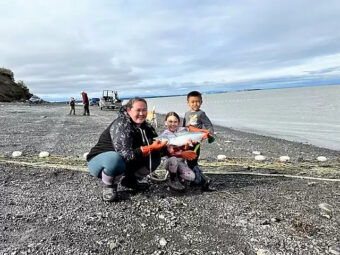
Jenny Bennis and her family donated sockeye from their setnet in Bristol Bay to help other families on the Yukon and Chignik rivers where salmon populations have crashed. (ALFA photo)

A seafood donation program that began in Sitka during the pandemic is still growing. Now called the Seafood Distribution Network, the program is supplying sockeye to families on the Yukon and Chignik rivers, whose traditional salmon runs have crashed.

The market shift in seafood during the COVID pandemic created a problem for the industry: Unlike many other sectors, the supply — the fish — was still there. How to connect those fish with people when traditional markets vanished?

For Linda Behnken, director of the Alaska Longline Fishermen’s Association, it was about connecting the dots.

“So we worked with the local processors here to figure out what fish was stranded by markets being closed, by restaurants being closed, the supply chain disruptions,” Behnken said. “We raised money, bought fish from fishermen that was stranded product, and then started distributing it to people in town that told us they were in need. So it was really ‘You let us know if you need seafood, we’ll provide it.’”

And that’s how the association’s Seafood Donation Program got started in 2020. Basically, a processor-to-doorstep delivery service for people who were having trouble getting by. It didn’t take long for word about the program to get out.

“And then we started hearing from people outside Sitka that there was a need and people really wanted seafood,” Behnken continued. “So we did a distribution with Sealaska, for example, that reached every community in Southeast Alaska. And we did distributions in the Lower 48 to Tribes along the Columbia River, to Anchorage military families, to communities in Western Alaska. Where we heard there was need, we found partners to work with to make that happen.”

Behnken credits Sitka-based processors Seafood Producers’ Coop, Sitka Sound Seafoods, and Northline Seafoods, along with tribes and tribal organizations across the state for helping make the connections that kept the program going.

On paper, it sounds like an impossible undertaking — delivering 645,000 seafood meals across the Pacific Northwest and Alaska, but Behnken says it conformed to basic Alaskan values.

“Alaska is a big state, but we’re also a small state and communities really care about other communities,” she said. “And we have a lot of relatives in different parts of the state, and that there is clear reason for us to share between those areas that have a lot and those areas of scarcity, but the infrastructure isn’t really there. So that’s what we’re working on developing is that infrastructure in Alaska so Alaskans can benefit from Alaska’s fish,

A grant from the Alaska Community Foundation got the Seafood Donation Program rolling; a regional food systems grant from the U.S. Department of Agriculture helped ramp it up. But just the energy of regular Alaskans is helping fuel things now. In a pilot project in Dillingham this June, the Alaska Longline Fishermen’s Association organized a drive to collect subsistence sockeye for communities affected by the crash in chinook and chum stocks.

Natalie Sattler is the program manager for the association.

“We worked with a lot of community members and locals in Dillingham and the Bristol Bay area to help us collect seafood and it was all subsistence donations,” Sattler said. “And within one week, we were able to collect 5,000 pounds of sockeye and folks rallied support, they went down to their setnet sites – kids, families, everyone just you picking fish and donating it and getting it ready to ship out.”

This year, the sockeye will be going to communities on the Yukon and Chignik rivers. And besides providing food, Behnken says the fish are intended to keep food traditions alive.

“What we’ve heard from people in these communities that aren’t able to harvest fish themselves right now because of scarcity is that they really wanted round fish because being able to process that fish as a family – and as a community – is really culturally important,” Behnken said.

The pandemic and the salmon crash have been a one-two punch for many communities in Western Alaska. In a news release, Rep. Mary Peltola said programs like the Seafood Distribution Network were a critical part of the rebound. “Low salmon abundance is an issue that needs to be addressed at every level, from the federal government down to individual communities, and efforts like this are an important piece of that larger goal,” Peltola said.
Bristol Bay fishermen protest low base price, lack of transparency from processors

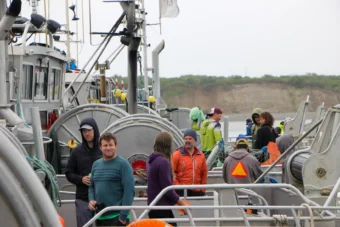
Fishing crews anchored at the Naknek River mouth in protest on July 20, 2023. (Photo by Jack Darrell/KDLG)

By 9 a.m. Thursday, over 100 boats were anchored in the Naknek River entrance, some after a night of fishing the Naknek-Kvichak. Ivan Basargin of the fishing vessel Top Notch was one of them. He was there to join the demonstration against this year’s low price.

Basargin has fished in Bristol Bay since the late 1980s and builds fishing boats in the offseason. Standing in the wheelhouse of a boat he built, he said this year’s low-price hit hard.

“I’m going to pay my workers. I’m going to pay my bills. As far as living expenses, I haven’t decided yet. This fifty cents that I get, when I get home, it’s going to be a wash. I’m not going to have any money in the bank saved,” he said.

Organizers of the protest are calling on processors to reconsider and improve the base price this season from fifty cents per pound — less than half of last year’s price.

Without change, many fishermen say it’s unsustainable for the industry, and some say they will go home in debt. Basargin said he was out on the water protesting because he feared accepting this year’s low base price will set a precedent.

“If they know we can fish for fifty cents, we’re going to get paid thirty cents next year,” he said. “That will happen if we don’t do anything. Like today — this is a peaceful protest. We’re not trying to block people or anything. We’re just trying to show the world that we’re hurting, and we need some help.”

Basargin said processors claim they are struggling financially, too, but he hasn’t seen evidence of this struggle.

“After a record fish catch last year, processors are complaining they are losing a lot of money. I see processors expanding. I see them buying other companies out,” he said. “If you look at the scenario, it kind of seems like they are putting a burden on us. They’re adding up their profits and expanding operations.”

Trident Seafoods was the first to post that base price on Sunday, with some handling incentives: fifteen cents for refrigerated seawater and ice, and for the drift fleet five cents for floating and ten cents for bleeding. North Pacific Seafoods announced the same a few days later, along with Peter Pan Seafoods, who is also offering a twenty cent bonus for “late season” fishing beyond July 18.

Protest organizers also called for processors to resume posting a base price ahead of the season. In recent years, Peter Pan Seafoods posted a price in mid-June, which was welcomed by fishermen. This year, processors did not release a price in Bristol Bay before fishing started. Fran Kaul, a longtime captain, says with prior knowledge of the low price, fishermen may have planned differently.

“It’s very interesting that the price came out pretty much at the very end of the season. They had all our fish, right? The fish had been caught. And then Trident posts fifty cents a pound,” she said.

Cheyne Blough has been fishing in Alaska for 35 years. He fishes for Trident and helped organize this protest, prompted by Trident’s price announcement letter to the fleet. His children crew on his boat in the summers, but he has discouraged them from buying into the fishery.

 A Bristol Bay fishermen radio group protest processors in the Naknek River
A Bristol Bay radio group protest processors in the Naknek River on July 20, 2023. (Photo by Jack Darrell/KDLG)

“The last thing you want is your children to get strapped to hundreds of thousands of dollars worth of debt, and then have the rug pulled out from under them,” he said. “And that’s what’s going on. I didn’t think it would happen quite this way, quite this fast.”

Adjusted for inflation, this year’s base price is the lowest recorded price in nearly 40 years, since 1984. Without adjustment for inflation, this year’s price is still the third lowest — the lowest was in 2001.

But Blough says he’s seen the quality of the fish sold to processors improve over that time. That’s due to fishermen’s investment in equipment and labor, according to Blough, but it’s not reflected in prices offered by the processors.

“We’ve been asked to make expensive capital improvements — a regular RSW (refrigerated seawater) system, we hire an extra deckhand so we can bleed the fish. They have quality control people on every tender going ‘your fish is good, your fish is bad, you need to do better,’” he said.

Blough says fishermen bear the cost of these improvements, but don’t benefit from the resulting revenue.

“And what do we get in return? We get half the price. And in my opinion, the processors need to do better. I cannot believe I’ve been fishing for 35 years, and I’m fishing for less base price than I did when I was in my teenage years,” he said.

Kelly Stier on the F/V Honey Badger says processors are taking advantage of fishermen, knowing they have few choices for buyers in the region.

“We’re out here, and the processors know that. They have us, and it does take a lot of infrastructure and they do have expenses on their side of things, but I think they’ve taken advantage of us because they know they have us backed into a corner,” he said.

Anna Mounsey is a new skipper on the fishing vessel Syren. She says younger members of the fleet, like herself, are questioning if this industry is worth buying into.

“As a new fisherman, new skipper, trying to make it in this fishery just starting out, the unsustainability with overhead and the price fluctuations, (we’re) just seeing if it’s even worth it,” she said. “With how much it fluctuates, not being able to count on making boat payments and all the other expenses that come with just starting out, being young. Watching this graying fleet leave, what hope do us young fisherman have with the vulnerability of this market?”

KDLG made repeated email and phone call requests for comment with the largest processors — Trident Seafoods, OBI Seafoods, North Pacific Seafoods, Silver Bay Seafoods and Peter Pan Seafoods — but did not receive a reply.

Some fishing crews heard the news about prices and ended their season. Others continued fishing, in an otherwise strong season with harvests over 36 million fish to date.

Vessels in the Naknek River entrance. (Photo by Jack Darrell/KDLG)

A group of attorneys and volunteers helped nearly 2,000 Alaskans get food stamps during backlog

Fruit is displayed at an Anchorage grocery store. (Photo by Yereth Rosen/Alaska Beacon)

About a year ago, Jamilyn Fenn noticed she was helping a lot of elders in the Seward area repeatedly fill out applications for food stamp benefits. The elders thought their applications were getting denied, but really they were caught up in the state’s food stamp backlog for the state’s Supplemental Nutrition Assistance Program.

Fenn is a finance manager for the Qutekcak Native Tribe, but she’s also a pro-bono lawyer representative for Alaska Legal Services. She hasn’t passed the bar in the state. She’s a specially trained volunteer that helps people from all over Alaska navigate the legal system with oversight from attorneys at Alaska Legal Services through the community justice worker program. The program serves a variety of needs, including those related to the federal Indian Child Welfare Act.

“They give nonlawyers like myself the ability to represent clients in certain avenues,” Fenn said. “Like domestic violence advocate, SNAP benefits representative, and then ICWA representative. And I can draft wills and trusts.”

Alaska Legal Services reached out to her and asked that she take on food stamp cases from around the state in addition to helping her tribal members navigate their benefits. Fenn estimates she helped up to 75 people get fair hearings — and their food stamps.

“I brought one family $19,996 in back payments,” she said. “Back in April, it was the highest Alaska Legal Services has ever been able to get.”

The state has been making headway on working through backlogged cases, but many Alaskans are still waiting. Fenn said she got five requests for a fair hearing on Tuesday alone.

She’s just one of the volunteers that helped Alaska Legal Services’ staff attorneys file fair hearings appeals for nearly 2,000 Alaskans to get their food stamps. At the height of the backlog this February, the organization got nearly 500 calls for help with food stamps; this month they’re down to 166 requests. Last year at this time, they got five.

Autumn Smith-Amy used to work for Alaska Legal Services before she opened her own consulting business in Anchorage and said she signed up for the community justice worker program when it began. She said the overwhelming majority of the cases she’s worked are to help people get food stamps, and that’s emotionally difficult.

“We’ve heard stories of people eating dog kibble in the villages because they have no more food,” she said. “I’ve heard stories from various food banks of just having completely empty shelves.”

The state is supposed to issue food stamps within 30 days of an application, but she said wait times are typically twice that. The state is supposed to get emergency applications — benefits for people with no food or money — within a week. She said most that she’s seen are waiting for a month.

“They’re eligible for these benefits because of their income level and to not have them means they’re taking from rent, they’re taking from child care — so they could be working more — they’re taking from utilities,” she said. “All these things have a risk to them, right? Like, if their benefits collapsed and they’re using all their money that was allocated for food stamps on something else, it’s just a very precarious position to be in.”

Smith-Amy said she’s helped about 30 families get food stamps since February. She said it’s both humbling and concerning. Some families even reach out to her afterwards.

“​​It’s such a thing to have their benefits that they want to update you and let you know that they really fed their kids today, and they had a really good meal,” she said. “It’s not a normal update to get. You and I don’t call people and say, ‘Hey, I ate a good meal today.’”

Smith-Amy still gets a couple of food stamp cases a week, but said demand has slowed from the peak she saw in February, when she was getting five or six cases weekly.

Sarah Carver, a senior attorney for Alaska Legal Services, said there are more than 200 volunteers throughout the state in dozens of communities, but a core group of about 10 of them managed most of the food stamp cases this year. She runs the Justice for All program that trains people like Fenn and Smith-Amy on how to advocate for fair hearings.

“Everything goes through Alaska Legal Services, but they are the person on the ground delivering the legal services, with us as backup,” she said. “Community justice workers can do the same exact work in these SNAP cases that the attorneys can do. And they are doing it just as effectively.”

Some of the volunteers are affiliated with tribes, or with the health care system as behavioral health aides. Others work for domestic violence shelters or homeless shelters, or with elders at community centers.

Carver said the justice system is supposed to be a place where everybody is treated equally, but “we know that it certainly does not work that way, especially in the civil world. Because in civil cases, you are not entitled to an attorney if you cannot afford one.”

She said the community justice workers who were trained to help people get fair hearings for food stamps have been invaluable in addressing the “huge crisis” of the backlog. Internally, Alaska Legal Services didn’t have the capacity to manage that many fair hearing requests. And she said the community justice workers were valuable in educating people that the food stamp delay was not legally acceptable.

“A lot of times people had no idea that the fact that their benefits are delayed isn’t just an administrative problem, it’s a legal problem,” Carver said. “And there are legal remedies, because there are laws in place that direct how the program is supposed to be run.”

Correction: This article has been updated to correct Autumn Smith-Amy’s name.

Site notifications
Update notification options
Subscribe to notifications