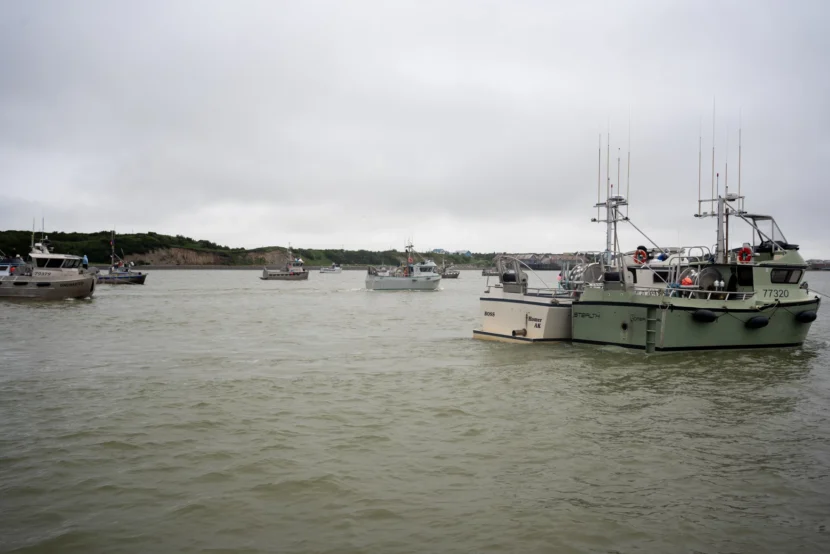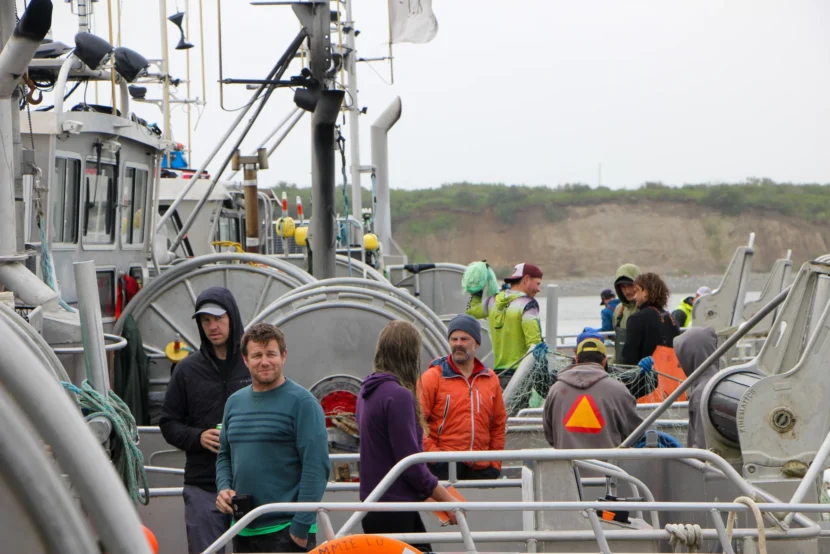
By 9 a.m. Thursday, over 100 boats were anchored in the Naknek River entrance, some after a night of fishing the Naknek-Kvichak. Ivan Basargin of the fishing vessel Top Notch was one of them. He was there to join the demonstration against this year’s low price.
Basargin has fished in Bristol Bay since the late 1980s and builds fishing boats in the offseason. Standing in the wheelhouse of a boat he built, he said this year’s low-price hit hard.
“I’m going to pay my workers. I’m going to pay my bills. As far as living expenses, I haven’t decided yet. This fifty cents that I get, when I get home, it’s going to be a wash. I’m not going to have any money in the bank saved,” he said.
Organizers of the protest are calling on processors to reconsider and improve the base price this season from fifty cents per pound — less than half of last year’s price.
Without change, many fishermen say it’s unsustainable for the industry, and some say they will go home in debt. Basargin said he was out on the water protesting because he feared accepting this year’s low base price will set a precedent.
“If they know we can fish for fifty cents, we’re going to get paid thirty cents next year,” he said. “That will happen if we don’t do anything. Like today — this is a peaceful protest. We’re not trying to block people or anything. We’re just trying to show the world that we’re hurting, and we need some help.”
Basargin said processors claim they are struggling financially, too, but he hasn’t seen evidence of this struggle.
“After a record fish catch last year, processors are complaining they are losing a lot of money. I see processors expanding. I see them buying other companies out,” he said. “If you look at the scenario, it kind of seems like they are putting a burden on us. They’re adding up their profits and expanding operations.”
Trident Seafoods was the first to post that base price on Sunday, with some handling incentives: fifteen cents for refrigerated seawater and ice, and for the drift fleet five cents for floating and ten cents for bleeding. North Pacific Seafoods announced the same a few days later, along with Peter Pan Seafoods, who is also offering a twenty cent bonus for “late season” fishing beyond July 18.
Protest organizers also called for processors to resume posting a base price ahead of the season. In recent years, Peter Pan Seafoods posted a price in mid-June, which was welcomed by fishermen. This year, processors did not release a price in Bristol Bay before fishing started. Fran Kaul, a longtime captain, says with prior knowledge of the low price, fishermen may have planned differently.
“It’s very interesting that the price came out pretty much at the very end of the season. They had all our fish, right? The fish had been caught. And then Trident posts fifty cents a pound,” she said.
Cheyne Blough has been fishing in Alaska for 35 years. He fishes for Trident and helped organize this protest, prompted by Trident’s price announcement letter to the fleet. His children crew on his boat in the summers, but he has discouraged them from buying into the fishery.

“The last thing you want is your children to get strapped to hundreds of thousands of dollars worth of debt, and then have the rug pulled out from under them,” he said. “And that’s what’s going on. I didn’t think it would happen quite this way, quite this fast.”
Adjusted for inflation, this year’s base price is the lowest recorded price in nearly 40 years, since 1984. Without adjustment for inflation, this year’s price is still the third lowest — the lowest was in 2001.
But Blough says he’s seen the quality of the fish sold to processors improve over that time. That’s due to fishermen’s investment in equipment and labor, according to Blough, but it’s not reflected in prices offered by the processors.
“We’ve been asked to make expensive capital improvements — a regular RSW (refrigerated seawater) system, we hire an extra deckhand so we can bleed the fish. They have quality control people on every tender going ‘your fish is good, your fish is bad, you need to do better,’” he said.
Blough says fishermen bear the cost of these improvements, but don’t benefit from the resulting revenue.
“And what do we get in return? We get half the price. And in my opinion, the processors need to do better. I cannot believe I’ve been fishing for 35 years, and I’m fishing for less base price than I did when I was in my teenage years,” he said.
Kelly Stier on the F/V Honey Badger says processors are taking advantage of fishermen, knowing they have few choices for buyers in the region.
“We’re out here, and the processors know that. They have us, and it does take a lot of infrastructure and they do have expenses on their side of things, but I think they’ve taken advantage of us because they know they have us backed into a corner,” he said.
Anna Mounsey is a new skipper on the fishing vessel Syren. She says younger members of the fleet, like herself, are questioning if this industry is worth buying into.
“As a new fisherman, new skipper, trying to make it in this fishery just starting out, the unsustainability with overhead and the price fluctuations, (we’re) just seeing if it’s even worth it,” she said. “With how much it fluctuates, not being able to count on making boat payments and all the other expenses that come with just starting out, being young. Watching this graying fleet leave, what hope do us young fisherman have with the vulnerability of this market?”
KDLG made repeated email and phone call requests for comment with the largest processors — Trident Seafoods, OBI Seafoods, North Pacific Seafoods, Silver Bay Seafoods and Peter Pan Seafoods — but did not receive a reply.
Some fishing crews heard the news about prices and ended their season. Others continued fishing, in an otherwise strong season with harvests over 36 million fish to date.